Disclosure: We may earn a commission when you buy through links on this page, at no extra cost to you. We buy nothing, sell nothing and accept no payment for coverage — commissions never decide what we recommend. How we make money.
Most electric massage chairs use about 100 to 300 watts while massaging, with heated modes sometimes raising the total draw into the 200 to 500 watt range. A 30-minute session at 200 watts uses 0.1 kilowatt-hour; at $0.17 per kWh, that is about 2 cents per session, or roughly 50 cents per month with daily use. A standard 120-volt grounded household outlet is usually enough, but always check the chair's rating label and owner instructions before plugging it in.
For practical home use, a massage chair is not a major electricity hog. It typically uses less energy than a space heater, hair dryer, or full-size treadmill, and it runs for shorter periods. The main variables are massage intensity, heating pads, air compression, reclining motors, body scanning, speakers, and standby power.
Typical massage chair electricity use: 100 to 300 watts while running
A full-size electric massage chair commonly draws about 100 to 300 watts during an active massage program. Smaller recliner-style chairs may sit near the lower end, while chairs with multiple motors, air bags, heat, foot rollers, and automatic reclining can draw more. Brief peaks may be higher than the running average because a chair may recline, inflate air cells, move rollers, and warm heating elements at the same time.
That wattage is usually listed on a label near the power cord, rear panel, or underside of the chair. Look for wording such as “rated power,” “power consumption,” or “input.” In the US, the label will normally show 120V and a watt or amp rating. If the label says 240W, the chair can draw about 240 watts under its rated operating conditions.
| Chair or mode type | Typical power range | What is using power |
|---|---|---|
| Basic vibration or simple recliner massage | 40 to 120 watts | Vibration motors, simple recline motor, controls |
| Standard roller massage chair | 100 to 250 watts | Back rollers, track motor, recline motor, control board |
| Full-body chair with air compression | 150 to 350 watts | Rollers, air pump, solenoids, foot and calf mechanisms |
| Chair using heat plus full-body massage | 200 to 500 watts | Massage system plus heating pads and more frequent motor activity |
| Standby mode | 1 to 5 watts | Display, remote receiver, memory settings, low-power electronics |
Standby draw is easy to miss. A chair that uses 3 watts around the clock consumes about 2.2 kWh in 30 days, even if nobody sits in it. That is still modest, but unplugging the chair or switching off a power strip can reduce it if you use the chair only a few times a week.
What it costs to run: a 30-minute daily session
The cost calculation is straightforward. Convert watts to kilowatts, multiply by hours used, then multiply by your local electricity rate. The formula is: watts divided by 1,000, multiplied by hours, multiplied by cost per kWh.
For example, a 200-watt chair used for 30 minutes uses 0.1 kWh: 200 ÷ 1,000 × 0.5 = 0.1. If electricity costs $0.17 per kWh, that session costs $0.017, or just under 2 cents. Even with daily use, the active-use electricity cost is usually small compared with the chair's purchase price, delivery cost, or any future service needs.
| Average running wattage | Use time | Energy used | Cost at $0.17/kWh | 30-day cost if used daily |
|---|---|---|---|---|
| 100 watts | 30 minutes | 0.05 kWh | $0.01 | $0.26 |
| 200 watts | 30 minutes | 0.10 kWh | $0.02 | $0.51 |
| 300 watts | 30 minutes | 0.15 kWh | $0.03 | $0.77 |
| 500 watts | 30 minutes | 0.25 kWh | $0.04 | $1.28 |
Your actual rate may be lower or higher than $0.17 per kWh, and some utilities charge more during peak hours. If your electricity rate is $0.30 per kWh, the same 200-watt, 30-minute session still costs only 3 cents. If four people in the house use the chair for 30 minutes each day, multiply the daily cost by 4.
Outlet and circuit needs: 120 volts and a 15-amp household circuit
Most massage chairs sold for US homes are designed for a standard 120-volt grounded outlet. A typical 15-amp household circuit can theoretically supply up to 1,800 watts, though continuous loads should not be pushed to the limit. Since many massage chairs draw only a few hundred watts, a dedicated circuit is usually not required for ordinary use.
To estimate amps, divide watts by volts. A 240-watt chair on a 120-volt outlet draws about 2 amps. A 500-watt chair draws about 4.2 amps. That is far below what a 15-amp circuit can handle, but total circuit load matters. If the same circuit is already running a space heater, dehumidifier, gaming PC, or window air conditioner, you may trip a breaker.
| Rated wattage | Approximate amps at 120V | Outlet concern |
|---|---|---|
| 120 watts | 1.0 amp | Low draw for most household circuits |
| 240 watts | 2.0 amps | Typical for many full-size chairs |
| 360 watts | 3.0 amps | Still modest, but check shared loads |
| 500 watts | 4.2 amps | Avoid sharing with high-heat appliances |
| 600 watts | 5.0 amps | Check the rating label and circuit capacity |
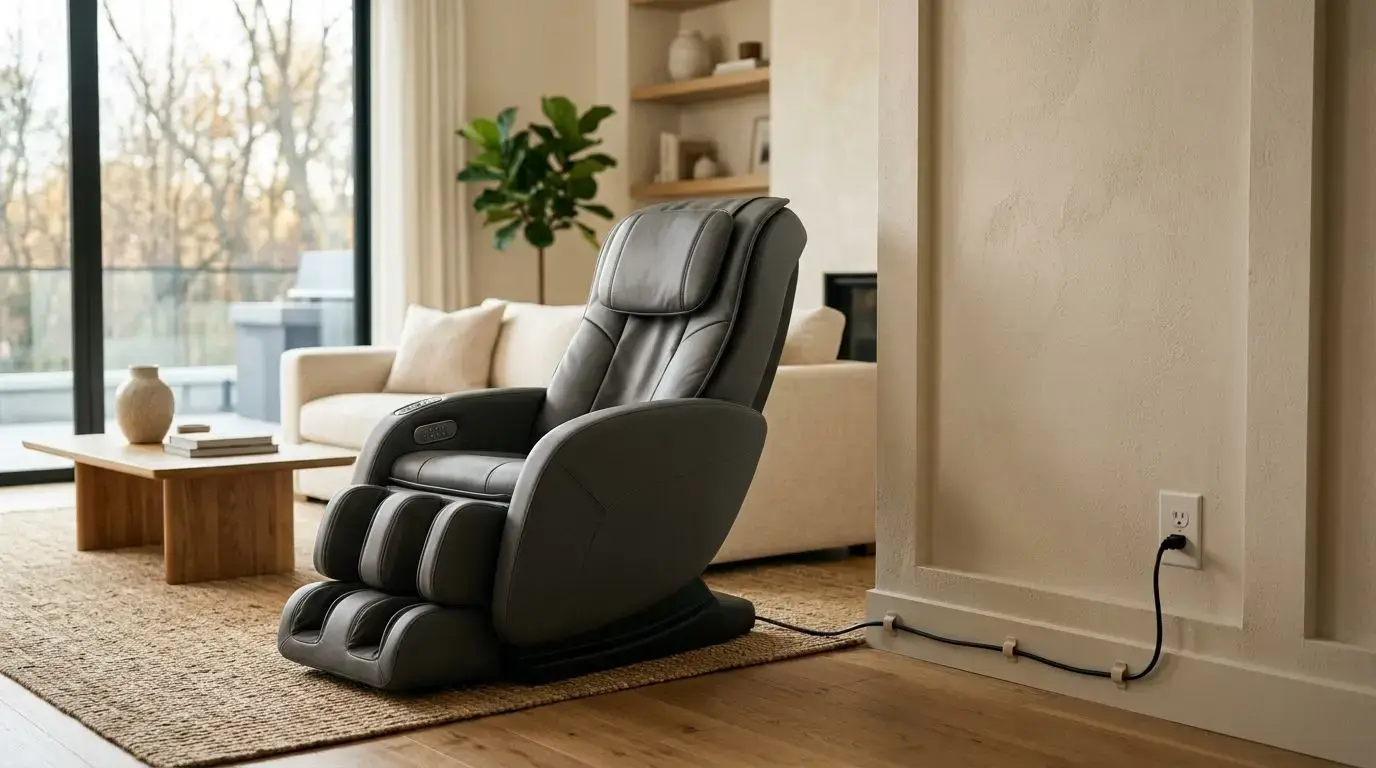
Use a grounded 3-prong outlet unless the manufacturer specifically provides a different plug design. Avoid daisy-chaining power strips. Do not run the chair through a lightweight household extension cord, especially if the cord will sit under a rug or be pinched by furniture. If an extension cord is unavoidable for a temporary setup, use the chair's instructions to confirm what is allowed and choose a properly rated cord.
Features that use the most power: heat, air pumps, and reclining motors
Not every feature draws power in the same way. Rollers and track motors use electricity while they move. Air compression uses a pump in cycles. Heat tends to add a steady load while warming and maintaining temperature. Reclining motors may draw a quick burst for 10 to 30 seconds, then stop once the chair reaches position.
Heat is often the biggest add-on load because heating pads are resistive elements. They convert electricity into warmth, similar in principle to a heating blanket, though a massage chair's heated zones are usually smaller. A chair with back heat only may use noticeably less electricity than one with heat in the back, calves, and feet.
| Feature | Power behavior | Ownership takeaway |
|---|---|---|
| Back rollers on an S-track or L-track | Moderate draw while moving | Core massage function; usually not the main cost driver |
| Air compression for arms, calves, or shoulders | Cyclic pump and valve activity | May raise average wattage during full-body programs |
| Heat zones | Steadier draw during warm-up and use | Use only when wanted if you are minimizing power |
| Zero-gravity recline or power recline | Short bursts of motor use | Small cost impact because movement lasts seconds |
| Foot rollers | Moderate draw during operation | Adds to load, especially with calf air compression |
| Bluetooth audio, screen, or lights | Low draw | Minor compared with heat and motors |
Program choice matters. A gentle 15-minute back-only program without heat may use much less energy than a 30-minute full-body program with heat, foot rollers, and air compression. The difference is real, but it is usually measured in cents per week rather than dollars per day.
Who it is best for: households using 15 to 60 minutes a day
From an electricity standpoint, massage chairs suit people who want daily comfort routines without adding much to the monthly utility bill. A single 15-minute session on a 200-watt chair uses only 0.05 kWh. A full hour at the same average wattage uses 0.2 kWh, which is still a small load in a typical home.
- Best for daily relaxation routines: Someone using the chair for 15 to 30 minutes after work is unlikely to notice a meaningful change on the electric bill.
- Best for shared family use: Even 2 hours of combined daily use at 250 watts equals 0.5 kWh per day, or 15 kWh in 30 days.
- Best for apartments and condos: Most units with standard grounded outlets can support the load, assuming the circuit is not overloaded by other devices.
- Less ideal for crowded circuits: If a room already trips breakers when a heater or AC starts, add the chair to another outlet on a different circuit if possible.
- Less ideal for off-grid power setups: Battery systems, inverters, and generators need wattage and startup capacity checked carefully.
Wellness benefits should be viewed responsibly. Massage chairs may help some users relax, loosen up after daily activity, or build a consistent self-care routine. They are not a substitute for medical diagnosis, physical therapy, or treatment for pain, circulation problems, injury, or nerve conditions. If you have a medical condition, implanted device, recent surgery, pregnancy concerns, or a doctor's restrictions, get professional guidance before regular use.
How to choose and measure electricity use in 3 steps
You do not have to guess. The most accurate way to know what your massage chair uses is to read the label and, if you want real-world numbers, measure it at the outlet. A plug-in electricity meter can show watts during operation and kWh over a full session.
Step 1: Read the rating label
Look for watts or amps. If the label lists amps only, multiply amps by 120 volts to estimate watts. For example, 3 amps × 120 volts = 360 watts. This is a rated figure, not necessarily the exact draw during every program.
Step 2: Measure a normal session
Plug the chair into an electricity usage meter, then plug the meter into the wall. Run your usual 20- or 30-minute program with the features you actually use, including heat if that is part of your routine. At the end, note the kWh reading.
Step 3: Multiply by your usage pattern
If one session uses 0.12 kWh and you use the chair 25 times per month, that is 3 kWh per month. At $0.17 per kWh, the monthly active-use cost is 51 cents. Add standby power if you leave the chair plugged in 24 hours a day.
When shopping, compare rated power alongside fit, room size, track style, and service access. A chair that fits your body and room is more important than saving a few watts, because the dollar difference between a 180-watt and 280-watt chair is small for normal home use.
Ways to lower usage without giving up 15- to 30-minute sessions
If you want to keep energy use lean, start with heat and standby power. Those are the easiest changes. You do not need to turn your chair into a special project; a few habits can reduce waste without changing the reason you bought it.
- Use heat selectively: Turn heat on only for the first 10 or 15 minutes, or skip it in warm months.
- Choose shorter programs: Two focused 15-minute sessions may be more useful than leaving the chair running through a longer program you do not need.
- Power it off fully: If the chair has a rear switch, turn it off after use to cut standby draw.
- Unplug for long gaps: If you will not use the chair for a week, unplug it after returning it to the upright position.
- Keep moving parts unobstructed: A chair that struggles against a wall, carpet edge, blanket, or misplaced object may work harder and wear faster.
- Use the right room temperature: In a cold room, heat zones may run longer; a normally heated living space is more efficient and more comfortable.
Do not disable safety features or use unauthorized adapters to save power. The electricity savings would be tiny, and the risk would not be worth it.
Safety and setup checks: 3 inches to 2 feet of clearance may matter
Electricity use is only one part of ownership. Massage chairs also need enough room to recline and enough space around cords and moving panels. Some wall-hugging designs need only a few inches behind the backrest, while other recliners may need 18 to 24 inches or more. Always use the clearance number in the instructions for your chair type.
Before daily use, check that the power cord is not under the base, caught in the reclining mechanism, or stretched tight across a walkway. The chair should sit on a stable floor, not on a thick unstable rug that interferes with the base. Keep liquids away from the control panel and power connection. A massage chair belongs in a dry indoor space, not a bathroom, patio, garage bay exposed to moisture, or anywhere condensation is likely.
If a breaker trips once, note what else was running on the same circuit. If it trips repeatedly, stop using the chair on that outlet until you identify the cause. Warm plugs, a burning smell, flickering lights, buzzing outlets, or visible cord damage are warning signs. Unplug the chair and contact a qualified electrician or the chair's service support rather than trying to work around the problem.
FAQ: 5 quick answers about massage chair power use
Does a massage chair use a lot of electricity?
No. Most use about 100 to 300 watts while running, so a 30-minute session usually costs only a few cents or less, depending on your electricity rate. Heat and full-body programs increase the draw, but normal home use is still modest.
Can I plug a massage chair into a regular wall outlet?
Usually, yes. Most US home massage chairs are made for a standard 120-volt grounded outlet. Check the rating label and instructions, and avoid sharing the circuit with high-draw appliances like space heaters.
Should I unplug my massage chair after every use?
You do not always have to, but unplugging or switching it off can reduce standby power, often around 1 to 5 watts. If you use the chair daily, the savings are small. If you use it rarely or will be away for several days, powering it off is sensible.
Does heat make a big difference in electricity use?
Heat can make a noticeable difference because heating elements draw steady power while warming and maintaining temperature. In dollars, the difference is usually small for 15- to 30-minute sessions, but heat is the first feature to limit if you want lower energy use.
Will a massage chair trip my breaker?
A properly working chair on a suitable outlet should not trip a breaker by itself in most homes. Breakers can trip if the same circuit is also powering high-load devices, if the cord or outlet is damaged, or if there is an electrical fault that needs attention.
Frequently asked questions
Does a massage chair use a lot of electricity? +
No. Most massage chairs use about 100 to 300 watts while running, so a typical 30-minute session usually costs only a few cents or less depending on your electricity rate.
Can I plug a massage chair into a regular wall outlet? +
Usually, yes. Most massage chairs for US homes are designed for a standard 120-volt grounded outlet. Always confirm the chair's rating label and avoid overloading the same circuit with high-draw appliances.
How much does it cost to run a massage chair for 30 minutes? +
A 200-watt chair used for 30 minutes uses 0.1 kWh. At $0.17 per kWh, that is about 2 cents per session, or roughly 50 cents per month with daily use.
Does the heat feature use more electricity? +
Yes. Heat zones can add steady power draw while they warm and maintain temperature. The added cost is usually small for short sessions, but heat is one of the biggest feature-related power increases.
Should I unplug my massage chair when not using it? +
If the chair has standby power, unplugging it or turning off its rear power switch can save a small amount of electricity, often around 1 to 5 watts. It is most useful if you use the chair infrequently or will be away for several days.
Related guides
How to Set Up a Massage Chair Safely: Outlets, Extension Cords, Surge Protection, and Cord Management
14 min read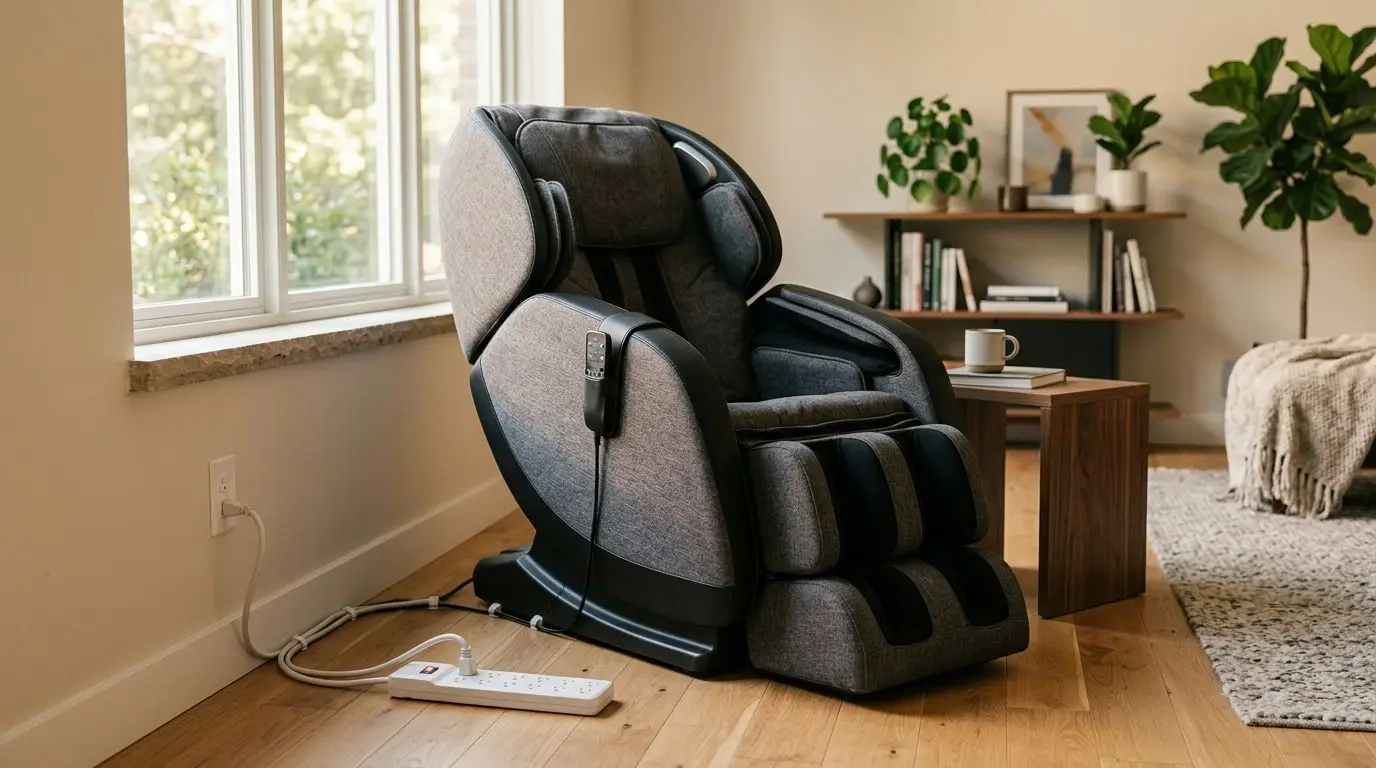
Do Massage Chairs Need a Surge Protector? Electrical Care for Home Use
15 min read
Is a Massage Chair Worth It? Cost, Use Frequency, and Break-Even Math for U.S. Buyers
12 min read
Massage Chair Benefits for Stress Relief and Relaxation at Home
11 min read
Is a Massage Chair Worth It? Benefits, Limitations, and Who Should Buy One
13 min read