Disclosure: We may earn a commission when you buy through links on this page, at no extra cost to you. We buy nothing, sell nothing and accept no payment for coverage — commissions never decide what we recommend. How we make money.
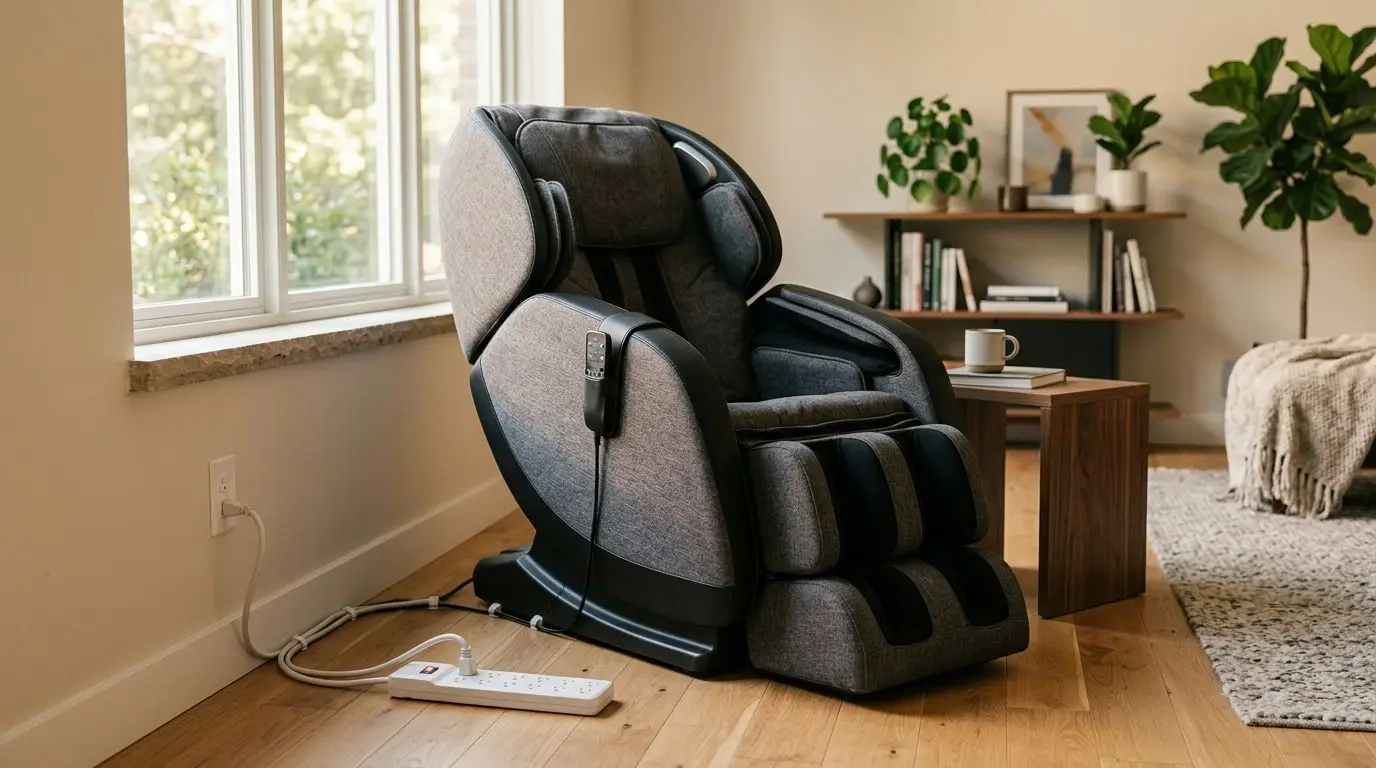
Yes, most home massage chairs should be plugged into a properly rated surge protector, unless the owner’s manual specifically says otherwise. A massage chair has control boards, motors, heaters and sensors, and a good surge protector helps lower the risk of electronics damage from everyday voltage spikes. Do not confuse a surge protector with a basic power strip, and do not use extension cords or overloaded outlets as a permanent setup.
The safest setup is usually straightforward: a grounded 120-volt wall outlet, a listed surge protector with enough capacity for the chair, and no high-draw appliances sharing the same strip. If your chair repeatedly trips a breaker, flickers lights, smells hot, or has a damaged cord, stop using it and have the outlet or chair inspected before plugging it back in.
Why a surge protector makes sense for a 120-volt massage chair
Most massage chairs sold for US homes are designed for standard 120-volt household power. Inside the chair, however, the work is not simple. A typical chair may use multiple small motors, a reclining mechanism, air pumps, a heating element, a display or remote, sensors and one or more control boards. Those electronics are more sensitive than a table lamp.
A surge protector is designed to absorb or divert brief voltage spikes before they reach the equipment plugged into it. These spikes can come from utility switching, large appliances turning on and off, wiring issues, or nearby storm activity. The spike may last only a fraction of a second, but that is enough time to stress electronics.
That does not mean a surge protector makes a chair indestructible. It cannot fix bad wiring, stop a direct lightning strike, increase the capacity of a weak circuit, or make an unsafe cord safe. Think of it as a practical layer of protection, not a guarantee.
For a massage chair, the case is strong because the chair is expensive, heavy, and inconvenient to service. If a small surge damages a control board, the chair may stop reclining, the rollers may fail to move, or the remote may go blank. A quality surge protector costs far less than an electronics repair visit, and it is easier to replace than internal parts.
Surge protector, power strip, UPS or wall outlet: 4 options compared
The words are often used loosely, but they are not the same thing. A basic power strip only gives you more outlets. A surge protector adds surge suppression. A UPS, or uninterruptible power supply, includes a battery for short backup power. A wall outlet provides direct power but no added surge protection unless your home has whole-house surge equipment at the electrical panel.
| Power option | What it does | Best use with a massage chair | Watch-outs |
|---|---|---|---|
| Grounded wall outlet | Supplies standard 120-volt power | Good baseline if the manual requires direct wall connection | No point-of-use surge protection unless another system is installed |
| Basic power strip | Adds extra outlets only | Not ideal for a massage chair | Can be overloaded; may provide no surge protection |
| Surge protector | Adds outlets and limits voltage spikes | Usually the best choice when rated properly | Must be listed, grounded and not overloaded |
| UPS battery backup | Provides battery power for minutes during outage | Usually unnecessary for massage chairs | Many units are not sized for motor loads; can be bulky and costly |
For most homes, the choice comes down to a wall outlet or a surge protector. If the manual clearly says to plug directly into the wall, follow it. Some manufacturers write that instruction to avoid undersized strips and extension cords. If the manual allows a surge protector, choose one with the right electrical rating and safety listing.
A UPS is usually not the best answer. Massage chairs are not computers that need time to save a file. The chair should simply stop safely when the power goes out. If you are worried about being reclined during an outage, learn how your chair returns to the upright position after power is restored, and keep the remote within reach during use.
How to choose a surge protector in 7 checks
You do not need a complicated setup, but you do need the right specs. Start with the label on the chair and the owner’s manual. Many massage chairs draw somewhere in the few-amp range during normal operation, though exact numbers vary by chair, features and what is running at the same time. The rating plate is the source that matters.
- Use a grounded 3-prong surge protector. Do not use a 2-prong adapter or remove the grounding pin from the chair’s plug.
- Look for a safety listing. Choose a surge protector marked as listed by a recognized testing lab, such as UL or ETL, rather than an unmarked bargain strip.
- Match the amperage. Many household surge protectors are rated for 15 amps. Do not exceed the rating of the strip, the outlet or the circuit.
- Check the joule rating. Joules indicate surge absorption capacity. Higher numbers generally mean more capacity, but joules alone do not prove overall quality.
- Use enough cord length without stretching. A 6-foot cord is common, but the chair should sit close enough that the cord does not pull tight when the chair reclines.
- Prefer an indicator light. Many protectors have a light showing that surge protection is still active. If that light goes out, replace the unit.
- Avoid daisy chaining. Do not plug a surge protector into another strip, extension cord or outlet tap.
Also consider the plug shape and how the chair moves. Some chairs slide forward as they recline, while others need several inches behind the backrest. Keep the surge protector and cord outside the moving path. A pinched cord is a bigger hazard than the surge protector is a benefit.
If the chair has heat, calf movement, air compression and a deep recline function running at once, it may draw more power than during a simple back program. That is why the total setup matters. The goal is not to guess; it is to keep every piece of the power chain within its rating.
Circuit load: what 15 amps, 20 amps and 1,500 watts mean at home
Most US living rooms and bedrooms use 15-amp or 20-amp circuits. A 15-amp circuit at 120 volts has a theoretical capacity of 1,800 watts. A 20-amp circuit has a theoretical capacity of 2,400 watts. In real use, you should avoid crowding a circuit with several high-draw devices at the same time.
This is where massage chair owners often run into trouble. The chair may not be the largest load in the room. A portable space heater can draw about 1,500 watts by itself. A vacuum, treadmill, hair dryer, dehumidifier or window air conditioner can also place a large load on the same circuit. If one of those is running while the chair is operating, the breaker may trip or the wiring may run warmer than it should.
| Item on the same circuit | Typical concern | Practical advice |
|---|---|---|
| Portable space heater | Often near 1,500 watts | Do not run it on the same strip as the chair |
| Treadmill or exercise equipment | Motor load can spike during use | Use separate outlets or circuits when possible |
| Window AC or dehumidifier | Compressor startup can be demanding | Avoid sharing during chair operation |
| TV, router, lamp | Usually low to moderate draw | Often fine if the circuit is otherwise stable |
| Vacuum cleaner | Short-term high draw | Turn the chair off before vacuuming the same room |
If a breaker trips once, unplug other devices and reset it. If it trips again while the chair is used normally, do not keep resetting it and hoping for the best. Repeated trips are a warning sign. The issue could be circuit load, a worn outlet, damaged wiring, a failing surge protector or a problem inside the chair.
A dedicated circuit is not required for every massage chair, but it can be smart in rooms already crowded with electronics or exercise equipment. If you are remodeling or placing a large chair in a finished basement, ask an electrician whether a dedicated 15-amp or 20-amp circuit makes sense for that location.
How to place the chair and measure the power setup in 10 minutes
Before the chair arrives, take 10 minutes to measure the outlet, wall clearance and cord path. This helps prevent the common mistake of forcing the chair into a corner and stretching the power cord diagonally across the room.
Start with the owner’s manual or product dimensions. Many full-size massage chairs are roughly 28 to 34 inches wide and can be 55 to 70 inches long when reclined, though compact and large-body designs vary. Some wall-hugging chairs need only a few inches behind them, while traditional recline designs may need much more. Use the chair’s actual clearance requirement, not a guess.
- Measure outlet distance. The plug should reach the outlet or surge protector without tension. Leave slack for reclining movement.
- Check the recline path. Run the chair through a full recline and return cycle while watching the cord.
- Keep cords out of walkways. If someone can step over it, snag it or roll an office chair across it, reroute it.
- Leave ventilation space. Do not bury the power supply area under blankets, pillows or thick dust.
- Protect the floor, not the cord. A mat can help with dents on wood or carpet, but do not trap the cord under a heavy chair base.
Do not run the cord under rugs. That hides heat, wear and pinch damage. It also makes it harder to notice if the cord jacket cracks or the plug loosens. If the only available outlet creates a trip hazard, the better fix is usually a new outlet installed by an electrician, not a long extension cord.
After setup, label the surge protector so family members know it belongs to the chair. That small step can prevent someone from adding a space heater, humidifier or holiday lights to the same strip later.
Storms, outages and vacations: a 3-step shutdown routine
A surge protector helps with many common spikes, but storm safety is different. During severe lightning activity, the simplest way to reduce risk is to unplug the chair from the wall after turning it off. No point-of-use protector can promise protection from a direct or very close lightning event.
Use a simple 3-step routine. First, stop the chair and return it to its normal upright or parked position. Second, turn the main power switch off if the chair has one. Third, unplug by holding the plug, not by yanking the cord.
Do the same before long vacations. If you will be away for a week or more, unplug the chair and surge protector. This reduces exposure to outages, utility switching events and accidental activation while no one is home.
After an outage, do not rush. Wait a minute, make sure power is stable, then plug the chair back in and turn it on. If the remote displays an error, the rollers do not park correctly, or the chair acts unusually, power it off and consult the manual. Repeated unplugging and replugging is not a repair method.
If your area has frequent storms or unstable power, ask an electrician about whole-house surge protection at the panel. Point-of-use protectors are still useful, but panel-level protection can add another layer for multiple appliances and electronics in the home.
Who it is best for: 5 home setups that benefit most from surge protection
A surge protector is sensible for most massage chair owners, but the need is stronger in some homes than others. Consider the value of the chair, the stability of your power, and what else runs on the same circuit.
| Home situation | Recommended setup | Why it matters |
|---|---|---|
| Typical bedroom or living room | Grounded outlet plus listed surge protector | Good everyday protection with simple setup |
| Older home with limited outlets | Electrician inspection before adding strips | Old outlets may be loose, ungrounded or overloaded |
| Finished basement | Check GFCI/AFCI behavior and humidity | Damp locations and nuisance trips need attention |
| Room with treadmill or space heater | Separate circuit or separate outlet path if possible | High-draw devices can crowd the circuit |
| Storm-prone area | Surge protector plus unplugging during severe storms | Layered protection is more realistic |
If you rent, you may not be able to add an outlet. You can still improve the setup by using a properly rated surge protector, keeping the cord visible, and avoiding shared high-draw appliances. If outlets are loose, warm, discolored or spark when used, report the issue before operating the chair.
If you own the home and plan to keep the chair for years, electrical placement is worth planning like furniture placement. A chair that fits the room physically but barely reaches power is not truly well placed.
Maintenance habits that reduce electronics failure risk every 30 days
Electrical care is not just about the first day. A monthly inspection takes less than 5 minutes and can catch small problems early. Pick a recurring date, such as the first weekend of the month, and check the power path from wall to chair.
- Inspect the plug and cord. Look for cracks, flattened spots, exposed wire, burn marks or loose prongs.
- Touch-test cautiously. After normal use, the plug and surge protector should not feel hot. Slight warmth can happen, but heat is a warning sign.
- Check indicator lights. If the surge protection light is off, replace the protector.
- Clean dust around vents. Use a dry cloth or vacuum brush near exterior vents, not liquid cleaners.
- Keep drinks away. A spill into the remote, side panel or power area can damage electronics.
- Listen for changes. New buzzing, clicking, grinding or electrical smells are reasons to stop and inspect.
Replace damaged surge protectors rather than trying to repair them. Also replace any protector that has taken a major surge, shows melting, or no longer holds plugs securely. Surge protectors wear out; they are not lifetime equipment.
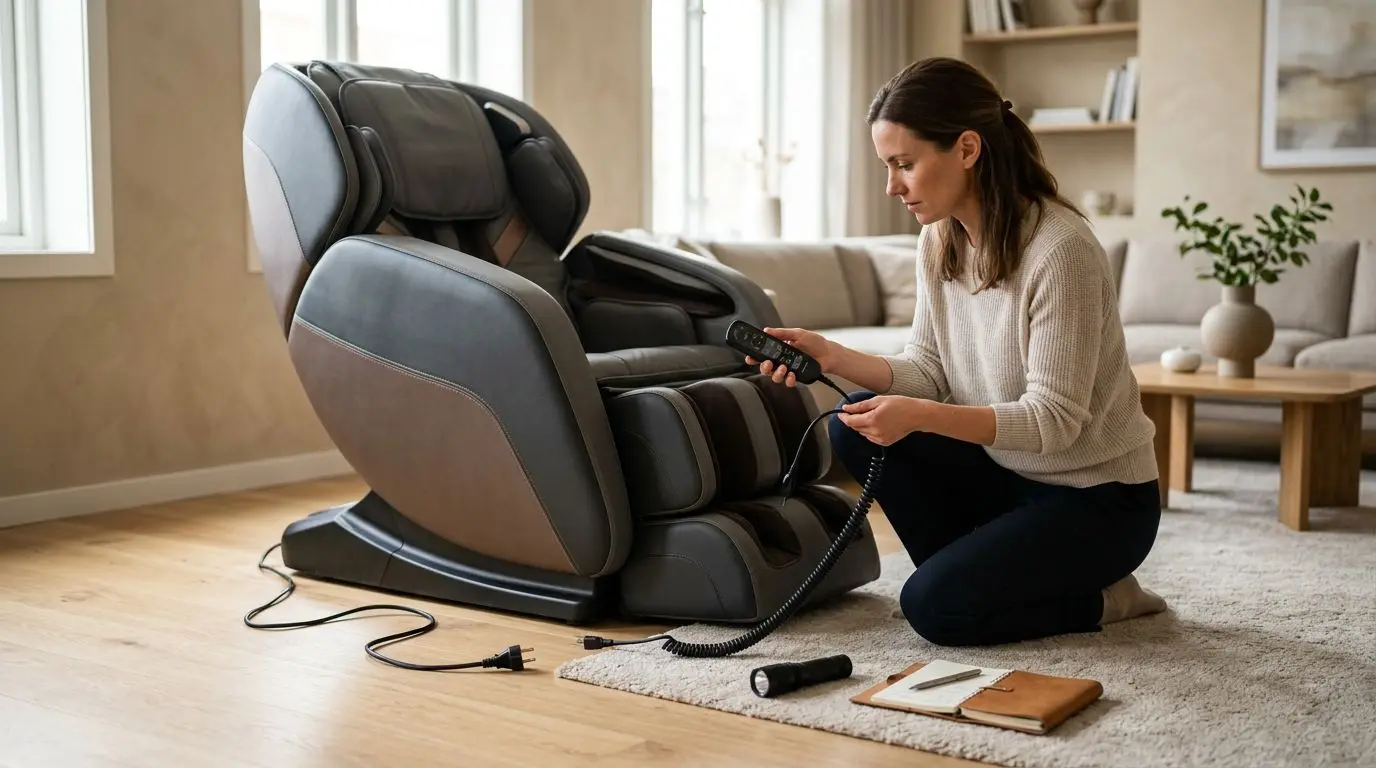
Do not open the chair’s electrical compartments unless the manual instructs you to do so and you are qualified for that task. Internal capacitors, wiring and moving parts can be hazardous. For most owners, safe maintenance means keeping the chair clean, dry, properly powered and unplugged before any exterior inspection.
Safety checks beyond the outlet: 8 situations to discuss with a physician
Electrical safety is only one part of responsible home use. A massage chair is a consumer wellness product, not a medical device. It is designed to provide mechanical pressure, movement, heat and body positioning that may feel comfortable to some users, but it should not be used as a substitute for professional medical advice.
Ask your physician before using a massage chair if you are pregnant; have a pacemaker or other implanted cardiac device; have a history of blood clots or take anticoagulants; have osteoporosis; recently had a fracture or surgery; have spinal disc problems; have neuropathy; or have uncontrolled hypertension. If any feature feels too intense, stop the session rather than pushing through.
Keep sessions within the chair’s recommended time. Many chairs use automatic programs around 15 to 30 minutes, and that limit is there for comfort, motor rest and predictable use. Longer is not automatically better.
Children should not play with the chair, remote or power switch. Pets should be kept clear of the base, footrest and reclining path. Before starting a session, check that nothing is under or behind the chair where moving parts can pinch it.
Common mistakes to avoid with strips, cords and outlets
The riskiest setups are usually easy to spot. They rely on too many adapters, too much cord length, or too many appliances on one outlet. If the setup looks improvised, it probably needs to be simplified.
- Using an extension cord permanently. Most chair manuals discourage this. If temporary use is unavoidable and allowed by the manual, the cord must be properly rated and fully uncoiled, but a permanent outlet is better.
- Plugging the chair into a cheap outlet tap. Small cube taps add outlets without proper cord management or surge protection.
- Removing the ground pin. Never modify the plug to fit an older 2-prong outlet.
- Hiding the surge protector behind the chair base. You need to see indicator lights and access the switch.
- Running the chair on a loose outlet. Plugs should fit firmly. Loose contact can create heat.
- Ignoring repeated resets. A breaker or GFCI that trips repeatedly is telling you something.
When in doubt, simplify. Chair, surge protector, grounded wall outlet. No chain of adapters. No high-draw neighbors on the same strip. No cords under rugs.
FAQ: 5 quick answers about massage chair power care
Can I plug a massage chair into a power strip?
Use a surge protector, not a basic power strip, if the owner’s manual allows it. The protector should be grounded, safety listed and rated for the chair’s electrical load. Avoid plugging other high-draw devices into the same strip.
Should I unplug my massage chair every night?
Nightly unplugging is not usually necessary in a normal, stable setup. It is smart to unplug during severe storms, long vacations, electrical work, or if the chair or outlet acts unusually.
Can a massage chair share an outlet with a TV?
Often, yes, if the outlet and circuit are in good condition and the total load stays within the rating. A TV is usually a lighter load than a space heater or treadmill. Still, do not overload a surge protector just because it has open sockets.
Why does my breaker trip when I use the chair?
The circuit may be overloaded, especially if a heater, treadmill, vacuum or compressor appliance is on the same circuit. It could also point to a worn outlet, damaged cord, faulty surge protector or chair issue. Stop repeated use and investigate.
Is whole-house surge protection enough?
Whole-house surge protection can add useful protection at the electrical panel, but many homeowners still use point-of-use surge protectors for expensive electronics. The two approaches can work together.
Frequently asked questions
Can I plug a massage chair into a power strip? +
Use a properly rated surge protector rather than a basic power strip if the owner’s manual allows it. It should be grounded, safety listed and not shared with high-draw devices.
Should I unplug my massage chair during a storm? +
Yes. Turn the chair off, return it to its parked position if possible, and unplug it from the wall during severe lightning activity. A surge protector cannot guarantee protection from a direct or very close lightning event.
Can a massage chair share a circuit with a space heater? +
It is not a good idea. A portable space heater can draw about 1,500 watts, which uses most of a 15-amp circuit’s practical capacity. Run high-draw appliances separately.
Do I need a dedicated circuit for a massage chair? +
Not always. Many chairs work fine on a normal grounded household outlet, but a dedicated 15-amp or 20-amp circuit may be useful in rooms with treadmills, heaters, dehumidifiers or frequent breaker trips.
How often should I replace a surge protector? +
Replace it if the protection indicator light goes out, it feels hot, shows melting or damage, no longer grips plugs securely, or has taken a major surge. Surge protectors wear out over time.
Related guides
How to Set Up a Massage Chair Safely: Outlets, Extension Cords, Surge Protection, and Cord Management
14 min read
Massage Chair Won’t Turn On? What to Check Before Calling for Service
13 min read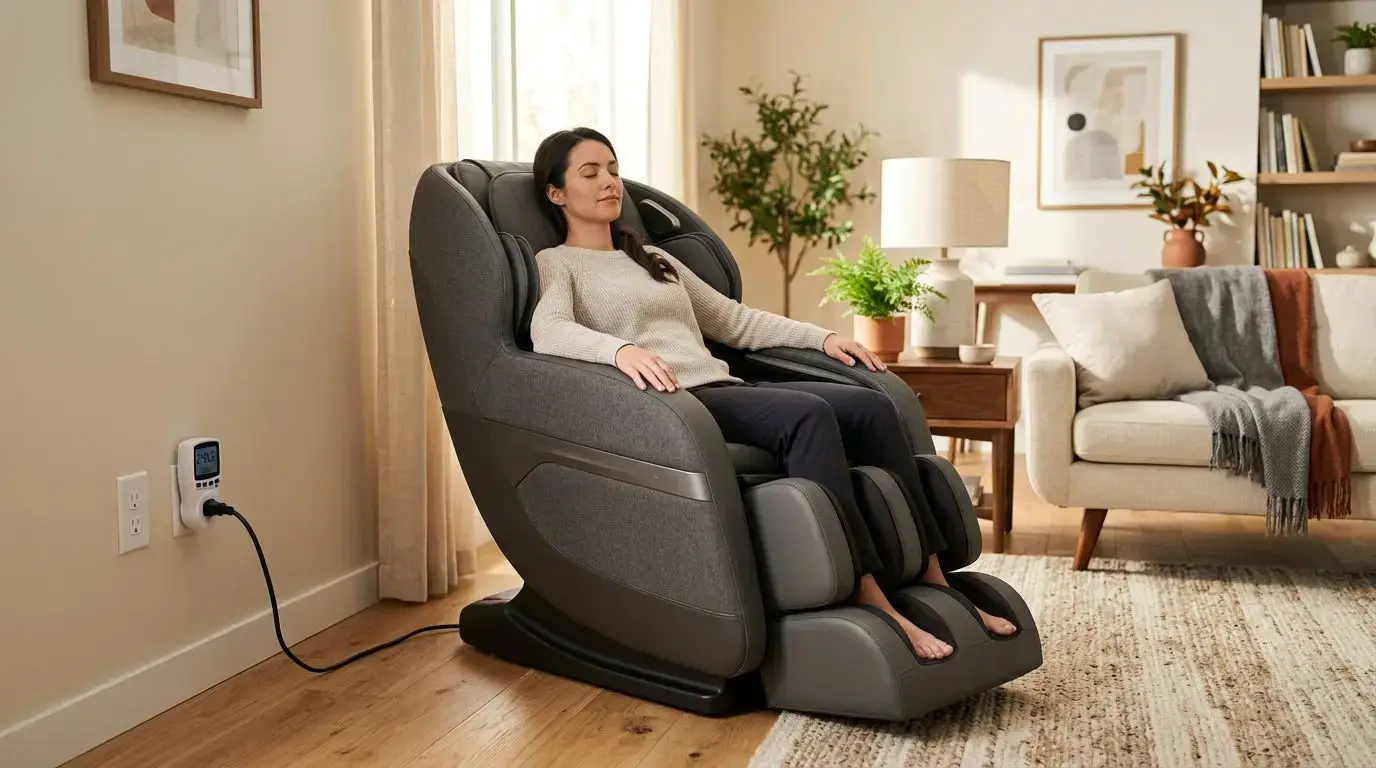
How Much Electricity Does a Massage Chair Use?
12 min read
Massage Chair Repair Guide: Problems, Parts, Service Calls, and Warranty Tips
14 min read
Massage Chair Maintenance Checklist: Weekly, Monthly, and Yearly Tasks
13 min read