Disclosure: We may earn a commission when you buy through links on this page, at no extra cost to you. We buy nothing, sell nothing and accept no payment for coverage — commissions never decide what we recommend. How we make money.
If your massage chair is not working, start with the basics: power, remote connection, safety locks, and a full reset. Most common failures can be narrowed down in about 10 to 20 minutes before you decide whether the chair needs professional service.
Unplug the chair before inspecting cords, rollers, air hoses, or moving parts. If you notice a burning smell, smoke, exposed wiring, repeated tripped breakers, or a loud grinding noise, stop using the chair and contact a qualified technician.
Start with the 10-minute safety and reset checklist
Before assuming the chair has a major failure, try a controlled reset. Many massage chairs use multiple sensors, a main power switch, a remote, a recline motor, roller motors, air pumps, heaters, and sometimes a footrest actuator. If one system stops in the wrong position, the chair may lock out until power is fully cycled.
Follow this order:
- Turn the chair off using the remote or side control, if it responds.
- Move the main power switch on the back or side of the chair to off.
- Unplug the power cord from the wall outlet.
- Wait 5 to 10 minutes so the internal electronics can discharge.
- Check that no blanket, cord, toy, pet item, or clothing is caught in the footrest, side panels, or backrest gap.
- Plug the chair directly into a wall outlet, not a loose power strip.
- Turn the main switch on, then try one basic program or a manual roller movement.
Do not sit in the chair while checking underneath it. A reclining chair can pinch fingers, cords, or fabric if it suddenly powers back on. Keep children and pets away during testing.
Safety matters as well. If you are pregnant or have a pacemaker or other implanted cardiac device, a history of blood clots, use anticoagulants, osteoporosis, a recent fracture or surgery, spinal disc problems, neuropathy, or uncontrolled hypertension, ask your physician before using a massage chair. A troubleshooting article can help identify a mechanical issue, but it cannot tell you whether use is appropriate for your body.
Power problems: test the 120-volt outlet, cord, switch, and fuse
In the US, most household massage chairs plug into a standard 120-volt outlet. If the chair is completely dead with no lights, no remote display, and no beep, treat it as a power path problem first.
| Symptom | Likely area to check | What to do |
|---|---|---|
| No lights anywhere | Wall outlet, plug, main switch | Test the outlet with a lamp or phone charger; confirm the chair switch is on. |
| Chair turns on, then shuts off | Overload, loose cord, internal protection | Unplug for 10 minutes, remove obstructions, and retry one simple function. |
| Breaker or GFCI trips | Electrical fault or overloaded circuit | Stop repeated testing and call a technician or electrician. |
| Power works only when cord is moved | Damaged cord or inlet | Do not use the chair until the damaged part is inspected or replaced. |
Look for a removable fuse holder near the power inlet only if your chair’s manual identifies one. Some chairs use a small glass fuse, while others do not provide user-serviceable fuses. If a fuse is blackened, broken, or repeatedly fails after replacement with the exact rated fuse listed by the manufacturer, that points to a deeper electrical problem.
Avoid extension cords when testing. A large massage chair can draw more current when the rollers, recline motor, air pump, and heat are all active. A weak extension cord or worn power strip adds another possible failure point. For diagnosis, plug directly into a grounded wall outlet.
Remote or control panel not responding after 2 basic checks
A nonresponsive remote does not always mean the whole chair is dead. Many chairs still have power at the base but fail to accept commands because the remote cable, plug, battery, display, or control board is not communicating correctly.
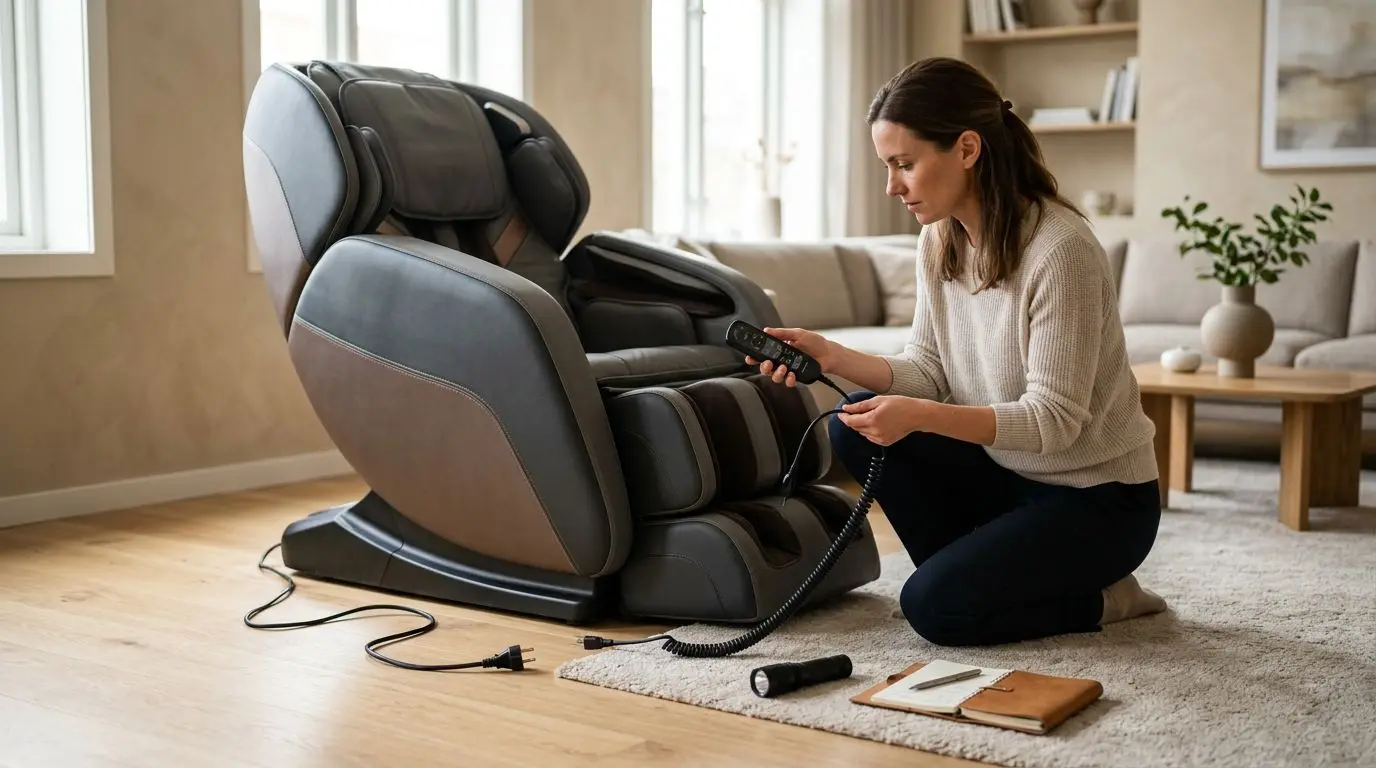
First, identify whether your chair uses a wired remote, built-in side panel, touchscreen, or wireless controller. For a wired remote, inspect the connector where it plugs into the chair. It should sit straight, not half-latched or bent. Unplug the chair before disconnecting and reconnecting that cable.
If the controller uses batteries, install fresh ones in the correct direction. Many small remotes use 2 batteries, but the size varies, so follow the markings in the battery compartment. Even clean-looking contacts matter; a thin layer of corrosion can stop a remote from working.
Try these control tests:
- Press only the power button once, then wait 5 seconds.
- Try a manual recline command before starting a full program.
- Lower the volume or voice prompt settings only after basic controls work.
- If a child lock or safety lock appears on the screen, follow the manual’s unlock sequence.
- If the display lights but buttons do nothing, perform the 5 to 10 minute unplug reset.
Do not spray cleaner into buttons or around a touchscreen. Use a barely damp microfiber cloth on exterior surfaces only. Liquid near a control panel can turn a minor button issue into a board failure.
Rollers stuck, noisy, or not moving along a 30-inch track
Back rollers typically travel on a track inside the backrest. Some chairs cover only the back, while others extend through the seat area. A back track may be roughly 28 to 32 inches on many full-size chairs, while extended tracks can be longer. The exact number varies, but the troubleshooting logic is similar.
If the rollers will not move, listen first. A quiet chair with no motor sound points toward power, control, sensor, or motor failure. A humming sound with no movement may suggest a jam, belt issue, or drive problem. Clicking, scraping, or grinding is a stop sign.
| Roller behavior | Possible cause | Safe user action |
|---|---|---|
| Stops at one spot | Obstruction, body scan error, track issue | Turn off, unplug, check for items caught in seams, then reset. |
| Moves only up or down | Limit sensor or drive issue | Try manual roller positioning after reset; call service if repeated. |
| Loud grinding | Mechanical damage or stripped drive part | Stop use and do not force the rollers. |
| Feels uneven side to side | Roller assembly, fabric tension, or user positioning | Recenter your body and test at low intensity; call if it persists. |
Check the backrest fabric for bunching. A throw blanket, hoodie drawstring, charging cable, or loose cushion can get pulled into the moving area. Never reach behind the rollers while the chair is powered.
Body scan errors can also make rollers feel wrong. Sit all the way back with your shoulders against the backrest, feet positioned normally, and pockets emptied. If the chair scans too high or too low, use manual shoulder position controls if available. A 1- or 2-inch shoulder adjustment can make a noticeable difference in where the rollers contact your back.
Heat not working after 15 minutes of warm-up
Massage chair heat is usually designed to feel gently warm, not hot. Depending on the design, it may be located in the backrest, seat, calf area, or footrest. Many chairs need 5 to 15 minutes before the warmth is easy to notice through clothing and upholstery.
Start with expectations. Chair heat is not a space heater, heating pad, or medical device. It should not be used to make health claims, and it should not feel painfully hot. If it smells burnt, causes discoloration, or produces sharp heat in one small area, turn the chair off and unplug it.
For normal troubleshooting, check these points:
- Confirm heat is turned on separately; it is often not active in every preset program.
- Wait at least 10 minutes before judging the result.
- Test with a thin shirt, not a heavy sweatshirt or blanket.
- Try another program or manual mode to see whether heat is locked to certain settings.
- Feel both sides of the heated zone with your hand after powering down, not while reaching into moving parts.
If one heating area works and another does not, the problem may be a connector, heating element, sensor, or control board. Those are not parts most users should repair inside the chair. If heat fails completely but everything else works, the chair may still be usable without heat, but schedule service if that feature matters to you.
People with reduced sensation, including some forms of neuropathy, should be especially cautious with heat and should ask their physician before use. If you cannot reliably judge temperature on your skin, avoid using heated features unless your clinician says it is appropriate.
Air compression weak, uneven, or silent in a 3-zone chair
Air compression systems use an air pump, valves, hoses, and inflatable airbags. A chair may have 1 zone or several zones, such as shoulders, arms, calves, and feet. If you hear the pump but feel little pressure, the issue may be settings, a disconnected hose, a small leak, or a valve that is not opening.
Air systems pulse by design. They inflate, hold briefly, then release. That cycle may run every few seconds, so a short pause does not always mean failure.
| What you notice | Likely explanation | What to check |
|---|---|---|
| Pump runs, no pressure | Open hose, leak, disabled zone | Check intensity level and zone selection first. |
| One side inflates more | Hose kink, valve issue, seating position | Reposition body and inspect visible hoses when unplugged. |
| Very loud pump | Loose mounting, aging pump, air leak | Stop use if noise is new or harsh. |
| No pump sound | Control, fuse, pump, or board issue | Reset chair and test a program known to use air compression. |
Look for visible hose connections under the leg rest or behind removable covers only if they are intended for user access. Do not remove structural panels or cut zip ties. Many internal air lines are routed tightly, and pulling one loose can create new problems.
If arm airbags feel weak, check that your arms are fully inserted and your elbows are not blocking inflation. If calf or foot compression feels uneven, confirm that your legs are centered and that the footrest is extended to a comfortable length. Even a 2-inch difference in leg position can change how firm the airbags feel.
Recline, footrest, and body scan issues with 6 inches of clearance
Recline problems are common because the chair needs room to move. Some wall-hugging designs need only a few inches behind the chair, while other recliners may need 12 inches or more. If the backrest or footrest hits a wall, table, rug edge, or power cord, the chair may stop or reverse.
Measure before you keep testing. Put the chair upright, then use a tape measure to check the distance from the back of the chair to the wall. Check the footrest path as well. A thick rug can catch a footrest roller or create drag.
If the recline motor clicks but does not move, do not keep pressing the button. Repeated commands can strain the motor or gears. Unplug the chair, inspect the area around the base, then reset. If the chair is stuck reclined and blocking a room, call service rather than forcing it upright.
Body scan problems can show up as rollers starting too low, stopping too high, or applying pressure in the wrong area. Sit normally during the scan. Do not lean forward, twist, or use a thick pillow behind your back unless the chair is designed for it. If the chair offers manual shoulder height adjustment, move it one step at a time and retest.
Who this 20-minute troubleshooting guide is best for
This guide is best for owners whose chair powers on inconsistently, has a dead remote, weak air compression, no heat, rollers that stop, or a recline feature that behaves oddly. It is meant for safe, external checks you can do in about 20 minutes without opening the chair’s electrical or mechanical systems.
It is not for chairs with smoke, burnt odor, exposed wires, fluid spills inside the controls, repeated breaker trips, or major mechanical noise. Those situations need professional attention. It is also not a substitute for the owner’s manual, because reset steps, fuse ratings, and connector locations vary by chair type.
| User situation | Use this guide? | Better next step |
|---|---|---|
| Chair is dead after moving rooms | Yes | Check outlet, cord, switch, and remote connection. |
| Rollers grind loudly | No | Stop use and call service. |
| Heat feels mildly warm after 10 minutes | Yes | Confirm normal operation and clothing thickness. |
| Breaker trips twice | No | Call a technician or electrician. |
How to choose the next step and measure before calling service
If the chair still does not work after basic checks, gather details before calling for help. A clear report can save 15 minutes or more on the phone and may help the technician bring the right parts.
Write down:
- What happened first: no power, remote error, roller stop, heat failure, or air issue.
- Whether the chair makes any sound when you press a button.
- Whether the problem happens in every program or only one feature.
- Any error code shown on the remote or display.
- The chair’s serial number or product label information, if accessible without moving it unsafely.
- The outlet used and whether a breaker, GFCI, or power strip was involved.
Measure the chair’s working space, too. Note the rear clearance, side clearance, and footrest clearance in inches. If the chair is in a tight corner with only 2 or 3 inches behind it, a recline fault may be a placement issue rather than a motor issue. Take 3 photos: one of the full chair, one of the power connection, and one of any error message.
When deciding between repair and replacement, consider age, parts availability, labor access, and how many systems have failed. A single remote cable issue is very different from a chair with power faults, roller noise, and failing air compression at the same time. Do not keep using a chair that shows electrical or mechanical warning signs just because one feature still works.
FAQ: 5 common massage chair troubleshooting questions
Why did my massage chair stop in the middle of a program?
It may have reached the end of a timed session, hit a safety limit, detected an obstruction, or lost power briefly. Many programs run about 15 to 30 minutes. Reset the chair, check for anything caught in moving areas, and try a simple manual function.
Can I replace a massage chair fuse myself?
Only if the manual identifies a user-serviceable fuse and gives the exact rating. Unplug the chair first. If the replacement fuse fails again, stop testing and call for service because repeated fuse failure can signal an internal fault.
Why does the remote light up but the chair will not move?
The remote may have power while the chair is locked, paused, in an error state, or unable to communicate with a motor or sensor. Try a full 5 to 10 minute unplug reset and test one function. If the display shows an error code, record it.
Is it normal for heat to feel weak?
Often, yes. Massage chair heat is usually gentle and filtered through upholstery and clothing. Give it 10 to 15 minutes, confirm the heat setting is on, and avoid judging it through heavy clothing.
Why is one airbag stronger than the other?
Uneven air compression can come from body position, zone settings, a kinked hose, a valve issue, or a small leak. Recenter your arms or legs, reduce intensity, and inspect only visible user-accessible areas while the chair is unplugged.
Frequently asked questions
Why did my massage chair stop in the middle of a program? +
It may have reached the end of a timed session, hit a safety limit, detected an obstruction, or lost power briefly. Many programs run about 15 to 30 minutes. Reset the chair, check for anything caught in moving areas, and try a simple manual function.
Can I replace a massage chair fuse myself? +
Only if the manual identifies a user-serviceable fuse and gives the exact rating. Unplug the chair first. If the replacement fuse fails again, stop testing and call for service because repeated fuse failure can signal an internal fault.
Why does the remote light up but the chair will not move? +
The remote may have power while the chair is locked, paused, in an error state, or unable to communicate with a motor or sensor. Try a full 5 to 10 minute unplug reset and test one function. If the display shows an error code, record it.
Is it normal for massage chair heat to feel weak? +
Often, yes. Massage chair heat is usually gentle and filtered through upholstery and clothing. Give it 10 to 15 minutes, confirm the heat setting is on, and avoid judging it through heavy clothing.
Why is one airbag stronger than the other? +
Uneven air compression can come from body position, zone settings, a kinked hose, a valve issue, or a small leak. Recenter your arms or legs, reduce intensity, and inspect only visible user-accessible areas while the chair is unplugged.
Related guides
Massage Chair Won’t Turn On? What to Check Before Calling for Service
13 min read
How to Reset a Massage Chair: Power Cycling, Error Messages, and Safe Restart Steps
14 min read
Massage Chair Repair Guide: Problems, Parts, Service Calls, and Warranty Tips
14 min read
Massage Chair Remote Not Working? Cable, Battery, Screen, and Control Panel Troubleshooting
13 min read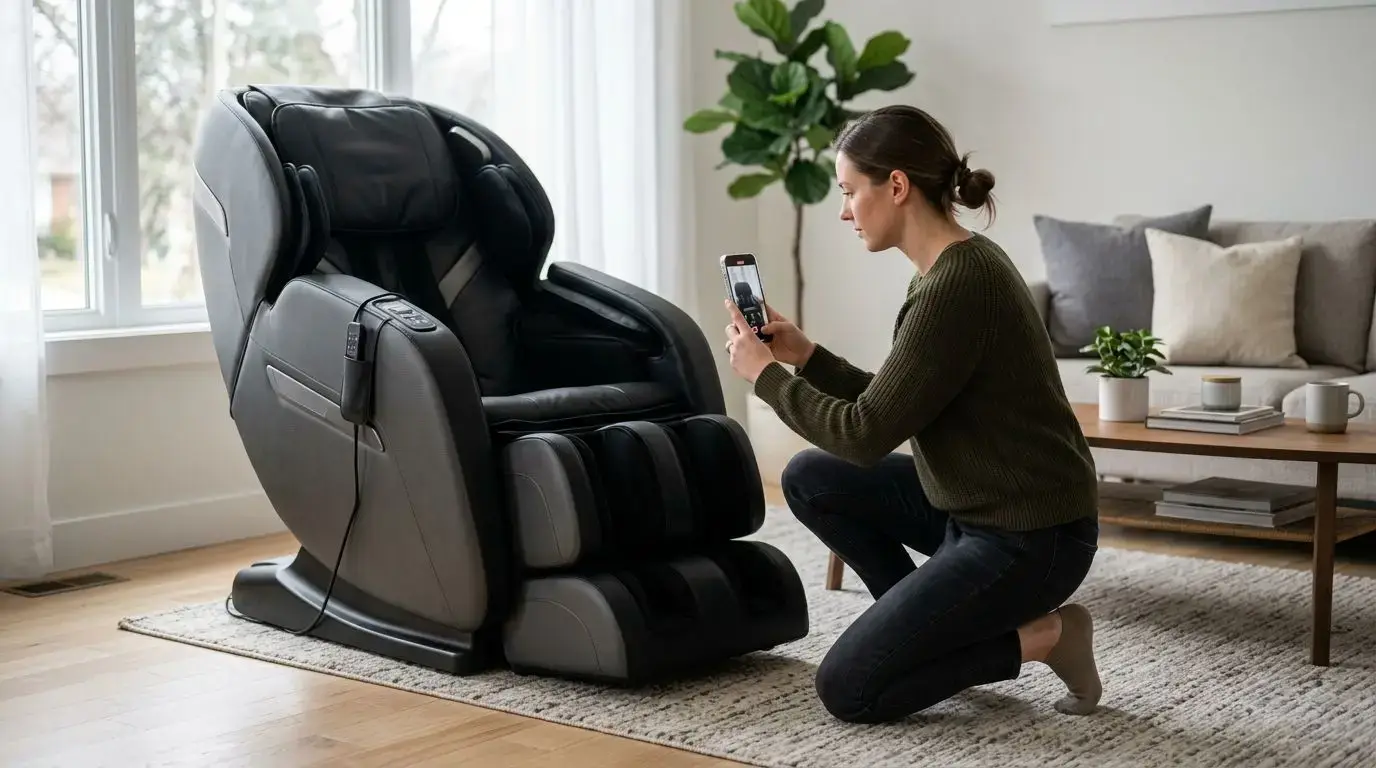
Massage Chair Making Noise? What Sounds Are Normal and When to Get It Serviced
13 min read