Disclosure: We may earn a commission when you buy through links on this page, at no extra cost to you. We buy nothing, sell nothing and accept no payment for coverage — commissions never decide what we recommend. How we make money.
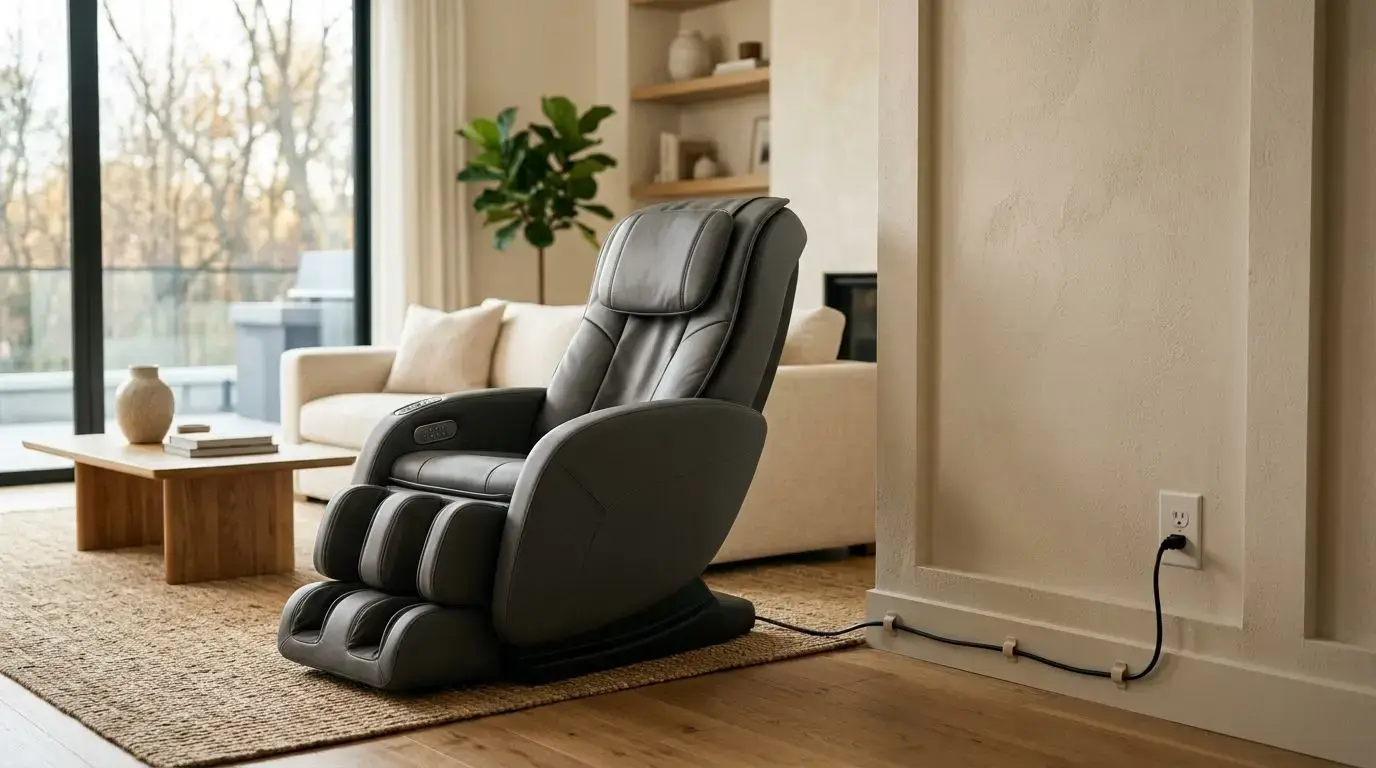
If your massage chair won’t turn on, start with the basic power path: wall outlet, power cord, rear master switch, remote, and any safety interlock. Most no-power checks take about 10 minutes and should not involve opening the chair, bypassing a switch, or touching internal wiring.
Unplug the chair before inspecting cords or moving it. Stop immediately if you notice burn marks, a hot plug, damaged insulation, smoke, or a burning smell. Those are service issues, not DIY troubleshooting tasks.
Start with a 10-minute, warranty-safe power check
A massage chair is a large powered appliance with motors, rollers, heaters, airbags, sensors, and a control system. When it seems completely dead, the cause is often outside the chair: a tripped outlet, loose cord, switched wall receptacle, power strip, or remote that has lost communication with the base.
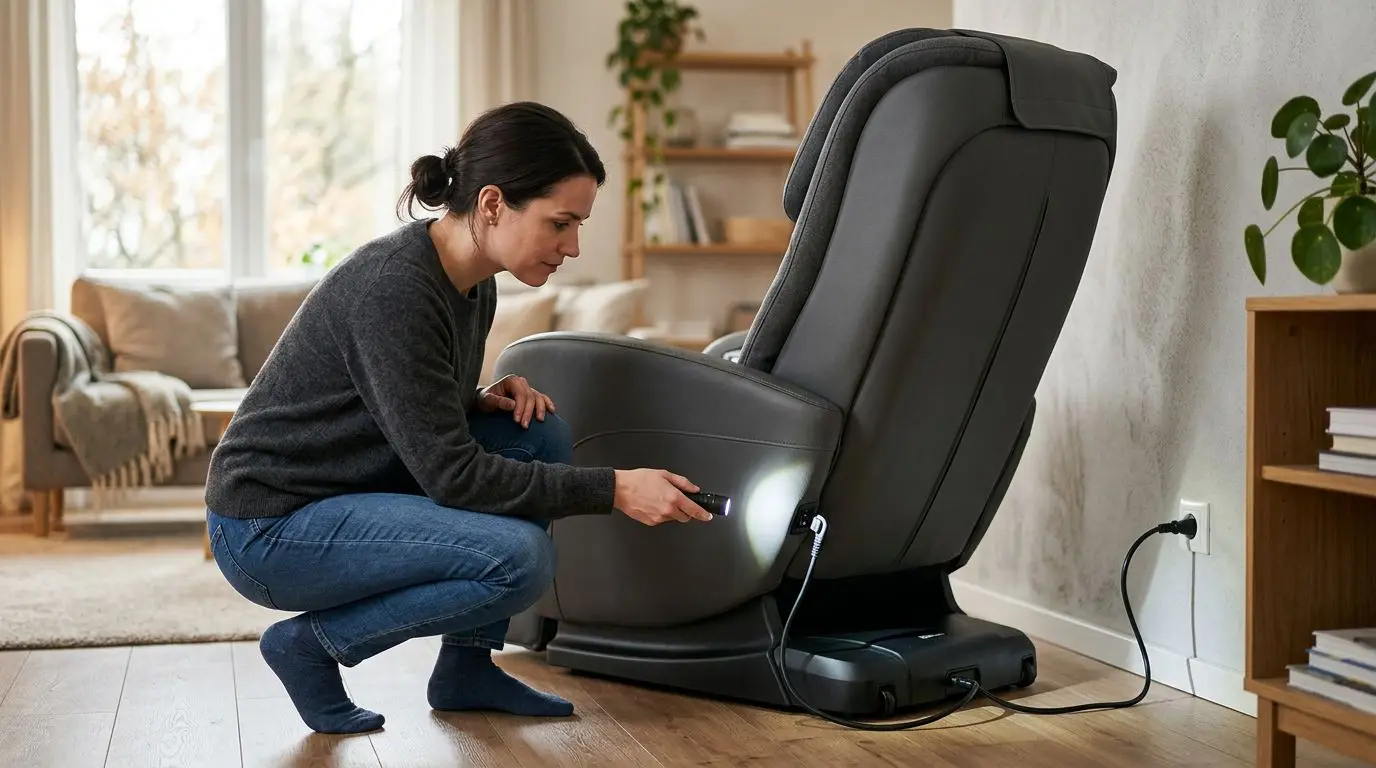
The safest first pass is a short checklist you can do without tools. Leave the chair in place if possible, clear the area around the base, and use a flashlight so you can see the rear switch and cord connection. If the chair weighs 150 to 300 pounds, do not tip it onto its side just to inspect the underside unless the manual specifically says that is safe and you have help.
- Turn the chair’s remote or control panel off.
- Unplug the chair from the wall for 60 seconds.
- Check the outlet with a lamp, phone charger, or another small device.
- Confirm the rear master switch is in the on position.
- Reconnect the power cord firmly at both ends if it is detachable.
- Plug directly into a wall outlet, not a power strip, for the test.
Do not remove panels, replace fuses, or bypass switches unless the owner’s manual clearly identifies that as a user-serviceable step. Many warranty terms allow basic external checks but exclude damage caused by unauthorized internal repairs.
Compare 7 no-power symptoms before you move the chair
Not every “won’t turn on” problem is the same. A chair with no lights at all points to a different issue than one that beeps, lights up for 2 seconds, and then shuts down. Use the symptoms below to narrow your first check.
| Symptom | Most likely area to check first | Warranty-safe action |
|---|---|---|
| No lights, no beep, no response | Outlet, cord, rear switch | Test the outlet and plug directly into the wall |
| Remote lights up but chair will not move | Remote cable, safety interlock, recline position | Reseat the remote cable if external and restart |
| Chair turns on for 1 to 3 seconds | Overload, obstruction, power supply protection | Unplug for 60 seconds and clear the base area |
| Heat works but rollers do not | Function lock, program setting, motor fault | Try a basic manual program with low intensity |
| Airbags inflate but rollers do not move | Track or roller drive issue | Stop if you hear grinding or repeated clicking |
| Chair stopped during a session | Auto timer, overheating protection, obstruction | Let it rest for 30 minutes before retrying |
| GFCI outlet trips immediately | Outlet, cord, moisture, internal electrical fault | Do not keep resetting it; call for service |
This table is not a diagnosis. It is a triage tool. If the same symptom comes back after one careful reset, document it and contact support instead of forcing repeated restarts.
Step 1: Verify a 120-volt outlet in the US
Most residential massage chairs sold for US homes are intended for a standard 120-volt household outlet. Before blaming the chair, confirm that the outlet is live. Plug in a lamp or phone charger that you know works. If it does not turn on, check the room switch, breaker panel, or GFCI reset button if the outlet is in a basement, garage, or similar area.
Some living rooms have half-switched outlets, where the top receptacle is controlled by a wall switch and the bottom receptacle is always on. Try both openings. Also watch for loose-fitting plugs; if the chair plug slips out easily or hangs at an angle, the outlet may be worn and should be evaluated by a qualified electrician.
Avoid testing a massage chair on an extension cord. A long or undersized cord can cause voltage drop, heat, and nuisance shutoffs, especially during recline or air-compression sequences when several systems run at once. For a basic no-power test, plug the chair directly into a grounded wall outlet.
Step 2: Inspect 3 power points: plug, cord, and rear switch
After unplugging the chair, inspect three external power points: the wall plug, the cord jacket, and the chair-side connection or rear switch area. You are looking for obvious physical problems, not opening the chair.
- Plug: Check for bent prongs, discoloration, melted plastic, or a plug that feels unusually warm after use.
- Cord: Look along the full visible length for cuts, crushed sections, exposed conductors, or damage from pets, vacuums, or furniture legs.
- Rear switch and inlet: Make sure the switch is fully clicked to on and the detachable cord, if present, is seated firmly.
Many power cords are around 6 feet long, though the exact length varies. If the chair was recently moved for cleaning, that is enough slack for the cord to pull partly out of the rear inlet without being obvious from the front. Push the connector straight in; do not wiggle it hard or force it.
If you see damage, stop using the chair. Do not tape a damaged cord, file a plug, or replace a cord with one that is not rated for the chair. A cord that looks similar is not always the right cord.
Step 3: Reset the remote and display in 60 seconds
On many chairs, the remote or side control panel is the only visible sign of life. If it does not wake up, the whole chair can seem dead even when wall power is present. A simple 60-second reset is often the safest place to start.
Turn the rear master switch off, unplug the chair, wait 60 seconds, plug it back in, switch it on, and then press the remote power button once. Give the display several seconds to boot before pressing more buttons. Repeated button tapping can make it harder to tell what the chair is doing.
If your chair uses a corded remote with an external connector, make sure the connector is fully seated and aligned correctly. Some connectors have pins or notches and can be damaged if forced at the wrong angle. If the remote is wireless or has replaceable batteries, replace the full set with fresh batteries and confirm the battery contacts are clean.
Also check for child lock, transport lock, sleep mode, or demo mode if your chair has those options. The names vary by manufacturer, but the pattern is similar: the display turns on, yet the chair will not start a program until the mode is cleared.
Step 4: Check 2 common safety interlocks and obstructions
Massage chairs often include safety logic that prevents operation when the chair senses an unsafe position, blocked movement path, or open component. Two common areas to check are the footrest and the rear recline zone.
First, clear the footrest. Shoes, toys, blankets, pet beds, and thick rugs can block the leg section from extending or returning. If the ottoman cannot move freely, some chairs will refuse to start or will shut down quickly. Do not pull hard on the leg unit by hand; remove the obstruction and restart normally.
Second, check behind the backrest. A zero-clearance style chair may need only a few inches behind it, while other designs may need 12 inches or more. If the chair has been pushed against a wall, window ledge, shelf, or power outlet, the recline mechanism may detect resistance. Slide the chair forward only if you can do so without straining the cord or scratching the floor.
Some chairs also include sensors for side doors, arm units, or service panels. If a removable panel is not fully latched after cleaning or moving, the chair may not start. Do not tape a switch closed. The sensor is there to keep moving parts separated from hands, cords, and objects.
Step 5: Evaluate surge protection and 15-amp circuits
A standard US household branch circuit is commonly 15 amps, although some rooms have 20-amp circuits. A massage chair sharing a circuit with a space heater, treadmill, dehumidifier, or large entertainment setup may trip a breaker or overload a power strip.
If the chair is plugged into a surge protector, power strip, smart plug, timer, or extension cord, remove that device for troubleshooting and plug directly into the wall. Some surge protectors have a small reset button or an indicator light that can fail or switch off after a surge. Others continue to pass power but no longer provide the level of surge protection they were designed to provide.
| Power accessory | Why it can cause no-power symptoms | Better test step |
|---|---|---|
| Basic power strip | Internal breaker may trip under load | Plug chair directly into the wall |
| Extension cord | Length and wire gauge may not suit the load | Move the chair closer or use the intended outlet |
| Smart plug | App settings or rating limits may cut power | Remove it during troubleshooting |
| Outlet timer | Schedule may shut off power unexpectedly | Bypass it for a restart test |
| Surge protector | Reset button or protection circuit may be tripped | Reset once, then test at the wall |
Surge protection can still be a sensible accessory when properly rated, but it should not be the first thing between a nonworking chair and your troubleshooting. Test the simplest path first: chair cord to grounded wall outlet.
Step 6: Let the chair rest for 30 minutes if it stopped mid-cycle
If the chair powered off during use, wait at least 30 minutes before restarting. Many powered seating products include overload or temperature protection that shuts the unit down when motors or electronics get too warm. This can happen after back-to-back sessions, heavy recline use, or an obstruction that makes a motor work harder than intended.
Check the session timer too. Many chairs automatically stop after 15, 20, or 30 minutes, depending on the program. That is normal operation, not a failure. The difference is what happens next: after a normal timer stop, the remote should still light up and the chair should accept a new command after a brief pause.
When restarting, choose the simplest low-intensity manual setting available instead of a full-body program with heat, recline, rollers, and airbags all at once. If the chair shuts down again, makes a grinding sound, or struggles to return upright, stop and document the behavior for service.
How to measure space and power before moving a 150- to 300-pound chair
If the chair needs to be moved to test a different outlet, plan the move first. Full-size massage chairs often weigh roughly 150 to 300 pounds, and dragging one can damage flooring, strain the frame, or pinch the cord. Measure the cord route, rear clearance, and doorway path before shifting it.
- Rear clearance: Measure from the back of the chair to the wall. Compare it with the clearance listed in your manual; common needs range from a few inches to more than 12 inches.
- Side clearance: Leave enough room to access the rear switch and cord without reaching under moving parts. A practical target is at least 6 inches on the service side if your room allows it.
- Cord path: The cord should reach the outlet without crossing a walkway, bending sharply, or running under the chair base.
- Floor protection: Use furniture sliders rated for heavy furniture if the manual allows sliding. Lift with help rather than yanking from the armrests.
If a different outlet works, the original outlet or circuit needs attention. If no outlet works and the chair still shows no sign of power after the checks above, the next step is documentation and service, not deeper disassembly.
Who this checklist is best for—and who should stop after 15 minutes
This checklist is best for owners whose chair was working recently, shows no visible damage, and is sitting in a normal indoor room with a grounded 120-volt outlet. It is also useful after moving, rearranging furniture, cleaning around the chair, or plugging the chair into a new surge protector.
You should stop after about 15 minutes if the checks do not reveal a simple external issue. More effort does not make internal electrical work safer. Call for service if the chair trips a breaker repeatedly, smells hot, shows scorch marks, makes abnormal mechanical noise, or will not return to a safe upright position.
Be honest about personal safety too. A massage chair is a consumer wellness product, not a medical device. If you are pregnant, have a pacemaker or other implanted cardiac device, have a history of blood clots or take anticoagulants, have osteoporosis, a recent fracture or surgery, spinal disc problems, neuropathy, or uncontrolled hypertension, ask your physician before using any powered massage chair. If a power problem caused the chair to stop in an awkward position, get help standing up instead of twisting or forcing your way out.
Warranty-safe next steps: record 5 details before calling service
Good notes make a service call faster. Before you call, gather 5 details: purchase date, serial number or product ID, exact symptom, what you already checked, and clear photos or video. Do not guess at internal parts. Describe what you see and hear.
- Take a photo of the wall outlet and how the chair is plugged in.
- Take a photo of the rear power switch and cord connection.
- Record a 10- to 20-second video of the remote when you press power.
- Write down whether the chair beeps, lights up, reclines, or shuts off.
- Note whether a breaker, GFCI, power strip, or surge protector tripped.
When contacting the retailer, manufacturer, or service provider, ask which steps are approved for owners and which require a technician. If the chair is under warranty, get instructions in writing before replacing a cord, remote, fuse, control board, or motor. A small unauthorized repair can create a larger warranty problem.
If the chair is out of warranty, the same safety rules still apply. Internal electrical components can store energy, and moving mechanisms can pinch fingers or cords. A qualified technician can test voltage, continuity, control boards, and motors with proper tools instead of trial-and-error parts swapping.
FAQ: 5 common no-power questions
Why did my massage chair turn off after 20 minutes?
Many chairs have an automatic session timer, commonly around 15 to 30 minutes. If the remote still works and the chair restarts normally after a short pause, that is usually normal operation.
Can I use an extension cord just to test it?
It is better to plug directly into a grounded wall outlet. Extension cords vary by length and wire gauge, and an undersized cord can create heat or voltage drop during recline or motor use.
What if the outlet works but the chair has no lights?
Check the rear master switch, detachable cord connection, and remote connection. If those are secure and the chair still has no lights after a 60-second reset, contact service rather than opening the chair.
Is it safe to reset a tripped GFCI over and over?
No. One reset is reasonable for testing. If it trips again immediately, stop using that outlet and the chair until the cause is identified by service or an electrician.
Will unplugging the chair reset the electronics?
Often, yes. Turn the rear switch off, unplug for 60 seconds, plug back in, switch on, and wait a few seconds before pressing the remote power button.
Frequently asked questions
Why did my massage chair turn off after 20 minutes? +
Many chairs use an automatic session timer, often around 15 to 30 minutes. If the remote still works and the chair restarts normally after a short pause, it may be normal operation.
Can I use an extension cord to test a massage chair? +
A direct connection to a grounded wall outlet is safer for troubleshooting. Extension cords vary by length and wire gauge and can cause heat, voltage drop, or nuisance shutoffs.
What should I check if the outlet works but the chair has no lights? +
Check the rear master switch, detachable cord connection, and remote connection. If those are secure and a 60-second reset does not help, contact service instead of opening the chair.
Is it safe to keep resetting a tripped GFCI outlet? +
No. One reset is a reasonable test. If the GFCI trips again immediately, stop using the chair and have the outlet or chair evaluated by a qualified professional.
Will unplugging the massage chair reset it? +
Often it will. Turn the rear switch off, unplug the chair for 60 seconds, plug it back in, switch it on, and wait a few seconds before pressing the remote power button.
Related guides
Massage Chair Remote Not Working? Cable, Battery, Screen, and Control Panel Troubleshooting
13 min read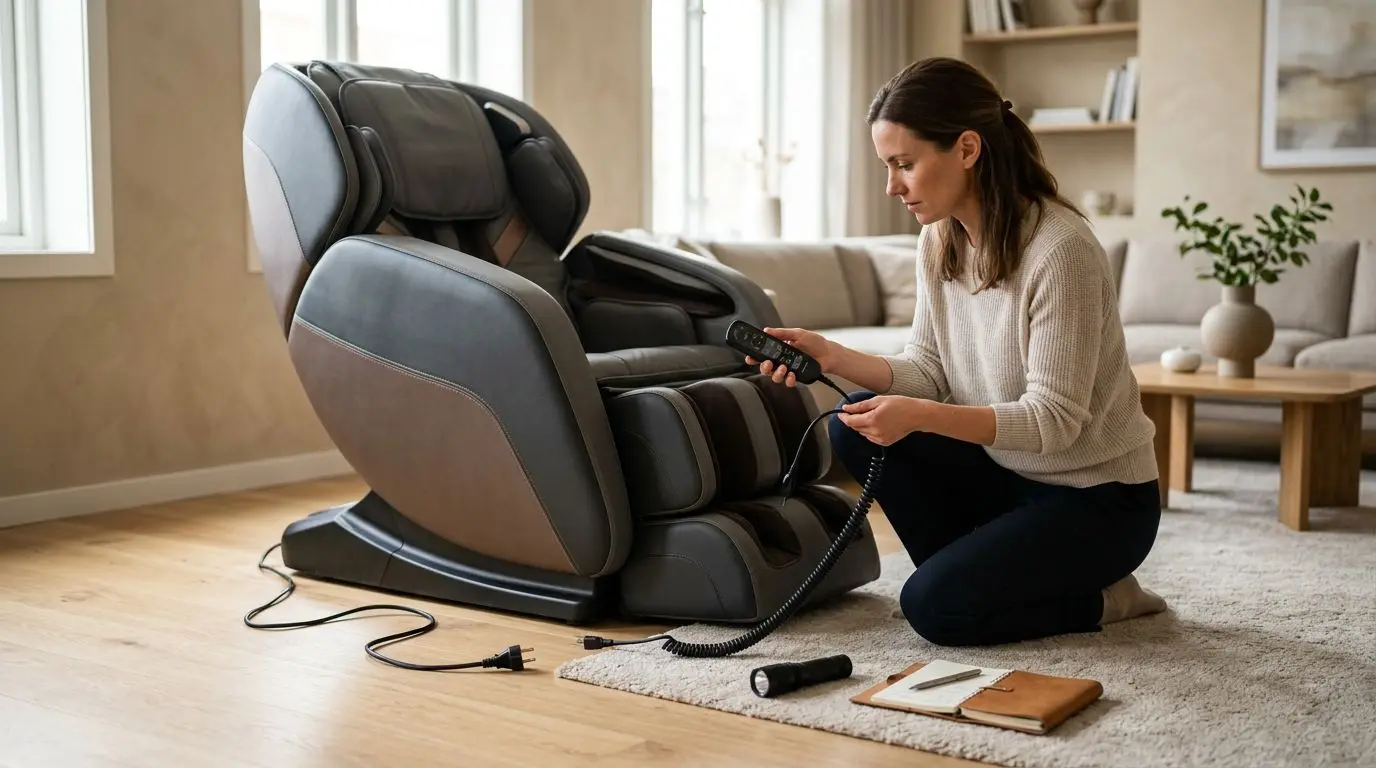
Massage Chair Not Working? Troubleshooting Power, Remote, Rollers, Heat, and Air Compression
13 min read
Massage Chair Repair Guide: Problems, Parts, Service Calls, and Warranty Tips
14 min read
How to Reset a Massage Chair: Power Cycling, Error Messages, and Safe Restart Steps
14 min read
Do Massage Chairs Need a Surge Protector? Electrical Care for Home Use
15 min read