Disclosure: We may earn a commission when you buy through links on this page, at no extra cost to you. We buy nothing, sell nothing and accept no payment for coverage — commissions never decide what we recommend. How we make money.
Set up a massage chair safely by plugging it into a properly grounded 120-volt, 3-prong wall outlet, keeping the power cord away from moving parts, and leaving enough clearance for the chair to recline without pinching the cord. Do not use an extension cord as a permanent solution; if you need one temporarily, choose a heavy-duty grounded cord rated for the chair’s load and keep it as short as practical. Add surge protection only when it is correctly rated, in good condition, and not overloaded with other high-draw devices.
A massage chair is more than a recliner with a plug. It contains motors, rollers, airbags, heaters, control boards, and sometimes powered footrests or zero-gravity recline systems. A safe setup protects the chair, reduces trip hazards, and lowers the risk of nuisance breaker trips or cord damage.
Start with a 120-volt, 3-prong grounded outlet
Most massage chairs sold for home use in the United States are made for a standard 120-volt household outlet. Start with a grounded, 3-prong receptacle that is in good condition, firmly mounted, and not loose when you plug in the chair.
Check the chair’s rating label and owner’s manual before plugging it in. Look for the voltage, frequency, and amperage or wattage. Many home massage chairs draw far less than a full 15-amp circuit during normal use, but the actual requirement depends on the number of motors, heat zones, air pumps, and moving features. If the label is missing or unreadable, do not guess.
A grounded outlet matters because it gives fault current a safer path if something goes wrong inside the chair. Never cut off the grounding pin to make a plug fit a 2-slot outlet. That turns a safety feature into a hazard. If the room only has 2-prong outlets, use another location or hire a licensed electrician to evaluate the circuit and install a properly grounded receptacle where local code allows.
Pay attention to the circuit too. A typical U.S. general-use receptacle circuit is 15 or 20 amps, but that does not mean the massage chair can share the same outlet strip with a space heater, portable air conditioner, treadmill, or several electronics. High-draw appliances on the same circuit can trip breakers or cause overheating. If the chair repeatedly shuts off, dims lights, trips a breaker, or makes the outlet warm, stop using it and have the setup checked.
In bathrooms, garages, unfinished basements, and some other locations, GFCI protection may be required or strongly recommended. Massage chairs are usually best placed in dry living areas, not damp rooms. If the chair must be in a basement or similar space, keep it away from water, plumbing leaks, wet floors, and condensation.
Give the chair 2 to 6 inches of wall clearance, or more if the manual says so
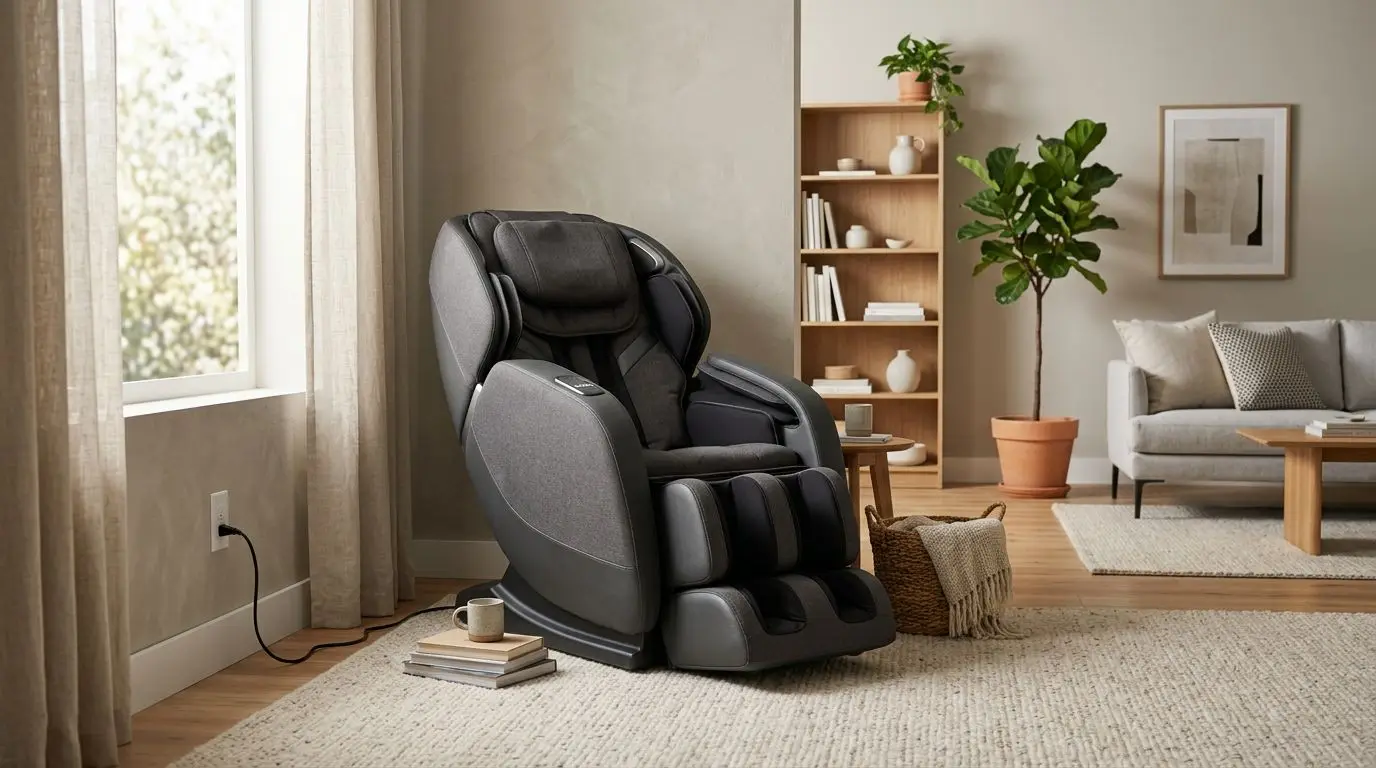
Electrical safety begins with placement. Many massage chairs need several inches of space behind the backrest, while some wall-hugging designs need less than conventional recliners. A practical rule is to measure the chair in its most reclined position and leave at least the manual’s required clearance; for many chairs, that is somewhere around 2 to 6 inches from the wall, while non-wall-hugging designs may need more.
Do not place the chair where the power cord can be crushed between the base and the wall. A cord may look fine from above yet be sharply bent behind the chair, especially after it reclines. Over time, that can damage insulation or internal conductors.
Before the first use, run the chair through its full range of motion with no one sitting in it. Watch the backrest, base, footrest, and any sliding frame section. The cord should not stretch, scrape, get pulled under a caster, or pass near scissor-style recline mechanisms. If the cord moves while the chair moves, reroute it.
Keep access to the plug. You should be able to unplug the chair without moving heavy furniture or reaching into a pinch point. A massage chair can weigh several hundred pounds, so a poorly placed plug becomes a real problem when you need to disconnect it quickly.
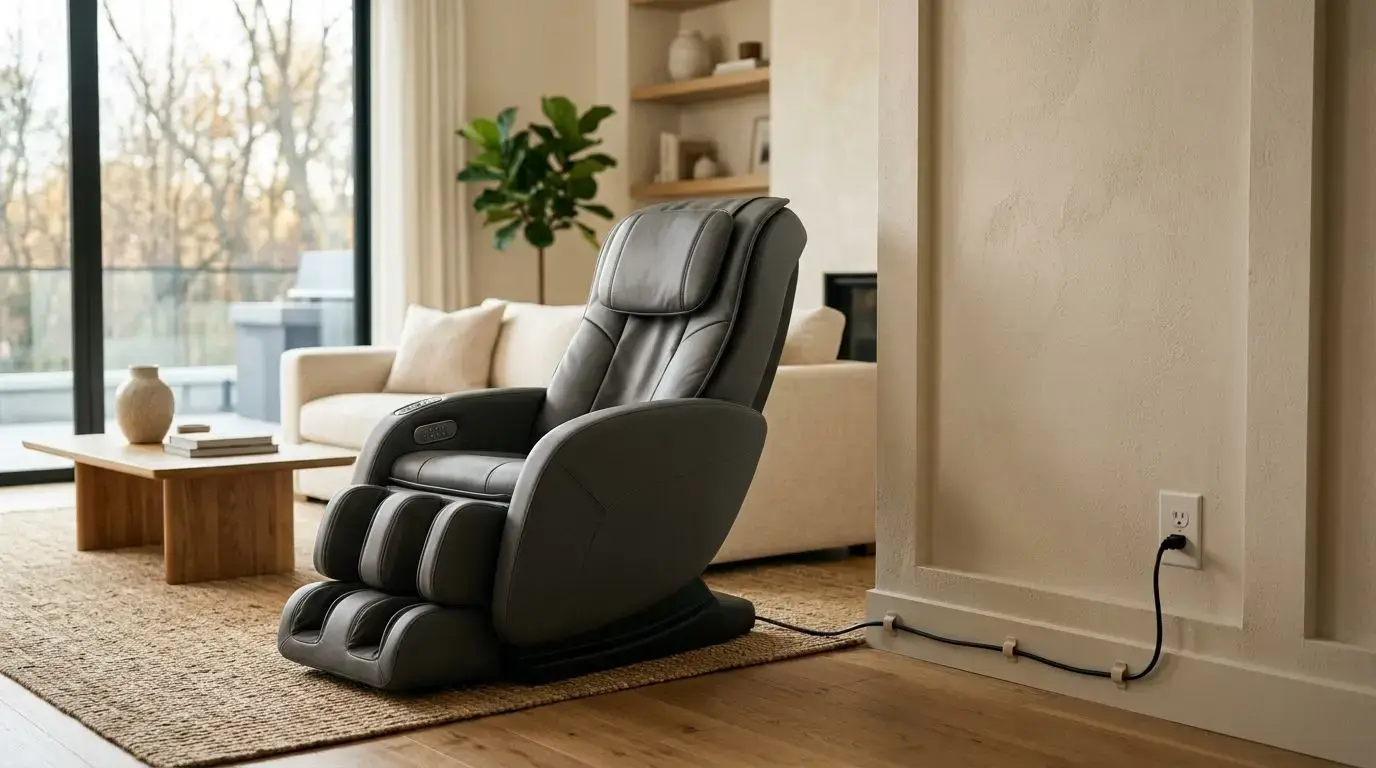
Flooring matters as well. On carpet, cords can disappear under the chair and become easier to crush. On hard flooring, cords can slide into a walking path or under the base. If the chair is near a wall outlet, route the cord directly toward the wall, not across an open walkway.
Extension cords: use one only temporarily, and keep it 14 AWG or heavier
The best setup is a massage chair plugged directly into a wall outlet. An extension cord should not be the permanent answer to a poorly placed outlet. If you need one briefly during setup, testing, or room rearranging, use a grounded 3-prong cord that is heavy-duty, undamaged, and rated for the chair’s electrical load.
Wire gauge matters. In American Wire Gauge sizing, a smaller number means a thicker wire. A 14 AWG extension cord is commonly used for heavier household loads than a thin 16 or 18 AWG cord. For a long cord run or a chair with multiple powered features, a 12 AWG cord may be more appropriate. Start with the owner’s manual, because some manufacturers state not to use extension cords at all.
Length matters too. A 25-foot cord has less voltage drop than a 50-foot or 100-foot cord of the same gauge. Do not buy extra length just to coil the unused portion behind the chair. Coiled cords can retain heat, and a coil behind a reclining chair can become a snag point.
Never daisy-chain extension cords. That means no extension cord into another extension cord, no power strip into an extension cord, and no multi-plug adapter stacked onto a surge protector. Each extra connection adds resistance and creates another place for looseness, heat, or damage.
Use an indoor-rated cord for indoor use, and keep it visible enough to inspect. Do not run an extension cord under a rug, through a doorway, under the chair base, or beneath a mat. Covering a cord hides wear and can trap heat. If an extension cord feels warm during use, unplug the chair and stop using that cord.
Surge protection: choose a 15-amp rated protector with a grounded plug
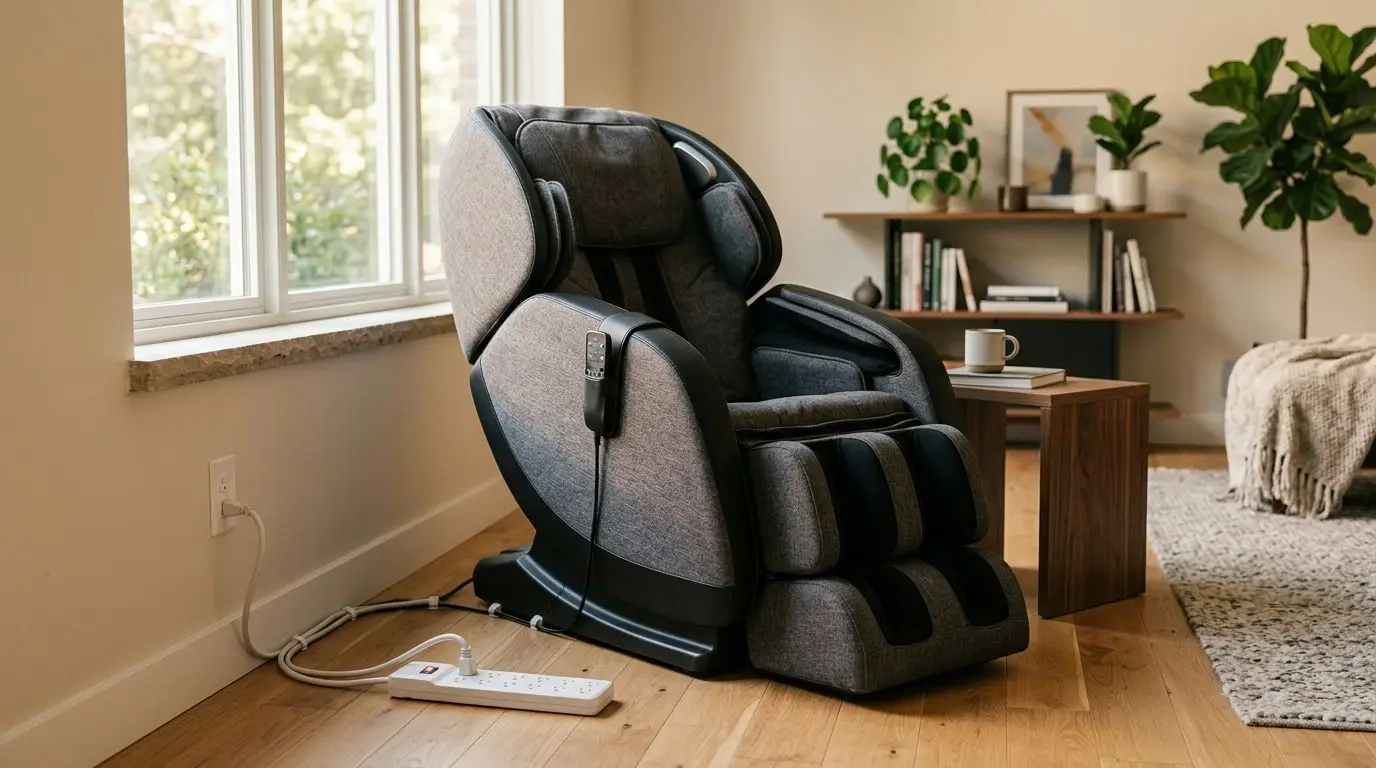
A surge protector can help protect the chair’s electronics from brief voltage spikes, but only when used correctly. Look for a grounded surge protector rated for a standard 15-amp household circuit, with a safety listing from a recognized testing laboratory such as UL or ETL. Avoid old power strips with no surge rating, loose outlets, cracked housings, or missing indicator lights.
Do not confuse a basic power strip with surge protection. A power strip mainly gives you more outlets. A surge protector contains components designed to absorb or divert voltage spikes. Those components age, especially after large surges, so a very old protector may no longer provide useful protection even if it still passes power.
Keep the load simple. Ideally, the massage chair should be the only large device on that surge protector. Do not plug in a space heater, humidifier, portable AC unit, or other high-draw appliance alongside it. Small accessories such as a low-power phone charger are less demanding, but the cleanest setup is still one chair, one protector, one wall outlet.
Placement counts. Put the surge protector where it can breathe and where its cord is not stretched. It should not sit under the moving base of the chair, under a rug, or where a pet water bowl, plant, or spilled drink can reach it. If the protector has an on/off switch, position it so it will not be kicked off accidentally during a massage session.
Some manuals may advise plugging directly into the wall rather than into a surge protector. Follow the manual when it is more restrictive. If you live in an area with frequent lightning or unstable power, a whole-home surge device installed by an electrician may be worth discussing, but it does not replace safe cord routing at the chair.
Cord management: keep a 3-inch bend radius and a clear walking path
A power cord should never be pulled tight, sharply kinked, crushed, or pinched. As a practical target, leave at least a gentle 3-inch bend radius wherever the cord changes direction. In other words, the cord should curve gradually instead of folding into a hard angle behind the chair or at the plug.
Start at the outlet and trace the entire cord path to the chair. The plug should sit fully in the receptacle. The cord should drop or run to the side without tension. From there, it should avoid the recline track, lift points, footrest linkages, casters, and any moving frame sections.
Use cord clips, low-profile cable channels, or furniture-safe guides if they help keep the cord against the wall. Choose products that hold the cord lightly rather than squeezing it. Tight zip ties are a poor choice because they can compress the insulation. Hook-and-loop straps are usually better for bundling extra length because they can be adjusted and do not bite into the jacket.
Trip prevention is just as important as electrical protection. If the chair sits in a living room, bedroom, or den, keep the cord out of the main walking route. A cord crossing a walkway is easy to catch with a bare foot, walker, cane, vacuum, or pet toy. If the only available outlet forces the cord across a path, reconsider the room layout or add a properly installed outlet.
Check the cord periodically. Look for cuts, flattened spots, exposed wires, melting, discoloration, or a plug that wiggles. Check again after moving the chair for cleaning. Many cord problems start after a heavy chair is slid a few inches and the cord is dragged underneath without anyone noticing.
Who it’s best for: 4 common home setups
Different rooms create different electrical risks. A chair in a dedicated relaxation corner is easier to set up safely than one squeezed into a busy family room with lamps, chargers, pet beds, and toys. Use the table below to match the setup to the safest approach.
| Home setup | Best electrical approach | Watch for |
|---|---|---|
| Dedicated room or corner | Plug directly into a nearby grounded 120-volt outlet | Hidden cord pinching behind the chair |
| Living room with shared electronics | Use a properly rated surge protector only if the manual allows it | Overloaded strips with TVs, consoles, lamps, and chargers |
| Bedroom placement | Route the cord along the wall and away from night walking paths | Trips in low light and cords under rugs |
| Basement or lower level | Use a dry, grounded outlet and consider GFCI where appropriate | Moisture, extension cords, and outlets near concrete floors |
If the chair will be used by an older adult or anyone with limited mobility, prioritize a cord-free walking path over cosmetic placement. A perfect-looking layout is not safe if the user has to step over a cord every day.
How to choose and measure in 10 minutes
You can evaluate a setup in about 10 minutes with a tape measure, a flashlight, and the chair manual. The goal is to confirm that the chair can recline fully, stay close enough to a safe outlet, and keep the cord out of danger.
- Measure the outlet distance. Place the chair where you want it, then measure from the chair’s power entry point to the outlet. The cord should reach with slack, not tension.
- Measure full recline depth. Recline the chair all the way and measure from the front of the extended footrest to the back of the chair. Add the wall clearance required by the manual.
- Check side access. Leave enough room to reach the plug, power switch, or surge protector. Even 12 inches of side access can make routine checks easier.
- Inspect the cord path. Use a flashlight behind and under the chair. Confirm the cord is not touching rollers, rails, hinges, or lift mechanisms.
- Test one full cycle. Run a short program, often 10 to 15 minutes, while watching the cord and listening for rubbing, clicking, or strain.
Do not rely only on the chair’s footprint in the upright position. A compact-looking chair can move backward, forward, or downward during recline. The safest measurement is always the chair at maximum extension.
Setup checklist: 12 safety checks before the first session
Before anyone sits down for a full massage, run through a short checklist. It takes less time than one automatic program and can prevent the most common placement mistakes.
- The outlet is grounded, 3-prong, and not loose.
- The chair’s voltage rating matches the household outlet.
- The plug is fully inserted and not angled.
- No adapter is used to defeat the grounding pin.
- The cord is not under the chair base, rug, mat, or caster.
- The cord has slack when the chair is upright and fully reclined.
- The wall clearance matches the manual’s requirement.
- No extension cord is used as a permanent power source.
- Any surge protector is grounded, safety-listed, and not overloaded.
- The cord does not cross a walking path.
- The chair is in a dry location away from water sources.
- The outlet, plug, and cord stay cool during a 10- to 15-minute test run.
If any item fails, fix it before regular use. Warm plugs, burning smells, buzzing from an outlet, flickering lights, or repeated breaker trips are not normal. Unplug the chair and call a qualified electrician if you suspect a wiring issue.
Feature comparison: 6 electrical safety choices
Not every accessory improves safety. Some help when used correctly; others create more risk than they solve. This table compares common choices without relying on any specific brand or model.
| Choice | When it helps | When to avoid it |
|---|---|---|
| Direct wall outlet | Best everyday setup for most chairs | Avoid if the outlet is loose, damaged, ungrounded, or frequently trips |
| Surge protector | Useful for electronics protection if properly rated and allowed by the manual | Avoid overloaded or old units with damaged outlets |
| Extension cord | Temporary testing or repositioning with a heavy-duty grounded cord | Avoid permanent use, thin cords, long runs, and cords under rugs |
| Outlet adapter | Rarely appropriate; only code-compliant adapters used correctly may be acceptable | Avoid any adapter that removes or bypasses grounding |
| Cord cover | Can reduce trips along a wall or low-traffic edge | Avoid covers that trap heat, pinch the cord, or hide damage |
| New dedicated outlet | Best fix when the safe chair location is not near power | Do not DIY if you are not qualified; hire a licensed electrician |
A dedicated outlet is often the cleanest long-term solution when a chair will stay in one place for years. The cost and feasibility vary by home, but it avoids the everyday compromises of extension cords and awkward routing.
FAQ: 5 practical electrical questions
Can I plug a massage chair into a regular wall outlet?
Yes, many home massage chairs are designed for a standard 120-volt grounded wall outlet in the United States. Confirm the chair’s rating label and manual first, and do not use a loose, damaged, or ungrounded outlet.
Is it safe to use an extension cord with a massage chair?
A direct wall connection is safer for everyday use. If an extension cord is unavoidable for a short period, use a grounded heavy-duty cord, commonly 14 AWG or thicker, keep it short, and never run it under rugs or furniture. Follow the manual if it prohibits extension cords.
Should a massage chair be on a surge protector?
A properly rated, grounded surge protector can help protect electronic controls, but only if the manual allows it and the protector is not overloaded. A surge protector is not a substitute for a grounded outlet or safe cord routing.
Why does my breaker trip when I use the chair?
The circuit may be overloaded, the outlet may have a fault, or another high-draw device may be sharing the same circuit. Stop using the chair on that circuit until you identify the cause. If it happens repeatedly, contact a qualified electrician.
Can I place a massage chair over the power cord?
No. The cord should not run under the base, recline track, footrest, or wheels. A heavy chair can crush the cord, and moving mechanisms can pinch or cut it during recline.
Frequently asked questions
Can I plug a massage chair into a regular wall outlet? +
Yes. Many home massage chairs are designed for a standard 120-volt grounded wall outlet in the United States. Always confirm the chair’s rating label and manual, and avoid loose, damaged, or ungrounded outlets.
Is it safe to use an extension cord with a massage chair? +
A direct wall connection is best for regular use. If you need an extension cord temporarily, use a grounded heavy-duty cord, keep it short, and make sure it is rated for the chair’s load. Do not run it under rugs or furniture.
Should a massage chair be plugged into a surge protector? +
A properly rated grounded surge protector can help protect the chair’s electronics if the manual allows it. Do not overload the surge protector with high-draw appliances.
What should I do if the outlet or plug feels warm? +
Unplug the chair and stop using that outlet. Warm plugs or outlets can indicate a loose connection, overload, or wiring problem. Have the setup checked by a qualified electrician.
How do I keep the massage chair cord from becoming a trip hazard? +
Route the cord directly to the nearest safe outlet, preferably along a wall and away from walkways. Use light cord clips or cable channels if needed, and never place the cord under the chair, a rug, or a moving mechanism.
Related guides
Do Massage Chairs Need a Surge Protector? Electrical Care for Home Use
15 min read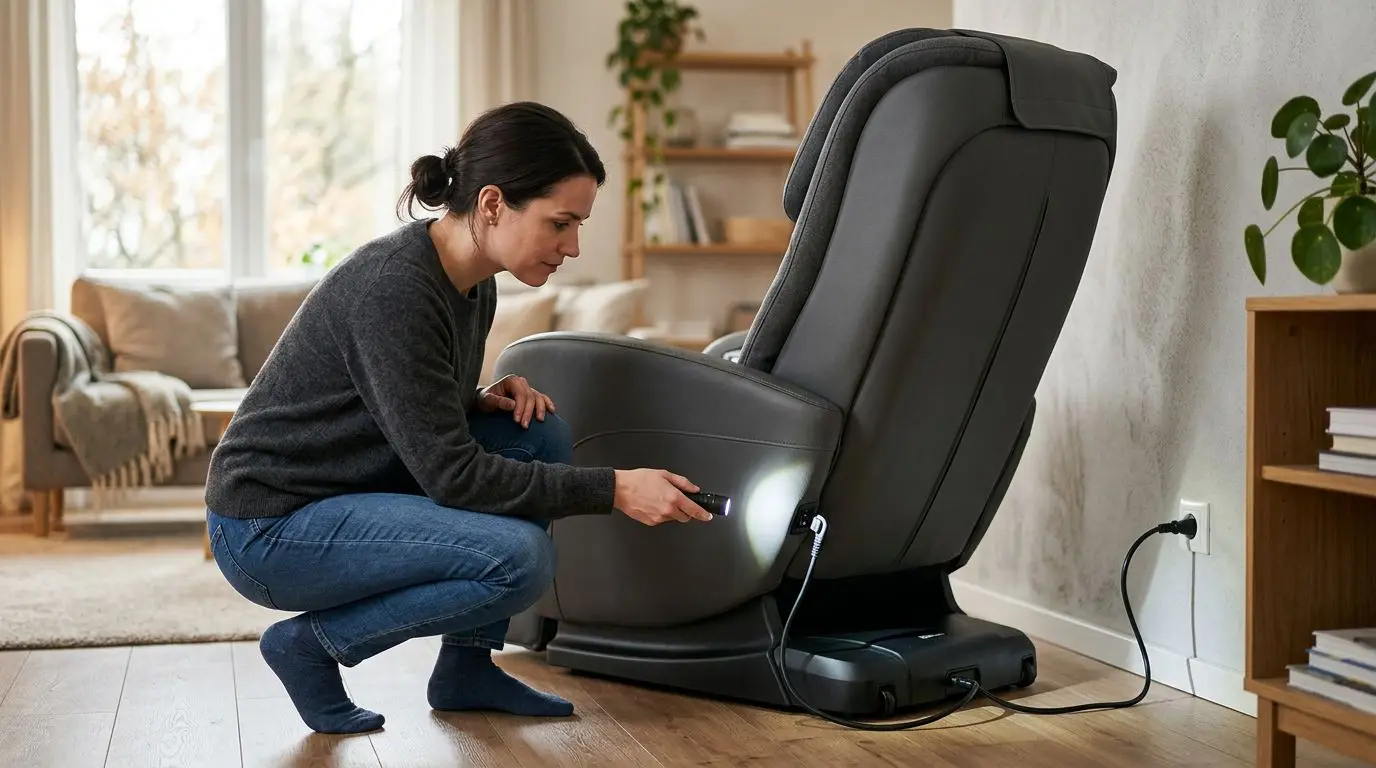
Massage Chair Won’t Turn On? What to Check Before Calling for Service
13 min read
The Hidden Costs of Buying a Massage Chair: Delivery, Setup, Repairs, and Moving
15 min read
How Much Electricity Does a Massage Chair Use?
12 min read
Massage Chair Not Working? Troubleshooting Power, Remote, Rollers, Heat, and Air Compression
13 min read