Disclosure: We may earn a commission when you buy through links on this page, at no extra cost to you. We buy nothing, sell nothing and accept no payment for coverage — commissions never decide what we recommend. How we make money.
If your massage chair stops working, start by unplugging it, documenting the exact symptom, and checking the warranty before removing panels or ordering parts. Many problems come down to power, remote controls, sensors, rollers, airbags, or wiring, but the smartest next step depends on the chair’s age, warranty status, error messages, and whether the issue involves moving parts or electricity.
Use this guide to separate low-risk checks from repair jobs that call for a qualified technician. You will learn what to record, which replacement parts commonly come up, when a service call makes sense, and how to avoid accidentally voiding coverage.
First 10 minutes: what to do before touching a panel
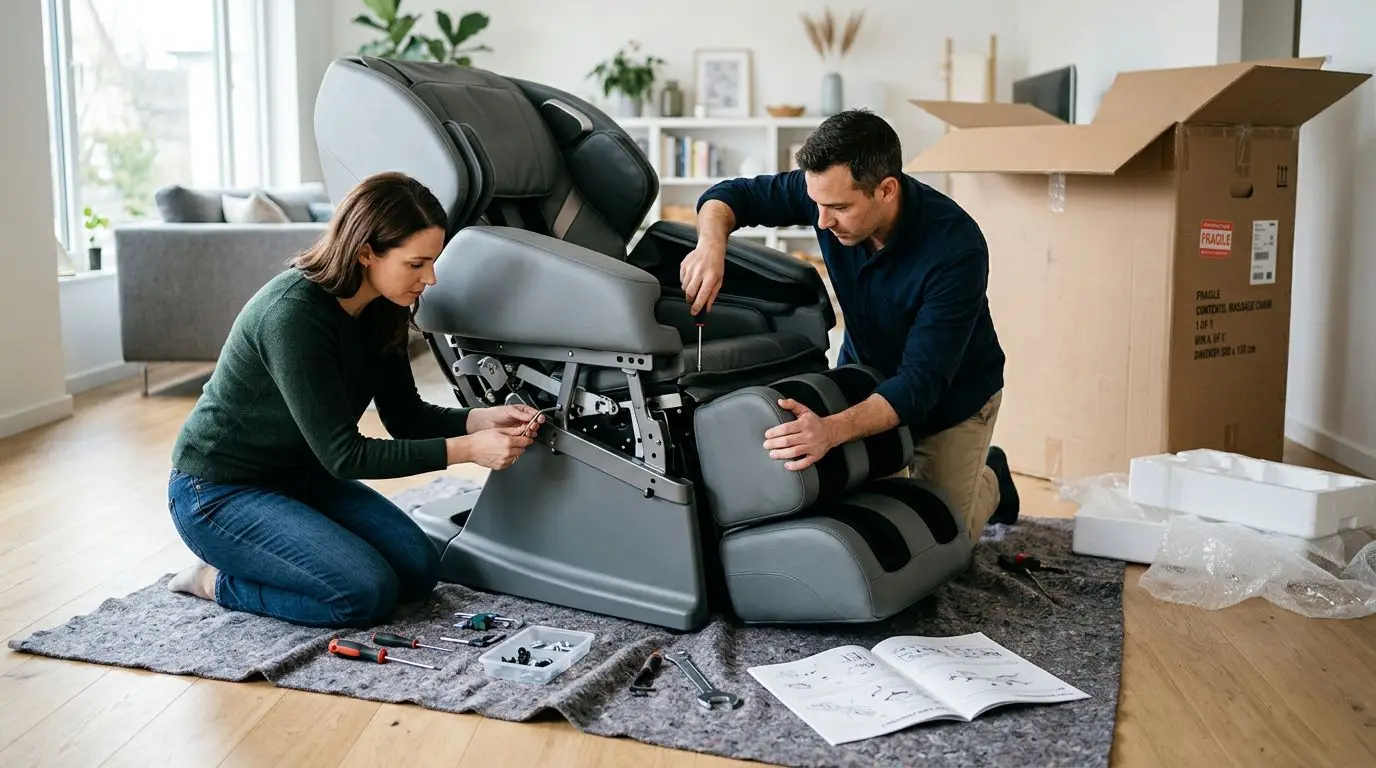
Before you grab a screwdriver, slow down. A massage chair can contain multiple motors, heated areas, rollers, airbags, sensors, and a main control board, all packed into a cabinet that may weigh 150 to 300 pounds. A rushed repair attempt can turn a minor problem into a warranty dispute or a safety issue.
- Unplug the chair for at least 60 seconds. This can reset some control boards and gives the motors time to stop fully.
- Check the outlet with another device. A lamp, phone charger, or small appliance can confirm whether the wall outlet is working.
- Look for a tripped breaker or GFCI outlet. Some rooms share circuits, especially basements, garages, and bonus rooms.
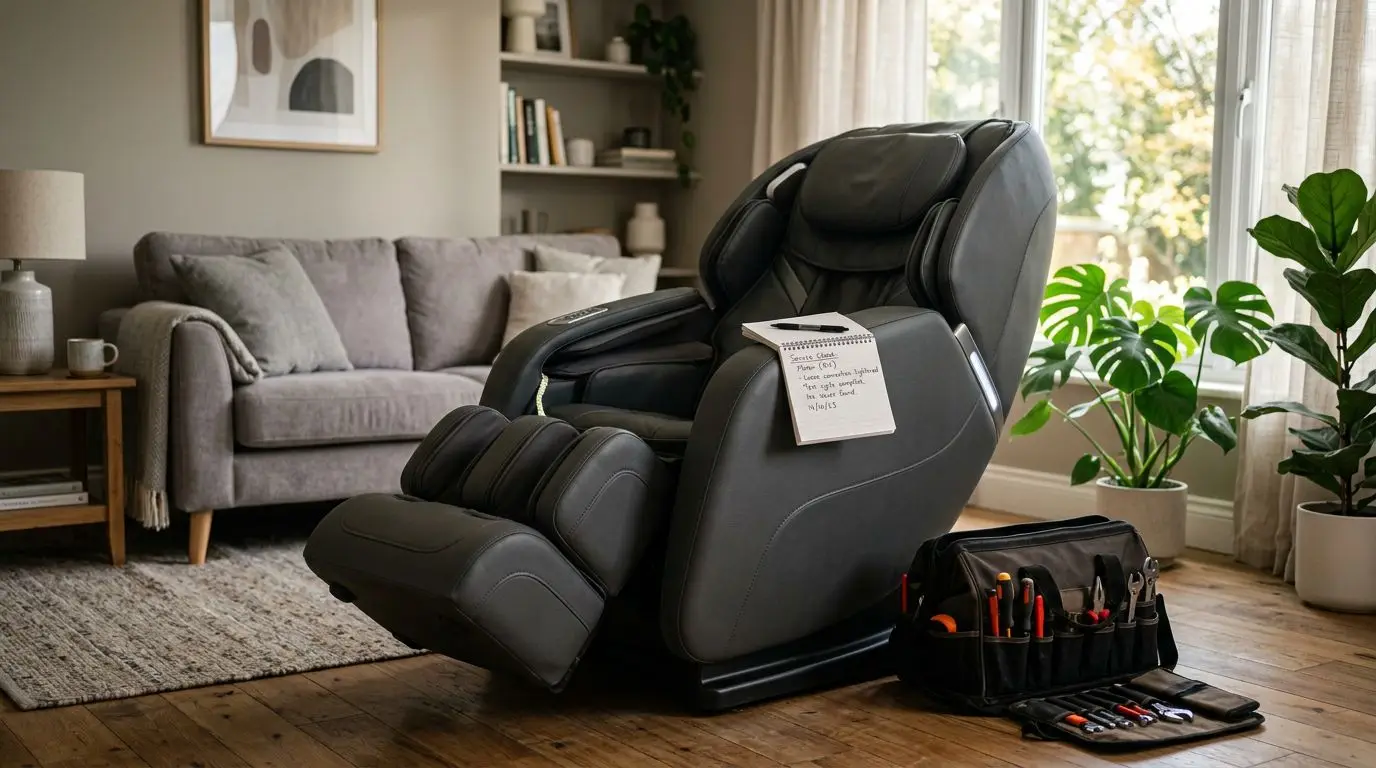
- Write down the symptom. Note whether the chair is dead, stuck reclined, making noise, flashing an error, or failing in just one feature.
- Take 3 to 5 photos. Photograph the power cord, remote, visible error code, rear panel, and serial label if accessible.
- Find your purchase date and warranty terms. Labor, parts, frame, and in-home service may have different coverage periods.
Do not keep pressing buttons if rollers are grinding, the backrest is jammed, a cable smells hot, or a fuse blows repeatedly. Repeated attempts can strain gears, belts, wiring, and control boards.
Common massage chair problems and likely causes
Most repair conversations start with a symptom, not a diagnosis. The same issue can have several causes, so use the table below as a triage tool rather than a shortcut for ordering parts. A chair that powers on but will not recline is very different from one that is completely dead.
| Symptom | Common possibilities | Owner check | When to stop |
|---|---|---|---|
| No power at all | Outlet, power switch, cord, fuse, power supply, main board | Test outlet, confirm rear switch is on, inspect cord | If fuse blows again or cord is damaged |
| Remote lights up but chair does not move | Remote cable, control board, motor wiring, safety sensor | Reseat remote connector if external and accessible | If panels must be removed to reach wiring |
| Rollers stop mid-track | Track obstruction, position sensor, roller motor, gear assembly | Power reset for 60 seconds, listen for motor hum | If grinding, clicking, or burning smell occurs |
| Airbags do not inflate | Air pump, valve block, air hose leak, loose connector | Listen for pump sound during an air-compression program | If hoses are buried inside the arms or seat |
| Recline or footrest stuck | Actuator, limit switch, linkage, trapped object | Check for blankets, cords, or objects around moving areas | If the chair is tilted, unstable, or under load |
| Heat not working | Heating pad, wiring, control board, timed shutoff | Run heat for 10 minutes and compare both sides by feel | If one area gets unusually hot |
| Loud knocking or squeaking | Loose fastener, worn roller, dry joint, track issue | Identify location without disassembly | If noise worsens during roller travel |
A good rule: if the issue involves an external connection, setup menu, outlet, or reset, it may be reasonable to check yourself. If it involves internal wiring, motors, actuators, a control board, or a stuck moving mechanism, plan on a service call.
Replacement parts: 12 components owners hear about most
Massage chair replacement parts are usually functional assemblies, not tiny retail accessories. A technician may replace a complete actuator instead of one internal gear, or a full remote control instead of a single button membrane. That can make repairs more predictable, but it also means part matching matters.
| Part type | What it does | Typical symptom when it fails | DIY suitability |
|---|---|---|---|
| Remote or control pad | Sends commands to the chair | Buttons fail, screen blank, erratic input | Possible if plug-in and compatible |
| Power cord | Connects chair to outlet | No power, intermittent power | Only if it is an external approved cord |
| Fuse | Protects electrical circuit | Chair shuts off or will not power on | Only if manual specifies exact rating |
| Main control board | Coordinates motors and features | Multiple systems fail or error codes appear | Service technician recommended |
| Roller motor | Moves massage rollers | Rollers stop, hum, or move unevenly | Service technician recommended |
| Track sensor | Reports roller position | Rollers stop at same point or misread position | Service technician recommended |
| Recline actuator | Moves backrest | Back will not raise or recline | Service technician recommended |
| Footrest actuator | Extends or retracts leg section | Footrest stuck or uneven | Service technician recommended |
| Air pump | Supplies air-compression zones | Airbags do not fill | Service technician recommended |
| Valve block | Routes air to zones | Some airbags work, others do not | Service technician recommended |
| Air hose | Carries air to airbags | Hissing sound or weak compression | Sometimes, if fully visible |
| Upholstery panel | Covers contact surfaces | Tears, peeling, worn padding | Possible if removable and matched |
Compatibility is often the hard part. Chairs can change wiring harnesses, remotes, sensors, or upholstery patterns across production runs even when the outside looks similar. Before ordering anything, record the serial number, purchase date, voltage label, connector shape, and the exact location of the failed part. A photo of a 6-pin connector, for example, is more useful than saying the plug is small.
DIY repair vs. service call: a 30-minute decision filter
Not every problem deserves a truck roll, but not every problem should be handled in the living room. Set a 30-minute limit for basic owner checks. If you have not found a clear, low-risk answer by then, stop and gather information for support.
Reasonable owner checks
- Power reset after unplugging the chair for 60 seconds.
- Testing a known working outlet.
- Removing objects trapped under the footrest or behind the base.
- Checking whether a child lock, pause mode, demo mode, or auto-off timer is active.
- Reseating an external remote connector if it is designed to be unplugged by the owner.
- Replacing an accessible fuse only when the manual lists the exact type and rating.
Jobs better left to a technician
- Opening the base to access live electrical components.
- Replacing a control board, actuator, roller motor, sensor, or internal wiring harness.
- Fixing a recline system that is jammed under load.
- Working around heating elements.
- Diagnosing repeated fuse failures.
- Repairing damage after a move, fall, spill, or power surge.
A service call is also the safer choice when the chair is in a tight space. Many chairs need several inches behind them to recline and may require 2 adults to move without scraping floors or stressing the frame. If the unit must be tipped on its side, lifted over a threshold, or pulled away from a wall, ask whether the technician handles positioning or expects the owner to prepare access.
What to ask before scheduling a service call
A good repair visit starts before anyone arrives. Most technicians can work faster when they already have the symptom, photos, serial number, and access details. Some repairs take 1 visit if the right part is on hand; others require diagnosis first and parts later.
Ask these questions before you book:
- Are you authorized to work on this chair under its warranty? If not, confirm whether outside labor affects coverage.
- Do you service chairs in homes, or must the chair be transported? A 200-pound chair is not simple to move.
- What information do you need before the visit? Serial number, purchase receipt, error code, and photos are common requests.
- Is there a diagnostic fee, trip fee, or minimum labor time? Get the structure in writing even if exact repair cost depends on diagnosis.
- Do you supply parts, or must the owner obtain them? This affects warranty and accountability.
- What happens if the part is not available? Ask about backorders, substitute parts, and whether the chair can remain usable.
- How long is repair workmanship covered? Some service providers stand behind labor for a defined period.
Give the technician a clear example: “The rollers start at the shoulders, move down about 8 inches, click 3 times, and stop.” That is more useful than “it is broken.” Details reduce guesswork.
Warranty tips: avoid 7 common coverage mistakes
Massage chair warranties often split coverage into separate buckets: parts, labor, frame, electronics, and in-home service. One portion may last 1 year while another lasts longer. The exact terms are controlled by your written warranty, not by what seems fair or what a salesperson said verbally.
Protect your coverage by avoiding these mistakes:
- Opening sealed panels too soon. Removing covers, cutting zip ties, or altering wiring can create a dispute about who caused the damage.
- Using an unapproved replacement part. A part that fits physically may still have the wrong connector, rating, or firmware behavior.
- Hiring unauthorized labor during the warranty period. Get written approval first if the warranty requires authorized service.
- Losing the purchase receipt. Warranty clocks usually start from the purchase or delivery date.
- Ignoring registration steps. Some warranties ask for registration within a stated window, such as 30 days.
- Moving the chair improperly. Damage from stairs, dollies, or dragging may be excluded.
- Using the chair outside normal household conditions. Garages, damp spaces, commercial use, or incompatible power setups may be excluded.
Before any paid repair, email support with your serial number, photos, and symptom summary. Ask whether the issue appears covered and whether a specific process must be followed. Keep screenshots, case numbers, receipts, and the technician’s notes. If a part is replaced, ask for the old part to be documented on the invoice, even if the technician must take it back.
How to choose repair, replacement, or retirement
The best choice depends on chair age, parts availability, total repair complexity, and your tolerance for downtime. A 2-year-old chair with a known actuator issue is a different decision from a 12-year-old chair with cracking upholstery, intermittent power, and unavailable parts.
| Situation | Repair usually makes sense when | Replacement may make sense when |
|---|---|---|
| Under warranty | Coverage is confirmed and authorized service is available | Warranty solution is impractical or parts are unavailable |
| Single failed feature | One part is clearly diagnosed and available | Diagnosis points to multiple related failures |
| Older chair | Frame, upholstery, remote, and rollers are still in good condition | Parts are discontinued or several systems are worn |
| Electrical fault | A qualified technician identifies a specific replaceable part | Repeated failures continue after repair |
| Cosmetic wear | Panels are available and easy to replace | Worn upholstery exposes padding or affects comfort across large areas |
Think in percentages instead of only dollars, since costs vary by location and part availability. If the full repair, shipping, diagnostic time, and labor approach a large share of the cost of a comparable new chair, step back. Also consider downtime. Waiting 6 to 10 weeks for a backordered board may be reasonable for a high-quality chair you enjoy, but not for a chair that already has several failing systems.
How to measure and document your chair for parts and access
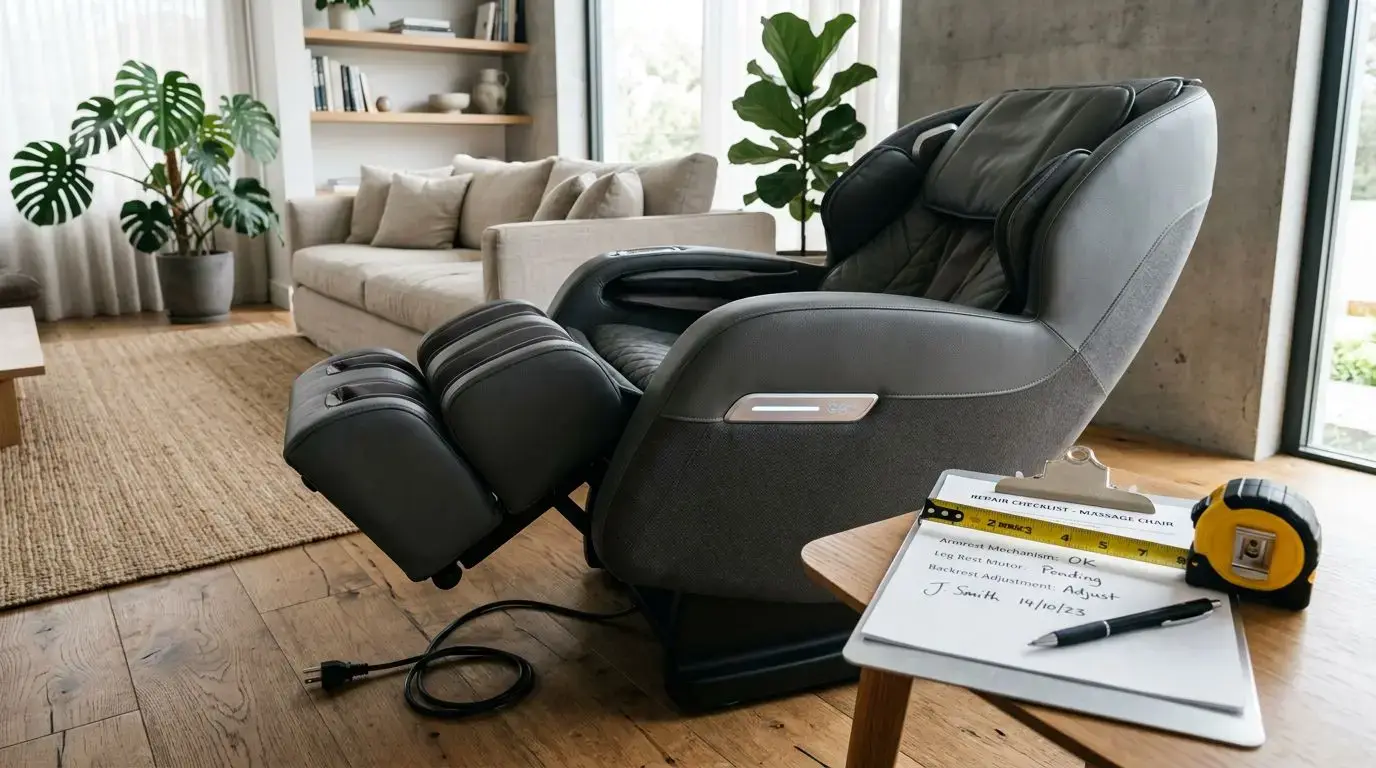
Accurate measurements help with both parts support and the service visit. Use a tape measure, a phone camera, and a note app. Spend 15 minutes collecting the basics before calling anyone.
- Overall width: Measure the widest point, often arm to arm. Many full-size chairs are roughly 28 to 36 inches wide.
- Depth upright and reclined: Measure from the rear edge to the front of the footrest in both positions if the chair still moves.
- Wall clearance: Note the gap behind the backrest. Some designs need only a few inches, while others need much more.
- Doorway path: Measure the narrowest doorway, hallway turn, and stair landing if the chair may be moved.
- Serial label: Photograph the label, not just the name on the outside.
- Connector photos: If a user-accessible cable is involved, photograph the plug end straight on so pin count and shape are visible.
- Error code: Record the exact letters, numbers, and timing. A code that appears after 20 seconds matters.
For upholstery, do not rely on color names alone. Take photos in daylight, include a close-up of the grain, and show the whole panel. A seat cushion, arm insert, and calf section may use different shapes even if they appear to share the same material.
Safety notes before using a repaired or malfunctioning chair
A massage chair is a consumer wellness product, not a medical device. If you are pregnant, have a pacemaker or other implanted cardiac device, have a history of blood clots or take anticoagulants, have osteoporosis, had a recent fracture or surgery, have spinal disc problems, neuropathy, or uncontrolled hypertension, ask your physician before using a massage chair. That advice matters even more if the chair is malfunctioning, unusually intense, or recently repaired.
Stop using the chair and unplug it if you notice smoke, a hot electrical smell, sparking, repeated fuse failure, unusual heat from one panel, exposed wiring, liquid intrusion, or movement that traps a body part. Do not let children play with the remote or climb into the footrest area. Moving sections can pinch fingers, cords, blankets, and pets.
After a repair, start with a short 5-minute session at the lowest intensity. Confirm the backrest, footrest, rollers, airbags, and heat behave normally before running a longer automatic program. The goal is comfort and predictable operation, not maximum intensity.
Simple maintenance that can prevent avoidable service calls
Basic care will not prevent every failure, but it can reduce strain and make problems easier to spot. Build a 10-minute monthly check into your routine.
- Vacuum around the base so dust, pet hair, and small objects do not collect near moving parts.
- Keep at least the manufacturer’s recommended clearance around the chair, especially behind the backrest and in front of the footrest.
- Inspect the power cord for crushing, kinks, or heat marks.
- Wipe upholstery with a soft cloth and only cleaners approved for that material.
- Do not overload the chair beyond the stated user height and weight limits.
- Avoid extension cords unless the manual explicitly allows them and the cord is properly rated.
- Run features regularly. A chair left unused for months can still develop stiff mechanisms or weak connections.
Listen for changes. A new click, scrape, squeal, or uneven motion is worth noting early. Describe it by location and timing: left arm airbag, right calf area, lower back rollers, or footrest hinge. Good notes save repair time, even when they do not change which parts are needed.
FAQ: massage chair repair questions owners ask most
Is it worth repairing a massage chair that is out of warranty?
It can be, especially when the problem is limited to one available part and the chair is otherwise in good condition. If the chair is older, has multiple failing systems, or needs unavailable parts, compare the full repair process with replacement.
Can I replace a massage chair remote myself?
Sometimes. If the remote is external, plugs in without opening the chair, and the replacement is confirmed compatible by serial number, it may be a reasonable owner repair. If the cable runs inside the chair or the remote must be paired or programmed, use support or a technician.
Why does my chair turn on but stop during a program?
Possible causes include a position sensor, motor issue, overheating protection, obstruction, control board fault, or wiring problem. Record when it stops, which feature is active, and whether an error code appears, then contact support if a reset does not fix it.
Can a furniture repair shop fix massage chair upholstery?
A furniture shop may be able to handle surface upholstery work, but powered chairs have airbags, wiring, heaters, and moving sections under the covers. During warranty, ask the manufacturer or seller before using any outside shop.
What should I do if the chair is stuck reclined?
Unplug it, check for obvious obstructions around the base and footrest, and do not force the backrest upright. A stuck actuator or linkage can be under load, so a technician is usually the safest next step.
Do massage chair parts have universal sizing?
No. Rollers, remotes, actuators, pumps, sensors, and upholstery panels are commonly specific to a chair platform or production run. Match parts using the serial number, connector photos, and support confirmation.
Frequently asked questions
Is it worth repairing a massage chair that is out of warranty? +
It can be worth repairing if the problem is isolated to one available part and the chair is otherwise in good condition. If several systems are failing or parts are unavailable, compare the full repair process with replacement.
Can I replace a massage chair remote myself? +
Sometimes. If the remote plugs in externally and compatibility is confirmed by serial number, it may be a reasonable owner repair. If wiring runs inside the chair or programming is required, contact support or a technician.
Why does my massage chair turn on but stop during a program? +
Common possibilities include a sensor issue, obstruction, motor problem, control board fault, wiring issue, or built-in protection stop. Record the timing, active feature, and any error code before contacting support.
What should I do if my massage chair is stuck reclined? +
Unplug the chair, check for visible obstructions, and do not force it upright. A stuck actuator or linkage can be under load, so a qualified service technician is usually the safer choice.
Are massage chair replacement parts universal? +
No. Remotes, actuators, rollers, pumps, sensors, boards, and upholstery panels often vary by platform and production run. Use the serial number, photos, and support confirmation before ordering.
Related guides
Should You Repair or Replace a Massage Chair? Common Problems, Costs, and Safety Signs
14 min read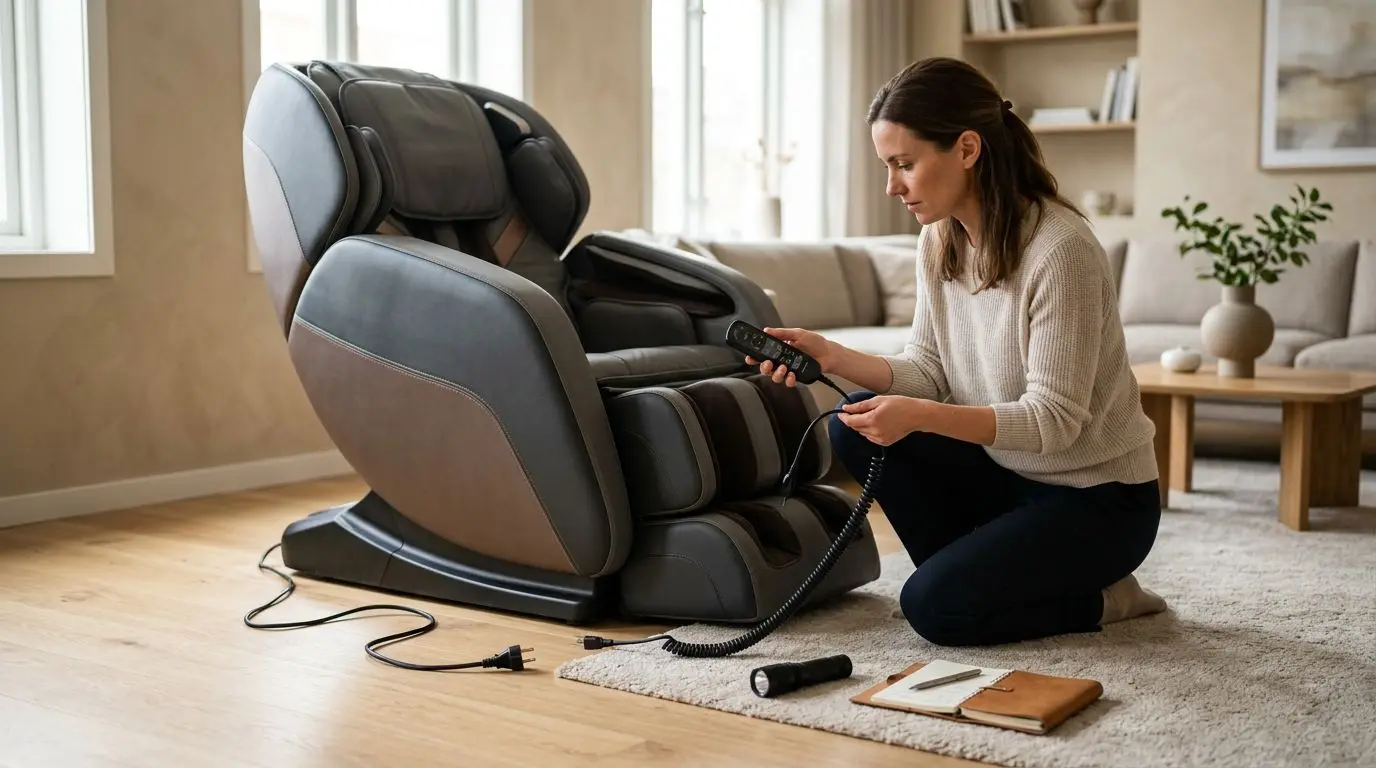
Massage Chair Not Working? Troubleshooting Power, Remote, Rollers, Heat, and Air Compression
13 min read
Massage Chair Remote Not Working? Cable, Battery, Screen, and Control Panel Troubleshooting
13 min read
Massage Chair Won’t Turn On? What to Check Before Calling for Service
13 min read
Massage Chair Maintenance Checklist: Weekly, Monthly, and Yearly Tasks
13 min read