Disclosure: We may earn a commission when you buy through links on this page, at no extra cost to you. We buy nothing, sell nothing and accept no payment for coverage — commissions never decide what we recommend. How we make money.
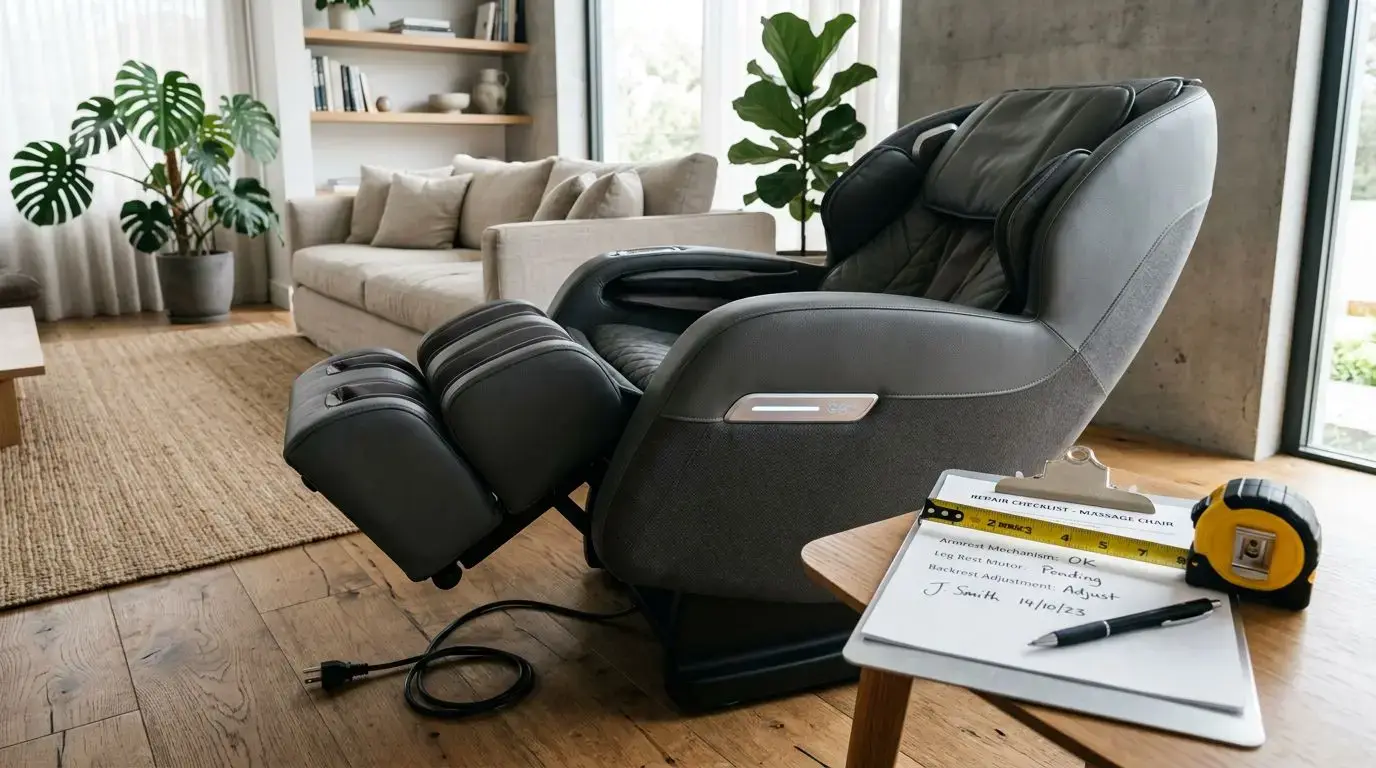
Repair a massage chair when the issue is isolated, the chair is structurally sound, and the total repair estimate is less than about 40% to 50% of a comparable new chair. Replace it when there are electrical safety signs, major frame or track damage, repeated failures, or repair costs that come close to half the value of a newer chair.
The right choice comes down to four things: safety, repair cost, age, and how well the chair still fits your body. A 3-year-old chair with a bad remote is usually worth fixing; a 10-year-old chair with a cracked track, intermittent power, and worn upholstery is usually a better candidate for replacement.
Repair vs. replace: use the 50% rule as your starting point
A practical rule is simple: if the total out-of-pocket repair is more than 50% of what you would spend on a comparable replacement, replacement deserves serious consideration. If the chair is under 5 years old and the repair is below 25% to 35% of replacement cost, repair is often the more sensible path, provided there are no safety concerns.
Do not look only at the part price. Add the service call, labor, shipping for heavy parts, diagnostic fees, and the possibility of a second visit. A massage chair can weigh 150 to 300 pounds, and some internal assemblies are awkward to access, so labor can be a significant part of the bill.
Also consider what you are preserving. If the chair still delivers a comfortable 15- to 30-minute session, fits the main user, reclines smoothly, and has no strange smells or electrical symptoms, one repair may extend its useful life. If several features have already stopped working, the next fix may only buy a few months.
| Decision factor | Repair leans right when... | Replace leans right when... |
|---|---|---|
| Total repair cost | Under about 40% of replacement cost | Near or above 50% of replacement cost |
| Chair age | Usually under 5 to 7 years | Often 8 to 12+ years, depending on use |
| Problem count | One clear failed part | Multiple systems failing together |
| Safety | No heat, smoke, sparking, or breaker trips | Any electrical warning sign is present |
| Fit and comfort | Still fits the main user well | Never fit well or now feels uncomfortable |
Common massage chair problems and typical repair-cost ranges
Out-of-warranty repair prices vary widely by region, chair design, parts availability, and whether a technician needs to make 1 or 2 trips. In the US, a diagnostic visit alone commonly falls in the low hundreds, while major motor, board, or track work can reach several hundred dollars or more. Treat the numbers below as planning ranges, not quotes.
| Problem | Likely cause | Typical out-of-warranty range | Repair or replace? |
|---|---|---|---|
| Remote or control panel does not respond | Bad remote, cable, connector, or control board | About $100 to $400 if parts are available | Usually repair, especially on a newer chair |
| Rollers move but feel rough or noisy | Worn roller, gear, bearing, or track obstruction | About $150 to $600 | Repair if the track is not cracked |
| Chair powers on, then shuts off | Sensor fault, overload, power supply, or board issue | About $200 to $700 | Depends on diagnosis and age |
| Airbags do not inflate | Leaking air line, valve, or pump | About $150 to $500 | Repair if the main massage still works well |
| Footrest will not extend or retract | Actuator, linkage, sensor, or obstruction | About $150 to $600 | Repair unless frame damage is present |
| Heat no longer works | Heating pad, wiring, switch, or board issue | About $100 to $500 | Repair only after ruling out safety risk |
| Torn upholstery or peeling surface | Wear, body oils, sunlight, age | About $100 to $800+ depending on panels | Repair if limited; replace if widespread |
| Cracked track or bent frame | Impact, overload, fatigue, failed hardware | Often expensive and parts-dependent | Often replace, especially on older chairs |
Parts availability matters as much as price. A $180 part is not helpful if it takes 12 weeks to arrive or cannot be sourced at all. Ask the repair company whether the part is in stock, whether it is new or refurbished, and whether the repair includes a labor or parts warranty for at least 30 to 90 days.
Safety signs that mean stop using the chair immediately
If a massage chair smells hot, gives off smoke, sparks, trips a breaker, or has exposed wiring, stop using it immediately and unplug it if you can do so safely. Most home massage chairs draw power through a standard 120-volt household outlet, and electrical faults should be taken seriously.
Do not keep testing the chair to see whether the problem comes back. One more 20-minute session is not worth the risk of overheating, shock, or further damage to the control board. If the plug, cord, or outlet is warm to the touch, turn the chair off, unplug it, and leave it unused until it has been inspected.
- Burning plastic or electrical smell: Stop use right away, even if the chair still runs.
- Breaker or GFCI trips: Do not reset and retry repeatedly; that can mask a real fault.
- Visible sparks or smoke: Treat this as a replacement-level warning until a qualified technician says otherwise.
- Pinched, frayed, or exposed wires: Especially risky around moving recline, footrest, and track sections.
- Overheating around heat pads: Heat should feel warm, not painfully hot or uneven.
- Grinding followed by sudden stop: A jammed mechanism can overload motors or damage the track.
Safety also applies to the user. If the chair suddenly clamps too hard, reclines unpredictably, or traps a foot or arm, discontinue use. Mechanical failures can be just as serious as electrical ones, especially for older adults or anyone with limited mobility.
Who repair is best for: chairs under 7 years old with one clear fault
Repair is most attractive when the chair is relatively young, the problem is easy to isolate, and the rest of the chair still feels solid. A 2- to 5-year-old chair with a failed air pump, footrest actuator, or remote has a much stronger repair case than a heavily used 11-year-old chair with several symptoms.
Repair is also a good fit when the main user loves the feel of the chair. Massage chairs are personal. Roller width, shoulder position, footwell depth, and recline angle can make or break comfort. If the chair scans your back correctly, reaches the right areas, and fits your height within about 2 to 3 inches of your preferred posture, keeping it may be worth the effort.
- The chair has had no more than 1 major repair in the past 2 years.
- The frame feels stable and does not rock, twist, or creak under normal use.
- The rollers travel smoothly from neck to lower back or glutes, depending on track type.
- The upholstery damage is cosmetic, not exposing foam, wires, or moving parts.
- Parts can be obtained within a reasonable window, such as 1 to 4 weeks.
- The repair includes a written estimate and a clear warranty on the work.
Repair can still be the wrong call on a newer chair if the failure is severe. A cracked track, repeated board failures, or an unresolved power problem changes the math quickly.
Who replacement is best for: older chairs with multiple failures or poor fit
Replacement is usually the cleaner decision when a chair is around 8 to 12 years old, has multiple failing systems, or no longer fits the user well. Even if one repair is affordable, an aging chair may soon need upholstery work, air-line service, a new actuator, and control-board attention.
Replace sooner if the chair has a history of intermittent problems. A massage chair that works on Monday, fails on Wednesday, and works again after being unplugged for 10 minutes may have a loose connector or sensor issue, but it may also have a control problem that is hard to diagnose. Intermittent faults can consume labor time.
Replacement also makes sense when the chair design no longer matches your needs. For example, a user who wants more glute coverage may prefer an L-track or SL-track layout instead of an older S-track design. Someone with limited living-room space may need a wall-hugging recline mechanism that can sit 2 to 6 inches from the wall rather than requiring a foot or more of clearance.
Comfort matters. If the rollers hit the shoulder blades harshly, the footrest is too short, or the chair squeezes the calves too aggressively even at the lowest setting, paying for repairs may only restore a chair you still do not enjoy using.
How remaining lifespan changes the repair value over 5, 8, and 12 years
A well-cared-for massage chair may last many years, but lifespan depends on build quality, use, user weight, maintenance, environment, and parts support. A chair used 15 minutes a day by one person has a very different wear pattern than a chair used 2 hours a day by several household members.
Think in remaining useful years, not just age. If a chair is 5 years old and has been lightly used, a $300 repair may be reasonable. If it is 12 years old, has peeling material, weak airbags, and noisy rollers, even a modest repair may be a bridge to the next failure.
| Chair stage | What to expect | Repair value |
|---|---|---|
| 0 to 3 years | Often still within or near warranty coverage | Repair is usually worth exploring first |
| 4 to 7 years | Normal wear items may appear | Repair is reasonable if the fault is isolated |
| 8 to 10 years | Parts availability and upholstery wear become bigger issues | Repair selectively; avoid expensive stacked repairs |
| 11+ years | Multiple systems may be near end of life | Replace if repair is costly or safety is uncertain |
Usage matters. A 250-pound user near the chair’s maximum rated capacity may put more strain on recline, lift, and footrest components than a lighter user, especially with daily full-body sessions. That does not mean the user is doing anything wrong; it just means rated capacity and mechanical load should be part of the repair discussion.
How to choose: measure the chair, the room, and the repair estimate
Before you authorize a repair or shop for a replacement, measure what you have. Write down the chair’s upright footprint, fully reclined length, width at the arms, doorway clearance, and distance from the wall. Many massage chairs are roughly 28 to 34 inches wide and may need 30 to 36 inches of doorway clearance, depending on whether parts can be removed.
Measure the user too. Height, shoulder width, calf length, and foot size all affect comfort. A chair can be technically functional and still be a poor fit if the shoulder rollers stop 2 inches too high or the foot rollers press the wrong part of the arch.
- Room depth: Measure from the wall to the front of the fully extended footrest.
- Wall clearance: Note whether the current chair needs 2 inches, 6 inches, or more than 12 inches behind it.
- Doorways and turns: Measure the narrowest doorway, hallway turn, and stair landing.
- Floor type: Heavy chairs can dent soft flooring; check the weight and contact points.
- User fit: Confirm shoulder scan accuracy, calf position, and headrest comfort.
- Electrical access: Use a grounded outlet without pinching the cord under the base.
Then compare repair and replacement in writing. Include the diagnostic fee, parts, labor, return trip, disposal of the old chair if replacing, and delivery setup for a new one. A replacement that looks more expensive at first may be less frustrating if it removes a 200-pound chair from the room and includes in-home placement.
Compare chair types and features before replacing a working-but-aging chair
If replacement is on the table, compare chair construction rather than brand names. The track shape, roller depth, recline design, and user fit will matter more day to day than a long feature list. A 30-minute auto program is only useful if the rollers land where your back actually needs them.
| Type or feature | What it changes | Best for | Tradeoff |
|---|---|---|---|
| S-track | Follows the spine from neck to lower back | Users focused on back massage | Less glute and hamstring coverage |
| L-track | Extends under the seat toward the glutes | Users wanting lower-body coverage | May have a fixed recline feel |
| SL-track | Combines spinal curve with longer seat coverage | Balanced full-back and glute massage | Usually more complex to service |
| 2D rollers | Move up, down, left, and right | Basic kneading and rolling | Less depth control |
| 3D rollers | Add in-and-out depth adjustment | Users who want softer or stronger pressure | More moving parts |
| 4D-style programs | Vary rhythm and speed in addition to depth | Users who like a more varied feel | Feature naming can vary by maker |
| Air compression | Uses airbags at arms, calves, feet, or shoulders | Gentle squeezing sensation | Air lines and valves can leak over time |
| Heat | Adds localized warmth, often in back or calves | Relaxation and comfort | Must be monitored for safe operation |
Be cautious with feature creep. More airbags, sensors, motors, and automated movements can improve the experience, but they also create future repair points. If you barely use foot rollers, voice controls, or complex programs, do not let those features drive the replacement decision.
DIY checks you can do in 10 minutes before calling a technician
Some problems are simple, but safety comes first. Before inspecting anything, turn the chair off, unplug it, and wait at least 10 minutes. Do not remove panels that expose wiring, capacitors, circuit boards, or moving mechanisms unless you are qualified to work on that equipment.
- Check that the wall outlet works by testing a small lamp or other low-power device.
- Inspect the power cord for cuts, flattened sections, chew marks, or a loose plug.
- Make sure the chair is not pressing the cord against the wall or base.
- Look for objects jammed in the footrest, side panels, or under the recline mechanism.
- Confirm the remote cable is fully seated if it uses a removable connector.
- Reset only according to the manual, and do not repeat resets after a burning smell or breaker trip.
Take a short video of the symptom. Capture the sound, error light, movement pattern, or shutoff behavior. A 20-second clip can help a technician identify whether the problem sounds like a motor, sensor, relay, or mechanical obstruction.
Skip DIY work when the chair has heat failure, smoke, repeated breaker trips, exposed wires, or a stuck recline position with someone at risk of being trapped. Those are not trial-and-error situations.
A 6-step decision worksheet for repair value
Use this quick worksheet to make the decision less emotional. Give each item a yes or no, then look at the pattern. If you have 4 or more repair-friendly answers, getting an estimate is reasonable; if you have 3 or more replacement warnings, do not put money into the chair without a strong reason.
- Is the chair safe to power on? No burning smell, smoke, sparking, or breaker trips.
- Is the chair under 7 years old? Younger chairs usually have better parts prospects.
- Is there only 1 main problem? A single failed remote is different from a failing remote, weak airbags, and noisy rollers.
- Is repair under 40% to 50% of replacement cost? Include labor and return visits.
- Does the chair still fit the main user? The best repair is wasted if the chair is uncomfortable.
- Can parts arrive within 1 to 4 weeks? Long delays reduce repair value.
If the answers are mixed, get a written diagnosis before deciding. Ask the technician to separate must-fix safety items from comfort or convenience items. You may choose to repair a recline actuator but skip a cosmetic panel if the budget is tight.
FAQ: 5 common repair-or-replace questions
Is it worth repairing a massage chair that is 10 years old?
Sometimes, but only for a limited, affordable problem. If a 10-year-old chair needs a remote, cable, or small upholstery panel and the rest works well, repair may be fine. If it has electrical issues, a cracked track, weak airbags, and peeling material, replacement is usually the better value.
Can I keep using the chair if only the heat stopped working?
Use caution. If the heat simply does not turn on and there is no smell, smoke, hot spot, or breaker trip, the massage function may be safe, but the chair should still be inspected before you assume it is harmless. Stop using it immediately if any area becomes unusually hot.
What repair is usually not worth doing?
Major track or frame damage is often a poor repair candidate, especially on an older chair. These repairs can require large parts, extensive labor, and careful alignment. Electrical faults that cannot be clearly diagnosed are also risky to chase.
How long should a repair warranty be?
For out-of-warranty work, ask for written coverage on both parts and labor. A 30- to 90-day repair warranty is common for many service jobs, though terms vary. The key is knowing what is covered if the same symptom returns.
Should I replace a chair just because the upholstery is peeling?
Not automatically. If peeling is limited to a head pillow, arm pad, or removable panel, repair may be practical. If the surface is flaking across the backrest, seat, arms, and footrest after years of use, replacement may be more sensible than recovering multiple sections.
Frequently asked questions
Is it worth repairing a massage chair that is 10 years old? +
Sometimes, but only for a limited, affordable problem. If the rest of the chair works well, a remote, cable, or small upholstery repair may make sense. Multiple failures, electrical symptoms, or track damage usually point toward replacement.
What is the 50% rule for massage chair repair? +
If the total repair cost is near or above 50% of the cost of a comparable replacement, replacing the chair is often the better value. Include diagnostics, parts, labor, return visits, delivery, and removal in the comparison.
When should I stop using a massage chair immediately? +
Stop using it if you notice burning smells, smoke, sparks, exposed wiring, repeated breaker trips, unusual overheating, or unpredictable movement. Unplug it if safe and have it inspected before using it again.
Are airbag or footrest problems worth fixing? +
Often, yes, if the chair is otherwise comfortable and mechanically sound. Air lines, valves, pumps, actuators, and sensors can sometimes be repaired, but the decision depends on the estimate, parts availability, and chair age.
Should I replace a massage chair with peeling upholstery? +
Not always. Limited peeling on a removable cushion or single panel may be repairable. Widespread peeling across the seat, back, arms, and footrest on an older chair often makes replacement more practical.
Related guides
Massage Chair Repair Guide: Problems, Parts, Service Calls, and Warranty Tips
14 min read
Massage Chair Warranty and Extended Protection Plans: What Is Actually Worth Paying For?
15 min read
Is an Extended Warranty Worth It for a Massage Chair? Coverage, Repair Risk, and Break-Even Scenarios
12 min read
Massage Chair Maintenance Checklist: Weekly, Monthly, and Yearly Tasks
13 min read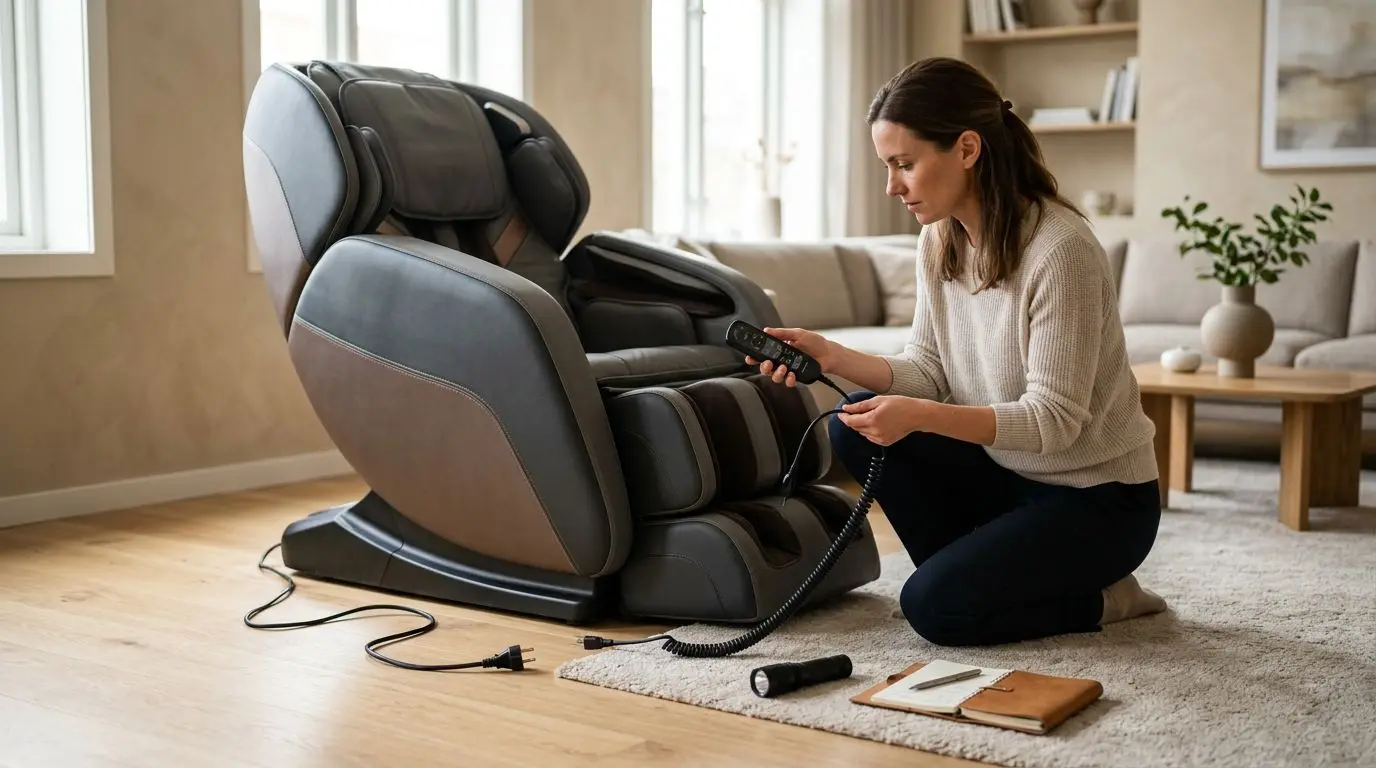
Massage Chair Not Working? Troubleshooting Power, Remote, Rollers, Heat, and Air Compression
13 min read