Disclosure: We may earn a commission when you buy through links on this page, at no extra cost to you. We buy nothing, sell nothing and accept no payment for coverage — commissions never decide what we recommend. How we make money.
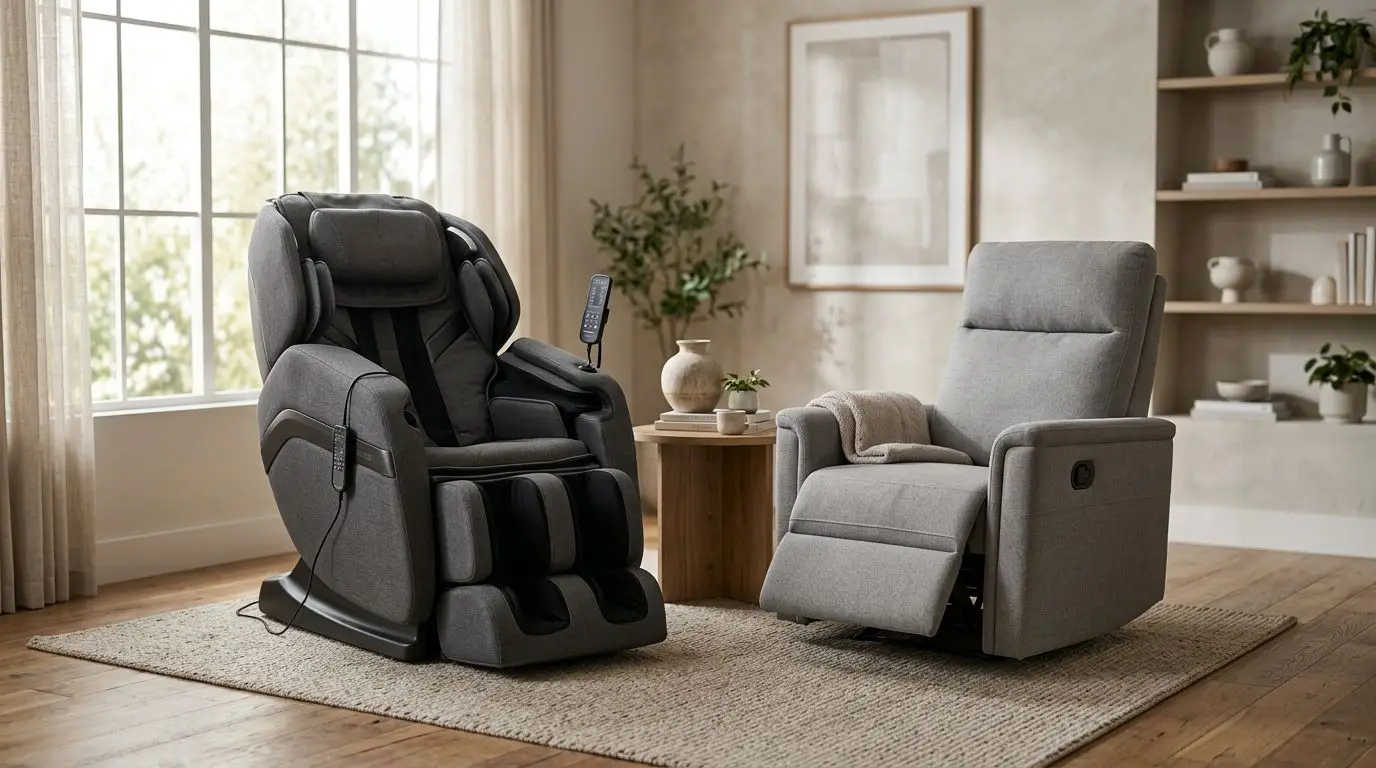
Electric massage chairs and manual massage recliners differ in how much work they do for you. An electric massage chair uses powered rollers, airbags, motors, and preset programs to deliver a more automated full-body experience. A manual massage recliner is mainly a reclining seat with simpler comfort features, such as vibration, heat, or a hand-operated footrest.
If you want deep adjustability, body scanning, and automated 15- to 30-minute sessions, an electric massage chair is the more capable option. If you mainly want a comfortable recliner with a light vibrating feel and fewer moving parts, a manual massage recliner can be the more practical choice.
The practical difference in 30 seconds
The simplest way to separate the two is this: electric massage chairs are built around a powered massage system, while manual massage recliners are built around the chair first. A powered chair usually has a roller track, multiple motors, a wired or wireless remote, and programs that run for a set time, often around 10, 15, 20, or 30 minutes. A manual recliner may have no massage at all, or it may include basic vibration zones that buzz rather than knead.
That difference shows up in daily use. With an electric chair, you can often choose upper back, lower back, legs, feet, air compression intensity, roller depth, or a preset routine. With a simpler recliner, you may pull a side lever, push back with your body weight, and turn on one or more vibration settings if the chair has them.
Neither category is automatically better. They solve different problems. One is closer to a purpose-built powered wellness appliance. The other is more like an everyday living room chair with added comfort features.
| Category | Electric massage chair | Manual massage recliner |
|---|---|---|
| Main purpose | Automated massage feel with powered movement | Comfortable reclining with light or limited massage |
| Typical session length | Often 10 to 30 minutes | User-controlled; vibration may run on a timer |
| Massage mechanism | Rollers, airbags, motors, sometimes foot rollers | Vibration pads, manual reclining, sometimes heat |
| Adjustability | Multiple modes, intensities, and body zones | Usually fewer settings |
| Power need | Requires an outlet | May be unpowered, or powered only for vibration/heat |
How each design works: rollers, tracks, vibration, and recline
Most electric massage chairs use a roller carriage that travels along a track inside the backrest. Track length varies by design. A shorter back-only path may be around 24 to 30 inches, while longer L-track or SL-track designs can extend toward the glutes and upper hamstrings, sometimes roughly 45 to 50 inches. The chair moves the rollers up and down the track while changing speed, width, rhythm, and pressure style.
Roller systems are commonly described as 2D, 3D, or 4D. A 2D system moves up and down and side to side. A 3D system adds in-and-out depth adjustment, which can make the contact feel stronger or softer. A 4D system usually adds more variation in rhythm or speed, though the exact meaning can vary by manufacturer. Since these terms are not standardized across the industry, it is smarter to test the actual feel than to buy by label alone.
Electric chairs may also include air cells in the shoulders, arms, calves, or feet. These inflate and deflate to create a squeezing and releasing sensation. Some models add foot rollers, calf kneading, powered leg extension, zero-gravity positioning, heat panels, Bluetooth speakers, or app controls. Not every chair includes all of these, and more features do not always mean better comfort.
Manual massage recliners are much simpler. Many use a pull handle, push-back recline mechanism, or manual footrest. If they include massage, it is often vibration from small motors placed in the back, seat, or leg area. Vibration can feel pleasant and gentle, but it is not the same as rollers that travel along the spine area and apply kneading pressure. Some manual recliners include heat, usually in the lumbar area, though coverage is often narrower than in larger powered chairs.
Feature comparison: 12 practical differences to know
Feature lists can get confusing because both categories may use words like reclining, heat, or massage. The details matter. A chair with 8 vibration motors will feel very different from one with a roller track and air compression, even if both are sold as massage seating.
| Feature | Electric massage chair | Manual massage recliner | Why it matters |
|---|---|---|---|
| Roller track | Common | Rare | Creates moving kneading contact instead of stationary vibration |
| Vibration | Sometimes included | Common on massage recliners | Light buzzing feel, usually less targeted |
| Air compression | Often in arms, calves, feet, or shoulders | Uncommon | Adds squeezing pressure in specific zones |
| Foot massage feel | May include rollers and air cells | Usually footrest only | Important if foot coverage is a priority |
| Recline type | Powered recline on most designs | Manual lever or push-back on many designs | Affects ease of use and setup |
| Preset programs | Often 5 or more | Few or none | Reduces the need to adjust settings each time |
| Body scanning | Available on many powered chairs | Not typical | Helps position rollers, but is not perfect |
| Heat | May cover back, calves, or feet | Usually limited if included | Check location, not just the word heat |
| Remote controls | Detailed remote or screen | Simple buttons or none | More control can also mean more learning |
| Weight and size | Often much heavier | Usually easier to move | Important for stairs, apartments, and delivery |
| Maintenance | More motors and electronics | Fewer complex parts | Can affect long-term ownership |
| Room style | Can look like specialty equipment | Often looks more like regular furniture | Matters in shared living spaces |
Comfort and intensity: what the experience feels like after 20 minutes
An electric massage chair usually feels more active. Rollers may press, knead, tap, roll, or move in patterns from the neck area down the back. Airbags may squeeze the calves or arms. In a 20-minute session, you might feel several types of contact without changing position. For people who like a defined, mechanical massage feel, that variety is the main appeal.
A manual massage recliner typically feels quieter and less targeted. The seat may be plush, the back may recline smoothly, and vibration may add a gentle buzz through the back or legs. Some people prefer that. Not everyone wants rollers pressing along the back, and a simpler recliner can be easier to use while reading, watching TV, or sitting with family.
Intensity control is a major separator. A powered chair may let you adjust roller depth, air pressure, speed, or body zone. In some chairs, adding a folded towel or chair pad can soften the roller feel, though you should not block vents or moving parts. A manual recliner usually depends more on cushion thickness, body position, and limited vibration settings.
Fit also changes comfort. Seat width often falls somewhere around 20 to 24 inches on many recliners and massage chairs, but dimensions vary widely. A narrow shoulder area, short seat depth, or fixed footrest angle can make a chair feel wrong even if the feature list looks strong. Always check the actual seat width, seat depth, back height, and user weight rating before buying.
Space, power, and delivery: measure at least 3 things first
Electric massage chairs usually need more planning. Many require a standard 120-volt household outlet, enough wall clearance to recline, and a delivery path wide enough for the chair. Some space-saving designs may need only a few inches behind the chair, while other recliners may need 12 inches or more. Measure the open reclined length, not just the upright footprint.
Weight is another practical issue. A full-size electric massage chair can be heavy enough that two adults should not casually carry it up a stairway without proper equipment. Manual recliners are often lighter and may separate into a back and base, but you still need to confirm carton size and assembled dimensions. Doorways around 30 to 36 inches wide can be a choke point depending on packaging and chair shape.
Floor surface matters, too. On hardwood, tile, or vinyl, use pads or a mat if the chair could shift or leave marks. On thick carpet, a heavy powered chair may be harder to move for cleaning. If you rent, live upstairs, or expect to rearrange the room often, simpler furniture may be less frustrating.
Noise is worth considering. Rollers, air pumps, and reclining motors are not silent. A powered chair may be perfectly acceptable in a den but distracting in a bedroom shared by a light sleeper. Vibration recliners can also hum, especially on hard floors.
Who it’s best for: 5 common buyer profiles
Choose an electric massage chair if you want a more automated experience. This is the better fit for someone who expects to use preset programs 3 or more times per week and wants coverage across the back, legs, arms, or feet. It also works better for a household where different users want different pressure levels and body zones.
Choose a manual massage recliner if you mainly want everyday seating. If the chair will be used for 2-hour TV sessions, reading, or napping, furniture comfort may matter more than massage features. A well-padded recliner with light vibration can be a better match than a large powered chair that feels too mechanical for regular sitting.
Choose electric if foot and calf features are a priority. Manual recliners usually have a footrest, not a dedicated foot massage system. Powered chairs may include foot rollers, air compression around the feet, or an extending leg rest. If your height is far above or below average, check the stated height range and leg extension measurement carefully.
Choose manual if you dislike complicated controls. Some electric chairs have remotes with 20 or more buttons, screens, menus, or app pairing. That can be useful, but it can also annoy users who only want to sit down and recline.
Choose based on the most sensitive user in the home. If one person finds strong roller pressure uncomfortable, a highly intense powered chair may go unused. If one person needs help operating a manual footrest, powered recline may be easier. The right choice is the one people will actually use.
How to choose and measure before you buy
Start with the room, not the feature list. Measure the floor space where the chair will sit, then mark the upright and reclined footprint with painter’s tape. Leave at least 24 inches of walking path where people need to pass, and check whether nearby tables, doors, curtains, or floor lamps will interfere with the recline path.
Next, measure the user. Compare height range, shoulder width, seat width, seat depth, and weight capacity. If a chair lists a maximum user weight, treat it as a firm limit. If multiple people will use it, choose for the largest and smallest regular users, not just the average person.
For electric chairs, ask these 7 questions:
- Does it use an S-track, L-track, SL-track, or another roller path?
- Can roller intensity be adjusted, or is it fixed?
- How many air compression zones are included?
- Can you turn off features you do not like, such as foot rollers?
- What is the shortest and longest auto program?
- How much wall clearance does it need when fully reclined?
- What are the delivery, assembly, return, and service terms?
For manual massage recliners, focus on these 6 points:
- Is the recline lever easy to reach from a seated position?
- Does the footrest close smoothly without a hard kick?
- Are the vibration zones in the back, seat, legs, or all 3?
- Is heat included, and where is it located?
- Can the back be removed for moving through doors?
- Does it feel supportive after sitting for at least 10 minutes?
If you can test a chair in person, sit in it longer than a quick showroom trial. Five minutes may tell you if a feature is impressive. Fifteen minutes tells you whether the seat angle, cushion firmness, and control layout still feel comfortable.
Ownership factors: service, controls, and long-term use
Powered massage chairs have more parts: motors, wiring, control boards, roller assemblies, airbags, pumps, remotes, and sensors. That does not mean they are unreliable, but service access matters. Before buying, read the warranty documents and look for separate terms for parts, labor, frame, electronics, and in-home service. A warranty may be 1 year, 3 years, 5 years, or another term depending on the seller, so do not assume coverage from a short product summary.
Manual massage recliners tend to have fewer complex systems. If they use vibration or heat, they still have electrical parts, but the core chair function may remain usable even if a massage feature stops working. Upholstery quality, frame construction, reclining hardware, and cushion support are often the bigger long-term questions.
Controls deserve more attention than they usually get. A large powered chair with a menu-based remote can be excellent for a tech-comfortable user and frustrating for someone who wants one-button operation. Manual recliners can have the opposite issue: easy to understand, but harder to fine-tune.
Cleaning is also different. Electric chairs often have shaped leg wells, arm slots, seams, and moving panels that collect dust or pet hair. Manual recliners usually clean more like regular furniture. For either type, follow the upholstery care label and avoid soaking electrical areas.
Safety and fit cautions: ask a physician in these 8 situations
A massage chair is a consumer wellness product, not a medical device. It is designed to create pressure, movement, vibration, warmth, and comfort sensations. It should not be used as a substitute for professional medical advice, and you should not rely on it to address a health condition.
Ask your physician before using an electric massage chair or massage recliner if you are pregnant; have a pacemaker or other implanted cardiac device; have a history of blood clots or take anticoagulant medication; have osteoporosis; recently had a fracture or surgery; have spinal disc problems; have neuropathy or reduced sensation; or have uncontrolled hypertension. These cautions are especially important with strong rollers, air compression, heat, or long sessions.
Stop using the chair if a setting feels painful, causes numbness, or makes you feel unsteady when standing. Use shorter sessions at first, such as 5 to 10 minutes, and choose the lowest intensity until you know how the chair feels. Keep children away from moving leg rests, roller mechanisms, and powered recline parts unless supervised.
FAQ: 5 quick answers before you decide
Is an electric massage chair always better than a manual massage recliner?
No. It is better if you want powered rollers, preset programs, and more body-zone control. A manual recliner may be better if you want a comfortable everyday chair with simple vibration or no electronics.
Do manual massage recliners need electricity?
Some do and some do not. A purely manual recliner can operate without power, but a recliner with vibration, heat, USB ports, or powered lift features will need electricity.
What is the biggest difference in massage feel?
Electric massage chairs often use moving rollers and air compression, so the feel is more targeted and active. Manual massage recliners usually use stationary vibration motors, which feel gentler and less specific.
How much space should I leave behind the chair?
Check the exact reclined clearance. Some space-saving electric chairs need only a few inches behind them, while other recliners may need around 12 inches or more. Measure the full reclined length before you buy.
Which type is easier to maintain?
Manual recliners are usually simpler because they have fewer powered parts. Electric massage chairs can offer more features, but you should review warranty coverage, service options, and how easy the chair is to clean.
Bottom line: Choose an electric massage chair when you want a purpose-built powered experience with rollers, programs, and adjustable zones. Choose a manual massage recliner when seating comfort, simplicity, lower complexity, and a furniture-like look matter more than advanced massage features.
Frequently asked questions
Is an electric massage chair always better than a manual massage recliner? +
No. An electric massage chair is better if you want powered rollers, preset programs, and more body-zone control. A manual recliner may be better if you want a comfortable everyday chair with simple vibration or fewer electronics.
Do manual massage recliners need electricity? +
Some do and some do not. A purely manual recliner can operate without power, but a recliner with vibration, heat, USB ports, or powered lift features will need electricity.
What is the biggest difference in massage feel? +
Electric massage chairs often use moving rollers and air compression, so the feel is more targeted and active. Manual massage recliners usually use stationary vibration motors, which feel gentler and less specific.
How much space should I leave behind a massage chair or recliner? +
Check the exact reclined clearance for the chair you are considering. Some space-saving electric chairs need only a few inches behind them, while other recliners may need around 12 inches or more.
Which type is easier to maintain? +
Manual recliners are usually simpler because they have fewer powered parts. Electric massage chairs can offer more features, but you should review warranty coverage, service options, and cleaning access before buying.
Related guides
Massage Chair Recliner vs. Standard Recliner: Which Is Better for Everyday Comfort?
15 min read
Office Massage Chairs vs. Home Massage Chairs: Key Differences Before You Buy
13 min read
How to Choose a Massage Chair for Home Use
14 min read
Best Massage Chair Features to Look For Before You Buy
13 min read
Is a Massage Chair Worth It? Benefits, Limitations, and Who Should Buy One
13 min read