Disclosure: We may earn a commission when you buy through links on this page, at no extra cost to you. We buy nothing, sell nothing and accept no payment for coverage — commissions never decide what we recommend. How we make money.
To choose a massage chair for home use, begin with fit, space, and the kind of massage you actually like. A good chair should suit your height and body shape, fit through your doors, leave enough room to recline, and have controls you can use several times a week without frustration.
Then compare track design, roller style, air compression, heat, foot massage, noise level, and warranty terms. The best choice is not the chair with the longest feature list; it is the one that feels comfortable, fits your room, and stays easy to live with for 5 to 10 years.
Start with fit: height range, shoulder width, and 250-plus lb capacity
Fit matters more than almost any menu feature. Many home massage chairs are built around an adult height range of roughly 5 feet to 6 feet 2 inches, while larger chairs may fit users closer to 6 feet 5 inches. Weight capacity commonly falls somewhere around 250 to 300 lb, though some heavy-duty designs support more. Always check the stated limits before comparing programs.
The main fit points are shoulder position, back length, hip width, and leg extension. If the rollers land too high, the chair may miss the upper back. If they land too low, the neck massage can feel awkward or nonexistent. Automatic body scanning can help, but it is not magic; it works best when the chair is close to your size from the start.
Seat width is easy to miss. A snug seat can make air compression feel too intense, especially around the hips and thighs. If two people at home will use the chair, choose for the larger user first, then confirm that the smaller user can still sit with the back and shoulders in the right place.
Who it is best for
- Average-height users: Most full-size chairs will likely work if the shoulder rollers align well.
- Taller users over 6 feet: Look closely at back track length, leg rest extension, and head pillow position.
- Shorter users under 5 feet 3 inches: Prioritize adjustable shoulder position, removable pillows, and footrests that do not overextend the legs.
- Broader users: Confirm seat width and hip airbag space, not only the listed weight limit.
Measure your room, doorway, and reclining clearance before you shop
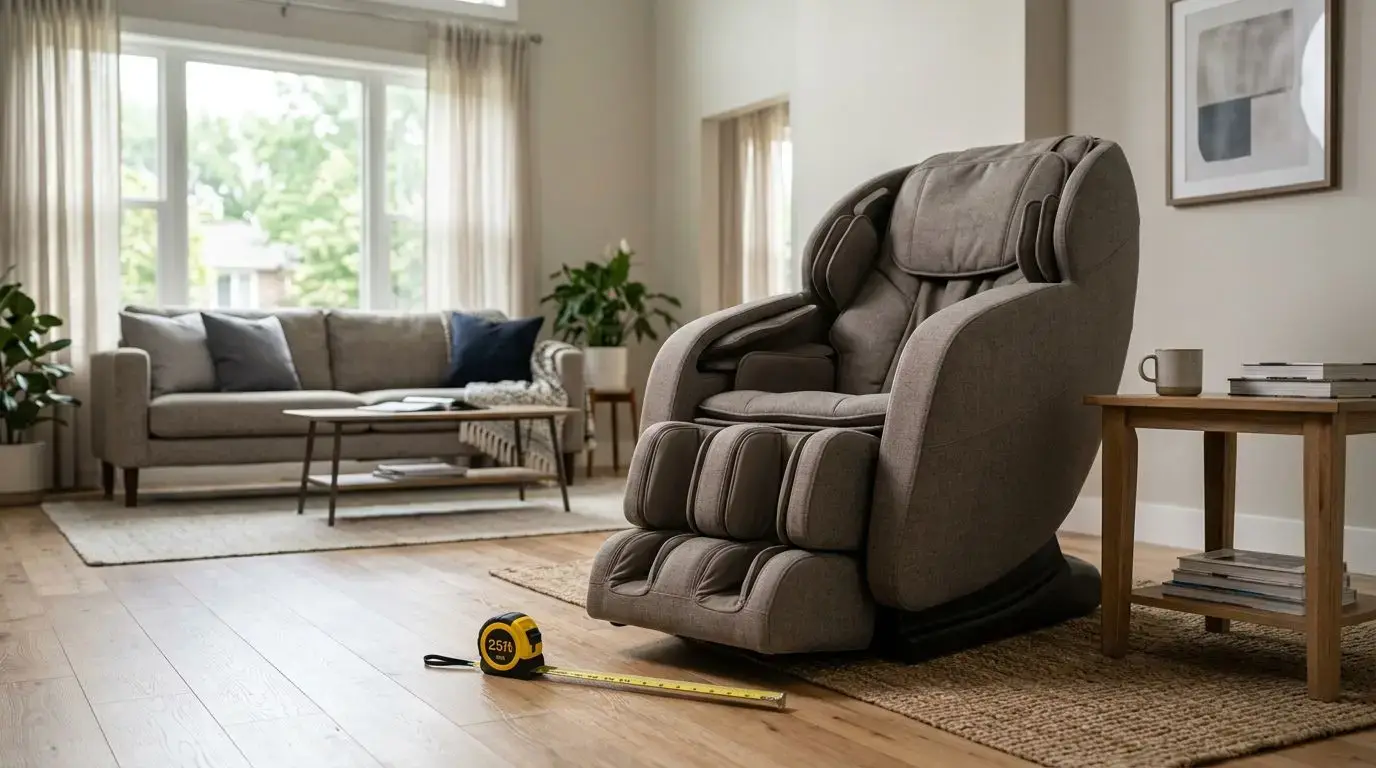
A massage chair is a large piece of powered furniture. Many full-size chairs are about 28 to 35 inches wide, 45 to 65 inches long depending on recline position, and 40 to 50 inches tall. Some weigh well over 150 lb. Before you get attached to a feature list, measure the path from the delivery point to the final location.
Measure doorways, hallway turns, stair landings, and elevator openings. A 30-inch doorway may not be enough if the chair cannot be turned at the right angle, especially with packaging included. Some chairs have removable side panels or arrive partially assembled, but do not assume that without confirming the shipping and setup requirements.
Recline clearance is the next issue. Traditional reclining chairs may need 12 to 24 inches behind them. Space-saving designs may need only about 2 to 6 inches from the wall because they slide forward as they recline. That difference can decide whether a chair works in a bedroom, den, apartment living room, or home office.
How to measure in 10 minutes
- Measure the final floor area with the chair upright and reclined.
- Leave at least 24 to 30 inches in front if the footrest extends outward.
- Check for outlets within reach without stretching a cord across a walkway.
- Use painter's tape on the floor to mark the approximate footprint.
- Sit in a regular chair inside that taped area to see whether the location feels natural.
If you plan to place the chair on carpet, tile, or wood flooring, think about weight distribution as well. A protective mat can help reduce indentations and make small position adjustments easier.
Compare track types: S-track, L-track, and SL-track in 30 seconds
The track is the rail system that guides the back rollers. It determines how far the rollers travel and which body areas receive mechanical kneading or rolling. Most home chairs use some version of an S-track, L-track, or SL-track design.
| Track type | Typical roller path | Best for | Trade-off |
|---|---|---|---|
| S-track | Follows the curve of the spine, often from neck to lower back | Users who want focused back and neck massage | Usually does not roll under the glutes or hamstrings |
| L-track | Extends from the back down under the seat | Users who want glute and upper hamstring coverage | May feel less contoured in the upper back on some designs |
| SL-track | Combines spinal contouring with an extended seat path | Households that want broader coverage | Often found in larger or more feature-heavy chairs |
An S-track can be a good choice if your main goal is back relief after desk work. An L-track or SL-track is usually more appealing if you want the massage to continue through the seat area. A longer track is not automatically better, though. Roller quality, pressure control, and how the chair fits your body still matter.
If you often feel tightness in the glutes or hips, an extended track is worth considering. If neck and shoulder work is your priority, pay attention to how high the rollers reach and whether the head pillow can be adjusted or removed.
Choose massage intensity: 2D, 3D, and 4D rollers explained
Roller technology affects how the massage feels. A basic 2D system moves rollers up, down, side to side, and along the track. A 3D system adds depth adjustment, so the rollers can press more or less firmly into the back. A 4D system usually adds speed variation or rhythm changes on top of depth control.
For many US shoppers, a well-designed 2D chair is enough for light to moderate daily use. If you like deep tissue work or have a muscular build, 3D depth control can be valuable because it lets you reduce intensity on sensitive days and increase it when you want stronger pressure. Some users find high-intensity rollers uncomfortable, so extra power only helps when it is adjustable.
| Roller type | What changes | Good match | Watch for |
|---|---|---|---|
| 2D | Position and pattern | Light to moderate massage | Limited depth control |
| 3D | Adds in-and-out pressure adjustment | Users who want firmer or softer sessions | Can feel intense if set too high |
| 4D | Adds more rhythm or speed variation | Users who like a more hand-like feel | Feature names vary by manufacturer |
Do not choose by the label alone. Find out how many intensity levels are available, whether different body zones can be adjusted separately, and whether there is a quick way to soften the massage during a session. A 15-minute session should feel helpful, not like something you have to endure.
Match the chair to your massage style: 5 common techniques
Most massage chairs combine several techniques in automatic programs. Common options include kneading, tapping, knocking, rolling, and shiatsu-style point work. Names can vary, but the goal is similar: create pressure, movement, and rhythm along the back and sometimes through the legs and feet.
Kneading is usually the most familiar all-purpose style. It uses circular or alternating roller movements that can feel good across the shoulders and mid-back. Tapping uses quick percussive movements and may feel energizing, while rolling travels up and down the back in a smoother motion. Shiatsu-style programs often pause on specific points and can feel more intense.
Think about when you will use the chair. A gentle rolling program may be better at night while watching TV. A more active tapping or kneading program may feel better after yard work, commuting, or standing for several hours. If two or more people will use the chair, look for manual controls as well as automatic programs so each person can adjust zone, intensity, and technique.
- For desk workers: Neck, shoulder, and upper-back programs are usually more important than calf airbags.
- For people on their feet: Foot rollers, calf compression, and recline comfort may matter more.
- For relaxation: Gentle full-body programs, heat, and quiet operation are worth prioritizing.
- For deep pressure fans: 3D depth adjustment and strong manual zone control are key features.
Decide which features are worth paying for, from heat to zero gravity
Feature lists can get long quickly. The trick is to separate daily-use features from nice-to-have extras. A chair you use 4 nights a week should make the basics easy: sit down, choose a program, adjust pressure, recline, and stop quickly if needed.
| Feature | What it does | Worth prioritizing if | Practical note |
|---|---|---|---|
| Heat | Warms the back, seat, legs, or feet | You like gentle warmth during 10 to 20 minute sessions | Often mild, not like a heating pad on high |
| Zero gravity recline | Elevates legs and reclines the torso | You want a more weightless, relaxed position | Check whether the angle feels comfortable getting in and out |
| Air compression | Inflates airbags around arms, calves, feet, or hips | You enjoy squeezing pressure and full-body contact | Can feel tight for broader users |
| Foot rollers | Roll or press under the soles | You stand, walk, or work on hard floors | Intensity can be strong; removable liners help |
| Body scanning | Estimates shoulder position and back shape | Multiple users share the chair | Still needs a good overall fit |
| Memory settings | Saves preferred adjustments | Two or more users have different preferences | Not all chairs save every setting |
Zero gravity is popular because it changes how body weight rests against the rollers. It may make pressure feel stronger in the back while reducing the sense that you are sitting upright. That can be relaxing, but it is not ideal for everyone. If you dislike being reclined far back, make sure the chair also works well in a less reclined position.
Heat is another feature that sounds simple but varies widely. Some chairs warm only the lower back; others include calf or foot heat. Look for clear information on heat locations and whether heat can be turned on without running an intense massage program.
Check comfort, controls, and noise during a 15-minute session
A massage chair is not just a machine. It is a seat you need to enjoy using. If possible, evaluate comfort for at least 15 minutes, because pressure points and awkward angles may not appear in the first 2 minutes. Pay attention to the headrest, lumbar support, arm position, seat padding, and how easy it is to shift your body.
Controls should be obvious. A large remote, clear screen, or simple side control can make the chair more pleasant for daily use. If the chair depends on an app or voice command, confirm that core functions still work without extra steps. You should be able to stop the massage, reduce intensity, and return upright quickly.
Noise matters in real homes. Rollers, air pumps, and foot mechanisms all create sound. A quiet hum may be fine in a living room; loud mechanical clacking can become annoying if someone nearby is watching TV, working, or sleeping. If you live in an apartment, also consider vibration through floors, especially during tapping programs.
Look at entry and exit, too. Some chairs have high side panels, deep seats, or extended foot wells that make standing up harder. If anyone in the household has limited mobility, prioritize a stable upright position, simple recline control, and armrests that are easy to use for support.
Plan for long-term ownership: cleaning, power, warranty, and service
A good home massage chair should be easy to maintain over years, not weeks. Synthetic upholstery is common and usually wipes clean with a soft cloth, but seams, foot wells, and arm pockets collect dust and body oils. Removable or washable foot liners are practical if several people will use the chair.
Check the power setup before delivery. Most chairs use a standard household outlet, but the cord should not run under rugs or across a walking path. Leave access to the plug so the chair can be disconnected if needed. If the chair has a battery backup for returning upright during power loss, understand what it does and what it does not do.
Warranty terms are worth reading closely. Look separately at parts, labor, frame, electronics, and in-home service. A warranty that covers parts for several years may still require you to pay labor or shipping after an initial period. Because massage chairs are heavy, service logistics can matter as much as the written coverage.
Think about future usability. Will you still like the style in 3 years? Can the upholstery color work in a different room if you move it? Is the chair too heavy to relocate without help? These questions are not glamorous, but they often determine whether the chair becomes a daily habit or an expensive obstacle.
A simple 7-step buying checklist for US homes
Use this checklist before you commit. It takes about 30 minutes and can prevent the most common buying mistakes.
- Measure the user: Note height, approximate shoulder width, and any fit concerns such as long legs or broad hips.
- Measure the home: Check doorway width, hallway turns, stairs, elevator access, and the final room footprint.
- Pick the track: Choose S-track for focused back massage, L-track or SL-track for extended seat coverage.
- Choose intensity: Decide whether 2D is enough or whether adjustable 3D depth is worth it.
- Rank features: Choose your top 3, such as heat, foot rollers, zero gravity, or memory settings.
- Test comfort: Sit for 15 minutes if possible, using the type of program you expect to use most.
- Read service terms: Confirm delivery, assembly, return window, warranty coverage, and who handles repairs.
If you cannot test the chair in person, be more conservative. Look for clear dimensions, a realistic return policy, detailed warranty language, and user controls that match your comfort level. Avoid buying only because a chair has the longest list of automatic programs. Ten programs you enjoy are better than 30 you never use.
Safety and wellness expectations: use 10 to 20 minutes at a time
Massage chairs are designed for relaxation, comfort, and general wellness, not for diagnosing or treating medical conditions. Many people enjoy them for easing everyday muscle tension or unwinding after work, but claims about curing pain, improving circulation, or treating injuries should be viewed carefully unless supported by qualified medical guidance.
Start with shorter sessions, often 10 to 15 minutes, especially if you are new to mechanical massage. Increase time only if your body responds well. Strong foot rollers, deep back pressure, or tight air compression can leave some users sore when overused.
Ask a healthcare professional before using a massage chair if you are pregnant, have a pacemaker or implanted medical device, recently had surgery, have a blood clot risk, significant osteoporosis, severe neuropathy, uncontrolled high blood pressure, or an acute injury. When in doubt, choose lighter settings and avoid direct pressure on sensitive areas.
The right chair should make regular use easy and comfortable. Choose the chair that fits your body, your room, your preferred massage feel, and your tolerance for maintenance. That practical match is what separates a smart home purchase from a feature-heavy chair that sits unused.
FAQ: choosing a home massage chair
What size massage chair do I need?
Match the chair to the tallest and broadest regular user first. Check stated height range, weight capacity, seat width, shoulder fit, and leg rest extension. Many full-size chairs are roughly 28 to 35 inches wide, so confirm room and doorway clearance too.
Is an L-track better than an S-track?
Not always. An L-track extends the roller path under the seat, which is helpful if you want glute and upper hamstring coverage. An S-track can still be excellent for neck, shoulder, and back work if it fits your body well.
How much space should I leave behind a massage chair?
Traditional recliners may need 12 to 24 inches behind the chair, while space-saving designs may need about 2 to 6 inches. Always check the reclined dimensions, not just the upright footprint.
Are 3D rollers worth it?
They can be worth it if you want adjustable pressure. A 3D system lets the rollers press more or less deeply, which is useful for households with different intensity preferences. If you only want gentle massage, a good 2D chair may be enough.
How long should I use a massage chair per session?
Many users do best with 10 to 20 minutes at a time. Start at the lower end, especially with deep pressure or strong foot rollers, and stop if you feel pain, numbness, dizziness, or unusual discomfort.
Frequently asked questions
What size massage chair do I need? +
Choose based on the tallest and broadest regular user. Check the stated height range, weight capacity, seat width, shoulder position, and leg rest extension, then confirm the chair fits through your doorways and into the room.
Is an L-track better than an S-track? +
An L-track is better if you want roller coverage under the seat for the glutes and upper hamstrings. An S-track can be better for focused neck, shoulder, and back massage when it fits your body well.
How much room does a massage chair need? +
Many full-size chairs are about 28 to 35 inches wide and can be much longer when reclined. Traditional recliners may need 12 to 24 inches behind them, while space-saving designs may need about 2 to 6 inches.
Are 3D or 4D rollers worth it for home use? +
They are worth considering if you want stronger pressure control or a more varied massage feel. For light relaxation, a well-designed 2D chair may be enough; for deep pressure, adjustable 3D depth is usually more useful.
How long should a massage chair session be? +
Start with 10 to 15 minutes and increase only if it feels comfortable. Many people use 10 to 20 minute sessions. Stop if you feel pain, numbness, dizziness, or unusual discomfort.
Related guides
Is a Massage Chair Worth It? Benefits, Limitations, and Who Should Buy One
13 min read
Best Massage Chair Features to Look For Before You Buy
13 min read
Massage Chair vs. Professional Massage: Which Is Better for Your Routine and Budget?
10 min read
How to Compare Massage Chair Features: 2D, 3D, 4D, L-Track, SL-Track, Heat, and Airbags
13 min read
Office Massage Chairs vs. Home Massage Chairs: Key Differences Before You Buy
13 min read