Disclosure: We may earn a commission when you buy through links on this page, at no extra cost to you. We buy nothing, sell nothing and accept no payment for coverage — commissions never decide what we recommend. How we make money.
If your massage chair feels too strong, lower the roller depth, reduce air pressure, slow the program, add a thin pad, and shorten the session to about 10 minutes. If it feels too light, remove extra padding, sit farther back, choose a slower kneading or tapping pattern, and raise roller depth one level at a time. The goal is steady, comfortable pressure, not the strongest setting the chair can deliver.
Intensity is not a single setting. It comes from several parts working together: roller protrusion, roller speed, airbag squeeze, body position, recline angle, footrest fit, and the thickness of clothing or padding between you and the chair. Small changes matter. A one-level roller adjustment or a 1-inch cushion can be the difference between useful pressure and an uncomfortable session.
Start with a 10-minute, low-intensity baseline
The safest way to adjust intensity is to start below your comfort limit. Choose a gentle full-back or manual kneading program, set air pressure to low, keep roller depth on the lowest available setting, and run the chair for 10 minutes. Do not begin with the longest auto program or deepest roller mode, even if you are used to firm hands-on bodywork.
During that first session, notice three things: pressure, coverage, and after-feel. Pressure should feel firm but not sharp. Coverage should follow broad areas of your back, hips, calves, or feet without digging into one small point. After-feel should be neutral or pleasantly worked, not tender enough to make you avoid the chair the next day.
A simple 1-to-10 comfort scale helps. Aim for a 5 or 6 out of 10 during the first few sessions. If you reach 7 or higher, reduce one control right away. If you feel pinching, numbness, tingling, dizziness, or sharp discomfort, stop the session instead of trying to push through it.
Many chairs default to 15-, 20-, or 30-minute programs. That does not mean every user should start there. A shorter test session gives you useful feedback without overdoing the pressure in one area.
Use the 5 main controls that change intensity
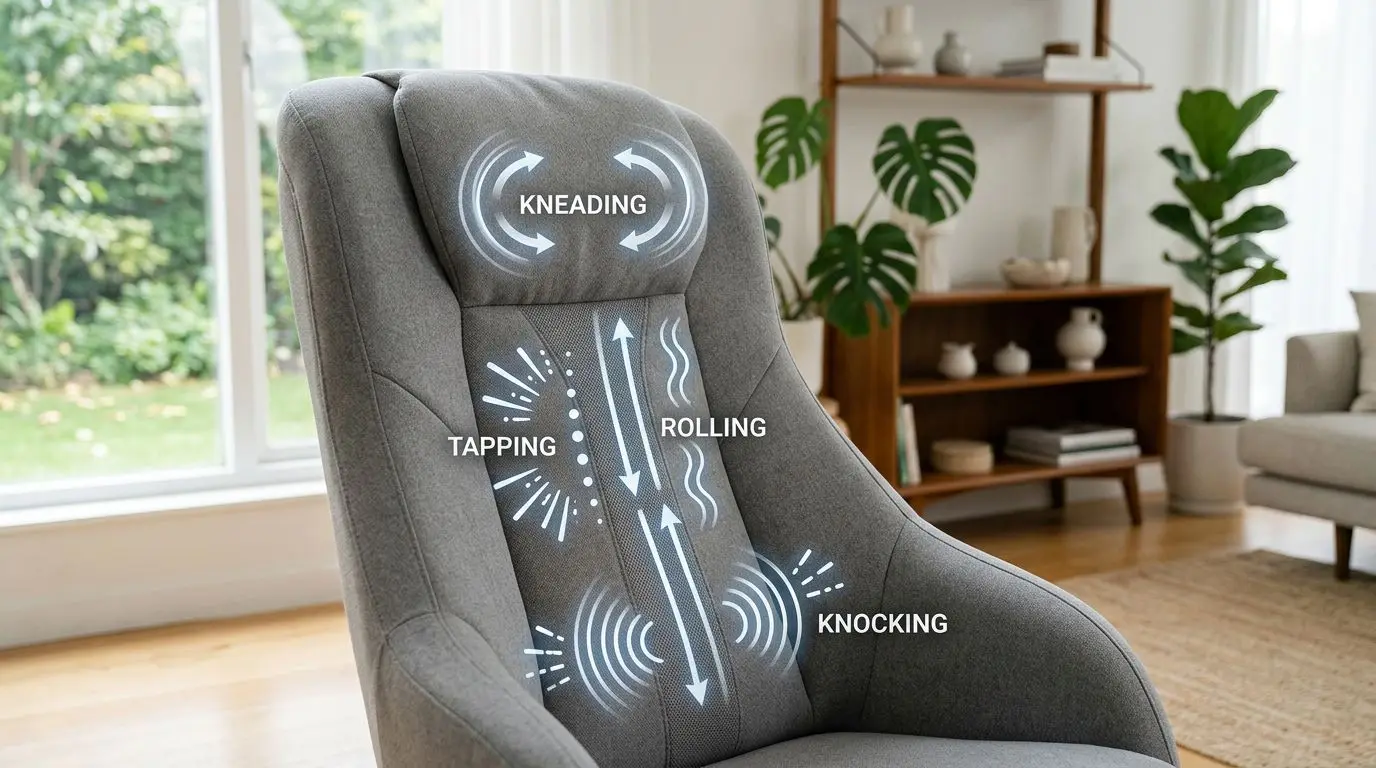
Most users think of massage chair intensity as one plus or minus button. In practice, at least 5 controls can change how strong the chair feels: roller depth, roller speed, air pressure, program style, and recline angle. Some chairs also let you adjust roller width, heat level, calf position, foot roller speed, and body scan targeting.
| Control | What it changes | Turn it down if... | Turn it up if... |
|---|---|---|---|
| Roller depth | How far the rollers press toward your body | Pressure feels pokey or too direct | Rollers feel like they are barely touching |
| Roller speed | How quickly kneading, tapping, or rolling moves | Fast motion feels jarring | Slow movement feels dull or inactive |
| Air pressure | How tightly airbags compress arms, legs, shoulders, or hips | Squeeze feels restrictive | Airbags feel loose or do not hold you in place |
| Program style | The pattern of rolling, kneading, tapping, or combined motions | Combination modes feel chaotic | A basic rolling mode feels too plain |
| Recline angle | How much body weight rests on the rollers | Deep recline feels too intense | Upright position feels too light |
Roller depth is usually the biggest factor on chairs with adjustable 3D or 4D roller systems. Air pressure is often the strongest factor in the shoulders, arms, calves, and feet. Recline angle is easy to overlook: the farther back you recline, the more body weight settles into the chair, making the same roller setting feel stronger.
Change only 1 setting at a time. If you raise roller depth, leave speed and air pressure alone for that session. If you also recline farther and choose a more vigorous program, you will not know which change caused the stronger feel.
Match intensity to your body size in inches and pounds
Fit affects intensity. A chair that fits a 6-foot-2 user well may position its rollers too high or too low for a 5-foot-2 user. A footrest that is 2 inches too short can push the knees upward and change how the lower back rests against the chair. Body weight also affects how deeply a person settles into the backrest, seat, and calf wells.
Before fine-tuning intensity, measure yourself and compare those numbers with the chair specifications. Start with your height, seated shoulder height, hip-to-knee length, and foot size. If the chair has an extending footrest, note the extension range in inches. If it has a shoulder scan, check whether the rollers land near the top of your shoulders rather than above your neck or below your upper back.
How to measure for better intensity control
- Standing height: Compare your height with the chair's stated user range, such as a typical range around 5 feet to 6 feet 2 inches, if listed.
- Seated shoulder height: Sit against a wall and measure from the seat surface to the top of your shoulders. This helps you judge whether the scan is finding the right shoulder point.
- Hip-to-knee length: Measure from the back of your hips to the front of your knee while seated. This affects how your legs sit in the chair.
- Calf and foot position: Your heels should sit naturally in the foot wells, not jammed forward or floating 1 to 2 inches short.
- Available room: Some chairs need only a few inches of rear clearance, while others need more. If the chair cannot recline fully, intensity may feel different than intended.
If the rollers miss your shoulders after the body scan, use the manual shoulder-position buttons if available. Moving the scan point by even 1 inch can make a neck-and-shoulder program feel more accurate and less intrusive.
Add or remove 1 to 2 inches of padding
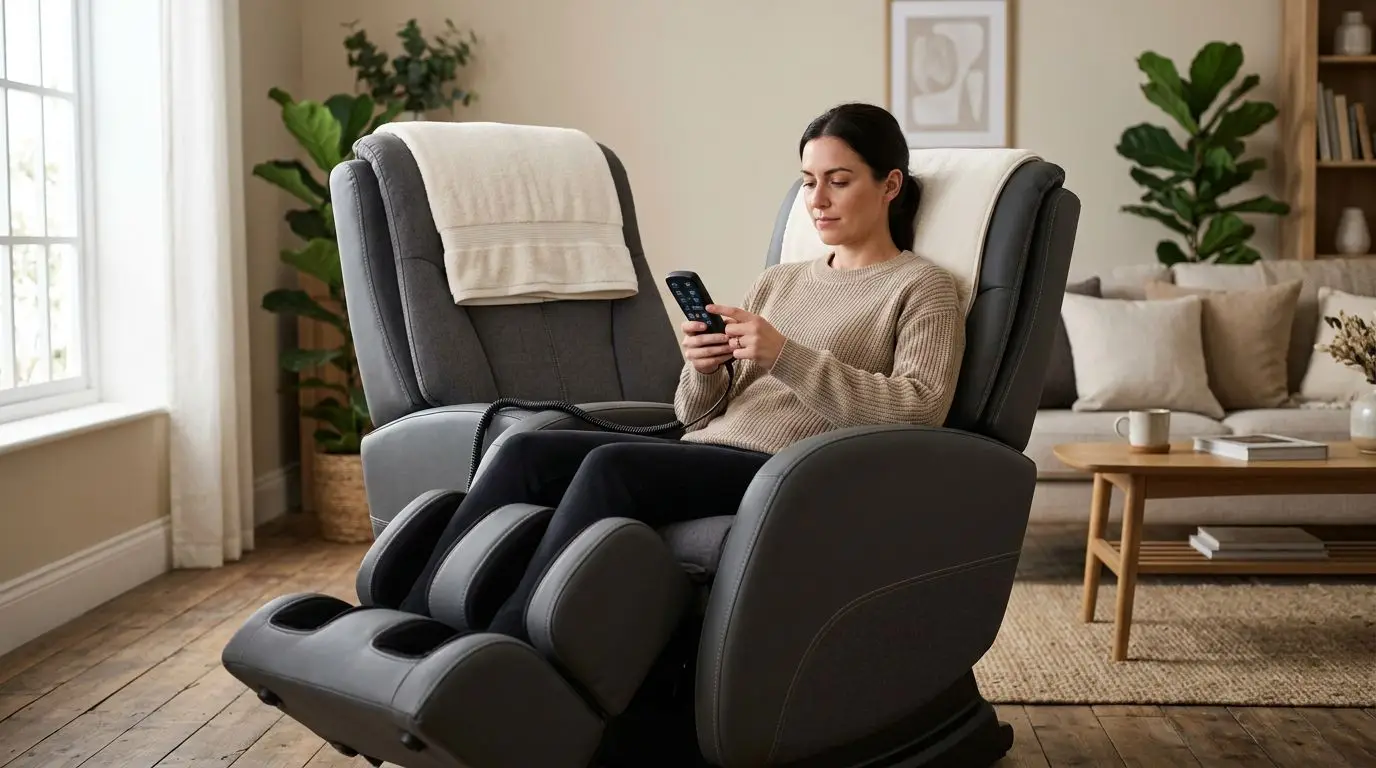
Padding is the simplest intensity tool. A folded towel, thin blanket, or removable back pad can reduce direct roller pressure without changing the whole program. Start with about 1 inch of padding over the area that feels too strong. If that is not enough, add a second thin layer rather than jumping to a thick cushion that blocks the rollers completely.
Use padding strategically. If the upper back feels too strong but the lower back feels right, place the towel only from shoulder blade level to mid-back. If the foot rollers feel too aggressive, wear thicker socks or place a thin towel under the soles if the chair design allows it without bunching. Do not use loose padding that can slide into moving parts.
To make a light-feeling chair stronger, first remove unnecessary padding. Many chairs include a removable back cushion, neck pillow, or lumbar pad. These are comfort parts, not permanent requirements. Removing one layer can give the rollers more contact, especially on 2D chairs where depth is not adjustable.
Clothing matters, too. A heavy sweatshirt can reduce roller feel across the back, while thin athletic fabric allows more direct pressure. If you are comparing settings, wear similar clothing each time so your results stay consistent.
Compare 2D, 3D, 4D, S-track, and L-track feel
Chair design sets the ceiling for intensity. A 2D roller system usually moves up and down and side to side, but it does not push outward as much as a 3D system. A 3D system can typically adjust roller protrusion, while 4D adds more variation in rhythm or speed depending on the chair. Track shape also matters: an S-track follows the curve of the back, while an L-track continues under the seat toward the glute area.
| Type or feature | Typical feel | Best adjustment strategy | Watch out for |
|---|---|---|---|
| 2D rollers | Moderate, surface-level contact | Use recline angle, padding, and program choice | May feel too light for users who want deep pressure |
| 3D rollers | More direct pressure because rollers can move in and out | Raise or lower depth 1 level at a time | High depth may feel sharp on bony areas |
| 4D rollers | Variable rhythm and depth, often more dynamic | Start with the slowest or gentlest mode | Complex programs can feel too busy |
| S-track | Focused back coverage from neck to lower back | Confirm the shoulder scan lands correctly | Less seat-area coverage than an L-track |
| L-track | Back plus under-seat coverage | Use padding if seat rollers feel too direct | May be intense near the hips for some users |
| Airbag compression | Squeezing hold on limbs, shoulders, hips, or calves | Set pressure low first, then increase 1 step | Can feel restrictive if set too high |
| Foot rollers | Localized pressure under the soles | Use socks, speed settings, or a short duration | Often feels stronger than expected |
Design also affects how easily you can solve a problem. If a chair feels too strong and has adjustable 3D depth, the fix may be simple. If a 2D chair feels too strong in one spot, you may need padding, better positioning, or a different program because roller protrusion may not be adjustable.
Choose programs by speed, not just by name: 15 minutes is enough
Auto program names can be vague. A program labeled for relaxation, recovery, stretch, or deep pressure may not mean the same thing from one chair to another, and some of those terms are marketing language. Judge the program by what it does: slow kneading, fast tapping, rolling, air compression, stretching movement, foot rollers, or a combination.
For many users, 15 minutes is a practical upper limit while learning the chair. A short manual mode can be even better because it isolates one motion. Try 5 minutes of rolling, 5 minutes of kneading, and 5 minutes of air compression on separate sessions. Once you know which motion feels best, build from there.
- Too strong: Choose rolling or gentle kneading, reduce depth, reduce air pressure, and sit more upright.
- Too light: Try slower kneading, increase depth 1 level, remove padding, and recline slightly farther.
- Too jumpy: Lower tapping speed or avoid programs that combine tapping and kneading at high speed.
- Too much squeeze: Turn arm, shoulder, calf, or hip airbags down separately if the controls allow it.
- Too focused in one spot: Use a wider roller setting or a moving program instead of a fixed-point mode.
Heat can change perception as well. Many chairs use gentle warming elements in the back, calves, or feet. Heat does not make rollers physically deeper, but it can make a session feel more comfortable for some users. Keep expectations realistic: chair heat is usually mild and localized, not the same as a dedicated heating pad.
Who it is best for: 3 common intensity profiles
Not everyone should use the same settings. A 120-pound user with a narrow frame may experience the same roller depth very differently than a 220-pound user with a broader back. Someone who likes firm pressure in the shoulders may still want very low air pressure around the calves or arms.
| User profile | Likely preference | Best starting setup | Adjustment tip |
|---|---|---|---|
| Pressure-sensitive user | Light contact, slower motion | 10 minutes, low depth, low air, upright recline | Add 1 inch of padding before changing programs |
| User who finds chairs too light | More direct roller contact | Low air, medium depth, slower kneading, moderate recline | Remove back pads and increase depth 1 level at a time |
| Mixed-preference household | Different settings for each person | Use manual controls and memory settings if available | Write down each person's preferred depth, air, and recline angle |
A shared chair needs shared rules. If two or three people use the same chair, do not leave the deepest settings as the default. Reset to a mild program after each use, especially if guests, older adults, or first-time users may sit down next.
For users who enjoy strong pressure, the key is control rather than maximum output. Strong can still be comfortable when it is broad, slow, and adjustable. The problem is usually not firmness by itself; it is pressure that is too narrow, too fast, too long, or aimed at the wrong body point.
Build a 7-day adjustment plan
A one-week plan helps you find your settings without guessing. Keep notes on session length, depth level, air pressure, recline, program, padding, and comfort score. You do not need a complicated spreadsheet; a phone note with 7 lines is enough.
- Day 1: 10 minutes, lowest roller depth, lowest air pressure, upright or slightly reclined.
- Day 2: Repeat Day 1. If it felt too light, remove one pad or recline a little farther.
- Day 3: Increase roller depth by 1 level only if Days 1 and 2 felt comfortable.
- Day 4: Test air pressure 1 level higher on calves or arms, not all zones at once.
- Day 5: Try a different slow program for 10 to 15 minutes.
- Day 6: Adjust roller width or shoulder position if the chair offers those controls.
- Day 7: Save or write down the best combination, then use that as your normal setting.
If your comfort score drops after a change, return to the previous setup. That is not a failure. It is exactly how tuning should work. The best setting is the one you can use consistently and comfortably, not the one with the highest numbers on the remote.
Safety checks before a 15- to 30-minute session
Massage chairs are consumer wellness products, not medical devices. They are designed to provide mechanical pressure, rolling, kneading, air compression, vibration, stretching movement, and warmth. They are not meant to diagnose, treat, cure, prevent, or manage any health condition.
Ask your physician before using a massage chair if you are pregnant or if you have a pacemaker or other implanted cardiac device, a history of blood clots, use anticoagulant medication, have osteoporosis, have had a recent fracture or surgery, have spinal disc problems, neuropathy, or uncontrolled hypertension. Also ask a clinician if you are unsure whether compression, recline, heat, or mechanical pressure is appropriate for you.
Stop immediately if you feel sharp discomfort, unusual numbness, tingling, chest discomfort, dizziness, shortness of breath, or anything that feels wrong. Do not use high air pressure over an area that is bruised, swollen, recently injured, or unusually sensitive. Avoid sleeping in the chair while it is running, because you may miss signs that the pressure is too much.
Check the manual for maximum user weight, height range, and session limits. Many chairs include an automatic shutoff, often around 15 to 30 minutes, but a timer is not a recommendation to use the longest setting every time.
FAQ: 5 common intensity questions
Why does my massage chair feel too strong even on low?
It may be your recline angle, body position, or padding rather than the low setting itself. Sit slightly more upright, add about 1 inch of padding, confirm the shoulder scan, and reduce air pressure in separate zones if possible.
How do I make a massage chair feel stronger without overdoing it?
Remove extra back padding first, sit fully against the backrest, and recline a little farther. Then increase roller depth by 1 level and keep the session to 10 or 15 minutes while you test the change.
Are foot rollers supposed to feel intense?
Foot rollers often feel stronger because they press into a smaller contact area under the soles. Use thicker socks, reduce foot roller speed if available, shorten the foot portion, or turn foot rollers off while keeping the rest of the program on.
Should I use the deepest setting if I like firm pressure?
Not automatically. Deepest is not always better. A medium depth with slower speed, better body alignment, and the right recline angle can feel more controlled than the highest setting.
How often should I change settings?
Change only 1 setting per session while you are learning the chair. After 5 to 7 sessions, most users can identify a preferred depth, air pressure, recline angle, and program length.
Frequently asked questions
Why does my massage chair feel too strong even on low? +
The issue may be recline angle, body position, or direct roller contact. Sit more upright, add about 1 inch of padding, confirm the shoulder scan, and lower air pressure in each zone if the chair allows it.
How can I make my massage chair feel stronger without overdoing it? +
Remove extra padding, sit fully against the backrest, recline slightly farther, and raise roller depth by 1 level. Keep the test session to 10 or 15 minutes before making another change.
Why are the foot rollers more intense than the back rollers? +
Foot rollers press into a smaller area under the soles, so they can feel more concentrated. Try thicker socks, a lower foot roller speed, a shorter session, or turning the foot rollers off.
Is the highest intensity setting the best choice? +
No. The best setting is the one that feels firm, controlled, and comfortable. Medium roller depth with slower speed and good positioning may feel better than the deepest setting.
How long should I test a new massage chair setting? +
Start with about 10 minutes. Change only 1 setting at a time, such as roller depth or air pressure, and use a simple 1-to-10 comfort score to compare sessions.
Related guides
Best Massage Chair Settings for Beginners: Intensity, Roller Position, Air Pressure, Heat, and Recline
13 min read
When to Use Manual Massage Chair Settings Instead of Auto Programs
14 min read
Massage Chair Auto Programs Explained: Relax, Stretch, Recovery, Sleep, and Deep Tissue Modes
14 min read
How to Use a Massage Chair for Lower Back Tightness
13 min read
How to Use a Massage Chair at Home: A Simple First-Week Routine for Comfort and Consistency
10 min read