Disclosure: We may earn a commission when you buy through links on this page, at no extra cost to you. We buy nothing, sell nothing and accept no payment for coverage — commissions never decide what we recommend. How we make money.
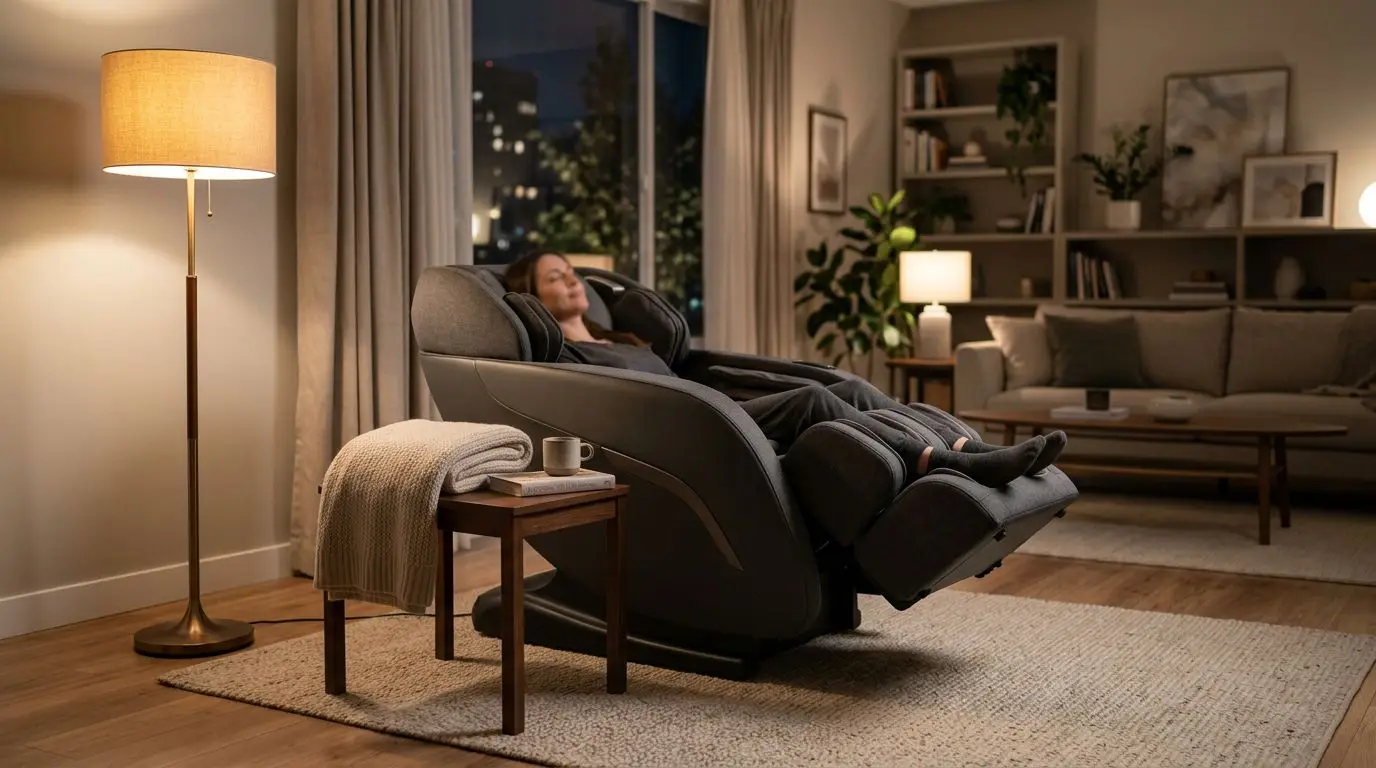
Use a massage chair before bed for 10–20 minutes, ideally at a gentle to moderate intensity, and stop before you feel drowsy enough to fall asleep in the chair. The goal is a calm wind-down, not the strongest massage your chair can deliver. Keep the session predictable, avoid aggressive settings late at night, and give yourself a few minutes afterward to transition to bed.
A good nighttime chair routine is simple: lower intensity, short duration, a comfortable body position, and no testing new deep settings right before sleep. If you have pregnancy, an implanted cardiac device, blood clots, anticoagulant use, osteoporosis, a recent fracture or surgery, spinal disc problems, neuropathy, or uncontrolled hypertension, ask your physician before using a massage chair.
The 10–20 Minute Rule for Bedtime Use
For most people, 10–20 minutes is enough time to enjoy a massage chair before bed without turning it into a long, overstimulating session. Many chairs default to 15-minute programs for a reason: that is long enough to cover the back, neck, hips, calves, or feet, but short enough to stay within a controlled routine.
Nighttime use should feel like a downshift. Choose a program that feels rhythmic and predictable, not intense or surprising. A chair that kneads hard into the shoulders, squeezes the calves at maximum air pressure, and rolls aggressively along the spine may feel impressive at 3 p.m.; at 10 p.m., it may leave you more alert than relaxed.
Think of the session in 3 parts. The first 2–3 minutes are for settling in and checking fit. The middle 8–12 minutes are the main relaxation window. The final 2–5 minutes should taper toward comfort, either by lowering intensity manually or choosing a program that ends gently.
Avoid stacking programs. One 15-minute session is very different from four back-to-back sessions that stretch to an hour. If you still want more after 20 minutes, that is a good sign to stop while the chair still feels pleasant. More pressure is not automatically more useful, especially at night.
Who It’s Best For—and 8 Situations to Clear With a Physician
A bedtime massage chair routine is best for adults who want a consistent, screen-free transition between the day and bedtime. It may also suit people who like structured rituals: dim lights, a short chair session, water, basic stretching, then bed. The chair is just one part of that sequence.
It is not ideal for everyone. Ask your physician before using a massage chair if any of these 8 situations apply: pregnancy, pacemaker or other implanted cardiac device, history of blood clots, use of anticoagulants, osteoporosis, recent fracture or surgery, spinal disc problems, neuropathy, or uncontrolled hypertension. If your doctor has told you to avoid strong compression, vibration, heat, or pressure on a certain area, follow that guidance.
Use extra caution if you cannot feel pressure accurately in your feet, calves, or back. A chair may feel fine in the moment but leave an area sore later if your sensation is reduced. In that case, use the lightest settings only if your physician says chair use is appropriate, and keep the first session to about 5 minutes.
Who a bedtime routine usually fits well
- People who prefer a predictable 10–20 minute wind-down.
- Users who can comfortably get in and out of the chair while awake and alert.
- Anyone who likes low to medium roller pressure rather than maximum intensity.
- Households where the chair is already set up in a quiet, low-traffic room.
Who should skip late-night use
- Anyone who tends to fall asleep in the chair.
- People who feel sore, overly warm, lightheaded, or irritated after sessions.
- Users who need help exiting the chair and may not have assistance nearby.
- Anyone under physician restrictions for heat, compression, pressure, or vibration.
A 30-Minute Routine That Keeps the Chair in Its Lane
The chair should not take over your whole night. A 30-minute routine gives it a defined role: prepare, sit, transition. That keeps the experience comfortable and reduces the temptation to keep adding time.
| Time | What to do | Why it helps the routine |
|---|---|---|
| Minutes 0–5 | Dim lights, silence notifications, use the bathroom, and drink a small amount of water if wanted. | You avoid interruptions once the chair reclines. |
| Minutes 5–20 | Run one gentle or moderate massage program. Keep heat low or off if you warm up easily. | The session stays short and predictable. |
| Minutes 20–25 | Return the chair upright, stand slowly, and notice how your shoulders, back, calves, and feet feel. | You check your body before going to bed. |
| Minutes 25–30 | Do a quiet transition: brush teeth, light stretching, or breathing at a normal comfortable pace. | The chair becomes part of bedtime, not the whole event. |
If your chair has a timer, use it. Set it once, then leave it alone. If the chair offers 5-, 10-, 15-, 20-, and 30-minute options, start with 10 or 15 minutes for nighttime use. Save longer sessions for earlier in the day, when you can better judge how the pressure feels afterward.
Keep the room boring in a good way. Bright TV, loud audio, work email, and scrolling can make the session feel less like a wind-down and more like another version of multitasking. A massage chair is most useful at night when it has a narrow job: help you settle into a calmer pace.
Settings to Use at Night: 3 Intensity Levels Compared
Most massage chairs offer several intensity controls, even if they use different names. For bedtime, you are usually choosing among 3 practical levels: gentle, moderate, and strong. Pick based on how the pressure feels during the session and how you typically feel 30 minutes later, not on the highest setting the chair can reach.
| Setting style | How it is designed to feel | Best nighttime use | What to avoid |
|---|---|---|---|
| Gentle | Light rolling, soft kneading, low air pressure, minimal surprise. | Good for first-time nighttime use, sensitive users, or sessions within 30 minutes of bed. | Do not assume gentle means you can run it for an hour. |
| Moderate | Noticeable pressure through the back or legs without sharp spots. | Good for regular users who know their preferred roller and air settings. | Avoid increasing multiple controls at once. |
| Strong | Firm rollers, tighter air compression, more pronounced stretching or tapping sensations. | Better earlier in the day for most users. | Avoid right before bed if it leaves you wired, sore, or restless. |
Make one change at a time. If you raise roller intensity, leave air compression unchanged. If you turn on heat, keep the massage program familiar. If you change the recline angle, do not also try a new deep-kneading mode. One variable tells you something; four variables make it hard to know what caused discomfort.
For many users, the best bedtime settings are intentionally unexciting: low-to-medium roller strength, light calf or foot compression, no sharp tapping, and a recline angle that feels supported. If the chair has manual controls, focus on broad areas such as upper back, lower back, calves, or feet instead of parking the rollers on one tender spot for several minutes.
How to Measure Fit Before You Start: 2 Inches Can Matter
Fit changes how intense a massage chair feels. A roller that lands 2 inches too high on the neck or too low on the lower back can turn a relaxing session into a distracting one. Before a nighttime session, take 1 minute to check body position.
Sit all the way back so your hips reach the backrest. Keep your shoulders relaxed rather than shrugged. Place your feet fully into the foot wells or on the foot section, depending on the chair design. If the chair has an adjustable leg rest, extend or retract it until your knees feel naturally bent and your calves are not jammed into the sides.
Pay attention during the body scan if your chair has one. Body scanning systems estimate shoulder height and back shape, but they are not perfect. If the rollers start above the base of your skull or press awkwardly on the neck, pause and adjust. If the chair lets you move the shoulder position up or down, shift it in small steps.
Quick fit checklist
- Neck: Rollers should not jab the base of the skull. Use a softer neck setting or skip the neck area if it feels too direct.
- Shoulders: Pressure should land on the upper back and shoulder area, not force your shoulders upward.
- Low back: The feeling should be supported, not pinching or sharply focused.
- Hips: In an L-track or SL-track chair, glute coverage should feel broad. Stop if it feels like a hard point.
- Calves and feet: Air pressure should feel snug, not trapping. You should be able to stop the chair quickly if needed.
Do not fight the chair. If a preset program keeps hitting the wrong area, switch programs or use manual mode. A lower-tech manual adjustment that feels comfortable is better than an advanced automatic routine that does not match your body.
Feature Choices for Night Use: Heat, Air, Recline, and Rollers in 5 Minutes
Take the first 5 minutes of any new nighttime routine to learn which features help you settle and which ones feel like too much. Chairs can combine rollers, air cells, heat, vibration, foot rollers, and reclining positions. At night, simpler is usually easier to manage.
| Feature | Nighttime-friendly approach | Use extra caution if |
|---|---|---|
| Heat | Use low heat for 10–15 minutes, or skip it if you warm up easily. | You are sensitive to heat, have reduced sensation, or were told to avoid heat on an area. |
| Air compression | Start at the lowest level for calves, feet, arms, or shoulders. | You have clotting concerns, use anticoagulants, or dislike a held-in-place feeling. |
| Zero gravity recline | Use a comfortable recline angle that supports your back and legs. | You feel stuck, dizzy when reclining, or have trouble getting out smoothly. |
| Foot rollers | Start with a short 5–10 minute setting, especially if the rollers are firm. | Your feet are sensitive or you have reduced sensation. |
| Stretch programs | Use mild versions earlier in the evening, not as the last thing before bed. | Twisting, traction-like movement, or hip pressure feels uncomfortable. |
Zero gravity is a reclined chair position that raises the legs and changes how body weight rests against the backrest. It can feel very comfortable for some users, but it is not mandatory. If a flatter recline makes you feel trapped or too drowsy, choose a less reclined position.
Use heat with restraint. Warmth can feel cozy, but more is not always better. Do not use heat if it feels hot, if your skin is irritated, or if you cannot judge temperature well. Check the area after the session, especially during your first few uses.
Signs You’re Overdoing It After 5 Minutes or 20 Minutes
Overdoing it is not only about a long session. Some people know within 5 minutes that a setting is too strong; others feel fine during a 20-minute program and notice later that they pushed past comfort. The safest habit is to stop at the first clear warning sign.
- Pressure feels sharp, pinching, or electric rather than broad and comfortable.
- You start bracing your shoulders, holding your breath, or clenching your jaw.
- Your feet, calves, arms, or back feel trapped by air compression.
- You feel too warm, lightheaded, nauseated, or uncomfortable in the recline.
- A specific spot feels irritated each time the rollers pass over it.
- You feel drowsy enough that you might fall asleep before the chair returns upright.
Stop the chair, bring it upright, and stand slowly. Do not treat discomfort as a challenge to push through. A massage chair is a consumer wellness product designed to create pressure, movement, warmth, and comfort. It is not a test of toughness.
If you feel sore after a bedtime session, shorten the next one by at least 5 minutes and lower one intensity level. If discomfort continues, stop using that setting. If you have pain, new symptoms, numbness, unusual swelling, chest discomfort, shortness of breath, or any concern that feels medical rather than ordinary post-session sensitivity, contact a qualified health professional.
6 Common Nighttime Mistakes to Avoid
The best nighttime massage chair routines are usually boringly consistent. These 6 mistakes are the ones that most often turn a useful wind-down into too much stimulation, too much pressure, or an awkward bedtime delay.
1. Running multiple full programs
A 15-minute preset can feel pleasant. Three in a row may not. Decide on one session before you sit down.
2. Testing new deep settings at bedtime
Try unfamiliar strong programs earlier in the day. Night is for settings you already know.
3. Using maximum air compression
Air cells can feel snug and grounding at low settings, but intense compression may feel restrictive. Start low.
4. Falling asleep in the chair
A massage chair is not a bed. If you are nodding off, stop the session and move to bed while you are alert enough to do so safely.
5. Ignoring fit problems
If rollers miss your shoulders or press into a bony area, adjust the position. Do not tolerate bad alignment for a full cycle.
6. Treating the chair as the whole sleep routine
The chair is one step. Keep the rest simple: low light, no work tasks, and a normal transition to bed.
FAQ: 5 Nighttime Massage Chair Questions
Is it okay to use a massage chair right before bed?
Yes, if you keep the session short, comfortable, and controlled. A 10–20 minute gentle or moderate session works better for most nighttime routines than a long, high-intensity program. Stop before you feel sleepy enough to fall asleep in the chair.
How long should I wait after a session before getting into bed?
Give yourself about 5–10 minutes to return the chair upright, stand slowly, and do normal bedtime tasks. That short transition helps you notice whether the session felt comfortable and prevents the chair from becoming a place where you doze off.
Should I use heat at night?
Use heat only if it feels comfortably warm, not hot, and keep it to a limited session such as 10–15 minutes. Skip heat if you are sensitive to temperature, have reduced sensation, notice skin irritation, or have been told by a physician to avoid heat on a certain area.
What setting is best for sleep-focused relaxation?
Choose gentle to moderate roller pressure, low air compression, and a familiar program. Avoid aggressive tapping, deep stretch modes, or maximum foot rollers at night unless you already know they feel comfortable afterward.
Can I use a massage chair every night?
Some people use one nightly, but frequency should depend on comfort. Start with 2–3 nights per week or short 10-minute sessions, then adjust based on how you feel during and after use. If sessions leave you sore, restless, or uncomfortable, reduce time, lower intensity, or take a break.
Frequently asked questions
Is it okay to use a massage chair right before bed? +
Yes, if the session is short and comfortable. Aim for 10–20 minutes at gentle to moderate intensity, and stop before you feel drowsy enough to fall asleep in the chair.
How long should I wait after using a massage chair before getting into bed? +
Plan on 5–10 minutes to bring the chair upright, stand slowly, and move through normal bedtime tasks. This gives you a quick check on how the session felt before you get into bed.
Should I use heat in a massage chair at night? +
Only if it feels comfortably warm and you can judge temperature normally. Keep heat sessions limited, such as 10–15 minutes, and avoid heat if you have reduced sensation, skin irritation, or physician instructions to avoid it.
What massage chair settings are best before bed? +
Use familiar gentle or moderate settings: low-to-medium roller intensity, low air compression, and a comfortable recline. Save aggressive tapping, strong foot rollers, and deep stretch programs for earlier in the day.
Can I use a massage chair every night? +
You can if it consistently feels comfortable, but start gradually. Try 2–3 nights per week or 10-minute sessions first, then adjust based on how your body responds during and after use.
Related guides
Morning, Afternoon, or Night: When Is the Best Time to Use a Massage Chair?
14 min read
Massage Chairs for Stress Relief and Better Sleep: What to Expect from Regular Use
11 min read
How to Use a Massage Chair at Home: A Simple First-Week Routine for Comfort and Consistency
10 min read
Massage Chair Use Before or After a Workout: Which Is Better for Recovery?
13 min read
How Often Should You Use a Massage Chair?
12 min read