Disclosure: We may earn a commission when you buy through links on this page, at no extra cost to you. We buy nothing, sell nothing and accept no payment for coverage — commissions never decide what we recommend. How we make money.
For beginners, the best massage chair settings are low intensity, light air pressure, a short 10-minute session, gentle heat if desired, and a modest recline instead of the deepest zero-gravity position. Start with a full-body auto program only if it includes a beginner or gentle option. Otherwise, use manual settings so you can control roller position, pressure, and duration. The goal is not to “power through” intensity, but to find a setting comfortable enough for your shoulders, back, and legs to stay relaxed.
Most first-time discomfort comes from turning on too many strong features at once. Rollers, airbags, foot rollers, heat, and deep recline may each feel fine on their own, but they can be overwhelming together. Use the chair the way you would adjust a car seat: make small changes, one at a time, and give yourself a few minutes to notice how each change feels.
Quick starter settings: use a 10-minute first session
If you are new to a massage chair, keep the first session short: about 10 minutes. Many chairs default to 15, 20, or 30 minutes, but a shorter test run lets you learn the controls without overdoing the intensity or staying in one pressure pattern too long.
Here is a simple beginner setup that works for many first-time users. Treat it as a starting point, not a rule.
| Setting | Beginner starting point | Why it helps |
|---|---|---|
| Session length | 10 minutes | Short enough to test comfort and learn controls |
| Roller intensity | Lowest or 1 of 5 | Reduces the chance of sharp pressure |
| Air pressure | Low or 1 of 5 | Keeps shoulder, arm, calf, and foot compression mild |
| Recline | Slight recline, not full lay-flat | Less body weight presses into the rollers |
| Heat | Off for the first 3–5 minutes, then low if wanted | Lets you judge roller pressure before adding warmth |
| Foot rollers | Off or low | Foot rollers can feel intense for new users |
| Program type | Gentle auto mode or manual back-only mode | Avoids aggressive sequences at the start |
After the first 10 minutes, pause and notice how you feel. If the session felt easy, add 5 minutes next time or raise one setting by one level. Do not increase intensity, air pressure, recline, heat, and foot rollers in the same session.
Why a chair can feel too intense in the first 5 minutes
A massage chair can feel surprisingly strong because its rollers are mechanical and follow a fixed path. Unlike a person using their hands, the chair does not automatically read your facial expression, breathing, or tension. It depends on the body scan, pressure sensors if included, and your manual adjustments.
The first 5 minutes matter because many chairs start with a body scan or warm-up pattern, then move into deeper kneading, tapping, rolling, or shiatsu-style motions. If your shoulders are not aligned with the scan, or if you recline too far too quickly, the rollers may press into a bony area instead of a broad muscle area. That can feel poky, sharp, or simply too much.
Three factors usually cause the “this is too intense” reaction:
- Body weight on the rollers: A deeper recline puts more of your weight against the back rollers.
- Roller position: If the shoulder height is off by even 1–2 inches, the upper rollers may land too high or too low.
- Stacked features: Airbags, foot rollers, heat, and strong roller modes can combine into a sensation that feels crowded or restrictive.
If a setting feels unpleasant, stop or reduce it. A beginner session should feel controlled, predictable, and easy to exit. Stronger is not automatically better.
Intensity and roller position: adjust in 1-level and 1-inch steps
Most chairs offer roller intensity in levels, often 3 to 5 levels, though some have more. Beginners should start at the lowest level and increase by only 1 level at a time. If your chair uses words instead of numbers, choose gentle, light, relax, or comfort before trying deep, stretch, vigorous, or sports-style programs.
Roller position matters just as much as intensity. Many chairs scan your back and estimate shoulder height, but the scan is not perfect. If the remote allows shoulder-position correction, move the shoulder point up or down in small steps, roughly 1 inch at a time, until the rollers begin just below the top of your shoulders instead of on your neck bones.
Use this quick check:
- Too high: Rollers push into the base of the skull or upper neck. Move shoulder position down.
- Too low: Rollers miss the tops of the shoulders and start around the shoulder blades. Move shoulder position up.
- Too sharp at the spine: Reduce intensity, sit slightly forward for a moment, or switch to a wider rolling style if available.
- Too much in the low back: Reduce recline first, then lower intensity if needed.
Roller type also changes the feel. A basic 2D mechanism moves up and down and side to side. A 3D mechanism can move in and out, creating a stronger pressing sensation. A 4D-style mechanism typically varies speed and rhythm more noticeably. If you have a 3D or 4D chair, keep depth at the lowest setting for the first several sessions.
| Roller feature | How it tends to feel | Beginner tip |
|---|---|---|
| 2D rollers | Moderate rolling and kneading across the back | Good starting point for most users |
| 3D depth | More pronounced inward pressure | Set depth to low before reclining deeply |
| 4D-style variation | Changing speed, rhythm, and pressure feel | Choose the slowest or gentlest program first |
| Spot mode | Focuses on one small area | Use for 1–3 minutes, then move on |
Spot mode can be helpful, but beginners should use it carefully. Keeping rollers on one small area for too long may feel irritating. Use short intervals, then return to a broader rolling or kneading pattern.
Air pressure settings: start at level 1 of 5
Air massage uses inflatable chambers, usually around the shoulders, arms, hips, calves, and feet. It creates a squeezing and releasing sensation. On many chairs, air pressure ranges from level 1 to level 5, and level 3 can already feel firm to a first-time user.
Start at level 1. If it feels barely noticeable after 3 minutes, move to level 2. Air compression can feel stronger in areas where the fit is snug, such as the arms or calves. A tall person, a broad-shouldered user, or someone with larger calves may feel more pressure at the same setting than a smaller user.
Airbags are often grouped by zone. If your chair allows zone control, turn on fewer zones at first.
| Airbag zone | Beginner setting | Comfort note |
|---|---|---|
| Shoulders | Low or off | Can feel restrictive if you are broad-shouldered |
| Arms and hands | Low | Remove watches, bracelets, and bulky sleeves |
| Hips | Low | May feel tight in narrow chairs |
| Calves | Low | Check that legs are centered in the wells |
| Feet | Low or off | Pairs strongly with foot rollers, so adjust carefully |
If air pressure makes you feel trapped, turn it off. You can still use the back rollers without airbags. Many beginners enjoy the chair more once they separate roller settings from air settings instead of running every feature at once.
Heat and recline: add heat after 3–5 minutes and recline gradually
Heat in a massage chair is usually located in the backrest, seat, calves, or feet, depending on the chair. It should feel warm and comforting, not hot. A good beginner approach is to leave heat off for the first 3–5 minutes, decide whether the roller pressure feels right, then turn heat on low if you want added warmth.
Do not use heat if it feels hot, if your skin is sensitive to temperature, or if you may not notice excessive warmth quickly. If you have neuropathy, reduced sensation, or any condition that affects how you perceive heat, ask your physician before using heated seating products.
Recline changes intensity more than many beginners expect. In an upright position, less of your body weight presses into the rollers. In a deeper recline, especially a zero-gravity-style position with the legs elevated, the back rollers can feel stronger. Some zero-gravity positions place the torso and thighs around a 120- to 130-degree open angle, though exact geometry varies by chair.
Use recline as an intensity dial:
- Upright to slight recline: Best for testing a new program.
- Medium recline: Good once you know the roller path feels comfortable.
- Deep recline or zero-gravity-style position: Save for later sessions and reduce roller intensity first.
One practical sequence works well: start upright, run the chair for 2 minutes, recline slightly, wait another 2 minutes, then decide whether to recline more. If the pressure jumps from comfortable to too strong, return to a more upright angle before changing other settings.
Who it’s best for, and who should ask a physician first
Massage chairs are best for adults who want a convenient consumer wellness product with adjustable pressure, warmth, recline, and full-body comfort features at home. They are especially useful for people who like routine: for example, a 10- to 15-minute session after work, after travel, or while winding down in the evening.
A beginner-friendly setup is best for:
- First-time users who find automatic programs confusing.
- People who prefer light to moderate pressure.
- Households with multiple users who need repeatable settings.
- Users who want to compare back rollers, airbags, heat, and recline separately.
- Anyone who has tried a chair once and thought it felt too aggressive.
Some people should ask their physician before using a massage chair. Do not guess. This includes anyone who is pregnant; has a pacemaker or other implanted cardiac device; has a history of blood clots or uses anticoagulant medication; has osteoporosis; has had a recent fracture, surgery, or injury; has spinal disc problems; has neuropathy or reduced sensation; or has uncontrolled hypertension. If a chair’s manual gives additional warnings, follow the manual.
Stop using the chair if you feel sharp pain, dizziness, numbness, unusual shortness of breath, skin irritation, or any sensation that feels wrong. A massage chair should be easy to pause, exit, and adjust.
How to choose and measure: check fit within 2 inches before you fine-tune settings
Comfort starts with fit. Even the best settings will feel awkward if the chair is too large, too small, too narrow, or not adjusted to your height. Before judging a program, make sure your body lines up with the chair’s roller track and leg rest.
Use a tape measure and a simple fit check:
- Height range: Compare your height to the chair’s stated range. If you are within about 2 inches of the top or bottom of the range, test carefully because shoulder scanning and leg extension may be less precise.
- Shoulder position: Sit fully back and confirm the rollers start near the upper shoulders, not the neck or mid-back.
- Seat depth: Your hips should sit back without forcing your knees too far forward.
- Leg rest length: Your knees should bend naturally, and your feet should sit flat in the foot wells without jammed toes.
- Calf width: Your calves should fit without hard side pressure before airbags inflate.
- Wall clearance: Some chairs need only a few inches behind them, while others need more. Measure before reclining.
Track design matters too. An S-track follows the curve of the back and usually stops around the lower back or upper seat. An L-track extends under the seat toward the glutes and hamstrings. An SL-track combines a curved back path with extended seat coverage. For beginners, longer coverage is not automatically better; it simply means more contact area to adjust.
| Track type | Typical coverage | Beginner consideration |
|---|---|---|
| S-track | Neck and back to lower back | Often simpler for back-focused sessions |
| L-track | Back plus under-seat coverage | Can feel stronger in the seat area |
| SL-track | Curved back path plus extended lower coverage | Good coverage, but start with low intensity |
If the chair includes a body scan, sit still during the scan. Keep your head back, shoulders level, and feet placed correctly. Moving during the scan can throw the roller map off by an inch or more.
Beginner setting combinations for 10-, 15-, and 20-minute sessions
Once you understand the basic controls, you can build simple setting combinations. Keep the first few sessions between 10 and 15 minutes. Move to 20 minutes only after you know which features feel comfortable.
| Use case | Time | Rollers | Air pressure | Heat | Recline |
|---|---|---|---|---|---|
| First test session | 10 min | Low, broad rolling | Off or level 1 | Off at first | Slight |
| Gentle evening routine | 10–15 min | Low kneading or rolling | Level 1–2 | Low if comfortable | Medium |
| Back-only setup | 10–15 min | Low to medium | Off | Optional | Slight to medium |
| Leg and foot test | 5–10 min | Back rollers low or off | Calves/feet level 1 | Off | Slight |
| Deeper pressure trial | 10 min | One level higher | Level 1 | Optional | Medium, not full |
The safest way to learn the chair is to isolate variables. If you want to try more recline, keep roller intensity the same. If you want more roller depth, keep recline the same. If you want to test foot rollers, lower or turn off foot air pressure for that session.
Troubleshooting uncomfortable settings in 30 seconds
When a setting feels wrong, do not wait for the program to finish. Most discomfort can be corrected in about 30 seconds if you know which control to change first.
| What you feel | Change first | If that does not work |
|---|---|---|
| Rollers feel too sharp | Reduce intensity or depth 1 level | Sit more upright |
| Rollers hit the neck | Move shoulder position down | Restart body scan while sitting still |
| Low back feels crowded | Reduce recline | Switch to a rolling pattern instead of focused kneading |
| Arms feel squeezed | Lower arm air pressure | Remove arms from arm wells or turn arm airbags off |
| Feet feel too intense | Turn foot rollers off | Lower foot air pressure or wear thicker socks |
| Heat feels too warm | Turn heat off | End the session and let the chair cool |
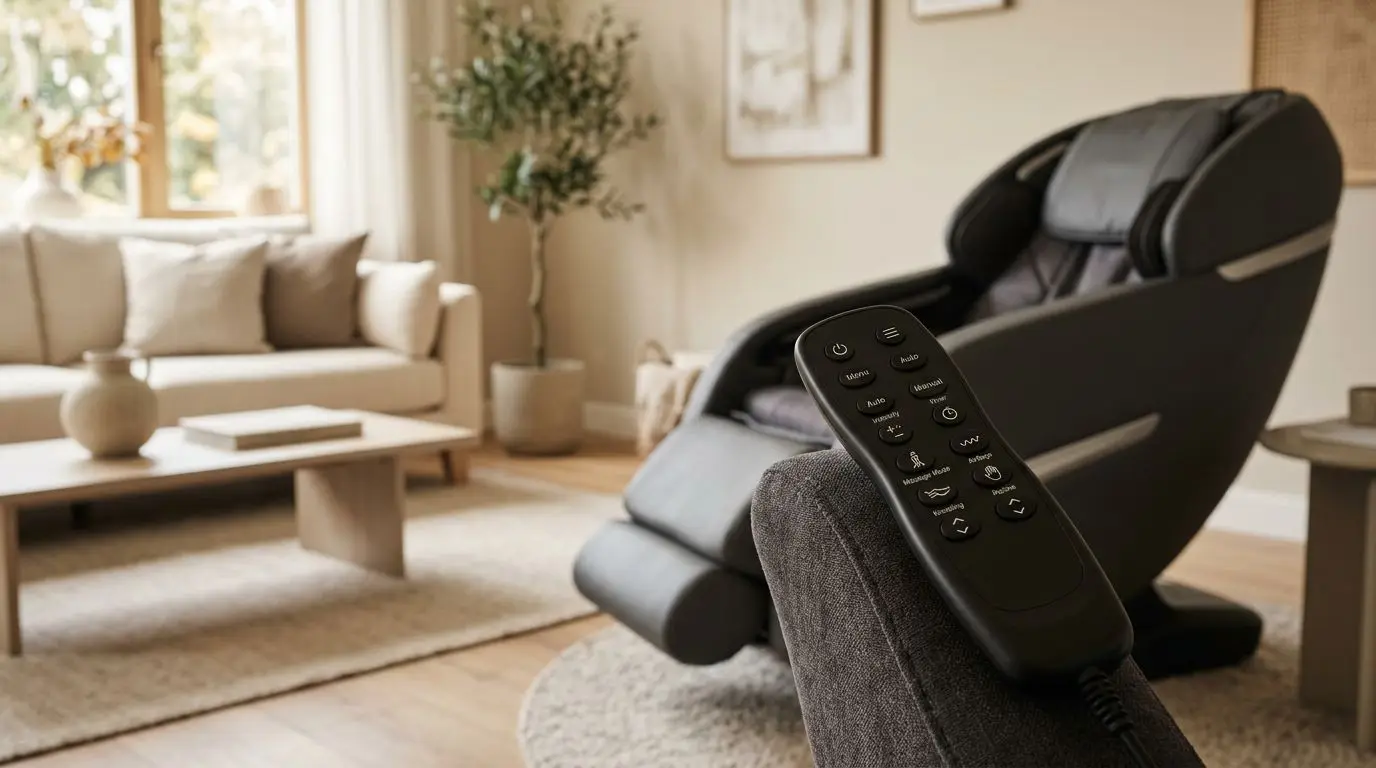
Keep the remote in your hand for the first few sessions. Learn the pause, power, recline, intensity, and air-pressure buttons before you start. If the remote has a screen, note whether it changes the whole chair or only one zone; many beginner mistakes come from adjusting the wrong area.
FAQ: beginner massage chair settings
How often should a beginner use a massage chair?
Start with 10 minutes, a few times per week, and see how the settings feel. If the chair remains comfortable, you can try 15-minute sessions. Follow the chair manual’s time limits, and do not use long sessions just because the timer allows them.
Should I use an automatic program or manual settings first?
Manual settings are often easier for a first session because you can control one feature at a time. If you use an automatic program, choose the gentlest option and lower the intensity, air pressure, and recline before it starts.
Why do foot rollers feel stronger than back rollers?
Feet have smaller contact areas, and the rollers press into a more concentrated space. Start with foot rollers off or on low for 5–10 minutes, especially if the chair also uses foot airbags.
Is zero gravity a good beginner setting?
It can be comfortable, but it often increases how firmly your back contacts the rollers. Beginners should try a slight or medium recline first, then test zero-gravity-style recline with roller intensity lowered.
Can I use heat every session?
You can use heat when it feels comfortable and your chair manual allows it, but it should feel warm rather than hot. If you have reduced sensation, neuropathy, or concerns about heat exposure, ask your physician before using heated seating products.
What is the single best adjustment when everything feels too intense?
Sit the chair more upright. Recline increases body contact with the rollers, so returning toward upright often reduces intensity quickly. Then lower roller depth or air pressure by 1 level.
Frequently asked questions
How often should a beginner use a massage chair? +
Start with 10 minutes, a few times per week, and see how the settings feel. If the chair remains comfortable, you can try 15-minute sessions while following the chair manual’s limits.
Should I use an automatic program or manual settings first? +
Manual settings are often easier for a first session because you can control one feature at a time. If you use an automatic program, choose the gentlest option and lower intensity, air pressure, and recline before it starts.
Why do foot rollers feel stronger than back rollers? +
Feet have smaller contact areas, so the pressure feels more concentrated. Start with foot rollers off or on low, especially if foot airbags are also active.
Is zero gravity a good beginner setting? +
It can be comfortable, but it often makes the back rollers feel stronger. Try a slight or medium recline first, then test a zero-gravity-style position with roller intensity lowered.
Can I use heat every session? +
Use heat only when it feels warm and comfortable, and follow the chair manual. If you have reduced sensation, neuropathy, or concerns about heat exposure, ask your physician first.
What is the single best adjustment when everything feels too intense? +
Sit the chair more upright. Then lower roller depth or air pressure by 1 level if needed.
Related guides
How to Adjust Massage Chair Intensity Without Overdoing It
13 min read
How to Use a Massage Chair at Home: A Simple First-Week Routine for Comfort and Consistency
10 min read
How to Use a Massage Chair for Lower Back Tightness
13 min read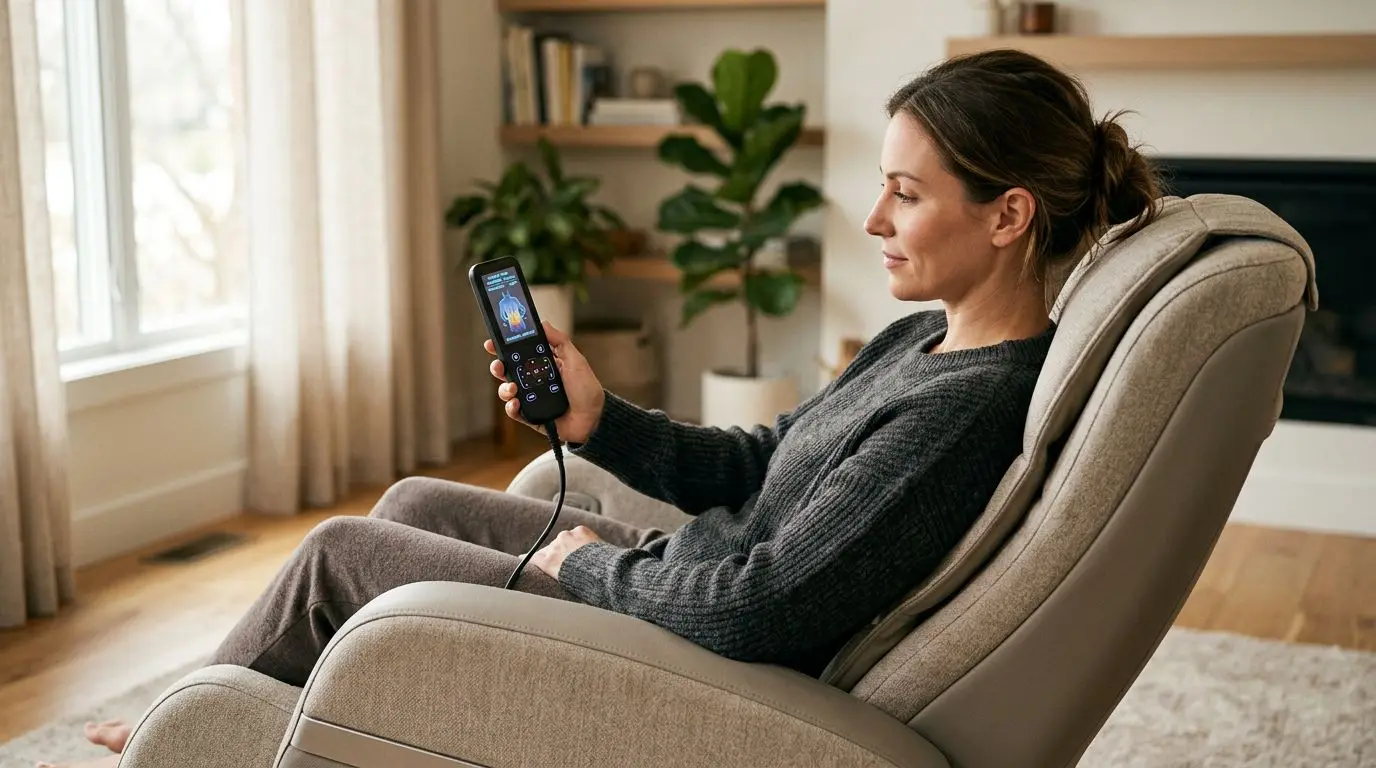
Massage Chair Routine for Lower Back Tightness: Settings to Try First
13 min read
Are Massage Chairs Good or Bad for You? Benefits, Risks, and Safe Use Guidelines
13 min read