Disclosure: We may earn a commission when you buy through links on this page, at no extra cost to you. We buy nothing, sell nothing and accept no payment for coverage — commissions never decide what we recommend. How we make money.
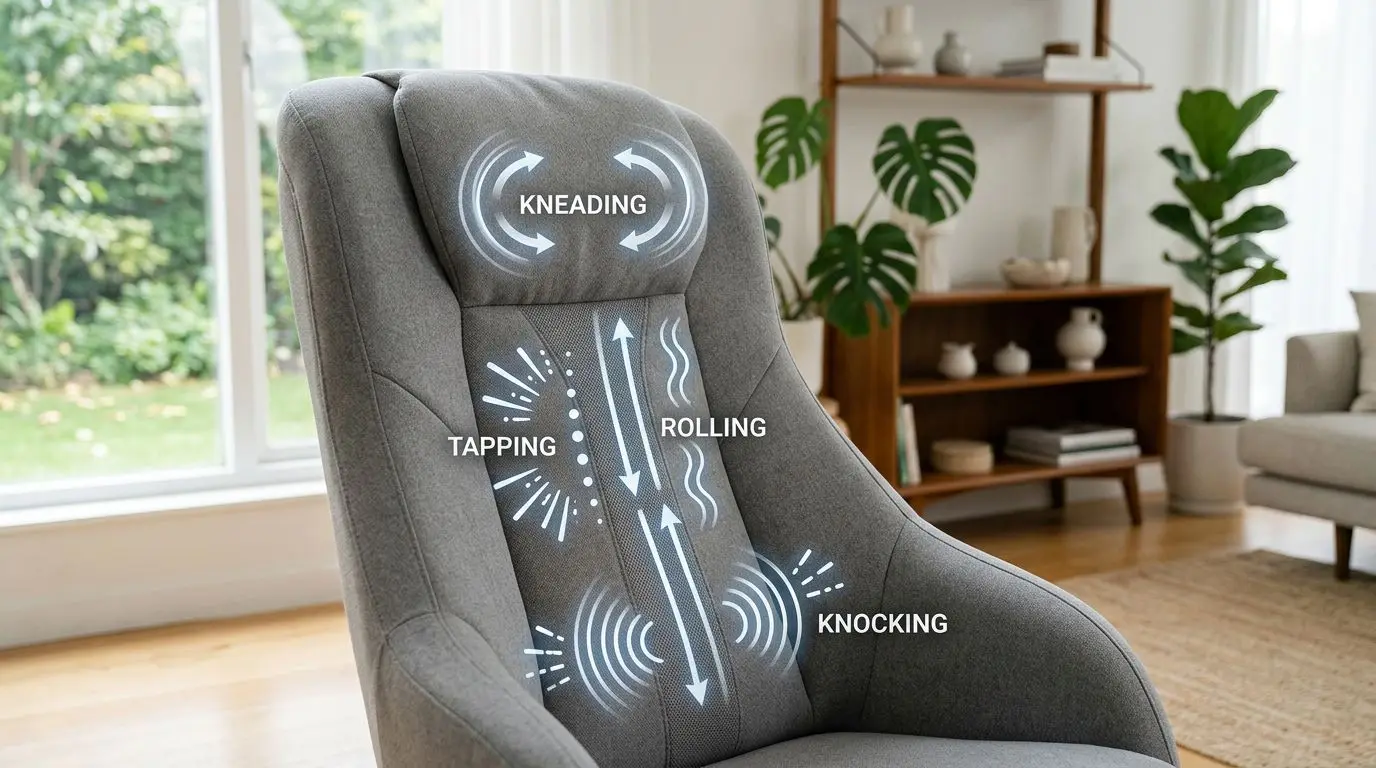
Massage chair roller techniques are the programmed motions that shape how a chair feels on your back, shoulders, seat, and sometimes legs. Kneading usually feels like circular squeezing, tapping and knocking feel percussive, rolling feels like broad up-and-down travel, and combination modes blend 2 or more motions for a fuller session. The best choice depends on whether you want gentle coverage, firmer pressure, rhythmic stimulation, or a preset program that changes sensations over 10 to 20 minutes.
Think of these terms as a comfort language, not proof of medical performance. A massage chair is a consumer wellness product, and roller names describe pressure, rhythm, coverage, and adjustability. Once you understand the motions, chair spec sheets become much easier to compare.
Quick guide: 5 roller motions and how they feel
Most full-size massage chairs list 4 to 6 core back techniques, though exact names vary. The same word can also feel different from one chair to another because roller depth, spacing, track shape, body scan accuracy, and upholstery thickness all affect the sensation.
Use the table below as a plain-English starting point when reading specs. It focuses on how each motion is designed to feel, not on health claims.
| Technique | Typical motion | Designed sensation | Best buyer match |
|---|---|---|---|
| Kneading | Circular or oval roller movement | Gripping, squeezing, medium to firm pressure | People who like targeted work around the shoulders and back |
| Tapping | Fast alternating pulses | Light to brisk percussion | People who prefer rhythmic, energetic sessions |
| Knocking | Slower, heavier percussion | Deeper thumping or drumming feel | People who want a bolder percussive setting |
| Rolling | Up-and-down travel along the track | Broad, stretching-style coverage | People who want a gentle full-back pass |
| Combination | 2 or more motions in sequence or at once | Varied, changing pressure | People who like preset programs and less manual adjustment |
If you are sensitive to pressure, start with rolling or a low-intensity kneading program before trying knocking. If you like a more active feel, tapping and combination modes may be more satisfying.
How chair rollers create motion in 2D, 3D, and 4D systems
Roller technique is only half the story. The roller mechanism determines how far the rollers move, how deeply they press, and whether the motion is fixed or adjustable. In many spec sheets, you will see 2D, 3D, or 4D used to describe this system.
| Roller system | What it usually means | Why it matters for technique feel |
|---|---|---|
| 2D | Rollers move up and down, and side to side | Good for basic kneading, tapping, and rolling, but depth adjustment is limited |
| 3D | Rollers can also move inward and outward | Lets you make kneading or knocking feel softer or firmer |
| 4D | Often adds variable speed, rhythm, or more nuanced depth control | Can make combination programs feel more human-like and less repetitive |
These labels are not standardized across every manufacturer, so do not buy from the label alone. A well-tuned 3D chair may feel better to you than a poorly tuned chair with a more impressive-sounding spec. Look for adjustable intensity, adjustable roller width, manual spot controls, and a return policy that gives you enough time to test a few full sessions.
Track design also changes the experience. A typical S-track follows the curve of the back and may measure around 28 to 32 inches. Longer L-track or SL-track layouts can run closer to 45 to 53 inches and continue under the seat area, which changes how rolling and kneading feel below the lower back.
Kneading: circular pressure for 10- to 20-minute unwind sessions
Kneading is one of the most common massage chair techniques. The rollers usually move in small circular, oval, or inward-outward patterns, creating a squeezing sensation on either side of the spine. On some chairs, the motion feels broad and cushioned; on others, it feels precise and firm.
This is often the first technique people notice around the upper back and shoulder blade area. A narrow roller-width setting can feel more focused, while a wider setting spreads pressure across a broader area. If the chair has 3D depth control, lowering the depth by 1 or 2 levels can make kneading more comfortable for smaller users or anyone who dislikes strong pressure.
Kneading is a good match if you want a steady, hands-on style sensation without the sharp rhythm of percussion. It works well in a 10-minute manual session when you want to focus on one back region, and it is also common inside longer 15- or 20-minute preset programs.
- Try it if: you like circular pressure and a grippy feeling around the back.
- Use caution if: you are bony, pressure-sensitive, or new to massage chairs.
- Helpful settings: lower depth, slower speed, wider roller spacing, extra back padding if included.
A practical test: sit fully back, place your shoulders against the chair, and run kneading for 2 minutes at the lowest intensity. If you feel yourself bracing or lifting away from the backrest, reduce intensity or switch to rolling.
Tapping and knocking: percussive patterns at 1 to 3 intensity levels
Tapping and knocking are both percussive techniques, but they are not identical. Tapping usually feels quicker and lighter, like alternating pulses. Knocking often feels slower, heavier, and more like a drumming motion.
Many chairs offer at least 1 to 3 intensity levels for these modes, and higher-end controls may separate speed from depth. Speed changes the rhythm. Depth changes how forceful the roller contact feels. When both are set high, the experience can be too much for some users, especially near the shoulder blades or lower ribs.
Tapping can suit buyers who like an active, rhythmic session and do not want the squeezing feel of kneading. Knocking is better for people who already know they enjoy a stronger percussive sensation. For first-time users, knocking should be tested briefly, not started at maximum.
| Mode | Rhythm | Feel | Beginner setting |
|---|---|---|---|
| Tapping | Faster alternating pulses | Brisk, lighter percussion | Low speed and low intensity for 2 to 3 minutes |
| Knocking | Slower repeated strikes | Heavier, drum-like contact | Lowest intensity, avoid bony areas at first |
Do not assume stronger is better. A comfortable setting you can relax into for 10 minutes is more useful than a maximum setting you tolerate for 30 seconds. If your chair lets you save a favorite manual program, store a low or medium percussion setting rather than defaulting to the strongest option.
Rolling: broad up-and-down coverage along a 28- to 50-inch track
Rolling is the simplest technique to understand. The rollers travel up and down the chair track, usually without a strong circular or percussive action. It is commonly used at the beginning of a program after the chair performs a body scan.
On an S-track chair of about 28 to 32 inches, rolling typically covers the neck, upper back, mid-back, and lower back. On a longer L-track or SL-track chair near 45 to 53 inches, the roller path can continue beneath the seat area. That longer path changes the experience for buyers who want coverage beyond the backrest.
Rolling is often the most approachable mode for new users because it distributes contact over a larger area. It can also help you decide whether the chair fits your torso length. If the rollers overshoot your shoulders, miss your lower back, or feel misaligned after the body scan, the chair may not be a good fit even if the technique list looks impressive.
- Best for beginners: rolling at low or medium intensity.
- Best for fit testing: full-back rolling after body scan recalibration.
- Best for gentle coverage: slow rolling with heat off or on low, if available.
Rolling can feel too mild for users who want a focused sensation, but that is also its advantage. It is the mode many people choose when they want broad contact without the sharper personality of tapping or knocking.
Combination modes: 2 motions at once, plus preset programs
Combination modes blend techniques either at the same time or in a planned sequence. A chair might combine kneading with tapping, rolling with kneading, or alternating percussion with spot work. Preset programs often layer roller techniques with air compression, recline angle, foot rollers, heat, or zero gravity positioning.
For buyers, the key number is not how many programs the chair advertises. A chair with 12 presets is not automatically better than one with 6. What matters is whether the programs vary in a useful way and whether you can adjust intensity, roller position, and airbag pressure while the program is running.
Combination modes are helpful if you do not want to manually build a session every time. They can also make a 15-minute program feel less repetitive because the chair changes pace and contact style every few minutes. The trade-off is control. Some presets may include techniques you dislike, such as knocking near the upper back or strong calf compression.
| Feature | Why it matters | What to look for |
|---|---|---|
| Manual technique selection | Lets you choose kneading, tapping, rolling, or knocking yourself | At least 4 named back techniques |
| Spot or zone control | Keeps rollers in one area | Upper, mid, lower, or precise up-down controls |
| Intensity adjustment | Changes comfort level | 3 or more levels is easier to fine-tune |
| Preset programs | Reduces setup time | Programs with clearly different intensity profiles |
| Air compression controls | Affects shoulders, arms, calves, or feet on many chairs | Separate airbag intensity, ideally with off option |
If you are comparing chairs in person, run the same type of preset on each chair for at least 5 minutes. Short demos can be misleading because many programs start gently and become firmer after the scan or warm-up phase.
Who each technique is best for: a 1-minute buyer match
The right roller motion depends on your comfort preference, body type, and patience for controls. Someone who wants a quiet 10-minute wind-down may not like the same settings as someone who wants a strong, rhythmic chair session after a long day at a desk.
| Buyer preference | Start with | Consider avoiding at first | Why |
|---|---|---|---|
| Gentle, predictable feel | Rolling | High knocking | Rolling spreads contact over a larger area |
| Focused shoulder and back pressure | Kneading | Fast tapping | Kneading feels more targeted and steady |
| Rhythmic, energetic sensation | Tapping | Deep kneading if pressure-sensitive | Tapping emphasizes pulse over squeeze |
| Stronger percussion | Knocking | Maximum intensity on first use | Knocking has a heavier feel |
| Set-it-and-go convenience | Combination presets | Chairs with no manual override | Presets work best when you can still adjust them |
Smaller users often benefit from adjustable shoulder position and roller width. Taller users should pay close attention to track length and body scan accuracy. If 2 people in the household differ by 8 inches or more in height, fit testing becomes especially important.
Noise matters, too. Percussive modes tend to sound more noticeable than rolling or kneading, especially in a quiet room. If you plan to use the chair while watching TV, ask about operating noise or test tapping and knocking in person.
How to choose and measure before you buy: 3 checks
Before you focus on technique names, confirm that the chair fits your body and your room. A chair with great roller programming will still disappoint if the shoulder scan is off, your feet do not sit properly in the footrest, or the recline path hits the wall.
1. Measure your body fit
Check the stated user height range and weight limit, then compare it to actual seated fit. Many full-size chairs are designed around a broad adult range, but the feel can change a lot between a 5-foot-2 user and a 6-foot-3 user. Sit back fully, let the body scan run, and confirm that the rollers locate the top of your shoulders without pressing into the neck.
2. Measure the room
Measure width, depth, and recline clearance in inches. Some chairs need only a few inches from the wall, while others require closer to 12 inches or more depending on the recline design. Also check doorways, stair turns, and hallway width before delivery; massage chairs are bulky even when partially assembled.
3. Test controls for 10 minutes
Do not judge a chair from a 60-second sit. Run rolling, kneading, tapping, and a preset program long enough to feel the differences. Test the lowest and middle intensity levels first. If the chair feels comfortable only at the absolute lowest setting, it may be too aggressive for regular use.
Look for simple controls. You should be able to pause, lower intensity, change zones, and stop airbags without digging through confusing menus. Good technique variety is helpful only if you can control it quickly.
Safety notes: ask a physician in these 8 situations
Massage chairs are consumer wellness products, not medical devices. If you are pregnant, have a pacemaker or other implanted cardiac device, have a history of blood clots, take anticoagulants, have osteoporosis, had a recent fracture or surgery, have spinal disc problems, have neuropathy, or have uncontrolled hypertension, ask your physician before using a massage chair. This is especially important before using strong kneading, knocking, inversion-like recline positions, heat, or tight air compression.
Stop using the chair if a setting feels sharp, causes numbness, or makes you feel unwell. Avoid placing strong roller pressure directly over bony areas, recent injuries, or areas your physician has told you to protect. Children should not use a massage chair without adult supervision, and pets should be kept away from moving footrests, reclining bases, and airbags.
Heat features deserve extra caution. They are usually mild, but people with reduced sensation may not notice excessive warmth quickly. Start with short sessions, such as 10 minutes, and keep intensity low until you know how your body responds to the chair.
FAQs: 5 common questions about roller techniques
Is kneading better than tapping?
Neither is automatically better. Kneading feels circular and more focused, while tapping feels rhythmic and percussive. Choose kneading if you like steady pressure; choose tapping if you prefer a quicker pulsing sensation.
What is the difference between tapping and knocking?
Tapping is usually faster and lighter. Knocking is typically slower and heavier, with a deeper drum-like feel. If you are new to massage chairs, test knocking on the lowest intensity first.
Do more roller techniques mean a better chair?
Not by themselves. A chair with 5 well-adjusted techniques, good body scanning, and clear controls can be more comfortable than a chair with a long feature list but poor fit. Fit and adjustability matter more than technique count.
What technique should a beginner start with?
Start with rolling or low-intensity kneading for 5 to 10 minutes. These modes are usually easier to tolerate than strong tapping or knocking. Increase intensity only after you know the chair fits your shoulders and back.
Are combination programs worth using?
Yes, if you like variety and want the chair to manage the session for you. The best presets still allow you to lower intensity, adjust roller position, turn off airbags, or stop a technique you do not like.
Frequently asked questions
Is kneading better than tapping in a massage chair? +
Neither is better for everyone. Kneading feels circular and focused, while tapping feels rhythmic and percussive. Pick the one that matches the sensation you enjoy.
What is the difference between tapping and knocking? +
Tapping usually feels faster and lighter. Knocking is often slower and heavier, with a stronger drum-like contact. Beginners should test both at low intensity.
What roller technique should beginners try first? +
Rolling or low-intensity kneading is usually the easiest starting point. Try a 5- to 10-minute session before moving to stronger tapping, knocking, or combination programs.
Do more massage techniques mean a better chair? +
Not necessarily. Fit, body scan accuracy, adjustable intensity, roller width, and easy controls matter more than a long list of named techniques.
Are combination modes useful? +
Combination modes are useful if you want a varied session without manual setup. Look for presets that still let you adjust intensity, roller zone, and air compression.
Related guides
How to Adjust Massage Chair Intensity Without Overdoing It
13 min read
Massage Chair Auto Programs Explained: Relax, Stretch, Recovery, Sleep, and Deep Tissue Modes
14 min read
How to Compare Massage Chair Features: 2D, 3D, 4D, L-Track, SL-Track, Heat, and Airbags
13 min read
When to Use Manual Massage Chair Settings Instead of Auto Programs
14 min read
Shiatsu Massage Chairs: What the Term Means Before You Buy
13 min read