Disclosure: We may earn a commission when you buy through links on this page, at no extra cost to you. We buy nothing, sell nothing and accept no payment for coverage — commissions never decide what we recommend. How we make money.
An open-box, floor-model, or clearance massage chair is worth buying when it works properly, the seller documents its condition, and you still receive a clear return window or warranty coverage. The discount is not worth it if the chair is final sale with unknown usage, missing controls, worn upholstery, or unclear service support. Treat the deal like buying a used appliance: inspect it, measure your space, read the policy, and price the risk.
Massage chairs are large mechanical products with rollers, airbags, motors, wiring, remotes, and moving leg rests. A small cosmetic scuff may be harmless; a noisy roller track or missing power cord is not. The goal is not to find the lowest tag. It is to find the lowest total risk.
The 10-minute answer: when a discounted chair is worth it
A discounted massage chair can be a good buy if you can verify 4 things before paying: it powers on, it runs a full automatic program, the remote or control panel works, and the seller puts the return and warranty terms in writing. If any of those 4 items are uncertain, the discount needs to be deep enough that you are comfortable owning the problem.
Condition matters more than the label. “Open-box” may mean a chair was delivered, unboxed, and returned within a few days. It can also mean it sat in a warehouse with repacked accessories and no clear use history. “Floor-model” usually means shoppers sat in it repeatedly, sometimes for months. “Clearance” can mean new overstock, discontinued inventory, or a store trying to move a damaged unit.
Use this simple rule: buy the discount when the chair is inspectable, returnable, and serviceable. Skip it when the seller will not let you test the main functions, refuses to list missing parts, or uses vague language such as “should work” or “all sales final, no exceptions.”
Open-box vs. floor-model vs. clearance: 3 discount types compared
The 3 main discount categories are not equal. They differ in expected wear, missing parts risk, and policy flexibility. Use the table below to separate a real value from a likely headache.
| Discount type | What it usually means | Best reason to consider it | Main risk to check |
|---|---|---|---|
| Open-box | Packaging was opened, or the chair was returned after delivery | May have little actual sitting time | Missing accessories, repacked damage, unclear return reason |
| Floor-model | Displayed in a store or showroom for public demos | You can often inspect and sit in the exact unit | Upholstery wear, weakened airbags, noisy motors, heavy use |
| Clearance | Inventory is being cleared out, often due to age, overstock, or discontinued styling | May be new in box with a lower price | Limited returns, shorter support window, older feature set |
An open-box unit is often the best middle ground if the original accessories are included and the seller confirms the chair was not heavily used. Floor-model chairs can be smart buys when you can inspect the exact chair under good lighting and run it for at least 10 minutes. Clearance chairs are attractive when they are new, sealed, and backed by the same basic coverage as regular inventory.
Do not assume a clearance chair is used. Do not assume an open-box chair is nearly new. Ask what happened to that specific unit.
Who it is best for — and who should buy new
Discounted massage chairs are best for shoppers who can tolerate a little uncertainty and are willing to check at least 10 inspection points before purchase. They are less ideal for buyers who need white-glove delivery, full manufacturer support, or a simple no-questions-asked return experience.
Discounted chairs are a better fit if you:
- Can inspect the exact chair before accepting delivery.
- Are comfortable with minor cosmetic marks, such as a small scuff on the side panel.
- Have measured your room and doorway already.
- Understand the difference between store warranty, manufacturer warranty, and no warranty.
- Can walk away if the paperwork is unclear.
Buying new may be smarter if you:
- Need the longest available warranty period.
- Want the easiest return process.
- Are buying the chair as a gift and do not want visible wear.
- Need predictable delivery, setup, and haul-away services.
- Do not have time to test the chair before purchase.
There is also a practical comfort issue. A floor model may have been tried by dozens or hundreds of shoppers. If that bothers you, even after cleaning, a sealed clearance unit or a new chair is likely a better match.
Inspect the chair in 15 minutes: what to check
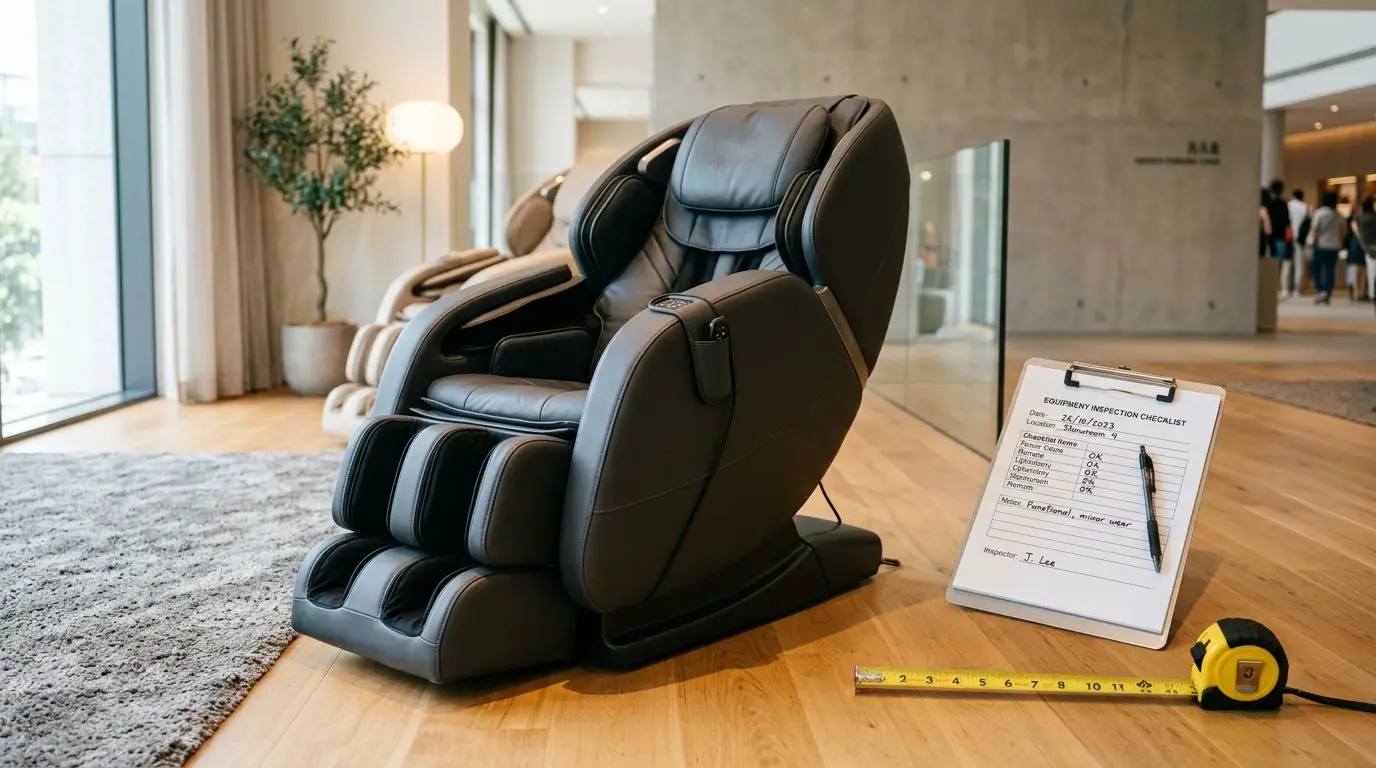
Before paying for any open-box or floor-model massage chair, spend 15 minutes testing it. Bring your phone, a small flashlight, and a tape measure. If you are buying online, ask the seller to provide a dated video showing the same checks.
- Power and startup: Confirm the chair turns on without flickering lights, error codes, burning smells, or clicking from the power area.
- Remote or control panel: Test every main button, including power, recline, leg rest, intensity adjustment, heat, and program selection.
- Roller movement: Run a full-back program and listen for grinding, skipping, or sudden stops. Rollers should move smoothly along the track.
- Recline function: Move from upright to fully reclined and back. Watch for uneven motion or hesitation.
- Foot and calf section: Extend and retract the leg rest if adjustable. Check that foot rollers, if included, feel balanced on both sides.
- Airbags: Run an air-compression setting and confirm shoulder, arm, calf, or foot airbags inflate and deflate in matched pairs where designed.
- Heat: If the chair includes heat, verify it warms gently after a few minutes. It should not feel sharp, overly hot, or inconsistent from one side to the other.
- Upholstery: Look for peeling, cracking, sticky texture, split seams, loose stitching, and worn head pillows.
- Track and frame: Use a flashlight behind the chair. Look for bent brackets, loose screws, crushed panels, or exposed wiring.
- Accessories: Confirm the power cord, remote holder, pillows, pads, manuals, and any small attachment pieces are present.
A massage chair can look clean from the front and still have problems in the back or underneath. Listen closely, too. A soft motor hum is normal; grinding, popping, and repeated stopping are not worth ignoring.
Measure your room before chasing a deal
A low price does not help if the chair cannot fit through a 30-inch doorway or recline without hitting a wall. Before buying, measure the path from the delivery point to the final spot, including doorways, hallways, stair turns, and ceiling height if the chair must be tilted.
Most full-size massage chairs are bulky. Many require a dedicated footprint, plus clearance for reclining and footrest movement. Some space-saving designs may need only a few inches behind the backrest, while other chairs may need much more room. Always use the seller’s listed dimensions for the exact unit.
| Measurement | Why it matters | What to record |
|---|---|---|
| Doorway width | The chair may arrive in 1 large carton or in sections | Narrowest opening in inches |
| Hallway turns | Long cartons can be difficult to pivot | Width before and after each turn |
| Room footprint | The chair needs space in upright and reclined positions | Width, depth, and recline clearance |
| Wall clearance | Backrest movement varies by design | Distance from chair back to wall |
| User fit | Shoulder width, leg length, and footwell size affect comfort | Seat width, shoulder area, calf and foot range |
Check floor protection as well. A massage chair can be heavy, and small caster wheels or narrow feet can mark soft flooring. On hardwood, vinyl, or laminate, place the chair on a sturdy mat that does not slide. If it will sit upstairs, consider whether the floor and delivery path can handle the weight; when in doubt, ask a qualified professional.
Warranty, returns, and missing parts: 5 policy questions
Ask 5 policy questions before buying any discounted massage chair. If the seller cannot answer them in writing, assume the risk is yours.
- Is it returnable, and for how many days? A 7-day return window is very different from a 30-day window, especially if delivery scheduling is slow.
- Who pays return freight? Large-chair freight can be expensive, and some sellers require original packaging.
- Is the manufacturer warranty still active? Some warranties start on the original sale date, not your purchase date. Others may not transfer.
- What does the store cover separately? A store may offer its own limited coverage for parts, labor, or exchange. Get the exact terms.
- What is missing or replaced? Ask for a written list of missing manuals, pillows, pads, remotes, side panels, or cords.
Be careful with the phrase “full warranty.” It can mean different things depending on the seller. Ask whether coverage includes in-home labor, parts only, shipping both ways, or only the ability to buy parts. A heavy chair with a small failed component can still be a problem if service requires crating and freight shipment.
For open-box chairs, ask why the unit was returned. The seller may not know, but the answer is useful when available. A customer who ordered the wrong size is different from a chair returned for noise, control issues, or damaged upholstery.
Discount math: a simple 4-line formula
Use a 4-line formula to judge the real deal, not just the sticker discount. Write it down before you buy.
- Discounted chair price
- Plus delivery, setup, stairs, and haul-away fees
- Plus missing parts, cleaning, mats, or accessory replacements
- Minus the value of lost warranty or return rights
The last line is the one shoppers often skip. A chair with no return option is not equal to a chair with a written trial period. A chair with a 1-year parts-only store policy is not equal to a new chair with broader support. Put a dollar value on that difference in your own mind, even if you cannot calculate it exactly.
Here is a practical example without brand names or made-up prices: if the discount would disappear after adding delivery, a replacement remote, and a floor mat, the deal is weak. If the chair is clean, tested, includes every part, fits your space, and has written coverage, the discount has real value.
Feature trade-offs to compare before you buy
Discounted inventory is often a mix of newer and older feature sets. Compare at least 6 feature areas before deciding whether the lower price is worth giving up newer design elements.
| Feature | Why it matters | What to check on a discounted chair |
|---|---|---|
| Track type | S-track follows the back; L-track extends under the seat area | Confirm roller coverage matches your preference |
| Roller feel | Some chairs feel broad and gentle; others feel focused and firm | Test the lowest and highest intensity levels |
| Body scanning | Designed to adjust roller position to the user | Check whether it locates shoulders accurately |
| Air compression | Changes the squeeze sensation at shoulders, arms, calves, or feet | Make sure both sides inflate evenly |
| Zero-gravity recline | Places the body in a laid-back position for a weightless-style feel | Test recline smoothness and comfort |
| Foot rollers | Add firm pressure under the feet | Try them with socks on and intensity adjusted |
Do not pay extra for a feature you dislike. Some shoppers enjoy strong foot rollers and firm shoulder pressure. Others turn those settings off after the first week. A discounted chair is only a value if its everyday settings feel comfortable to the people who will actually use it.
Safety and comfort: ask a physician first in these 8 situations
A massage chair is a consumer wellness product, not a medical device. It is designed to create sensations such as rolling pressure, kneading-style motion, compression, heat, vibration, and reclined comfort. It should not be used as a substitute for professional medical advice.
Ask your physician before using a massage chair if any of these 8 situations apply: pregnancy, a pacemaker or other implanted cardiac device, a history of blood clots or use of anticoagulants, osteoporosis, recent fracture, recent surgery, spinal disc problems, neuropathy, or uncontrolled hypertension. If a setting feels painful, causes numbness, or creates unusual discomfort, stop using the chair and seek appropriate guidance.
Think about household users, too. A chair that feels comfortable to a 6-foot adult may feel too intense for a shorter person, an older adult, or someone with limited mobility. Test entry, exit, recline speed, and remote readability before assuming everyone will use it comfortably.
Final checklist: 12 signs the discount is actually worth it
Before you say yes, look for these 12 green flags. You do not need perfection, but you do need enough certainty.
- The exact chair powers on and completes a full program.
- The rollers move smoothly without grinding or skipping.
- The recline and leg rest operate in both directions.
- The remote or control panel responds to all main commands.
- Airbags inflate and deflate evenly where included.
- Upholstery has no major cracking, peeling, or split seams.
- All required cords, pads, pillows, and control accessories are included.
- The seller lists any defects in writing.
- You know the return window and who pays freight.
- Warranty coverage is documented, not verbal.
- The chair fits your doorway, room, and user height range.
- The final cost still makes sense after delivery and accessories.
If the chair fails 2 or more of these checks, slow down. There will be another discount. A massage chair is too large, heavy, and mechanical to buy on hope alone.
FAQ: 5 common questions about discounted massage chairs
Is an open-box massage chair the same as used?
Not always. Open-box means the packaging was opened, but actual use can range from almost none to repeated testing. Ask why it was opened, whether it was returned by a customer, and whether the seller inspected it after repacking.
Are floor-model massage chairs a bad idea?
Not automatically. A floor model can be worthwhile if it is clean, fully functional, documented, and priced to reflect public demo use. Pay close attention to upholstery, noise, air compression, and return terms.
What missing parts matter most?
The remote or control panel, power cord, pads, pillows, and any required attachment pieces matter most. A missing manual is usually manageable, but a missing controller or proprietary cord can make the chair difficult or impossible to use.
Should I buy a final-sale clearance massage chair?
Only if you can inspect and test the exact chair, understand the warranty, and accept that you may not be able to return it. Final sale shifts most of the risk to you, so the condition and documentation need to be strong.
How long should I test a discounted massage chair?
Plan on at least 10 to 15 minutes. Run an automatic program, adjust intensity, recline fully, test the foot and calf area, check heat if included, and listen for unusual noises.
Frequently asked questions
Is an open-box massage chair the same as used? +
Not always. Open-box means the packaging was opened, but actual use can range from almost none to repeated testing. Ask why it was opened, whether it was returned, and whether it was inspected before resale.
Are floor-model massage chairs worth buying? +
They can be worth buying if you can inspect the exact chair, test it for 10 to 15 minutes, and get the return and warranty terms in writing. Check upholstery, roller noise, air compression, and missing parts closely.
What missing parts are most important? +
The remote or control panel, power cord, required pads, pillows, and attachment pieces are the most important. A missing manual is usually less serious than a missing controller or proprietary cord.
Should I buy a final-sale clearance massage chair? +
Only if you can test the chair, verify its condition, and accept the risk of no return. Final sale can be reasonable for a clean, working unit with written coverage, but it is risky when condition or support is unclear.
How do I know if a discounted massage chair will fit? +
Measure the narrowest doorway, hallway turns, room footprint, wall clearance, and reclined depth. Also compare the chair’s seat width, shoulder area, and footwell range with the people who will use it.
Related guides
Massage Chair Sale Prices: How to Tell a Real Deal From a Fake Discount
12 min read
New vs. Refurbished Massage Chairs: Savings, Warranty Trade-Offs, and Buyer Risk
13 min read
Where to Buy a Massage Chair Near You: Showroom Testing and Dealer Questions to Ask
12 min read
Massage Chair Warranty and Return Policy Buying Guide: What U.S. Shoppers Should Check
15 min read
New vs. Used Massage Chairs: Savings, Risks, and What to Check Before You Buy
13 min read