Disclosure: We may earn a commission when you buy through links on this page, at no extra cost to you. We buy nothing, sell nothing and accept no payment for coverage — commissions never decide what we recommend. How we make money.
Before you buy a massage chair, read the warranty and return policy as carefully as the feature list. The key items to check are parts coverage, labor coverage, in-home service availability, trial-period rules, restocking fees, and who pays return freight.
A massage chair is large, motorized furniture, often weighing 150 to 300 pounds, so returning one is not like mailing back a small appliance. A clear warranty and return policy can protect you from surprise service bills, expensive freight charges, and a chair that does not fit your home or meet your expectations.
Why the warranty matters on a 150- to 300-pound chair
A massage chair combines a recliner frame, rollers, tracks, motors, airbags, heat elements, wiring, sensors, upholstery, and a control system. It is far more complex than a standard living room chair. If something fails, the cost and hassle depend less on which feature broke and more on how the warranty is written.
The biggest mistake shoppers make is assuming that a “3-year warranty” means every repair is free for 3 years. Often, it does not. One warranty may cover parts for 3 years but labor for only 1 year. Another may cover the frame longer than electrical components. Some include in-home service during the first year, while others require the owner to coordinate service or pay travel charges.
Returns matter just as much. A chair may feel too strong, too mild, too narrow at the shoulders, or awkward for a user’s height. Those are comfort and fit issues, not necessarily defects. The return policy determines whether you have a practical way out, and what it will cost.
For U.S. shoppers, especially those ordering online, the warranty and return policy should be treated as part of the product. If two chairs look similar, the one with better protection may be the smarter buy.
The 6 warranty terms to read before checkout
Most massage chair warranty pages use familiar words, but the details vary. Read the full written policy, not just the summary box on a product page. If the seller cannot provide the warranty in writing before purchase, consider that a warning sign.
| Warranty term | What it means | What to check |
|---|---|---|
| Parts | Replacement components such as motors, rollers, airbags, control boards, remotes, or wiring | Length of coverage, shipping cost, and whether wear items are excluded |
| Labor | Technician time to diagnose and repair the chair | Whether labor is covered for 1 year, longer, or not at all |
| In-home service | A technician comes to your home for covered repairs | Service area limits, travel fees, and appointment process |
| Frame | Structural parts of the chair | Separate frame term and exclusions for misuse or commercial use |
| Electronics | Controls, boards, sensors, wiring, and related systems | Whether power surge damage is excluded |
| Upholstery | Synthetic leather or fabric covering | Whether peeling, cracking, stains, or normal wear are excluded |
Pay close attention to mismatched coverage. A warranty might advertise 5 years overall, but only the frame is covered for the full period. If labor ends after 12 months, a covered part may still leave you paying for installation.
Also check who decides whether a problem is a defect. Many policies exclude damage from pets, spills, incorrect assembly, moving the chair, commercial use, or using the chair outside the stated weight limit. A common residential chair may list a maximum user weight around 250 to 300 pounds, but the exact limit should come from the written specifications for that chair.
In-home service: what it covers in the first 12 months
In-home service is one of the most valuable warranty features because massage chairs are heavy and difficult to ship after setup. During the first 12 months, a strong policy may cover a technician visit for approved defects, including diagnosis and repair. A weaker policy may ship parts only and expect you to handle the repair or hire help.
Ask whether in-home service is available at your ZIP code. Some sellers cover only the contiguous 48 states. Others may exclude remote locations, islands, Alaska, Hawaii, or areas far from an authorized service provider. If service is available only within a certain radius of a technician, a rural buyer could face travel charges.
Clarify how the process works. Do you call the retailer, the manufacturer, or a third-party warranty company? Will they troubleshoot by phone first? Do they require photos, videos, serial numbers, proof of purchase, or error codes from the remote?
Basic troubleshooting is not a problem. A loose connector, tripped outlet, or setup issue can look like a failure. Still, you should know when the seller will send a technician and whether you pay anything up front.
- Ask if the first service visit is free for approved claims.
- Ask whether travel, diagnosis, and return visits are covered.
- Ask who installs replacement parts if the chair is still under labor coverage.
- Ask if missed appointments create a fee.
- Ask how long service usually takes after claim approval, such as 7 to 21 business days.
If in-home service is not included, the chair may still be worth buying, but the price should reflect that risk. Parts-only coverage is less useful when the part is buried inside a 200-pound chair.
Parts versus labor: the 1-year gap that can cost you
Parts and labor are not the same. A covered part means the seller or manufacturer supplies the component. Covered labor means someone is paid to install it. If parts are covered for 3 years but labor ends after 1 year, year 2 can still cost money.
This gap matters because massage chairs are not simple plug-in cushions. Replacing an air pump, main board, roller mechanism, or actuator may require opening the chair, documenting wiring, testing functions, and reassembling panels. Even if you are handy, self-repair can create warranty problems if the policy requires authorized service.
Read the warranty exclusions for “unauthorized repair” and “customer installation.” Some policies allow customer-installed parts such as a remote control or side panel. Others require a technician for anything internal. If the policy is unclear, ask in writing before buying.
| Coverage pattern | How it usually feels as a shopper | Risk to watch |
|---|---|---|
| 1 year parts and labor | Straightforward first-year protection | Shorter protection after year 1 |
| 3 years parts, 1 year labor | Common middle-ground coverage | You may pay labor in years 2 and 3 |
| 5 years frame, shorter electrical coverage | Long structural coverage | Electronics and moving parts may have shorter terms |
| Parts-only warranty | Better than no parts support | Repair logistics fall heavily on the owner |
| Extended service plan | Extra coverage beyond the base warranty | Exclusions, deductibles, and claim limits vary |
Do not judge a warranty by its largest number. Judge it by the first thing likely to cost you money: labor, freight, service travel, diagnosis, or an excluded part.
Return windows and trial periods: 30 days is not always 30 days at home
A posted 30-day return window sounds simple, but the clock may start on the order date, ship date, delivery date, or installation date. For a large chair shipped by freight, that difference can reduce the time you actually have to sit in it.
Ask when the return period begins. Delivery date is usually more shopper-friendly than order date. Also ask whether you must request a return authorization within the window or have the chair picked up before the window ends.
Trial periods can come with conditions. Some sellers require the chair to be in like-new condition, with all accessories, manuals, packaging, and serial labels intact. Others limit returns after white-glove setup, clearance purchase, open-box purchase, or financed purchase. If a “comfort return” is allowed, it may still involve freight and restocking charges.
Use the first week intentionally. Test the chair at different settings for short sessions, such as 10 to 15 minutes, instead of deciding after one quick sit. Try the body scan, back rollers, foot rollers if included, shoulder airbags, calf area, recline angle, heat setting, and manual zones. You are checking fit and comfort: whether the rollers line up well, whether the pressure is too strong or too light, and whether you can get in and out easily.
If you are pregnant, have a pacemaker or other implanted cardiac device, a history of blood clots or use anticoagulants, osteoporosis, a recent fracture or surgery, spinal disc problems, neuropathy, or uncontrolled hypertension, ask your physician before using a massage chair. A return window is not a substitute for medical guidance.
Restocking fees and freight returns: the 15% line item to find
Restocking fees are common enough that you should look for them before checkout. A fee may be a fixed amount or a percentage, such as 10% to 20% of the purchase price. On a large chair, that can be significant.
Return freight is the other major cost. Massage chairs ship by freight carrier, often on a pallet, because of their size and weight. If the customer pays return freight, the bill may include pickup, liftgate service, residential access, repackaging, and insurance. The seller may deduct these charges from the refund instead of asking for payment separately.
White-glove delivery can complicate returns. If a team brought the chair inside, assembled it, and removed packaging, you may not have the original box or pallet. Some policies require original packaging for returns. Others can arrange repackaging for a fee. Know the answer before the installers leave.
| Possible return cost | Typical trigger | Question to ask |
|---|---|---|
| Restocking fee | Non-defective return or comfort return | What percentage or fixed amount applies? |
| Outbound shipping deduction | Seller offered “free shipping” but deducts original freight on return | Is original shipping refundable? |
| Return freight | Customer changes mind or chair does not fit preferences | Who pays pickup and freight back? |
| White-glove fee | Inside delivery or setup was used | Is this service refundable? |
| Repackaging fee | Original box or pallet is missing | Can the carrier pick up without original packaging? |
| Damage deduction | Chair returns scratched, stained, incomplete, or damaged in transit | How should the chair be inspected and photographed? |
Take photos when the chair arrives and again before any return pickup. Photograph the carton, pallet, serial label, accessories, remote, upholstery, side panels, and any visible damage. Keep emails and return authorization numbers. Documentation matters.
Delivery, inspection, and damage claims within 48 hours
Freight damage is different from a warranty defect. A warranty generally covers eligible product problems after delivery. Freight claims address damage that happened during shipping. Many sellers require visible shipping damage to be reported quickly, often within 24 to 48 hours.
Inspect the carton before signing. If the box is crushed, punctured, wet, or leaning badly on the pallet, note the damage on the delivery receipt before the driver leaves. If the driver will not wait for a full unboxing, at least document the exterior with photos and written notes.
Do not discard packaging right away. Even if the chair looks fine, keep the carton, foam, pallet, and straps through the return window if your space allows. For a chair that weighs 200 pounds, packaging is not just trash; it may be the only practical way to return the item without extra charges.
If you choose threshold delivery, the carrier may leave the chair at the first dry area, such as a garage or entryway. If you choose room-of-choice or white-glove service, confirm whether stairs are included and how many flights. A policy might include one flight but charge for additional stairs, narrow turns, or unusual access.
Save the bill of lading, tracking number, delivery receipt, and any setup paperwork. If a problem appears later, these documents help establish dates and condition at delivery.
How to measure your home before ordering a 32-inch-wide chair
Fit problems are among the most avoidable reasons for returns. Before buying, measure the chair, the route, and the room. A massage chair may be roughly 28 to 34 inches wide, and it may need several inches behind or in front depending on the recline design.
Start with the product dimensions in three positions: upright, fully reclined, and packaged. Packaged dimensions matter because the box may be larger than the chair itself. If the carton is 32 inches wide and your hallway turn effectively gives you 30 inches, delivery can fail even if the assembled chair would fit.
Measure the path from truck to room. Include the front door, storm door, entryway, hallway width, stair width, ceiling height on stairs, elevator opening, tight corners, and room doorway. Remove obstacles such as shoe racks, console tables, baby gates, and wall art before delivery day.
- Measure door width at the narrowest point, not just the frame.
- Measure hallway width where the chair must turn.
- Measure stair landings diagonally if a turn is required.
- Check elevator door width, depth, and weight limit in apartments or condos.
- Confirm floor space with the chair fully reclined.
- Leave walking clearance, often at least 24 inches where people pass.
Check floor protection too. A heavy chair can mark soft wood, vinyl, or delicate flooring, especially when moved. Use furniture sliders only if they are safe for your floor and the chair’s weight, and follow the manufacturer’s moving instructions.
If the chair includes a space-saving recline, it may need only a few inches from the wall, but verify the stated clearance. Do not assume “wall-hugging” means zero clearance in every room.
Who return-friendly policies are best for in 5 common situations
A strong return policy is valuable for every shopper, but it matters most when fit, access, or comfort is uncertain. If you already tested the same type of chair locally and measured carefully, your return risk is lower. If you are buying sight unseen, the policy matters more.
| Shopper situation | Why the policy matters | What to prioritize |
|---|---|---|
| First-time massage chair buyer | You may not know your preferred intensity or roller feel | Clear comfort return rules and low restocking fees |
| Small apartment or condo | Elevators, tight halls, and limited storage make freight returns harder | Packaged dimensions, delivery access rules, return pickup details |
| Shared household | Users may differ by height, shoulder width, and pressure preference | Adjustability, user height range, trial window |
| Rural address | Technician access and freight pickup may be limited | In-home service ZIP-code confirmation and travel fees |
| Buyer considering open-box or clearance | Return and warranty terms may be reduced | Written warranty length and final-sale language |
Return-friendly does not always mean free returns. It means the rules are written clearly, the costs are knowable, and the process is realistic for a large freight item.
How to choose warranty protection in 4 practical steps
Use a side-by-side checklist before checkout. If a seller’s policy is vague, ask direct questions and save the answers. A written email or chat transcript is more useful than a phone promise you cannot document.
1. Compare the first year separately
The first year is when in-home service and labor coverage matter most. Look for parts, labor, and in-home service in the same period. If only parts are covered, decide whether you are comfortable arranging repair help.
2. Compare years 2 through 5 honestly
Longer coverage may be limited to parts or frame. That can still be useful, but it is not the same as full service coverage. Write down what you would pay after labor ends.
3. Price the return scenario before you buy
Ask for a sample return cost. You do not need an exact freight quote to understand the rules. Ask: If I return a non-defective chair during the trial window, do you deduct restocking, original freight, return freight, white-glove delivery, or repackaging?
4. Check the extended plan only after reading exclusions
Extended plans can add peace of mind, but read deductibles, claim limits, transfer rules, commercial-use exclusions, and whether the plan starts after the base warranty or overlaps it. Overlapping coverage may be less valuable than it sounds.
A good protection package is not the longest one on paper. It is the one that matches your risk: chair weight, home access, distance from service providers, and comfort uncertainty.
Red flags in warranty and return fine print: 10 phrases to question
Some policies are fair but strict. Others leave too much room for surprise charges. Watch for language that sounds simple but gives the seller wide discretion.
- “Customer is responsible for all freight charges.” Ask whether that includes original and return freight.
- “Free shipping is non-refundable.” Ask what dollar amount can be deducted.
- “Return must be in original packaging.” Ask what happens if white-glove delivery removed it.
- “Labor not included.” Ask who can perform repairs without voiding coverage.
- “Service available in select areas.” Confirm your ZIP code before ordering.
- “Normal wear and tear excluded.” Ask how upholstery peeling, cracking, and seam issues are evaluated.
- “Final sale.” Treat this as no comfort return unless the policy says otherwise.
- “Commercial use voids warranty.” Do not use a residential chair in an office, gym, salon, rental property, or waiting room unless the policy allows it.
- “Proof of purchase required.” Keep your invoice and serial number.
- “Warranty is non-transferable.” If you move or sell the chair, coverage may not follow.
None of these phrases automatically makes a policy bad. They simply deserve follow-up before you spend money on a large item that is difficult to move.
5 warranty and return FAQs for U.S. massage chair shoppers
Is a longer massage chair warranty always better?
No. A longer warranty is better only if it covers the parts and service you are likely to need. A 5-year frame warranty with 1 year of labor may be less useful than a shorter policy with stronger in-home service during the early ownership period.
Should I keep the box and pallet?
Yes, at least through the return window if you have space. Many freight returns are easier and less expensive when the original carton, foam, pallet, and straps are available.
What is the difference between a defect return and a comfort return?
A defect return involves a covered product problem, such as a component not working as intended. A comfort return means the chair works, but you do not like the fit, pressure, size, or feel. Comfort returns are more likely to involve restocking or freight charges.
Can I refuse delivery if the chair is damaged?
If the carton is seriously damaged, ask the seller or freight carrier what their policy requires. If you accept delivery, write the damage on the delivery receipt and take photos before unboxing. Report it quickly, often within 24 to 48 hours.
Are open-box massage chairs covered by the same warranty?
Not always. Open-box, floor-sample, clearance, or refurbished chairs may have shorter coverage, cosmetic exclusions, or final-sale terms. Get the exact warranty and return policy in writing before paying.
The safest purchase is not just the chair with the most features. It is the chair with written protection you understand: who services it, who pays for parts and labor, how returns work, and what happens if freight is involved.
Frequently asked questions
Is a longer massage chair warranty always better? +
No. A longer warranty is better only if it covers the parts and service you are likely to need. Compare parts, labor, in-home service, and exclusions instead of judging by the biggest year number.
Who usually pays return freight on a massage chair? +
It depends on the written policy. For non-defective or comfort returns, many policies make the customer responsible for return freight, and some also deduct original shipping or restocking fees.
Should I keep the massage chair box and pallet? +
Yes, at least through the return window if you have space. Original packaging can make a freight return easier and may help avoid repackaging fees.
What is the difference between parts and labor coverage? +
Parts coverage supplies eligible replacement components. Labor coverage pays for the technician time to diagnose and install those parts. A warranty can cover parts longer than labor.
What should I inspect at delivery? +
Check the carton, pallet, straps, and chair for visible damage. Note damage on the delivery receipt, take photos, keep paperwork, and report problems quickly, often within 24 to 48 hours.
Related guides
Massage Chair Warranty and Extended Protection Plans: What Is Actually Worth Paying For?
15 min read
Open-Box, Floor-Model, and Clearance Massage Chairs: When the Discount Is Actually Worth It
12 min read
Where to Buy a Massage Chair Near You: Showroom Testing and Dealer Questions to Ask
12 min read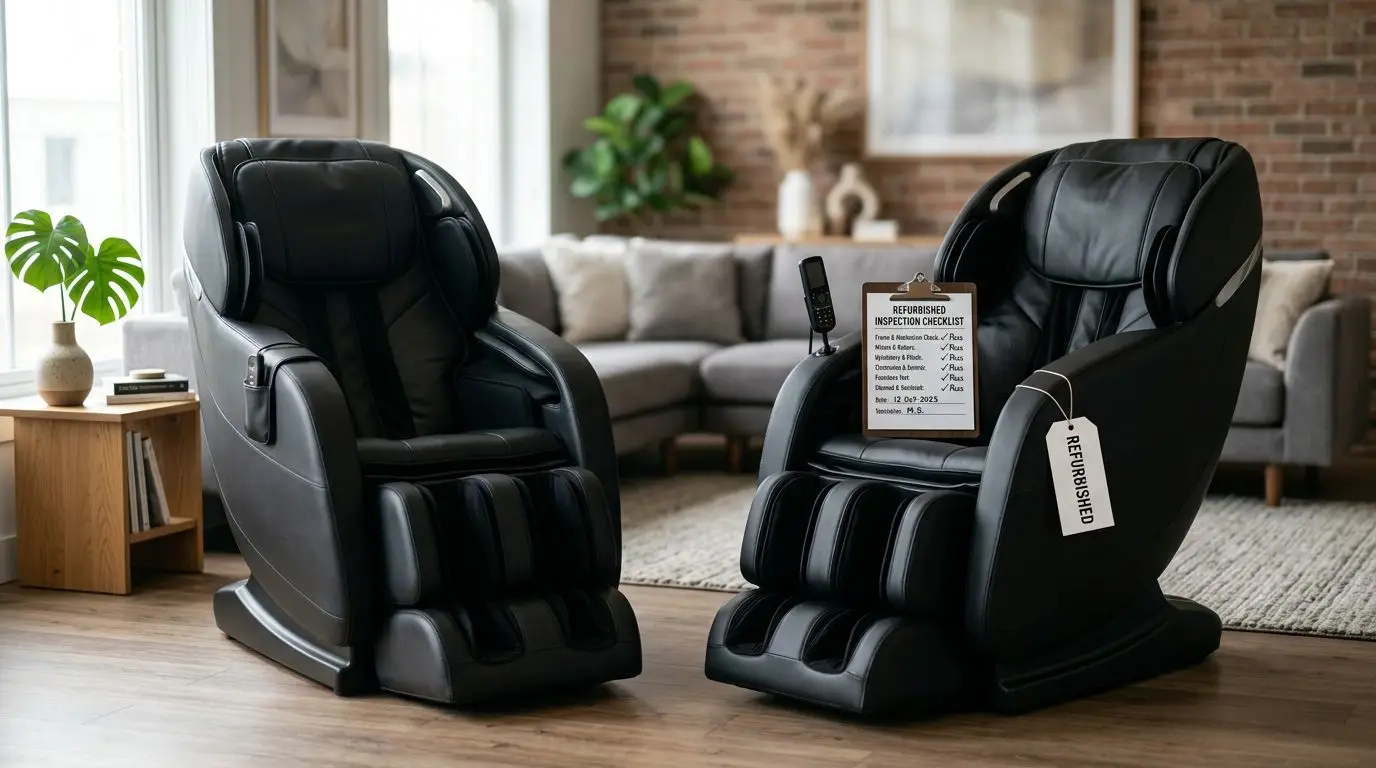
New vs. Refurbished Massage Chairs: Savings, Warranty Trade-Offs, and Buyer Risk
13 min read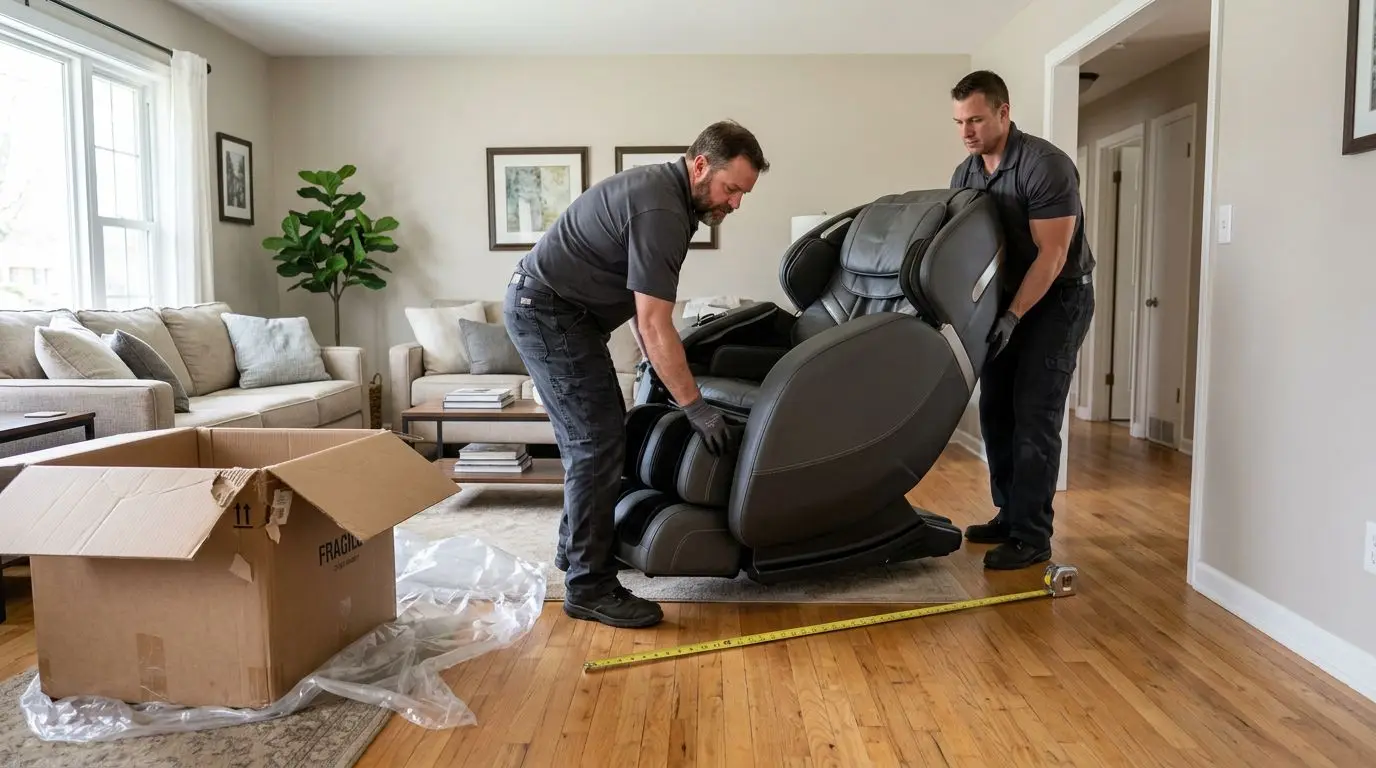
The Hidden Costs of Buying a Massage Chair: Delivery, Setup, Repairs, and Moving
15 min read