Disclosure: We may earn a commission when you buy through links on this page, at no extra cost to you. We buy nothing, sell nothing and accept no payment for coverage — commissions never decide what we recommend. How we make money.
The best-fitting massage chair is the one that lines up its rollers with your shoulders, gives your hips and arms enough room, and lets your legs rest without forcing your knees or ankles into an awkward angle. For tall users, leg extension and back-track length usually matter most. For short users, shoulder scan accuracy, seat depth, and footrest adjustment are often the deciding factors. Before buying, measure your height, seated shoulder height, hip width, inseam, and room space, then compare those numbers with the chair’s published fit range.
Fit is not a small detail. A chair can have strong rollers, heat, air compression, and zero-gravity recline, but if the shoulder position is off by 3 inches or the footrest cannot adjust to your legs, the massage can feel misplaced instead of comfortable.
3 fit features that matter before anything else
Most shoppers look at overall chair size first, but personal fit comes down to 3 areas: shoulder detection, seat width, and leg extension. These features determine where the rollers start, how much space your lower body has, and whether your feet land naturally in the ottoman.
A typical full-size massage chair may be about 29 to 35 inches wide, 45 to 55 inches tall when upright, and 60 to 75 inches long when reclined. Those are room-planning numbers, not a guarantee of body fit. A chair can fit through your door and still be too narrow at the hips or too short through the leg rest.
| Fit area | What it controls | Why it matters |
|---|---|---|
| Shoulder scan | Starting point of the back rollers | Helps the roller path line up with upper-back and neck height |
| Seat width | Hip and thigh space | Affects comfort, posture, and whether arm panels feel tight |
| Leg extension | Footrest and calf-rest position | Helps tall and short users place knees, calves, ankles, and feet naturally |
If you are between sizes, prioritize the part of the chair that cannot be adjusted. Some footrests extend several inches, and some programs let you fine-tune shoulder position. Seat width, arm spacing, and seat depth are usually fixed.
Shoulder scan: why 1 to 3 inches can change the feel
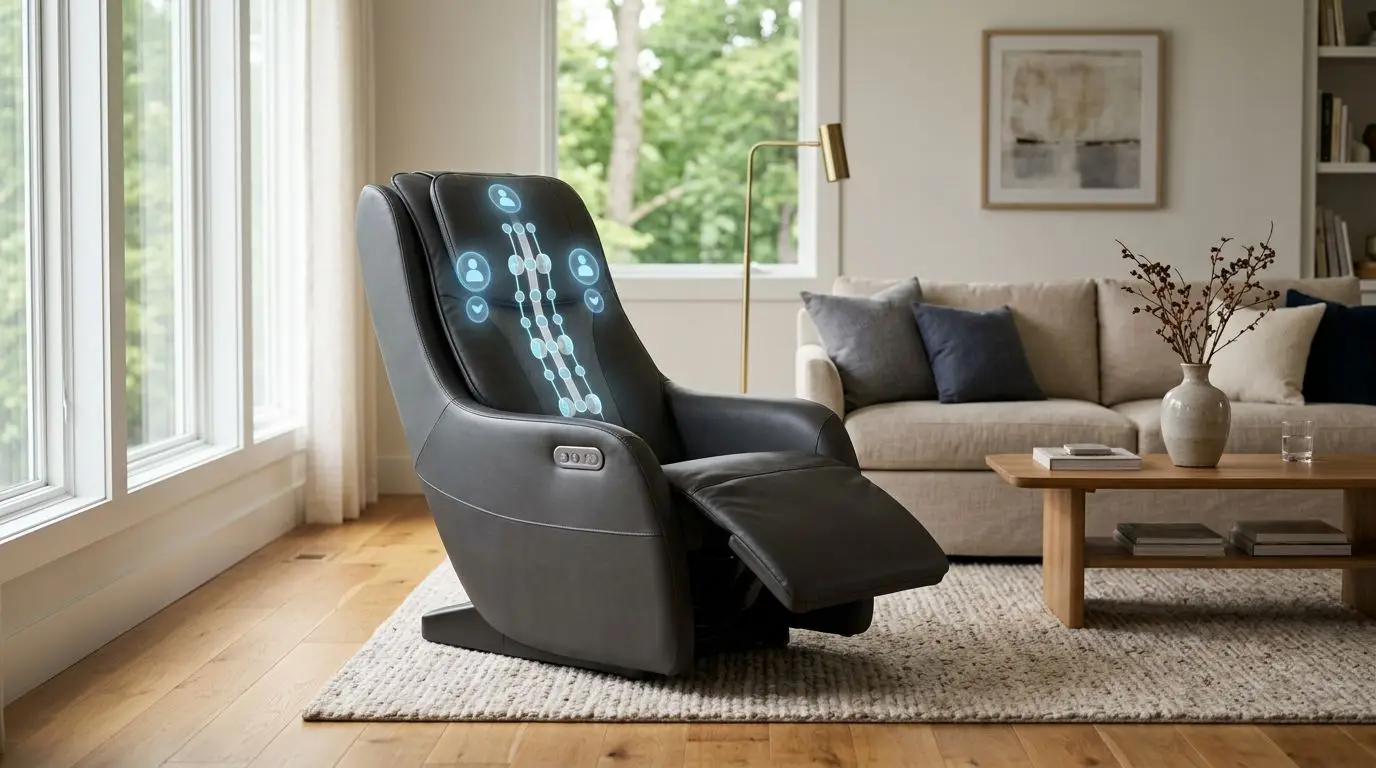
A shoulder scan is the chair’s body-detection step at the start of an automatic program. It usually takes about 30 to 90 seconds. During that time, the rollers move along the back track and try to identify where your shoulders are so the program can scale the roller path to your body.
This matters because the shoulders are the reference point for much of the upper-back and neck coverage. If the scan reads too high, the rollers may spend too much time above your shoulders or press into an area that feels cramped. If it reads too low, the chair may miss the upper-back area you expected it to cover.
Many chairs allow manual adjustment after the scan, often through up and down buttons on the remote. Even a 1-inch adjustment can be noticeable around the neck and shoulders. If you share the chair with someone who is 5 feet 1 inch and someone who is 6 feet 2 inches, manual shoulder adjustment is more than a convenience; it is a practical fit tool.
Short users: watch the headrest and shoulder starting point
Shorter users often sit lower in the chair, especially when the seat is deep. A person around 5 feet tall may need to sit fully back, use the head pillow correctly, and adjust the shoulder point downward after the scan. If the chair has a thick removable pillow, testing with and without it can change how the upper rollers feel.
Tall users: check track length, not just scan accuracy
For taller users, the scan can work only within the chair’s physical track. If the back track does not reach high enough or the headrest pushes the shoulders forward, the scan may be accurate but still limited. Shoppers over about 6 feet 2 inches should look closely at the published height range and, when possible, try the chair in person for at least 10 minutes in a full recline position.
Seat width: measure for at least 2 inches of breathing room
Seat width is one of the most overlooked massage chair dimensions. Many full-size chairs have an inner seat width somewhere around 19 to 23 inches, though the exact number varies by design. The usable width may be narrower than the outside width because arm panels, air cells, and side bolsters take up space.
A good starting rule is to allow at least 2 inches of total side-to-side clearance beyond your seated hip width. If your seated hip width is 20 inches, a 22-inch usable seat gives you basic room. More room may be better if you dislike a tucked-in feeling or plan to wear bulky clothing while using the chair.
Seat width is not only about whether you can sit down. It also changes how the chair positions you. A narrow seat may hold you more centered, which can help roller alignment for some users, but it can also feel restrictive. A wider seat can feel more open, though very small users may shift off-center if the chair lacks supportive shaping.
| Your seated hip width | Minimum usable seat width to consider | Fit note |
|---|---|---|
| 16 inches | 18 inches | Most full-size chairs should have enough width, but seat depth still matters |
| 18 inches | 20 inches | Look for moderate room without excessive side gap |
| 20 inches | 22 inches | Check whether arm panels reduce practical space |
| 22 inches | 24 inches | Fit may be limited; verify the actual inner seat width |
Also check the user weight rating. Many home massage chairs list a maximum user weight in the 250 to 300 pound range, with some designs above or below that. Treat the stated limit as a fit and durability boundary, not a suggestion.
Leg extension: match 4 to 8 inches of travel to your inseam
Leg extension determines how far the foot and calf section can move to match your leg length. Many chairs use spring-loaded footrests, motorized extension, or a sliding ottoman. A common extension range is roughly 4 to 8 inches, though some designs offer less and some offer more.
This feature is especially important for tall people. If the footrest is too short, your knees may stay bent too sharply, your heels may press into the foot pockets, or your calves may not line up with the intended calf area. If the leg rest is too long for a shorter user, the feet may not reach the bottom of the footwell, making foot rollers or air compression feel misplaced.
Do not judge leg fit by standing height alone. Two people who are both 5 feet 10 inches can have different inseams. One may need extra leg extension; the other may fit better in a shorter ottoman. That is why inseam, seated thigh length, and foot size all matter.
Foot rollers and shoe size
Foot roller position is tied to footwell size. A chair may feel fine through the calves but place the arch rollers too far forward or back. If you wear a men’s size 13 or larger, check footwell length. If you wear a women’s size 5 or smaller, check whether your foot can sit flat enough for the rollers to feel centered rather than catching the heel or toes.
How to measure at home in 10 minutes
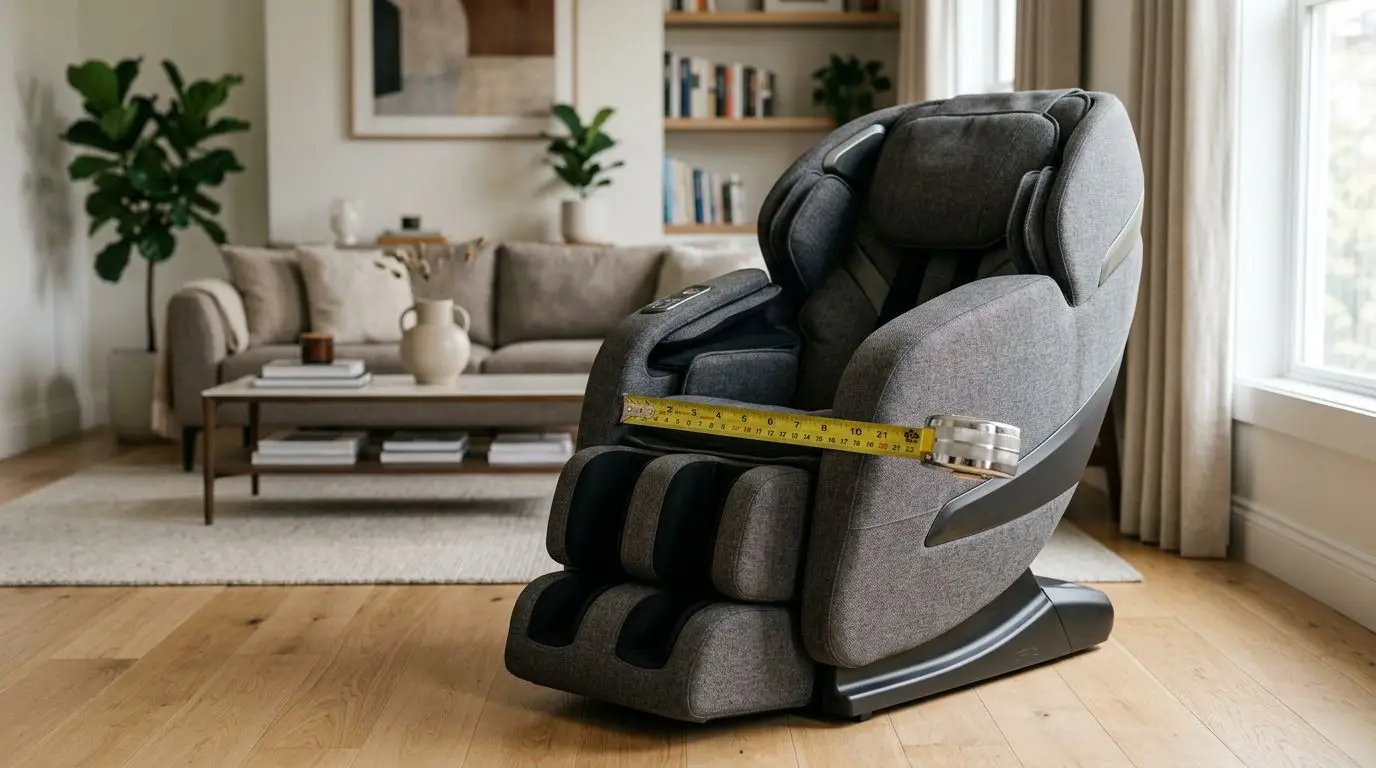
You can get useful fit numbers with a tape measure, a straight chair, and 10 minutes. Wear the kind of clothes you would normally use in the chair. Sit upright with your back against the chair, feet flat on the floor, and knees at about a 90-degree angle.
- Standing height: Measure without shoes. Compare it with the chair’s recommended user height range.
- Seated shoulder height: Measure from the seat surface to the top of your shoulders. This helps you think beyond total height.
- Seated hip width: Measure the widest point across your hips or thighs while seated. Add about 2 inches for baseline clearance.
- Seat depth need: Measure from your lower back to the back of your knee. A seat that is too deep can push shorter users forward.
- Inseam: Measure from crotch to floor, or use your pants inseam as a rough reference. This helps estimate leg-rest fit.
- Foot size: Note shoe size and whether you have wide feet. Footwell shape can matter as much as length.
Compare those numbers with the chair’s specifications. Look for inner seat width, user height range, maximum user weight, upright footprint, reclined length, and required wall clearance. Wall-hugging designs may need only a few inches behind the chair, while other recliners may need 12 to 24 inches or more.
Doorways count too. Many US interior doors are about 28 to 32 inches wide. If the chair’s shipping or assembled width is close to that number, check whether the side panels can be removed for delivery. Do not assume a full-size chair will turn easily through a hallway.
Tall vs. short users: fit priorities from 5 feet to 6 feet 4 inches
Published height ranges are helpful, but they are not perfect. A chair advertised for users from about 5 feet to 6 feet 3 inches may fit many people in that span, yet still feel better for some body proportions than others. Use the range as a first screen, then verify the specific fit features.
| User profile | Fit features to prioritize | Potential issue to test |
|---|---|---|
| Under 5 feet 3 inches | Adjustable shoulder position, shorter seat depth, footrest retraction | Feet may not sit fully in the footwell |
| 5 feet 3 inches to 5 feet 10 inches | Balanced seat width, accurate scan, comfortable head pillow | Most chairs may fit, but intensity and posture still vary |
| 5 feet 11 inches to 6 feet 2 inches | Longer track, leg extension, taller backrest | Upper shoulder coverage and knee angle need checking |
| Over 6 feet 2 inches | Maximum height range, long ottoman travel, larger footwell | Track may not reach as high as expected |
Couples and families should shop for the hardest-to-fit person first. If one user is 5 feet 1 inch and the other is 6 feet 3 inches, choose a chair with both manual shoulder adjustment and meaningful leg extension. A chair that works well only for the average-height user may disappoint everyone else.
Track design: SL, S, and L tracks with 30 to 50 inches of coverage
The back track is the rail system the rollers travel on. It affects coverage from the neck and upper back down toward the lower back, glutes, or upper hamstring area, depending on the design. Track lengths vary, but many home chairs fall roughly in the 30 to 50 inch coverage range.
| Track type | General coverage | Fit consideration |
|---|---|---|
| S-track | Follows the curve of the back | Can feel focused through the back, but usually has less seat-area coverage |
| L-track | Extends from back into seat area | Often adds glute coverage, but the fixed curve may affect very tall or short users differently |
| SL-track | Combines back contour with longer seat-area reach | May offer broader coverage, but still depends on your shoulder scan and seated posture |
More track length is not automatically better. If you are short, a long track with a deep seat may place some roller action lower than expected unless the chair scales well to your body. If you are tall, a longer track may help, but only if the top of the track and shoulder scan align with your upper body.
Feature comparison: which adjustments are worth paying attention to
When comparing chairs, put fit adjustments ahead of decorative extras. A 15-minute automatic program feels much better when the chair starts in the right place, supports your legs, and does not squeeze your hips. The table below shows which features are most useful for different fit concerns.
| Feature | Best for | What to check |
|---|---|---|
| Manual shoulder adjustment | Shared households and short users | Can you move the roller start point after the scan? |
| Motorized leg extension | Tall users and mixed-height households | How many inches of travel are available? |
| Spring-loaded footrest | Simple leg-length adjustment | Does it stay comfortable without constant pressure? |
| Wide seat | Users needing more hip room | Is the listed width inner usable width or outside width? |
| Removable head pillow | Fine-tuning upper-back feel | Does removing it improve shoulder alignment? |
| Adjustable intensity | Different comfort preferences | Are there at least 3 intensity levels? |
Air compression also affects fit. Arm, shoulder, hip, calf, and foot airbags can create a snug feeling. Some users like that held-in sensation; others find it too tight. Look for separate air intensity settings if more than one person will use the chair.
Who it is best for: matching features to 4 shopper types
Different users need different fit solutions. A 6-foot-4 user with long legs is not shopping for the same chair as a 5-foot user who needs the footrest to retract fully. Think in terms of fit problems, not feature lists.
- Tall users: Best served by a longer backrest, published tall-user height range, long leg extension, and larger footwell. Check reclined fit, not just upright fit.
- Short users: Best served by accurate shoulder scanning, manual shoulder controls, shorter effective seat depth, and a footrest that retracts enough for full foot contact.
- Wide-seat shoppers: Best served by verified inner seat width, less aggressive side bolstering, and adjustable air intensity around hips and thighs.
- Shared households: Best served by memory settings if available, manual scan correction, broad height range, and adjustable calf and foot positioning.
If you cannot test the chair locally, read the specifications as carefully as you would for furniture. Check fit dimensions first, then comfort features. A chair that almost fits is not a bargain if you avoid using it after the first week.
Safety and comfort checks before a 20-minute session
A massage chair is a consumer wellness product, not a medical device. It is designed to provide mechanical pressure, movement, warmth, compression, and a reclined resting position. It should not be used as a substitute for medical care or as a way to address a health condition.
Ask your physician before using a massage chair if you are pregnant; have a pacemaker or other implanted cardiac device; have a history of blood clots or take anticoagulants; have osteoporosis; have had a recent fracture or surgery; have spinal disc problems; have neuropathy; or have uncontrolled hypertension. If a feature creates sharp pain, numbness, dizziness, or unusual discomfort, stop using it.
For fit testing, start with a short session of about 5 to 10 minutes on a low-intensity setting. Keep the back pad or pillow in place at first, then adjust only one variable at a time: shoulder height, recline angle, leg extension, air intensity, or foot position. This makes it easier to tell what is helping and what is not.
FAQ: 5 fit questions shoppers ask before buying
What massage chair features matter most for tall users?
Tall users should prioritize the published height range, back-track reach, leg extension travel, and footwell size. If you are over about 6 feet 2 inches, test the chair reclined and make sure your shoulders, knees, calves, and feet all land naturally.
What should short users check first?
Short users should check shoulder scan accuracy, manual shoulder adjustment, seat depth, and whether the footrest retracts enough for the feet to sit flat. A chair can be comfortable in the back but still feel awkward if the feet float above the footwell.
How much seat width do I need?
Measure your seated hip width and add about 2 inches as a practical minimum. If your seated hip width is 20 inches, look for at least 22 inches of usable inner seat width, not just a wide outside frame.
Is an automatic shoulder scan enough?
It helps, but manual correction is valuable. Body scans can misread posture, thick clothing, pillows, or unusual proportions, so the ability to move the shoulder point up or down after the scan is important.
Can one massage chair fit both a tall and short user?
Yes, but only if it has a broad user-height range, adjustable shoulder position, and a leg rest with enough extension and retraction. Shared households should avoid chairs with fixed footrests or limited scan controls.
Frequently asked questions
What massage chair features matter most for tall users? +
Tall users should prioritize the published height range, back-track reach, leg extension travel, and footwell size. If you are over about 6 feet 2 inches, test the chair reclined and make sure your shoulders, knees, calves, and feet all land naturally.
What should short users check first? +
Short users should check shoulder scan accuracy, manual shoulder adjustment, seat depth, and whether the footrest retracts enough for the feet to sit flat. A chair can be comfortable in the back but still feel awkward if the feet float above the footwell.
How much seat width do I need? +
Measure your seated hip width and add about 2 inches as a practical minimum. If your seated hip width is 20 inches, look for at least 22 inches of usable inner seat width, not just a wide outside frame.
Is an automatic shoulder scan enough? +
It helps, but manual correction is valuable. Body scans can misread posture, thick clothing, pillows, or unusual proportions, so the ability to move the shoulder point up or down after the scan is important.
Can one massage chair fit both a tall and short user? +
Yes, but only if it has a broad user-height range, adjustable shoulder position, and a leg rest with enough extension and retraction. Shared households should avoid chairs with fixed footrests or limited scan controls.
Related guides
How to Buy a Massage Chair for Tall, Short, or Plus-Size Users
14 min read
What Size Massage Chair Do You Need? Dimensions, Clearance, and Fit Guide
11 min read
Best Massage Chair Features to Look For Before You Buy
13 min read
Ergonomic Massage Chairs: What “Ergonomic” Really Means Before You Buy
13 min read
How to Choose a Massage Chair for Home Use
14 min read