Disclosure: We may earn a commission when you buy through links on this page, at no extra cost to you. We buy nothing, sell nothing and accept no payment for coverage — commissions never decide what we recommend. How we make money.
An ergonomic massage chair fits your body in seated and reclined positions, supporting a natural posture at the neck, shoulders, lower back, hips, and legs before the rollers ever turn on. Ergonomic does not automatically mean a stronger massage; it should mean proper sizing, consistent support, adjustable recline, and controls you can use without twisting.
That difference matters. A chair can feel intense and still fit poorly if the shoulder rollers miss your frame, the seat is too deep, or the footrest pushes your knees into an awkward angle.
What ergonomic means in a massage chair: 5 fit zones to check
In everyday seating, ergonomic design is about how well a chair supports the body during use. In a massage chair, it also includes how the moving parts work with your shape: the backrest track, shoulder position, seat angle, calf wells, footrest length, armrests, and control layout.
Think in terms of 5 fit zones: head and neck, shoulders, lower back, hips, and legs. If even one of those zones is badly matched, the chair may feel impressive for 3 minutes and irritating after a full 15- or 20-minute session.
| Fit zone | What to look for | Common problem if it misses |
|---|---|---|
| Head and neck | Pillow height, neck roller reach, headrest thickness | Chin pushed forward or neck unsupported |
| Shoulders | Body scan accuracy and shoulder width clearance | Rollers work too high, too low, or too wide |
| Lower back | Lumbar contact in upright and reclined positions | Gap behind the low back or pressure in the wrong spot |
| Hips and seat | Seat width, seat depth, side clearance | Sliding forward, pinching, or uneven pressure |
| Legs and feet | Ottoman length, calf well width, foot roller position | Knees bent too tightly or feet not aligned |
A good ergonomic fit should feel almost boringly correct at first. Your back meets the backrest without effort. Your shoulders line up with the programmed shoulder area. Your hips sit level. You should not need to scoot, brace, or hunch to make the chair work.
Seat depth and width: why 18 to 22 inches can change comfort
Seat depth is one of the easiest specifications to overlook. Many adult recliners are about 18 to 22 inches deep, measured from the front edge of the seat to the point where the backrest begins. That range works for many people, but not for everyone.
If the seat is too deep, shorter users may have to slide backward until their feet no longer rest naturally in the footrest. If the seat is too shallow, taller users may feel as though their thighs are not supported. Either problem can change how the backrest and rollers meet the body.
Width matters as well. Check both the seat width and the shoulder area. A chair can have a roomy seat but a narrower upper back design, especially if it has side panels or shoulder air cells. If you usually need extra space in office chairs, dining chairs, or car seats, do not assume a massage chair will automatically fit.
How to measure seat fit at home
- Sit on a firm dining chair with your back against the chair back.
- Measure from the back of your hips to the crease behind your knee.
- Subtract about 1 to 2 inches so the chair edge does not press directly behind the knees.
- Compare that number with the massage chair’s listed seat depth, if available.
- Measure your hip width while seated, then allow extra side clearance for clothing and natural movement.
Do not treat these numbers as exact science. Padding, recline angle, and the slope of the seat pan can all change the feel. Even so, measuring gives you a useful filter before you focus on rollers and programs.
Lumbar alignment: the 1 place a chair should support without forcing
The lower back is where ergonomic claims often sound better than they feel. A supportive lumbar area should meet the curve of your lower back without forcing you into an exaggerated arch. In a massage chair, that support needs to work in at least 2 positions: upright and reclined.
Look for a backrest shape that maintains contact through the lower back as the chair reclines. Some chairs use a deeper lumbar contour, while others rely on roller pressure and padding. Neither approach is automatically better. What matters is whether your back feels evenly supported instead of pushed in one isolated spot.
This is where track design also matters. An S-track follows the curve of the spine through the back. An L-track continues under the seat toward the glutes and upper hamstrings. An SL-track combines a spinal curve with extended seat coverage. The right choice depends on the coverage you want and how the seat supports your posture.
| Track type | Typical coverage | Ergonomic consideration |
|---|---|---|
| S-track | Neck to lower back | Often follows the back curve closely; less seat coverage |
| L-track | Back through the seat area | Adds glute/upper hamstring coverage; back contour varies by design |
| SL-track | Curved back plus extended seat path | Can balance spinal contour and longer coverage, if the seat fits |
Be careful with the idea that more coverage is always more ergonomic. A long track can be excellent for some users, but if the seat depth is wrong or the roller path feels too firm under the hips, longer coverage may not feel better.
Recline comfort and zero gravity: what a 120 to 170 degree range feels like
Massage chairs vary widely in recline. Some lean back only modestly, while others move into a deep position that may approach about 160 to 170 degrees depending on the design. Many chairs also include a zero gravity-style position, where the legs are elevated and the body reclines to spread contact across the chair.
Zero gravity is a seating position, not a guarantee of better wellness results. Its practical value is comfort and body positioning. For some users, it makes roller pressure feel deeper because more body weight rests against the backrest. For others, especially those who dislike being tilted far back, a moderate recline feels more usable.
Watch the transitions. An ergonomic recline should move smoothly, without making you feel folded at the hips or stretched at the knees. The footrest should extend enough that your heels or arches land where the foot area is designed to meet them.
Questions to ask about recline
- How many recline positions are available: 2, 3, or a continuous motorized range?
- Does the chair require wall clearance, or does it slide forward as it reclines?
- Can you use the chair comfortably for a 15-minute session without adjusting your hips?
- Does the footrest extend manually, automatically, or not at all?
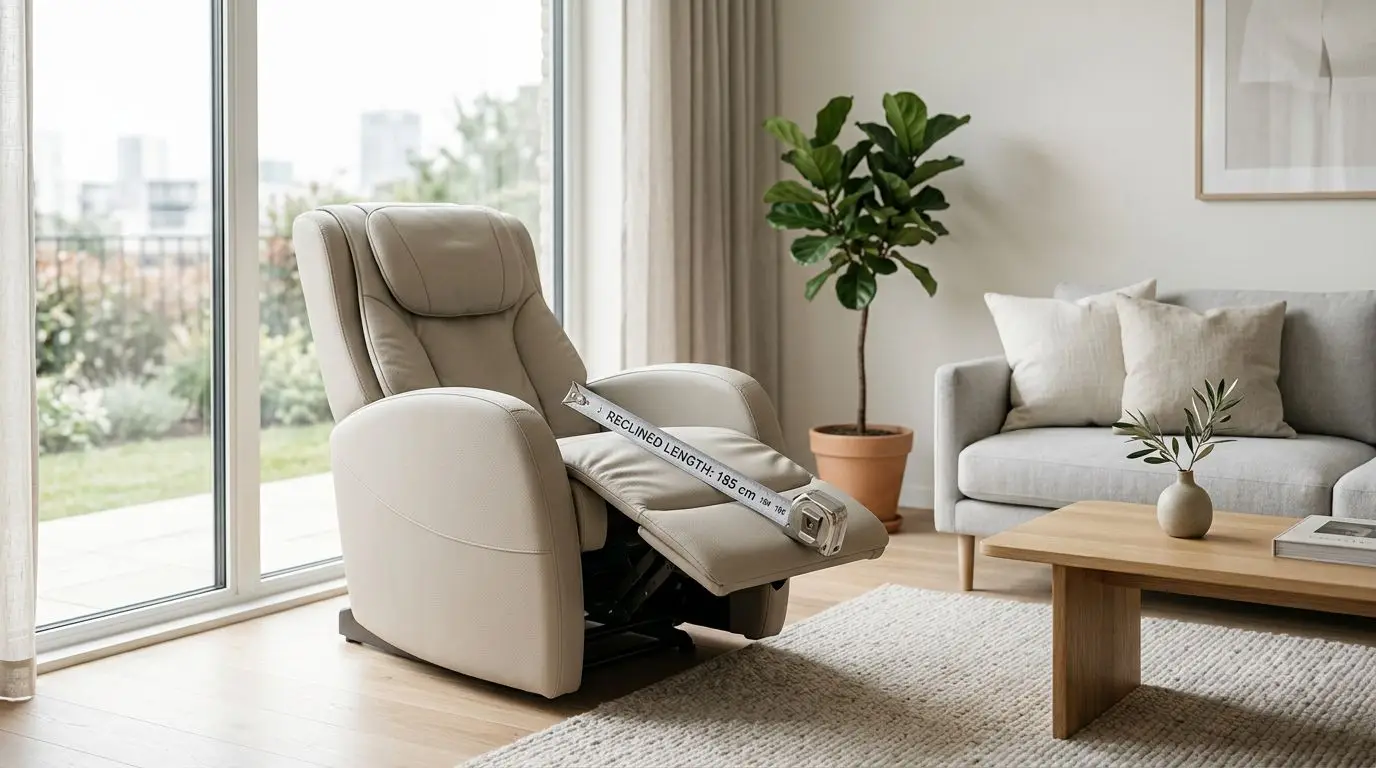
Wall clearance is a real placement issue. Some full-size chairs may need several inches behind them, while space-saving designs can require much less. Always measure the reclined footprint, not just the upright dimensions.
Massage intensity is not ergonomics: 2 different buying questions
Ergonomics and massage intensity are related, but they are not the same thing. Ergonomics asks, “Does this chair fit and support my body?” Intensity asks, “How strong, focused, or broad does the roller and air pressure feel?”
A chair with 3D or 4D rollers may let you adjust depth, speed, and rhythm. That can help if multiple people use the same chair or if you prefer lighter pressure on some days. Still, adjustable intensity cannot fully correct a poor fit. If the shoulder rollers land at the wrong height, turning the intensity down does not make the chair ergonomic.
| Feature | What it changes | What it does not fix |
|---|---|---|
| 2D rollers | Up/down and side-to-side movement | Limited depth adjustment |
| 3D rollers | Adds in/out depth control | Wrong chair size or seat depth |
| 4D rollers | Adds more variation in rhythm or speed, depending on design | Poor shoulder alignment |
| Air compression | Creates a snug squeezing sensation in areas like arms, calves, or shoulders | Incorrect frame width or awkward posture |
| Heat | Adds warmth in selected zones, often the back or calves | Bad lumbar contour or inadequate padding |
If you are shopping specifically for an ergonomic massage chair, start with fit, then choose intensity. That order saves time and lowers the chance of buying a feature-heavy chair you avoid using.
Who ergonomic massage chairs are best for: 6 shopper profiles
An ergonomic design is useful for almost anyone, but it matters more for certain buyers. If you expect to use the chair 4 or more days per week, fit becomes more important than novelty features.
- Desk workers: People who sit for 6 to 8 hours a day often notice small seating differences quickly. Adjustable neck, shoulder, and lumbar support can make the chair easier to settle into.
- Taller users: Anyone near or above 6 feet should check shoulder scan range, backrest height, and ottoman extension before focusing on programs.
- Shorter users: Users near or below 5 feet 3 inches should pay close attention to seat depth, head pillow height, and whether the footrest meets the feet naturally.
- Shared households: If 2 or more adults will use the chair, body scan, adjustable roller width, and multiple intensity levels become more important.
- People sensitive to strong pressure: Softer roller settings, removable pads, and granular intensity controls are worth prioritizing.
- Home office or living room buyers: If the chair will sit in a main room, upright footprint, reclined footprint, and control access matter every day.
This is also where safety belongs, not in tiny print. If you are pregnant, have a pacemaker or other implanted cardiac device, a history of blood clots, use anticoagulants, have osteoporosis, a recent fracture or surgery, spinal disc problems, neuropathy, or uncontrolled hypertension, ask your physician before using a massage chair. A massage chair is a consumer wellness product, not a medical device, and it is not a substitute for professional medical guidance.
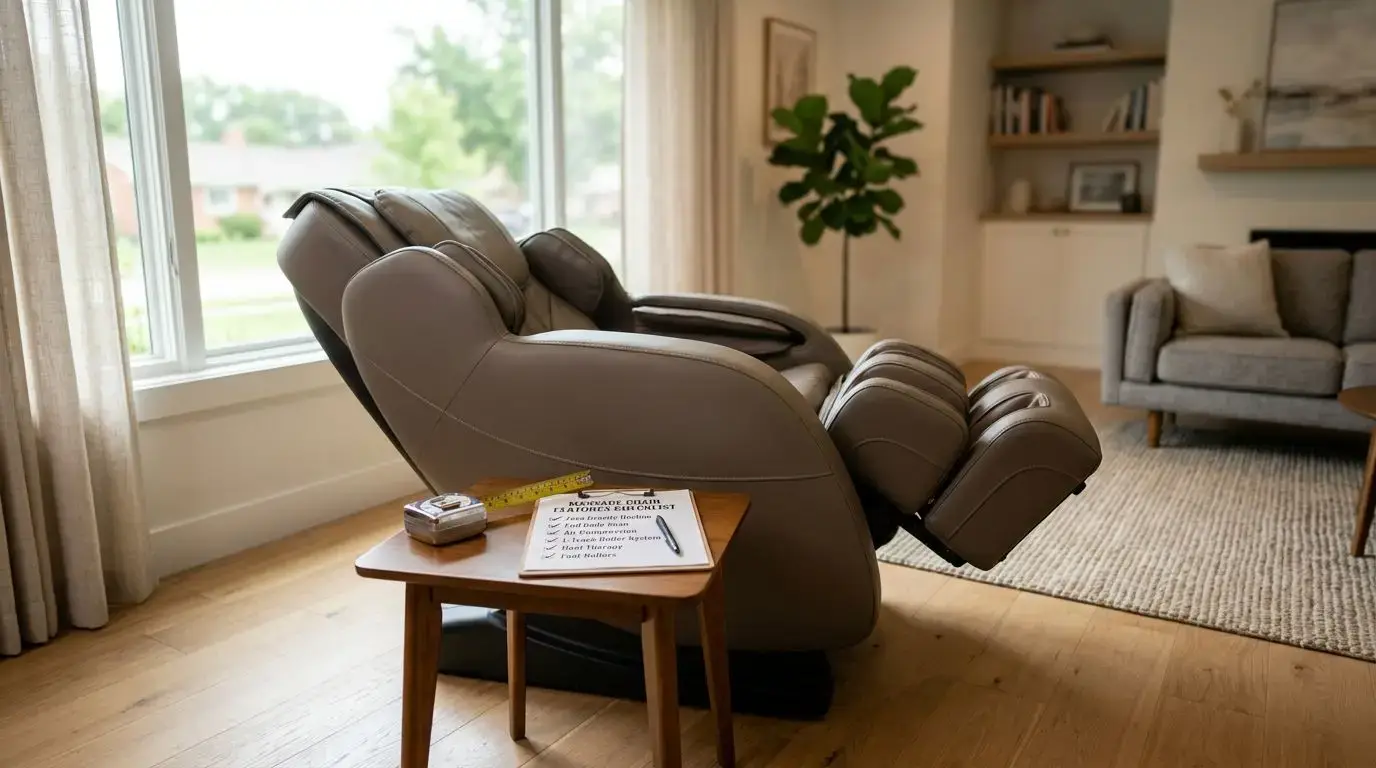
How to choose and measure: a 10-minute ergonomic checklist
You can do a practical pre-purchase check in about 10 minutes with a tape measure, a doorway measurement, and the chair specifications. The goal is not to find a perfect laboratory fit. It is to rule out obvious mismatches before you buy.
Step 1: Measure your body
- Height: Compare your height with the chair’s stated user height range, if provided.
- Seated hip-to-knee length: Use this to estimate seat depth comfort.
- Shoulder height while seated: Helps you judge whether the body scan range may align with your frame.
- Hip and shoulder width: Compare with seat and upper body clearance.
Step 2: Measure your room
- Measure the width of doorways, hallways, and turns. Many full-size chairs are heavy and wide, often well over 30 inches across before packaging details are considered.
- Measure the floor space with the chair fully reclined, not only upright.
- Allow walking clearance. A chair that technically fits can still be frustrating if it blocks a path.
- Check flooring. On hardwood, vinyl, or tile, use a suitable mat or furniture pads to spread weight and reduce marks.
Step 3: Check adjustability
- Body scan with manual shoulder adjustment
- Roller intensity levels, ideally more than 1 or 2
- Removable head or back pads
- Footrest extension range
- Air compression zones that can be reduced or turned off
- Remote or side controls reachable without twisting
Controls are part of ergonomics. If you have to crane your neck, reach behind your hip, or sit up every time you want to reduce intensity, the chair is less user-friendly than it looks on paper.
Feature comparison: 8 ergonomic details that matter more than buzzwords
Feature lists can be long, sometimes 20 or more items. For ergonomic shopping, a shorter list is more useful. Focus on the features that affect how the chair fits, supports, and adapts.
| Ergonomic detail | Why it matters | Good sign |
|---|---|---|
| Body scan | Helps locate shoulders and back shape | Manual correction is available after scanning |
| Seat depth | Affects hip position and leg comfort | Your measured fit leaves 1 to 2 inches behind the knee |
| Backrest contour | Shapes lumbar and mid-back contact | No obvious gap when seated upright |
| Roller width adjustment | Changes shoulder and back coverage | Multiple width settings or adaptive movement |
| Footrest extension | Controls knee angle and foot alignment | Feet land naturally without forcing the knees |
| Removable padding | Lets you soften contact points | Head, neck, or back pads can be repositioned |
| Zone controls | Reduces unwanted pressure in specific areas | Air, rollers, heat, or foot features can be adjusted separately |
| Control placement | Prevents awkward reaching | Remote, screen, or quick buttons are easy to reach while reclined |
Do not pay extra for vague ergonomic language alone. Look for the mechanism behind the claim. If a chair says it is ergonomic but gives no useful information about seat dimensions, user height range, recline, or adjustability, you have little to evaluate.
Common ergonomic mistakes to avoid before a 20-minute session
A long session exposes fit problems quickly. Before you settle into a 20-minute automatic program, take a few minutes to set the chair up correctly.
- Ignoring the shoulder scan: If the scan misses, adjust the shoulder point manually before starting.
- Leaving every feature on high: More pressure does not mean better fit. Start low, especially with rollers and air compression.
- Using the wrong pillow setup: A thick head pillow can push the neck forward. Try repositioning it if your chin feels tucked or lifted.
- Letting the knees float: If the footrest is too short, your legs may not settle. Check extension before judging the whole chair.
- Skipping the owner’s manual: Weight limits, placement clearance, and use instructions vary by chair.
- Assuming one chair fits everyone: A chair that fits a 6-foot user well may feel awkward for someone 5 feet 2 inches tall.
Short sessions are smart when testing a new chair. Begin with about 5 to 10 minutes, use lower settings, and notice whether the chair supports your posture or asks you to adapt to it.
FAQ: 5 buyer questions about ergonomic massage chairs
Is an ergonomic massage chair always better than a regular one?
Not automatically. Ergonomic is meaningful only if the chair’s dimensions, recline, support, and controls fit your body and room. A simple chair that fits well can be more comfortable than a feature-heavy chair that does not.
What is the best track type for ergonomic support?
There is no single best track for everyone. S-tracks tend to follow the back curve, L-tracks extend into the seat area, and SL-tracks try to combine both. The best choice depends on your height, seat fit, and preferred coverage.
How do I know if the seat depth is right?
Sit with your back supported and measure from your hips to the crease behind your knee, then subtract about 1 to 2 inches. Compare that estimate with the listed seat depth when available, and consider footrest reach too.
Does zero gravity make a massage chair ergonomic?
No. Zero gravity-style recline can make the chair feel more settled and change roller pressure, but it does not fix poor seat depth, bad shoulder alignment, or an uncomfortable footrest.
Should I choose stronger rollers for better ergonomics?
Not as a first priority. Stronger rollers change intensity, while ergonomics is about fit and support. Choose a chair that fits your body first, then decide how much roller depth and adjustability you want.
Who should ask a doctor before using one?
Ask your physician before use if you are pregnant, have a pacemaker or other implanted cardiac device, a history of blood clots, use anticoagulants, have osteoporosis, a recent fracture or surgery, spinal disc problems, neuropathy, or uncontrolled hypertension.
Frequently asked questions
Is an ergonomic massage chair always better than a regular one? +
Not automatically. Ergonomic is only meaningful if the chair’s dimensions, recline, support, and controls fit your body and room. A simpler chair that fits well can be more comfortable than a feature-heavy chair that does not.
What is the best track type for ergonomic support? +
There is no single best track for everyone. S-tracks tend to follow the back curve, L-tracks extend into the seat area, and SL-tracks try to combine both. The best choice depends on your height, seat fit, and preferred coverage.
How do I know if the seat depth is right? +
Sit with your back supported and measure from your hips to the crease behind your knee, then subtract about 1 to 2 inches. Compare that estimate with the listed seat depth when available, and consider whether the footrest reaches your feet naturally.
Does zero gravity make a massage chair ergonomic? +
No. Zero gravity-style recline can make the chair feel more settled and can change roller pressure, but it does not fix poor seat depth, bad shoulder alignment, or an uncomfortable footrest.
Should I choose stronger rollers for better ergonomics? +
Not as a first priority. Stronger rollers change intensity, while ergonomics is about fit and support. Choose a chair that fits your body first, then decide how much roller depth and adjustability you want.
Who should ask a doctor before using a massage chair? +
Ask your physician before use if you are pregnant, have a pacemaker or other implanted cardiac device, a history of blood clots, use anticoagulants, have osteoporosis, a recent fracture or surgery, spinal disc problems, neuropathy, or uncontrolled hypertension.
Related guides
How to Choose a Massage Chair for Home Use
14 min read
How to Buy a Massage Chair for Tall, Short, or Plus-Size Users
14 min read
How to Compare Massage Chair Features: 2D, 3D, 4D, L-Track, SL-Track, Heat, and Airbags
13 min read
Shiatsu Massage Chairs: What the Term Means Before You Buy
13 min read
Are Massage Chairs Good or Bad for You? Benefits, Risks, and Safe Use Guidelines
13 min read