Disclosure: We may earn a commission when you buy through links on this page, at no extra cost to you. We buy nothing, sell nothing and accept no payment for coverage — commissions never decide what we recommend. How we make money.
The right massage chair size comes down to five things: the chair’s open and reclined dimensions, wall clearance, your doorway path, user height, and weight capacity. For most homes, expect a chair that is about 30–36 inches wide, 55–63 inches long when upright, and up to 70–80 inches long when fully reclined with the footrest extended.
If space is limited, look for a space-saving recline design and measure before you buy. A chair that works on paper can still fail at delivery if it cannot get through a 30-inch doorway, a narrow hallway turn, or a stair landing.
Typical massage chair dimensions: 30–36 inches wide and 55–63 inches long
Most full-body massage chairs are bigger than a standard recliner because they include a roller track, motorized backrest, leg-and-foot unit, airbags, and a reinforced base. A common size range is about 30–36 inches wide, 45–50 inches high, and 55–63 inches long in the upright position.
Reclined length is the measurement that catches many buyers off guard. Once the backrest tilts and the footrest extends, a massage chair may need about 70–80 inches from front to back. That is nearly the length of a twin mattress, which is typically 75 inches long.
| Chair type | Typical upright footprint | Typical reclined length | Best room fit |
|---|---|---|---|
| Compact massage chair | About 28–32 in. wide by 50–58 in. long | About 65–72 in. | Apartment bedrooms, offices, smaller dens |
| Standard full-body chair | About 30–36 in. wide by 55–63 in. long | About 70–80 in. | Living rooms, spare rooms, media rooms |
| Oversized or big-and-tall chair | About 34–40 in. wide by 58–66 in. long | About 78–85+ in. | Large rooms, open layouts, dedicated wellness spaces |
These are general ranges, not fixed rules. Always use the exact product dimensions from the seller or manufacturer, and confirm whether those measurements include the side panels, controller pocket, calf massager, and fully extended footrest.
Room clearance: plan for 6–12 inches behind a space-saving chair
Wall clearance is the space between the back of the chair and the wall as the chair reclines. Traditional recliners may need 18–24 inches behind them. Many modern massage chairs use a sliding base or forward-glide mechanism and may need only 2–6 inches, while other space-saving designs are closer to 6–12 inches.
Do not assume “zero clearance” means the chair can touch the wall. You still need room for the chair to move, for airflow around motors, and for your hand to reach the power switch or cord if the outlet is behind the chair. A practical minimum is often 3 inches more than the stated requirement.
| Placement area | Suggested clearance | Why it matters |
|---|---|---|
| Behind the chair | 2–24 in., depending on recline design | Prevents wall contact during recline |
| In front of the chair | 18–30 in. beyond footrest travel | Lets users enter, exit, and walk around safely |
| Each side | 4–8 in. minimum | Allows arm movement, remote storage, and cleaning |
| Outlet access | Within cord reach; avoid stretched cords | Reduces trip hazards and plug strain |
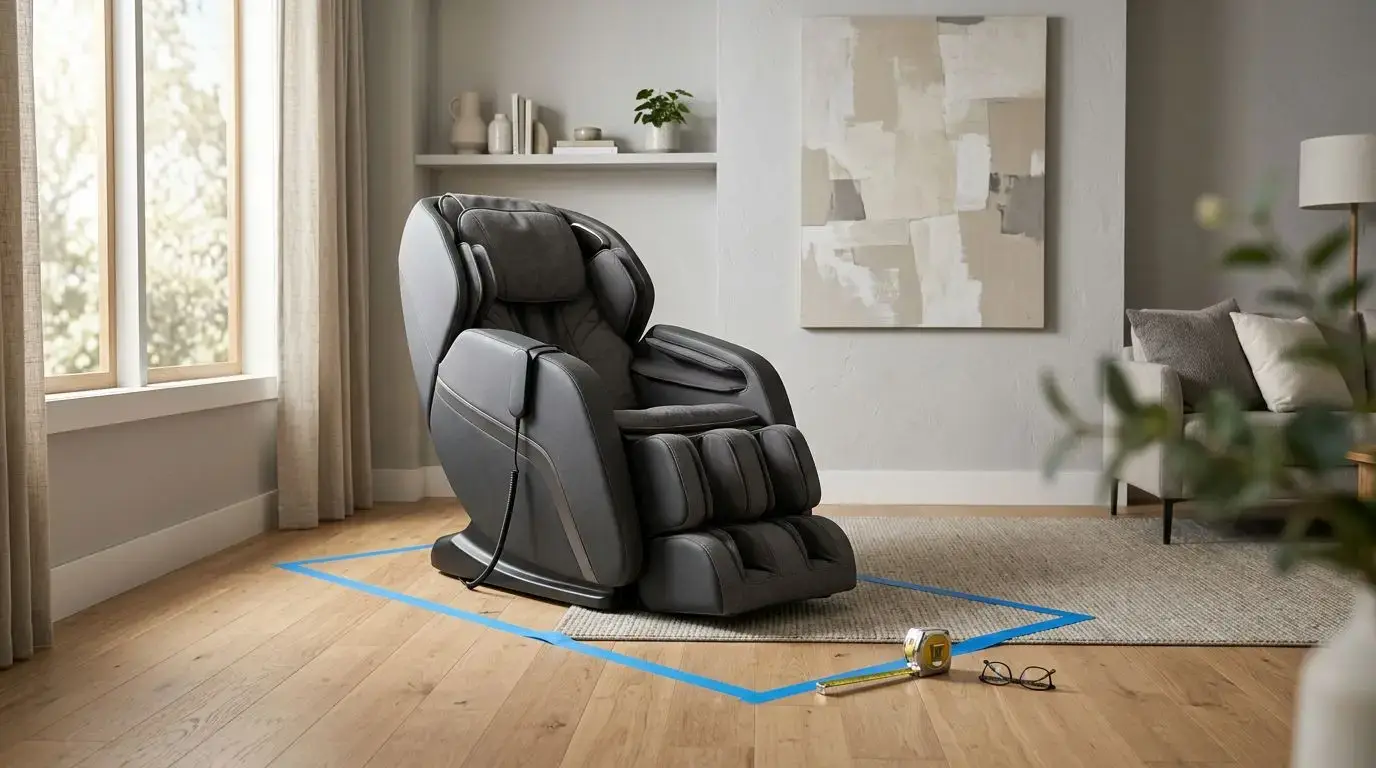
For a simple room check, mark the upright footprint on the floor with painter’s tape, then mark the fully reclined footprint in a second color. Sit in a nearby chair and see whether the taped area blocks a walkway, cabinet, closet door, or TV viewing angle.
Doorways and delivery path: measure every 30-inch opening and tight turn
A massage chair may fit the room without fitting the route to the room. Before delivery, measure the narrowest doorway, hallway, stair turn, and landing. Many interior doorways are about 28–32 inches wide, which can be tight for a chair with a 30–36 inch outside width.
Width is only part of the delivery challenge. A chair can sometimes be turned on its side, have the side panels protected, or be brought in with the footrest partially removed, but do not count on disassembly unless the seller confirms it in writing. Large chairs can weigh 150–300 pounds, so tight stairs and sharp turns need serious planning.
- Measure door width from the narrowest point, not trim to trim if hinges or stops reduce the opening.
- Measure hallway width, especially at corners where the chair must pivot.
- Check ceiling height on stairs; low ceilings can block a tall chair from rotating.
- Remove small obstacles before delivery, including rugs, plant stands, shoe racks, and wall art.
- Confirm whether packaging dimensions are larger than the assembled chair dimensions.
If your doorway is 30 inches wide and the chair is listed at 31 inches wide, ask whether any panels can be removed and whether the delivery team is allowed to do it. The answer depends on the chair type and delivery service.
User fit: match height range, shoulder width, and 250–350 lb capacity
Room fit is only half of sizing. The chair also has to fit the person using it. Many full-body massage chairs are designed for users roughly 5 feet to 6 feet 2 inches tall, while big-and-tall designs may support users closer to 6 feet 4 inches or more. Compact chairs may feel short for anyone with long legs.
Check the stated weight capacity carefully. Many chairs fall somewhere around 250–300 pounds, while larger reinforced chairs may be rated around 300–350 pounds or higher. Do not treat weight capacity as a suggestion; exceeding it can affect frame stress, motor performance, warranty coverage, and user safety.
Shoulder width matters because upper-body airbags, armrests, and side panels create a fixed seating envelope. A user with broad shoulders may prefer a wider chair even if their height and weight are within range. Seat width can vary, but many massage chairs provide about 18–22 inches of usable seat space.
| User measurement | What to check | Fit concern if ignored |
|---|---|---|
| Height | Published height range and leg extension range | Neck rollers may hit too high or too low |
| Weight | Rated weight capacity, often 250–350 lb | Added motor and frame strain |
| Shoulder width | Interior backrest and airbag space | Pinched feeling around upper body |
| Leg length | Ottoman extension and calf/foot unit depth | Knees may bend awkwardly or feet may not align |
Massage should feel secure, not cramped. If two or more people will use the chair, size it for the tallest or broadest regular user, then choose adjustable intensity settings so smaller users can still get a comfortable session.
How to measure your space in 15 minutes
You can size a massage chair quickly with a tape measure, painter’s tape, and the chair’s published dimensions. Set aside about 15 minutes and measure twice: once for the room and once for the delivery path.
Step 1: Mark the upright footprint
Find the chair’s upright width and length. If the chair is 34 inches wide and 60 inches long, tape a 34-by-60-inch rectangle on the floor where you want it to sit. Leave at least 4 inches on each side if the chair has side controls, arm airbags, or a remote pocket.
Step 2: Mark the reclined footprint
Next, mark the full recline length, including the extended footrest. If the chair extends to 78 inches, mark that full depth from the back of the reclined position to the front of the footrest. This measurement determines whether the chair blocks a walkway.
Step 3: Check wall clearance
Look up the required wall clearance, then add a small buffer. If the listed clearance is 4 inches, plan for 6–8 inches if the room allows. This helps account for baseboards, uneven walls, plugs, and slight placement changes.
Step 4: Walk the delivery route
Measure the narrowest door, hallway, and turn. Write down the smallest number. If the tightest point is 29 inches and the packaged chair is 33 inches wide, you need a different delivery plan or a different chair size.
Step 5: Test daily use
Stand inside the taped area and act out normal use: walking to the seat, sitting down, swinging your legs in, reclining, getting up, and reaching the outlet. If you bump into a coffee table or block a closet door, adjust the layout before ordering.
Feature trade-offs: SL tracks, footrests, and zero gravity can add 5–15 inches
Massage chair features affect size. A longer roller track, a larger calf-and-foot massager, and a deeper recline mechanism can all increase the footprint. The difference between a compact chair and a feature-heavy full-body chair can easily be 5–15 inches in reclined length.
| Feature | Space impact | Fit note |
|---|---|---|
| S-track | Usually shorter back coverage | May fit smaller frames and compact chairs |
| L-track | Extends under the seat | Can require a longer base than basic back-only designs |
| SL-track | Combines curved back coverage with seat coverage | Often found in larger full-body chairs |
| Zero gravity recline | Requires recline travel and footrest lift | Check full recline length, not just upright size |
| Enclosed foot-and-calf unit | Adds front depth and leg alignment needs | Important for tall users and shared households |
| Arm and shoulder airbags | Adds side bulk | Check overall width and interior width |
Track type is about massage coverage, not room fit alone. An S-track follows the curve of the spine. An L-track continues into the glute area. An SL-track combines a curved back path with extended seat coverage. Longer tracks may improve coverage for some users, but they often come in larger chairs.
Zero gravity is another sizing variable. It tilts the body back and lifts the legs to distribute body weight more evenly. Many people find that position relaxing, but it does not mean the chair is medically necessary or guaranteed to relieve pain. Treat it as a comfort feature and measure its reclined footprint carefully.
Who each size is best for: apartments under 900 square feet to large rooms
A small apartment can still fit a massage chair, but the chair should be chosen around the actual traffic pattern. In a room under 900 square feet, a compact or space-saving chair usually makes more sense than an oversized design. In a larger room, user fit may matter more than every inch of footprint.
Compact chairs
Best for apartments, bedrooms, offices, and users who prefer a smaller seating feel. They are often easier to place near a wall and may be easier to route through narrow doorways. The trade-off is less room for broad shoulders, long legs, or heavier users.
Standard full-body chairs
Best for most homes with a dedicated corner, spare room, or media room. A standard chair usually balances features and footprint, with enough room for average-height adults and common features such as back rollers, airbags, heat zones, and a leg-and-foot unit.
Oversized or big-and-tall chairs
Best for taller, broader, or heavier users, especially when the main user is over about 6 feet 2 inches or close to the upper end of a standard weight rating. These chairs need more delivery planning and more open floor space, but they can be the better fit when comfort and capacity are the priority.
For shared households, avoid buying only for the smallest user. A chair that fits a 5-foot-4 user comfortably may not align well for a 6-foot-3 user, especially at the neck, shoulders, knees, and feet.
Common setup mistakes to avoid before delivery day
The biggest sizing mistakes are usually preventable. Most take less than 10 minutes to check, but they can save you from rescheduling delivery or living with a chair that blocks the room.
- Measuring only the upright chair. Always check the reclined length with the footrest extended, which can reach 70–80 inches on many full-size chairs.
- Ignoring the box size. Packaging may be several inches larger than the assembled chair.
- Forgetting baseboards and outlets. A 4-inch clearance requirement may not account for a plug sticking out of the wall.
- Placing the chair on a thick rug. A heavy chair can compress carpet and become harder to move for cleaning or repositioning.
- Blocking a walkway. Leave at least 24–30 inches for a comfortable walking path in busy rooms.
- Buying at the weight limit. If a regular user is close to the rated capacity, consider a higher-capacity chair instead of operating at the limit every day.
Also consider flooring. On hardwood, tile, or vinyl plank, use a protective mat if recommended for the chair’s weight and base design. On carpet, confirm that the chair can sit level and recline smoothly without rocking.
FAQ: 5 massage chair sizing questions buyers ask before ordering
How much space do I need for a massage chair?
For many full-size chairs, plan for a footprint around 30–36 inches wide and up to 70–80 inches long when reclined. Add side clearance, walking space, and the required wall clearance. A compact chair may need less, while an oversized chair may need more.
Can a massage chair fit through a 30-inch door?
Sometimes, but not always. A 30-inch doorway is tight for many full-body chairs, especially when packaging or fixed side panels add width. Measure the chair, the box, and the doorway at the narrowest point, then ask whether any parts can be removed for delivery.
How far from the wall should a massage chair be?
It depends on the recline mechanism. Some space-saving chairs need only about 2–6 inches, while traditional recline designs may need 18–24 inches. Use the stated clearance and add a small buffer if the room allows.
What weight capacity should I choose?
Choose a chair rated above the heaviest regular user, not right at the limit. Many chairs are rated around 250–300 pounds, while larger designs may be rated around 300–350 pounds or more. Staying within the rating helps protect the frame, motors, and user safety.
Is a compact massage chair enough for tall users?
Usually not if the user is well over 6 feet tall. Tall users should check the published height range, ottoman extension, neck roller position, and shoulder space. A longer chair with an adjustable leg unit is often a better fit.
Should I choose chair size based on the room or the user?
Both matter, but safety and user fit come first. If the chair does not support the main user’s height or weight, it is the wrong size even if it fits the room. If the chair fits the user but blocks a doorway or walkway, choose a smaller design or a different location.
Frequently asked questions
How much space do I need for a massage chair? +
For many full-size massage chairs, plan for about 30–36 inches of width and up to 70–80 inches of length when fully reclined. Add wall clearance, side clearance, and walking space around the chair.
Can a massage chair fit through a 30-inch doorway? +
Sometimes, but it depends on the chair and packaging dimensions. Measure the doorway at its narrowest point and confirm whether the chair can be turned, unpacked, or partially disassembled for delivery.
How far from the wall should a massage chair be? +
Space-saving massage chairs may need about 2–6 inches behind them, while traditional recline designs may need 18–24 inches. Always follow the stated clearance and allow a small buffer.
What weight capacity should I look for? +
Choose a chair rated above the heaviest regular user. Many massage chairs are rated around 250–300 pounds, while larger designs may support around 300–350 pounds or more.
Are compact massage chairs good for tall users? +
Compact chairs can feel short for tall users. Check the height range, leg extension, neck roller position, and seat space before buying, especially for users over about 6 feet tall.
Should I measure the room or the delivery path first? +
Measure both before ordering. A chair that fits the room can still fail delivery if it cannot clear the doorway, hallway turn, stair landing, or packaged width.
Related guides
Where Should You Put a Massage Chair at Home? Room-by-Room Placement Guide
13 min read
How to Buy a Massage Chair for Tall, Short, or Plus-Size Users
14 min read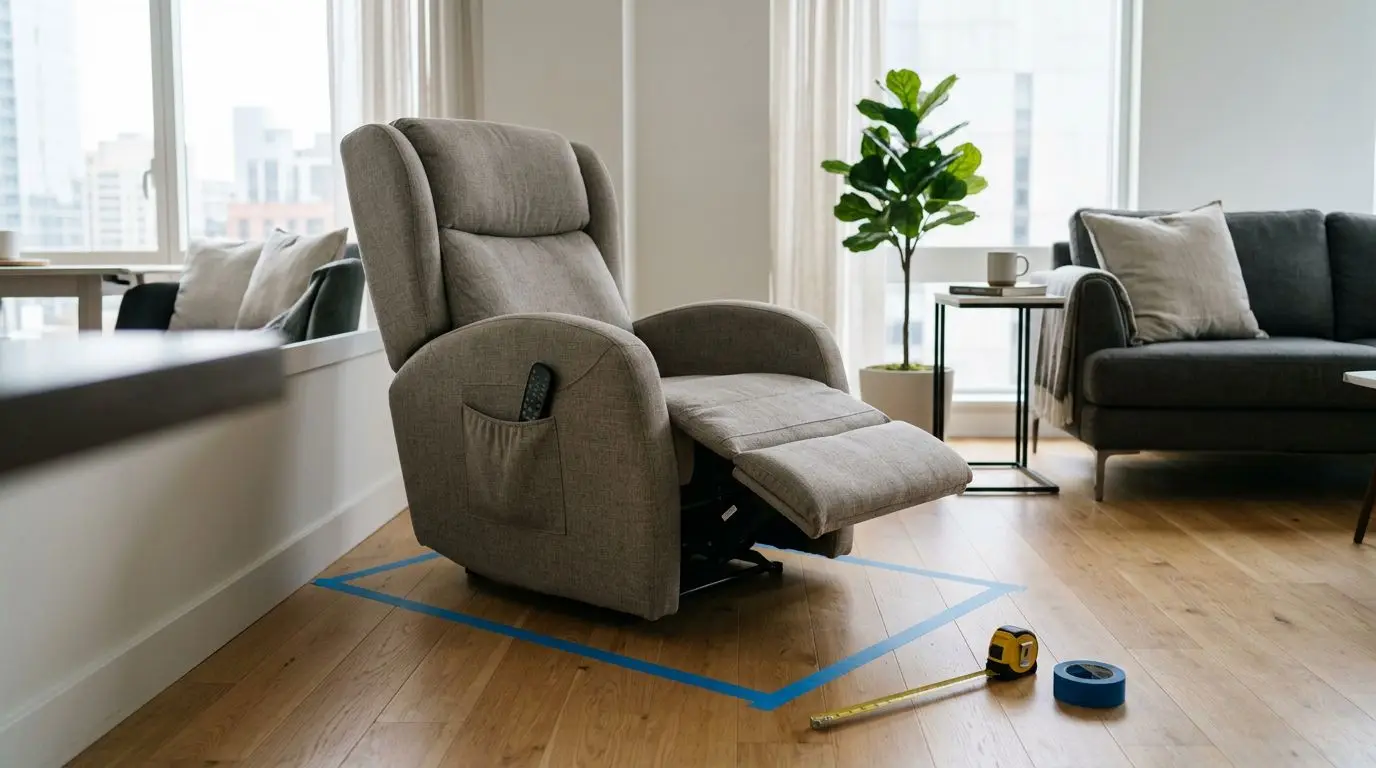
Space-Saving Massage Chairs Explained: How Wall-Hugger Recline Works in Real Homes
13 min read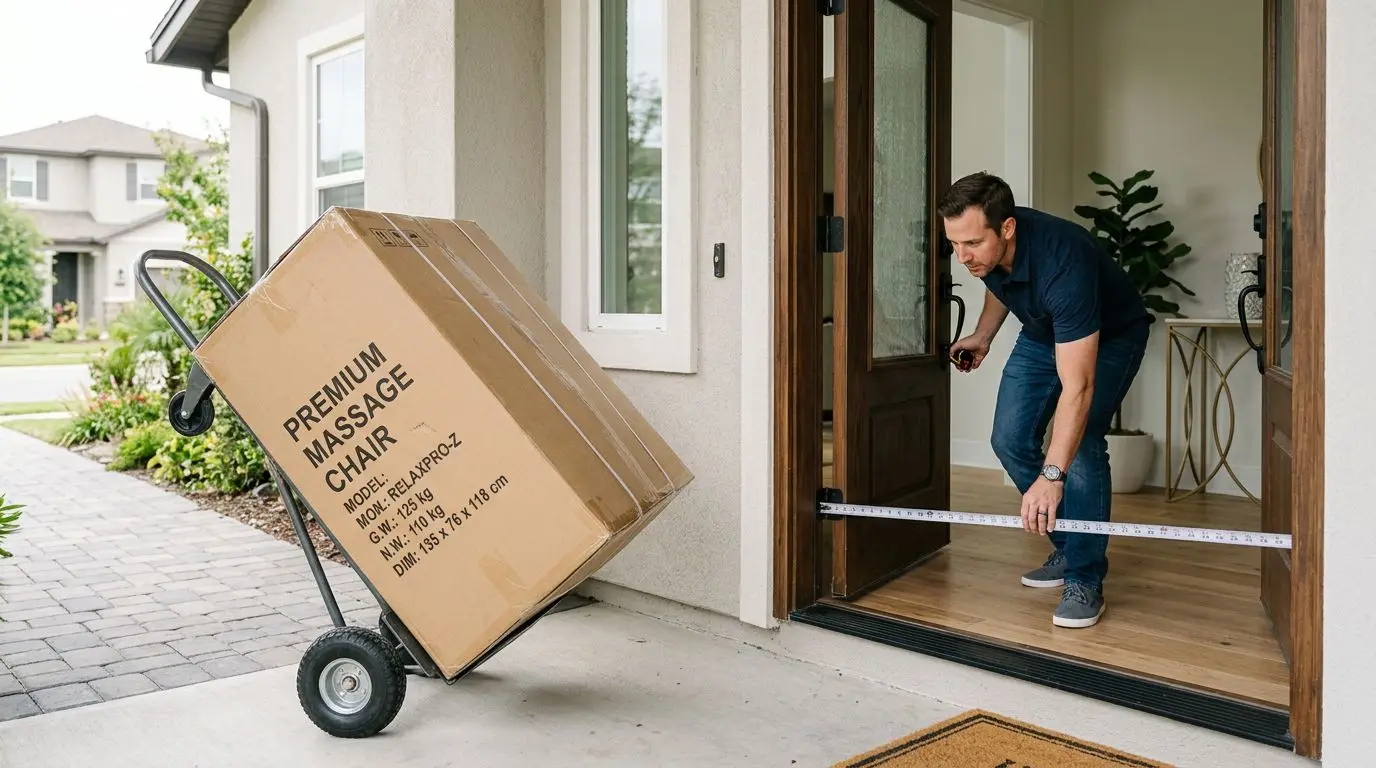
Will a Massage Chair Fit Through Your Door? Measuring Doorways, Hallways, Stairs, and Elevators
13 min read
Compact Massage Chairs for Small Spaces: What to Know Before Buying
12 min read