Disclosure: We may earn a commission when you buy through links on this page, at no extra cost to you. We buy nothing, sell nothing and accept no payment for coverage — commissions never decide what we recommend. How we make money.
A massage chair will fit through your door only if its smallest pass-through dimension is less than the narrowest point along your delivery path, with at least 1 to 2 inches of working clearance. Most full-size chairs take more planning than a sofa because the boxed unit can be bulky, heavy, and hard to turn in tight halls or on stair landings.
The safest approach is to measure the chair, the shipping box, every doorway, each hallway turn, stairs, elevator doors, and the final room clearance before delivery day. If the numbers are close, ask whether the chair can be delivered unboxed, partially disassembled, or moved by an experienced white-glove team.
Quick fit check: 3 measurements that decide delivery
Start with three numbers: the narrowest doorway, the tightest turn, and the chair or box depth. If any one is too small, delivery can fail even when the front door looks wide enough.
Many U.S. interior doors are about 28 to 32 inches wide, while many exterior doors are about 32 to 36 inches wide. That can sound generous until you subtract trim, hinges, door handles, storm doors, railings, and the thickness of packaging. A 34-inch front door may leave only 32 inches of usable opening once the door is swung open.
Massage chairs vary by style, but many full-size units are roughly 30 to 36 inches wide, 45 to 65 inches long when upright or reclined, and about 180 to 350 pounds. The boxed size can be larger in every direction. Compact chairs may be easier to place, while zero-gravity, enclosed, or feature-heavy chairs can be bulkier.
| Fit checkpoint | What to measure | Practical target |
|---|---|---|
| Doorway | Usable width with door open | Chair or box width plus 1 to 2 inches |
| Hallway turn | Hall width before and after the turn | Enough room to rotate a 4 to 5 foot object |
| Stairs | Stair width, landing depth, railing clearance | No tight 90-degree landing with zero extra space |
| Elevator | Door width, cab depth, cab height | Enough diagonal room for the box or chair |
| Final room | Chair footprint plus recline clearance | Often 4 to 12 inches behind wall-hugger designs, more for standard recliners |
Do not rely on square footage alone. A large living room will not help if the delivery path includes a 29-inch basement door or a 36-inch stair landing with a fixed railing.
Boxed vs. unboxed: a 4 to 10 inch difference can matter
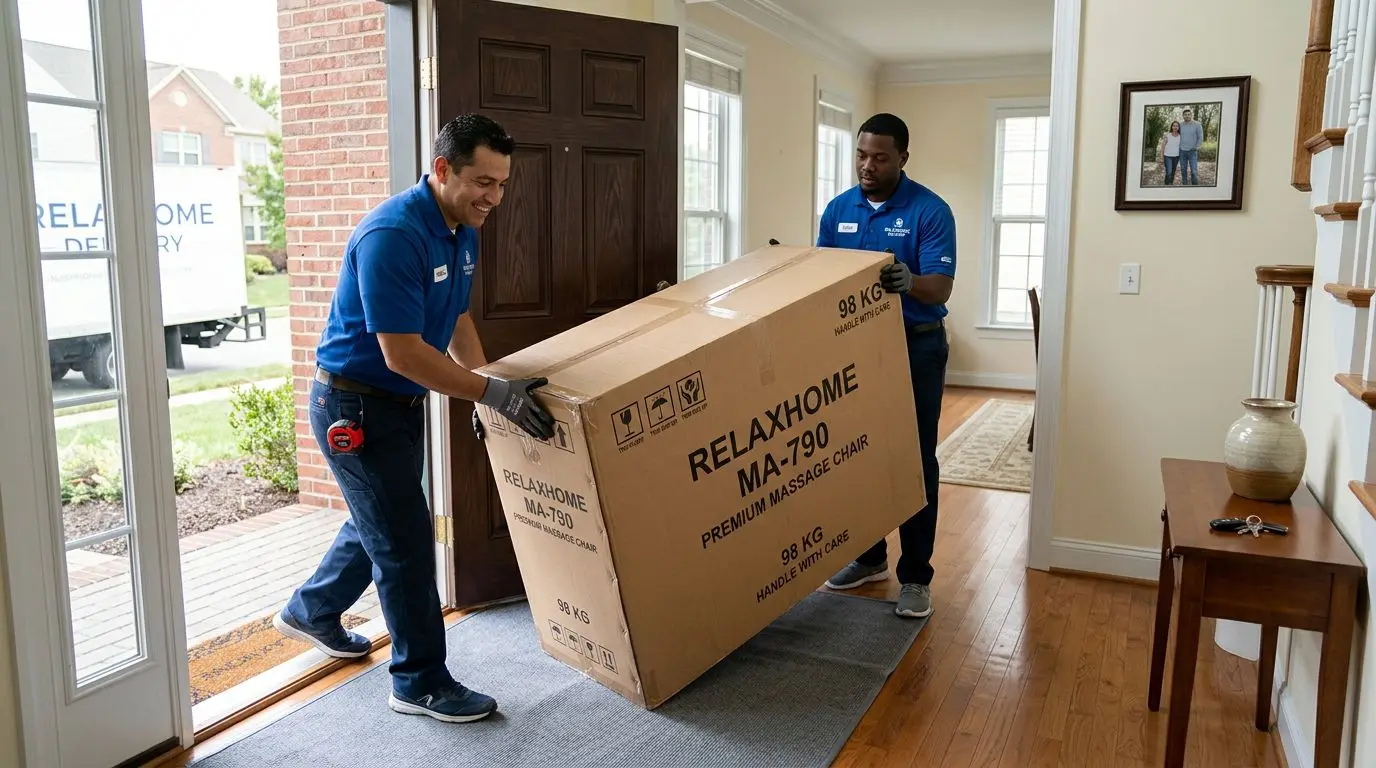
The box is often the deal-breaker. Packaging protects the chair, but it also adds bulk. Depending on the chair type, the carton may add several inches to the width, depth, or height, and its squared-off corners can make it harder to pivot.
As a general planning range, a boxed massage chair may be about 30 to 40 inches wide, 48 to 65 inches long, and 30 to 48 inches high. Those figures do not replace exact product specifications, but they show why a chair with a 31-inch body may not pass through a 31-inch hallway while still boxed.
Unboxed delivery can reduce bulk, but it also removes the protective shell. That may be fine for a straight path through a wide front door, but it can be risky around brick steps, tight stairwells, or sharp corners. If unboxing is necessary, confirm who carries the damage risk and whether the delivery team is allowed to remove packaging before the chair reaches the room.
| Delivery form | Typical advantage | Typical concern | Best use case |
|---|---|---|---|
| Boxed | Best protection during transport | Largest dimensions and square corners | Wide doors, straight halls, garage entry |
| Unboxed | May save 4 to 10 inches in spots | More exposure to scuffs and bumps | Tight interior turns with careful handling |
| Partially disassembled | Can reduce arm or side width | Not every chair is built for this | Narrow doorways where side panels are removable |
| Threshold delivery | Lower service complexity | You handle indoor placement | Ground-floor garage or wide entry |
| White-glove delivery | Placement and setup may be included | Limits vary by carrier and stairs | Stairs, elevators, condos, tight paths |
Ask for the boxed and unboxed dimensions in writing. If only product dimensions are listed, request the carton measurements before scheduling delivery.
How to measure doors, halls, stairs, and elevators in 30 minutes
You can complete a useful fit survey in about 30 minutes with a tape measure, phone camera, notepad, and a second person if stairs are involved. Measure the actual route the delivery team will use, not the route you wish they could use.
Step 1: Choose the delivery path
Pick the most direct path from truck to final room. Include the driveway, porch, exterior steps, lobby, elevator, hall, interior doors, and the exact resting place. If you have two possible entries, measure both. A back door with 3 porch steps may be better than a front door with a narrow foyer.
Step 2: Measure usable doorway width
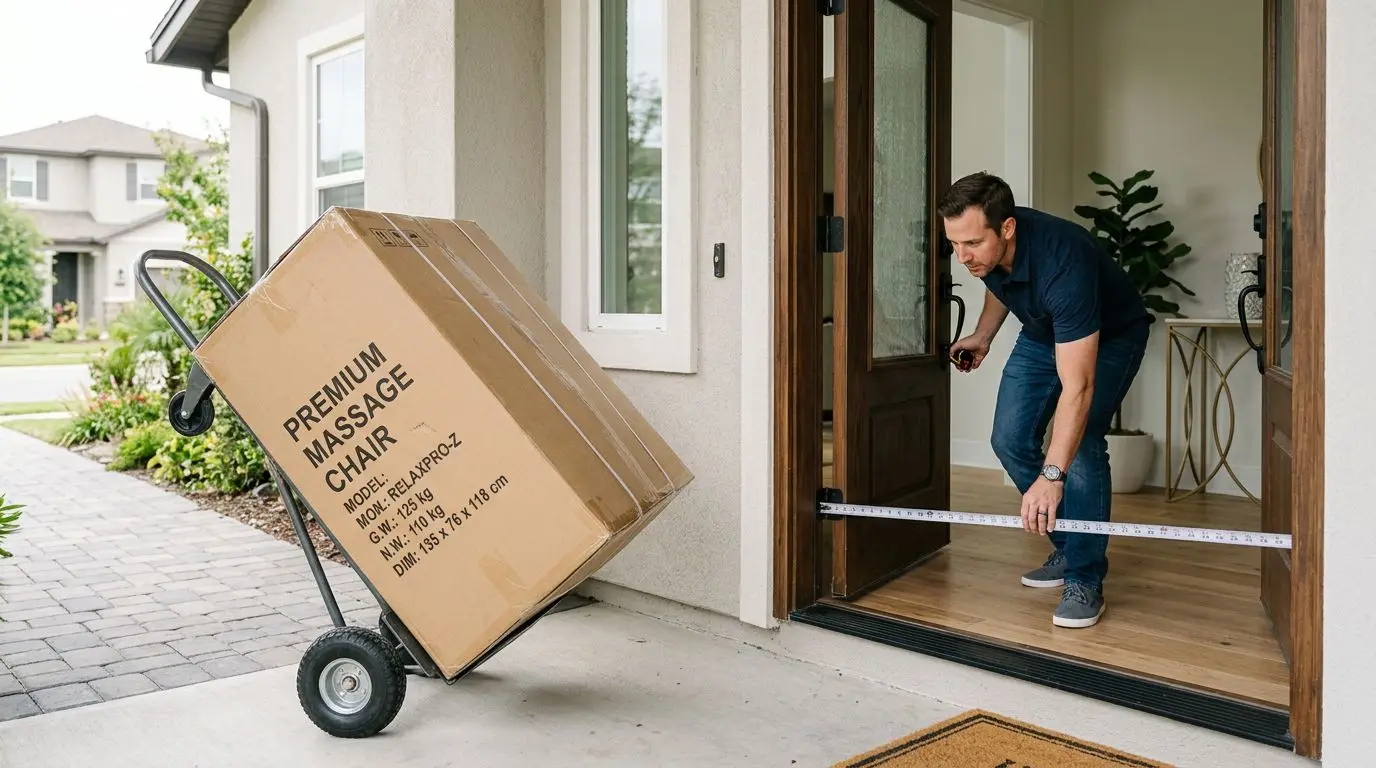
Open the door as far as it will go. Measure from the inside edge of the frame to the door face, not just trim to trim. Remove nothing yet; measure the real opening first. Then note whether removing hinge pins, door handles, or a storm door could add 1 to 3 inches.
Step 3: Measure height and thresholds
Most fit problems involve width, but height matters for boxed delivery and elevators. Measure the doorway height and note raised thresholds over about 1 inch. A heavy chair can catch on a lip, especially when it is on a hand truck.
Step 4: Measure hallway width and turn radius
Measure the narrowest hallway width. At turns, measure both hallway widths plus the open space at the corner. A 32-inch hall connected to another 32-inch hall may still be too tight if the chair must rotate 90 degrees and the box is long.
Step 5: Measure stairs and landings
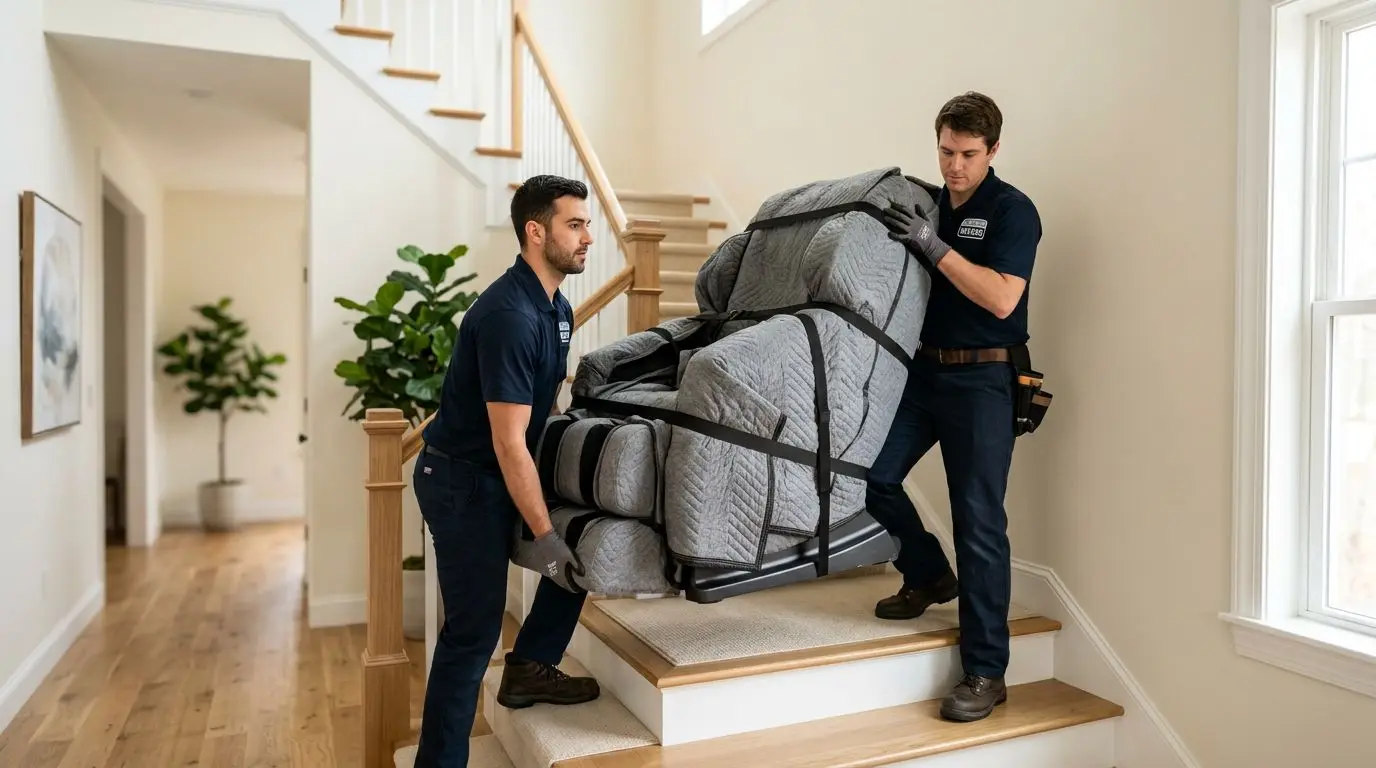
For stairs, measure the width from wall to railing, not wall to wall. Then measure landing depth and height clearance. A landing under 40 inches deep can be a problem for a large boxed chair because the team may not be able to set it down and pivot safely.
Step 6: Measure elevator door and cab
Elevators need three measurements: door width, cab depth, and cab height. Also measure the diagonal from the back floor corner to the opposite front upper area if the box may need to tilt. Some residential or older building elevators have doors around 36 inches wide but shallow cabs that make long boxes difficult.
Step 7: Map the final room clearance
Once inside, the chair still needs operating space. Many wall-hugger designs are made to sit about 4 to 6 inches from the wall, while standard reclining layouts may need 12 inches or more behind the chair. Leave walking space around footrests and side controls, too. A chair that fits through the door can still feel cramped in a small room.
- Write down the narrowest measurement on the entire path.
- Take photos of tight turns, stairs, and elevator doors.
- Mark removable obstacles such as doors, pictures, small tables, and rugs.
- Share measurements with the seller or delivery coordinator before the appointment.
Massage chair types and space demands: 28 to 36 inch bodies
Fit depends heavily on chair design. A compact chair with a simpler recline shape may move through a home more like a lounge chair, while a full-body chair with side panels, calf sections, and a large reclining frame may require a wider route.
| Chair type | Typical fit profile | What to watch | Who it is best for |
|---|---|---|---|
| Compact massage chair | Often closer to 28 to 32 inches wide | May have less leg or shoulder coverage | Apartments, bedrooms, narrow halls |
| Full-size recliner style | Often around 30 to 36 inches wide | Longer body and more turning space | Ground-floor rooms with normal doors |
| Zero-gravity style | May be bulky at the base and back | Recline clearance and heavy frame | Rooms with dedicated open space |
| Enclosed side-panel design | Can have a wider shoulder or arm area | Side panels may catch on door trim | Wide entries and straight delivery paths |
| Ottoman or calf-section design | Longer front-to-back footprint | Footrest clearance in final room | Users who have 2 to 3 feet clear in front |
Roller track type can affect the shape as well. S-track chairs follow the back and are often more compact from front to back. L-track and SL-track chairs extend under the seat area, which can add structure and weight. That does not automatically mean they will not fit, but it does mean you should confirm the chair dimensions instead of judging from photos.
Air-cell features, shoulder panels, side calf sections, built-in speakers, and wide arm assemblies can add bulk. These features are designed to change the feel and coverage of the chair, but they can also affect delivery. A smooth rectangular box might measure wider than the chair itself, while an unboxed chair may have protruding pieces that need padding and careful angles.
Who it's best for: delivery paths that need extra planning for 200-plus pounds
Pre-delivery measuring matters for everyone, but it is especially important when the chair weighs 200 pounds or more, the room is upstairs, or the home has older, narrower doorways. The heavier the chair, the less realistic it is to improvise at the doorway.
This guide is especially useful if you live in a townhouse, condo, walk-up apartment, split-level home, basement apartment, older house, or building with a small elevator. It is also useful if your preferred room is a bedroom or office rather than a main-floor living room. Secondary rooms often have narrower doors than main entries.
- Best candidates for extra planning: homes with 28 to 30 inch interior doors, stair landings, tight hallways, or elevators.
- Lower-risk setups: ground-floor rooms with a 36-inch exterior door, straight entry, and no stairs.
- Higher-risk setups: basement stairs, 90-degree turns, spiral stairs, narrow condo hallways, and small elevator cabs.
If you are unsure, use a cardboard mockup. Cut or tape together a rectangle that matches the widest and longest side of the shipping box. You do not need to build a full 3D box; even a flat template can show whether a turn is clearly impossible. For close calls, a full cardboard outline is better.
What to ask before delivery day: 5 questions that prevent surprises
Before delivery is scheduled, ask five direct questions. Keep the answers in your email or order notes so everyone works from the same information.
- What are the boxed dimensions and weight? Product dimensions are not enough. Ask for carton length, width, height, and total shipping weight.
- What are the unboxed dimensions? Ask for the narrowest pass-through dimension when the chair is on its side or back, if that is allowed.
- Can any parts be removed? Some chairs have detachable side panels, arm sections, or footrest components. Others do not. Do not assume.
- What does delivery include? Threshold delivery, room-of-choice delivery, white-glove placement, assembly, packaging removal, and stair carry can be separate service levels.
- What happens if it does not fit? Ask about return shipping, restocking fees, failed delivery charges, and whether a second attempt is available after door removal or route changes.
Be precise when describing stairs. A delivery company may approve one flight but not two, or may require an extra fee for more than a certain number of steps. Tell them if there are 12 steps to the porch, 14 steps to the second floor, or a turn halfway up.
Ask about floor protection, too. A 250-pound chair on a dolly can mark soft wood, scrape thresholds, or catch area rugs. Removing rugs and clearing a 36-inch walking path can save time.
If it will not fit: 4 practical options before you cancel
A tight measurement does not always mean the chair is impossible. It means you need a plan. Try these four options before giving up on the room.
1. Remove doors and handles
Removing a door from its hinges may add about 1 to 2 inches. Removing a handle, knob, or storm door may help, too. This is often the simplest fix for an exterior entry or bedroom doorway.
2. Choose a different entry
A garage, patio door, or basement walkout may offer a wider opening. Sliding glass doors can be generous, but measure the actual opening with the panel fully open. Some look wide and still leave less usable space than expected.
3. Change the room
If the chair will not make a stair turn, a main-floor room may be the better choice. A massage chair is designed for comfort and pressure across specific body areas, but it is still furniture. Placement should be safe, accessible, and realistic.
4. Choose a smaller chair category
If your narrowest doorway is 29 inches and the chair body is 34 inches, do not force the issue. Look for a compact category, slimmer arm design, or chair with removable components. Confirm dimensions before buying.
Do not ask delivery workers to remove railings, lift over balconies, or force a heavy chair through a tight opening unless that service is specifically approved, insured, and planned. A failed attempt can damage the chair, the home, or both.
Use and safety notes before the first 15-minute session
Once the chair is in place, do a basic safety check before the first 15-minute session. Make sure the chair sits flat, the power cord is not pinched, and the footrest can extend without hitting a wall, table, pet bed, or child toy.
A massage chair is a consumer wellness product, not a medical device. It is designed to provide a certain feel: rolling pressure, kneading motion, tapping sensation, air-cell compression, heat-like warmth, or a reclined resting position. Comfort varies by body size, sensitivity, and the intensity settings you choose.
Ask your physician before using a massage chair if you are pregnant or have a pacemaker or other implanted cardiac device, a history of blood clots, use anticoagulant medication, osteoporosis, a recent fracture or surgery, spinal disc problems, neuropathy, or uncontrolled hypertension. Do the same if a clinician has told you to avoid mechanical pressure, heat, or prolonged reclined positions.
Start low. Use the gentlest setting for 10 to 15 minutes, then adjust only if the pressure feels comfortable. More intensity is not automatically better, especially with strong rollers, firm calf sections, or deep shoulder panels.
FAQ: 5 common fit questions before delivery
What doorway width do I need for a massage chair?
There is no single width that works for every chair, but many buyers should plan for at least 30 to 36 inches of usable doorway width. Always compare your narrowest opening to the boxed and unboxed chair dimensions, then allow 1 to 2 inches of working clearance.
Can delivery teams turn a massage chair sideways?
Often, yes, but only if the chair design and packaging allow it. Sideways handling can reduce the pass-through width, but it may increase the height or make the chair harder to rotate at a landing. Ask the delivery team or seller what orientations are allowed.
Will a massage chair fit in a small elevator?
It depends on the elevator door width, cab depth, and box length. Measure all three. A 36-inch elevator door does not guarantee success if the cab is too shallow for a 5-foot carton.
Should I unbox the chair outside?
Only if the seller or delivery team approves it and you understand the damage risk. Unboxing can save several inches, but the chair loses the protection of its carton and may be harder to grip safely.
How much room does a massage chair need once installed?
Many wall-hugger designs need about 4 to 6 inches behind the chair, while standard reclining designs may need 12 inches or more. Leave clearance in front for the footrest and enough side space to sit down safely.
Frequently asked questions
What doorway width do I need for a massage chair? +
There is no single width for every chair, but many full-size massage chairs require roughly 30 to 36 inches of usable doorway width. Compare your narrowest opening with the boxed and unboxed dimensions and allow 1 to 2 inches of clearance.
Is the boxed size more important than the chair size? +
For delivery, yes. The box can add several inches and has square corners that are harder to pivot. Ask for carton length, width, height, and shipping weight before scheduling delivery.
Can a massage chair be carried upstairs? +
Sometimes, but it depends on chair weight, stair width, landing depth, railings, and the delivery service level. Give the carrier the number of steps and landing measurements before delivery day.
Will a massage chair fit in an elevator? +
Measure the elevator door width, cab depth, and cab height. A wide door is not enough if the cab cannot accept the chair or box at its full length or diagonal angle.
What should I do if my doorway is too narrow? +
Ask whether the chair can be delivered unboxed, partially disassembled, or routed through another entry. If the numbers are still short, choose a smaller chair category rather than forcing the delivery.
Related guides
Massage Chair Delivery and Setup Guide: Threshold Delivery, White-Glove Installation, Stairs, and Assembly
14 min read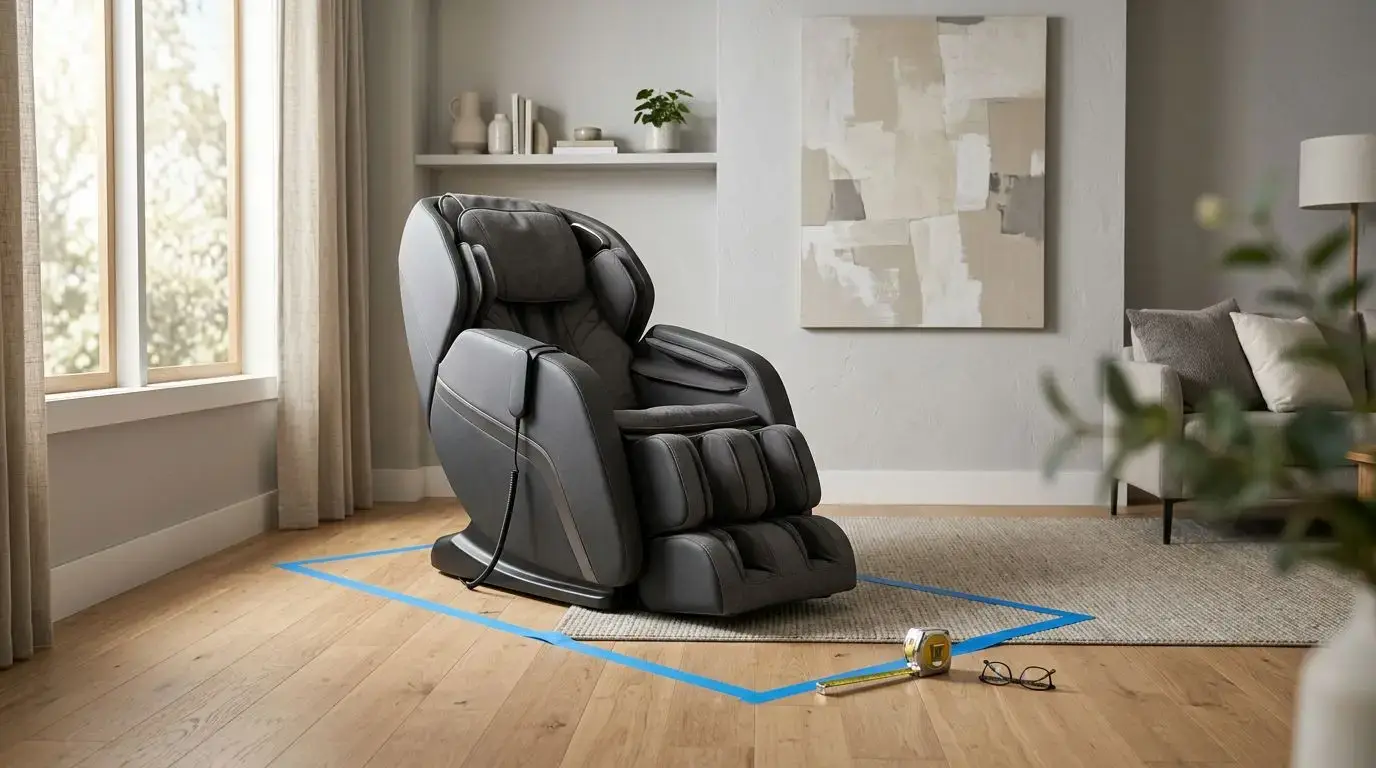
What Size Massage Chair Do You Need? Dimensions, Clearance, and Fit Guide
11 min read
Where Should You Put a Massage Chair at Home? Room-by-Room Placement Guide
13 min read
Space-Saving Massage Chairs Explained: How Wall-Hugger Recline Works in Real Homes
13 min read
Massage Chair Assembly and Disassembly: What to Expect Before Setup or Moving
13 min read