Disclosure: We may earn a commission when you buy through links on this page, at no extra cost to you. We buy nothing, sell nothing and accept no payment for coverage — commissions never decide what we recommend. How we make money.
A lay-flat massage chair is a good fit if you want a deeply reclined, stretched-out position during a typical 10- to 30-minute massage session. Compared with a standard recliner-style chair, this design brings the backrest much closer to horizontal, often near 150 to 180 degrees depending on the model. It is best for shoppers who value recline comfort, full-body positioning, and a lounge-like experience more than the smallest possible footprint.
Not every deep-reclining chair works the same way. Some chairs use “lay-flat” because the backrest reclines nearly level, while others pair deep recline with zero-gravity positioning, extended roller tracks, a leg rest, and air compression zones. The right choice depends on how your body fits in the chair, how much room you have, and whether you prefer a flatter, bed-like posture or a cradled, knees-elevated position.
What “Lay-Flat” Means in a Massage Chair: Usually 150° to 180°
In massage chair language, “lay-flat” usually means the backrest reclines much farther than a typical living room recliner. A conventional recliner may stop around 120 to 140 degrees, while a lay-flat massage chair often reaches roughly 150 to 180 degrees. A true near-horizontal design brings the torso close to level with the floor, though the exact body angle depends on the seat pan, leg rest, and how the chair supports your hips.
That detail matters. A chair can look flat in marketing photos but still hold the body in a slight V-shape because the seat remains tilted or the leg rest lifts at a different angle than the backrest. Many users find that comfortable. Others, especially people who want a more open hip angle, will notice the difference between a 160-degree recline and a 180-degree recline.
Lay-flat also does not automatically mean “better massage.” It mainly changes body positioning. When the backrest reclines deeply, body weight may settle more evenly into the back pad, making roller pressure feel broader and sometimes gentler. In a more upright chair, the same roller path can feel more direct because gravity presses the torso into the chair differently. Neither option is universally better; it comes down to feel.
Most lay-flat massage chairs are designed for timed sessions, commonly around 15 or 20 minutes per program. They are not a replacement for a bed, and they are not intended to be used as medical equipment. Think of them as deep-recline wellness seating with built-in massage mechanisms.
Who Lay-Flat Massage Chairs Are Best For: 5 Practical Use Cases
Lay-flat massage chairs are best for people who want a more open, lounge-style recline than a standard massage chair offers. They are especially appealing if your favorite position is close to horizontal and you plan to use the chair in short, repeatable sessions of about 10 to 30 minutes.
- People who dislike sitting upright during massage. A deep recline can feel less like a task chair and more like a chaise lounge.
- Users who want a relaxed full-body posture. If the leg rest rises high enough, the body can feel more evenly supported from shoulders to calves.
- Shoppers comparing massage chairs to recliners. A lay-flat chair may suit someone who wants both deep recline and automated rollers, not just a vibrating recliner.
- Households with multiple users. Many chairs include adjustable shoulder positions, footrest extension, and intensity settings, which can help users of different heights fit more comfortably.
- People with a dedicated relaxation space. These chairs can require 70 to 85 inches of total length when reclined, depending on the model type and leg rest travel.
This chair type may be a poor match if you need the smallest possible footprint, have difficulty getting in and out of low reclined seating, or prefer a more upright neck and torso position. It can also feel too immersive for users who like light, short, chair-back-only massage.
Fit is personal. A 5-foot-2 user and a 6-foot-3 user can have very different experiences in the same chair, especially at the shoulder rollers, lower-back curve, and foot wells. If several people will use the chair, prioritize adjustable features rather than choosing by the deepest recline angle alone.
Lay-Flat vs. Zero-Gravity vs. Standard Recline: Key Differences at 120° to 180°
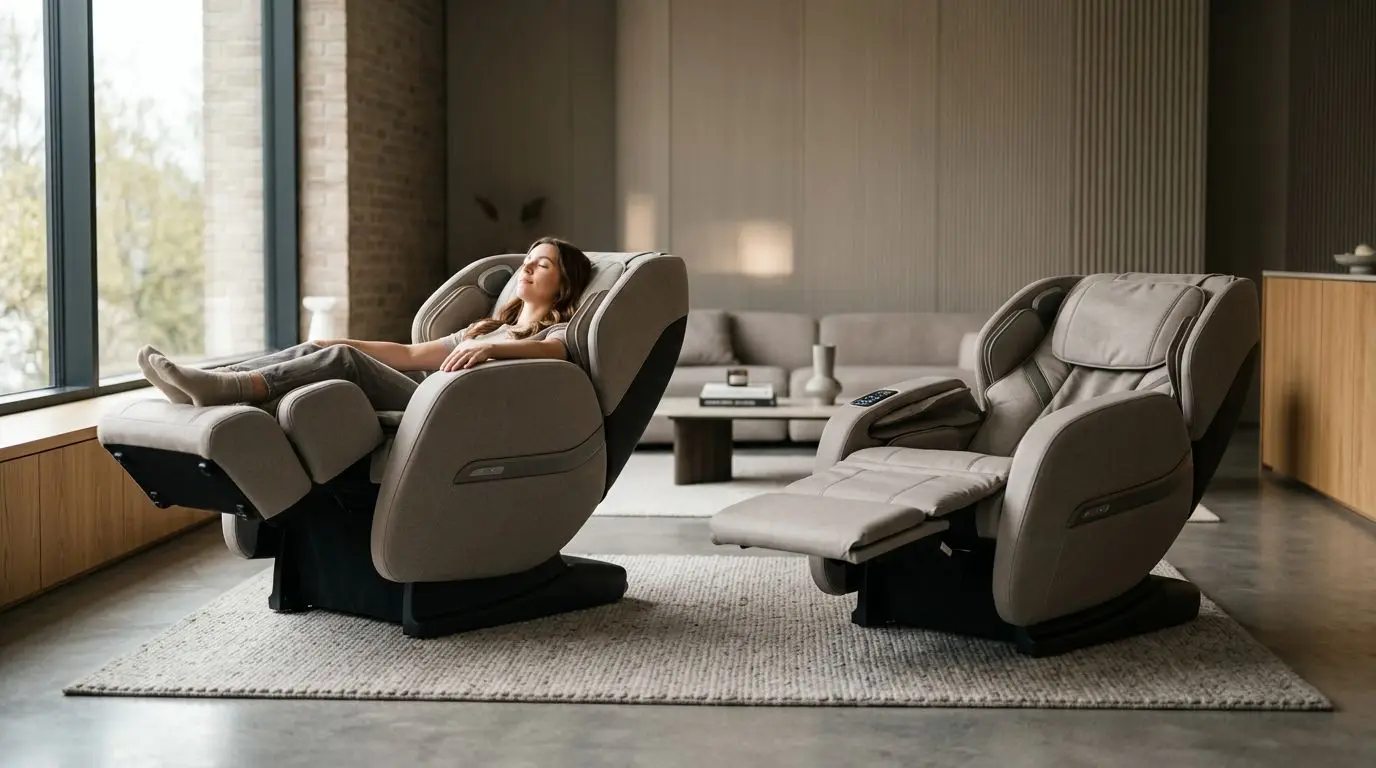
Lay-flat and zero-gravity are related, but they are not the same. Lay-flat describes how far the backrest reclines, often approaching a flat position. Zero-gravity refers to a cradled position where the knees are elevated relative to the torso, inspired by a neutral reclined posture. A chair can be lay-flat without being zero-gravity, zero-gravity without being fully flat, or both.
| Chair position type | Typical recline range | How it feels | Best for |
|---|---|---|---|
| Standard recline | About 120° to 140° | Upright to lounge-like, with easier conversation and TV viewing | Small rooms, casual daily use, users who dislike deep recline |
| Zero-gravity | Often about 130° to 160° | Cradled position with legs elevated and weight distributed into the chair | Users who like a supported, knees-up posture |
| Lay-flat | Often about 150° to 180° | More horizontal, stretched-out, and bed-like | Deep recline comfort, long-body support, dedicated relaxation rooms |
| Lay-flat with zero-gravity | Varies by setting, often 150°+ | Deep recline with elevated legs and a more enveloping chair feel | Shoppers who want multiple recline styles in one chair |
If you are choosing between these designs, start with posture instead of labels. Do you want your back nearly level, or do you want your legs lifted and your body cradled? Do you want to watch TV comfortably, or do you mainly plan to close your eyes for a 20-minute session? Those answers will guide the chair type better than a spec sheet alone.
Comfort Features That Matter in a Lay-Flat Chair: Track Length, Rollers, and Width
The recline angle is only one part of comfort. A lay-flat massage chair also needs the right roller system, track shape, padding, shoulder fit, and leg support. Many full-size chairs use roller tracks in the 30- to 50-inch range, but the shape of that track matters as much as its length.
Roller track shape
An S-track follows the curve of the back, typically from the neck and shoulders to the lower back. An L-track continues under the seat toward the glutes and upper hamstrings. Some chairs use an SL-style track that combines a curved back path with extended seat coverage. If you want massage sensation past the low back while reclined, look closely at L-track or SL-track designs.
Roller movement and intensity
Roller systems are often described as 2D, 3D, or 4D. In plain terms, 2D rollers move up and down and side to side along the track. 3D rollers add in-and-out depth adjustment, which can make the pressure feel lighter or stronger. 4D designs usually add more variation in speed, rhythm, or protrusion patterns, depending on the manufacturer. These are feel differences, not guaranteed quality levels.
Seat and shoulder fit
Seat width commonly falls around 19 to 23 inches, though oversized designs may offer more room. Shoulder spacing matters too, because air cells or side panels can feel snug on broad users. If a chair has a narrow upper body cradle, a user with broad shoulders may feel pinned in place before the massage even starts.
Leg rest comfort
Many lay-flat chairs include a foot and calf unit with spring-loaded or motorized extension. Extension ranges vary, but several inches of travel can make a big difference for taller users. Check whether the foot wells fit your shoe size comfortably, whether the calf rollers or airbags feel too firm, and whether the leg rest supports the knees without forcing them into an awkward bend.
Padding is worth checking as well. Thick padding can soften roller intensity, while thinner padding may make the massage feel more direct. Some users prefer strong roller definition; others want a cushioned, gentler feel. Reclining flat can make these differences more noticeable because more of your body weight settles into the back pad.
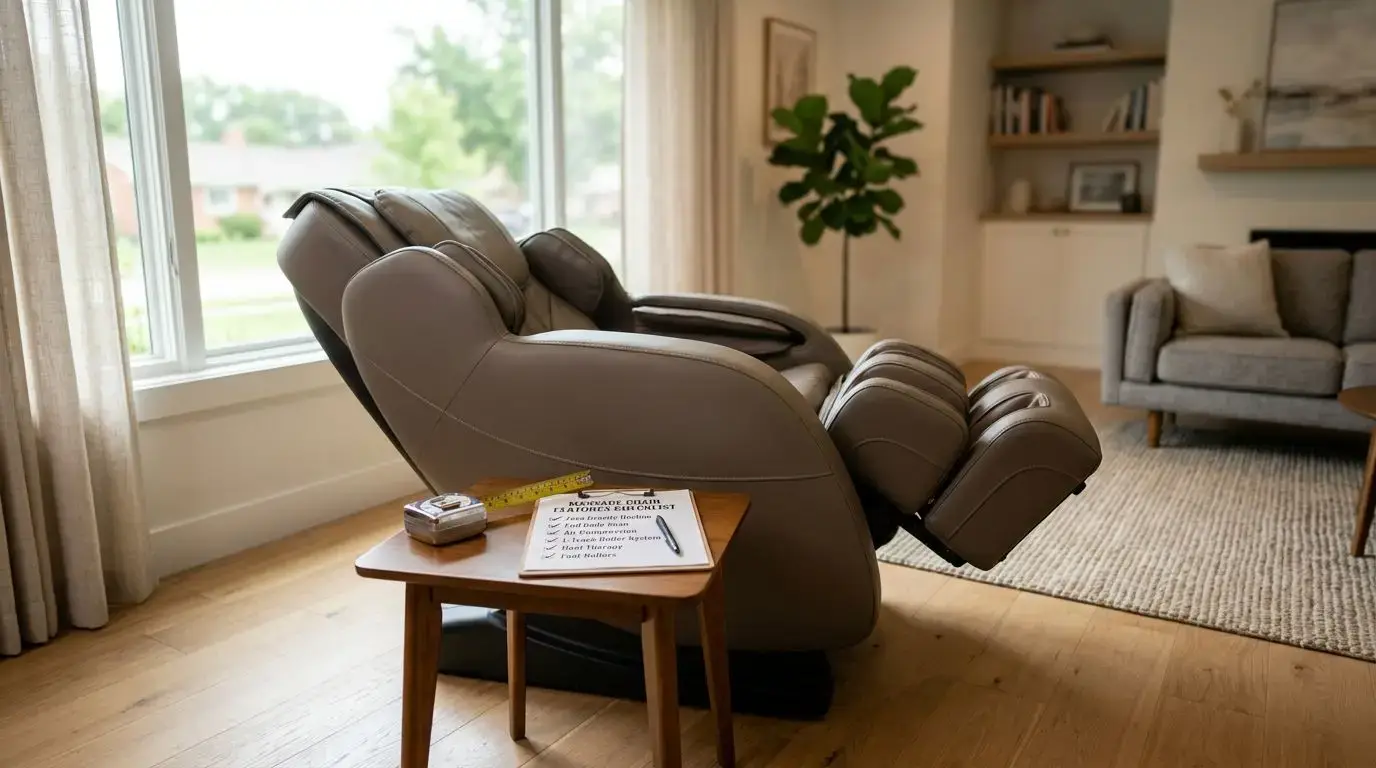
How to Measure Your Room Before Buying: Plan for 2 to 3 Feet of Clearance
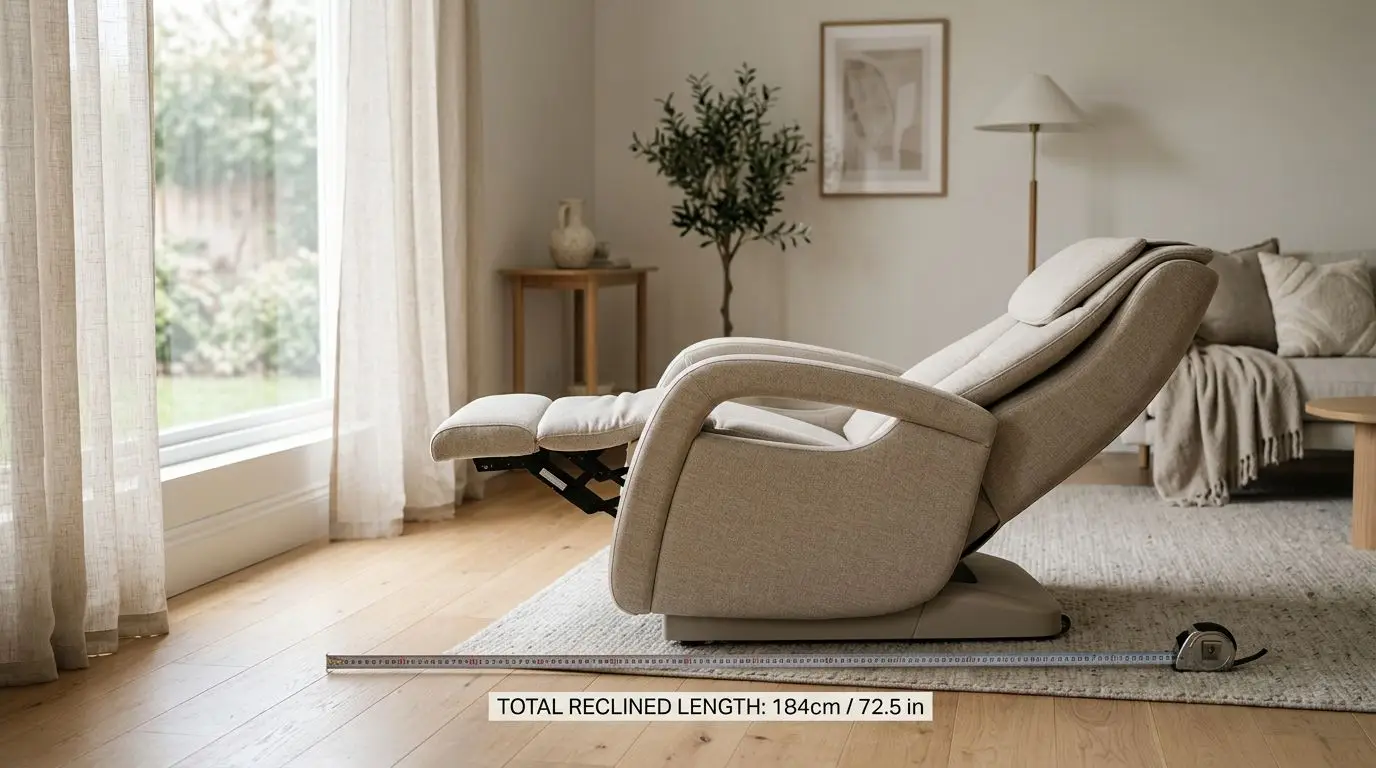
A lay-flat massage chair takes more planning than a basic recliner. When fully reclined, many full-size chairs measure roughly 70 to 85 inches from the rear of the chair to the front of the leg rest. Some space-saving designs slide forward as they recline and may need only 2 to 6 inches behind the backrest, while others need 12 to 24 inches or more.
Measure the chair in the position you will actually use, not just upright. A showroom or online spec page may list upright dimensions first, but lay-flat use depends on reclined length, rear clearance, side clearance, and the arc of the leg rest.
- Measure wall clearance. Confirm how many inches the chair needs behind it when fully reclined.
- Measure total reclined length. Add the chair’s reclined footprint to walking space at the front and sides.
- Check doorways. Many interior doors are about 30 to 36 inches wide; compare that with delivery dimensions, not just assembled size.
- Confirm floor strength and surface. Full-size massage chairs can weigh well over 150 pounds, and some larger designs are substantially heavier.
- Leave service access. A few inches on each side helps with cleaning, plug access, and safe entry or exit.
Look at the floor, too. On hardwood, vinyl, or tile, use a chair mat or protective pads if the chair has small contact points. On thick carpet, make sure the chair sits level and can recline without dragging. If the chair will be upstairs, confirm the path through stairs, turns, landings, and door frames before scheduling delivery.
How to Measure Your Body Fit: Height, Shoulder Line, and Foot Rest Travel
Most massage chairs list a recommended user height range, often spanning something like 5 feet to 6 feet 2 inches, though some designs fit shorter or taller users. Do not rely on height alone. Two people who are both 5 feet 10 inches can have different torso lengths, shoulder heights, and leg proportions, which changes how the rollers and leg rest line up.
Start with shoulder alignment. In a good fit, the roller scan or manual shoulder adjustment should place the upper rollers near the shoulder area without riding too high into the neck or stopping too low across the upper back. If the chair includes body scanning, still check whether manual correction is available. Automatic scans are useful, but they are not perfect for every body shape.
Then check hip and low-back contact. In a lay-flat position, your lower back should stay supported without feeling like it is floating away from the pad. If the seat angle creates a gap, roller contact may feel inconsistent. A small pillow can change the feel, but it can also interfere with roller coverage, so it should not be the main fix for poor fit.
Finally, measure leg rest fit. Your calves should sit naturally in the leg channels, and your feet should reach the foot section without your knees being forced too high or your toes jammed at the end. If you are taller than 6 feet or have long legs, footrest extension is one of the most important specs to compare.
| Fit area | What to check | Why it matters |
|---|---|---|
| Shoulders | Rollers align near shoulder level after scan or adjustment | Prevents the massage path from feeling too high or too low |
| Seat width | Commonly around 19–23 inches, depending on design | Affects hip comfort and side-panel pressure |
| Leg rest | Foot and calf section reaches your natural leg length | Helps avoid cramped knees or unsupported feet |
| Recline entry | You can get in and out safely before and after recline | Deep recline can be awkward for some users |
Feature Comparison: What Is Worth Paying Attention To in a $0-Brand Guide
Because this guide is brand-neutral, the useful comparison is by feature type, not by model. Lay-flat chairs can vary widely in build, size, upholstery, controls, and massage style. A chair with 12 automatic programs is not automatically better than one with 6 if the fit, roller feel, and recline comfort are wrong for you.
| Feature | What it changes | Best reason to choose it | Watch out for |
|---|---|---|---|
| 3D roller depth | Lets rollers press more or less firmly | You want adjustable intensity for different users | Maximum setting may feel too strong for some people |
| L-track or SL-track | Extends roller coverage into the seat area | You want coverage beyond the back | Track shape may limit how flat the seat feels |
| Space-saving recline | Moves chair forward as it reclines | You have less than 1 foot behind the chair | Still check total front clearance |
| Heated areas | Adds warmth in zones such as back or calves | You like a warmer seating feel during a session | Heat coverage and temperature vary |
| Air compression | Uses inflatable cells at shoulders, arms, calves, or feet | You like a squeezing, holding sensation | Can feel restrictive in narrow chairs |
| Manual controls | Targets a zone or changes technique and strength | You want repeatable settings, not only auto programs | Menus can be confusing; test before buying |
Do not overlook the remote or control panel. If it takes 10 button presses to change intensity, you may use fewer features than expected. A clear control layout, memory settings, and easy stop button can matter more in daily use than a long feature list.
Safety and Contraindications: Ask a Physician Before Use in These 8 Situations
A massage chair is a consumer wellness product, not a medical device. It is designed to create pressure, rolling, kneading, tapping, stretching, heat, and compression sensations for comfort and relaxation. It should not be used as a substitute for professional medical advice, diagnosis, or care.
Ask your physician before using a lay-flat massage chair if you are pregnant; have a pacemaker or another implanted cardiac device; have a history of blood clots or take anticoagulant medication; have osteoporosis; recently had a fracture or surgery; have spinal disc problems; have neuropathy or reduced sensation; or have uncontrolled hypertension. In these situations, pressure, heat, vibration, compression, or deep recline may not be appropriate for everyone.
Start conservatively even if you are healthy. Use the lightest setting for the first 10 to 15 minutes, especially in a deep recline. Stop if you feel sharp pain, numbness, dizziness, shortness of breath, or any unusual discomfort. Keep the chair on a stable surface, keep children and pets away from moving parts, and use the emergency stop or power-off function if the chair feels wrong.
Deep recline also affects entry and exit. If standing up from a low lounge position is difficult, test the chair upright and reclined before committing. Armrests, seat height, and how quickly the chair returns to upright can all affect daily usability.
Buying Checklist: 10 Questions to Answer Before You Choose
Before you buy a lay-flat massage chair, answer these 10 questions in writing. It may feel basic, but it helps you avoid overbuying features you will not use or choosing a chair that does not fit your room.
- Do I want a near-horizontal 170° to 180° recline, or is a 150° lounge position enough?
- Do I prefer lay-flat posture, zero-gravity posture, or both?
- What is my available reclined floor space in inches?
- How much wall clearance does the chair need when fully reclined?
- Does the user height range match every primary user?
- Is the seat wide enough for comfortable hip and shoulder positioning?
- Do I want an S-track, L-track, or SL-track roller path?
- Is adjustable intensity important, especially 3D depth control?
- Can the chair be delivered through my doors, stairs, and hallway turns?
- What warranty, service process, and return terms apply?
If you can test a chair in person, spend at least 15 minutes in the exact recline setting you expect to use. Try one automatic program and one manual setting. Notice the first 3 minutes, then the last 3 minutes. A chair that feels exciting at first can feel too aggressive later, while a gentler chair may become more comfortable as your body settles in.
FAQ: 5 Common Questions About Lay-Flat Massage Chairs
Is a lay-flat massage chair the same as a zero-gravity chair?
No. A lay-flat chair is defined mainly by deep backrest recline, often around 150 to 180 degrees. A zero-gravity chair is defined by a cradled, legs-elevated posture. Some chairs offer both, but the terms are not interchangeable.
How much space does a lay-flat massage chair need?
Many full-size lay-flat chairs need roughly 70 to 85 inches of total reclined length. Rear wall clearance can range from a few inches on space-saving designs to 12 inches or more on traditional recliners, so measure the fully reclined footprint.
Are lay-flat massage chairs comfortable for tall people?
They can be, but only if the shoulder scan, back track, seat depth, and footrest extension fit the user. Taller users, especially those over 6 feet, should pay close attention to footrest travel and where the rollers land at the shoulders.
Do lay-flat chairs give a stronger massage?
Not necessarily. Deep recline changes how your body rests against the rollers, which can make pressure feel different. Roller depth, padding, track shape, and body weight have more influence on intensity than the lay-flat label alone.
Can I use a lay-flat massage chair every day?
Many people use massage chairs regularly for short comfort sessions, but start with 10 to 15 minutes on a gentle setting and follow the chair’s instructions. Ask your physician first if you have pregnancy-related concerns, an implanted cardiac device, blood clot risk, recent surgery or fracture, osteoporosis, spinal disc problems, neuropathy, uncontrolled hypertension, or take anticoagulants.
Frequently asked questions
Is a lay-flat massage chair the same as a zero-gravity chair? +
No. A lay-flat chair is defined mainly by deep backrest recline, often around 150 to 180 degrees. A zero-gravity chair is defined by a cradled, legs-elevated posture. Some chairs offer both, but the terms are not interchangeable.
How much space does a lay-flat massage chair need? +
Many full-size lay-flat chairs need roughly 70 to 85 inches of total reclined length. Rear wall clearance can range from a few inches on space-saving designs to 12 inches or more on traditional recliners, so measure the fully reclined footprint.
Are lay-flat massage chairs comfortable for tall people? +
They can be, but only if the shoulder scan, back track, seat depth, and footrest extension fit the user. Taller users, especially those over 6 feet, should pay close attention to footrest travel and where the rollers land at the shoulders.
Do lay-flat chairs give a stronger massage? +
Not necessarily. Deep recline changes how your body rests against the rollers, which can make pressure feel different. Roller depth, padding, track shape, and body weight have more influence on intensity than the lay-flat label alone.
Can I use a lay-flat massage chair every day? +
Many people use massage chairs regularly for short comfort sessions, but start with 10 to 15 minutes on a gentle setting and follow the chair’s instructions. Ask your physician first if you have pregnancy-related concerns, an implanted cardiac device, blood clot risk, recent surgery or fracture, osteoporosis, spinal disc problems, neuropathy, uncontrolled hypertension, or take anticoagulants.
Related guides
Zero Gravity vs. Lay-Flat Massage Chairs: Recline Position, Comfort, and Use Cases Compared
12 min read
Are Massage Chairs Good or Bad for You? Benefits, Risks, and Safe Use Guidelines
13 min read
Can a Massage Chair Help With Lower Back Pain? Benefits, Settings, and Safety Tips
12 min read
How to Choose a Massage Chair for Home Use
14 min read
Massage Chair Recliner vs. Standard Recliner: Which Is Better for Everyday Comfort?
15 min read