Disclosure: We may earn a commission when you buy through links on this page, at no extra cost to you. We buy nothing, sell nothing and accept no payment for coverage — commissions never decide what we recommend. How we make money.
The best massage chair footrest for you comes down to 4 practical fit points: foot size, calf length, preferred pressure, and how easily you can get in and out of the chair. Enclosed ottomans usually feel more secure and immersive, while open-toe designs give longer feet more room and make entry simpler. Extension range and adjustability matter just as much as the footwell style, especially when users in the same home differ by 6 inches or more in height.
Footrests do more than support your feet. They help decide whether the chair feels roomy or cramped, whether the calf section lands where it should, and whether you can sit down without awkward twisting. Even a great back massage can be spoiled by a footrest that pinches your toes or stops short of your heels.
How massage chair footrests work: 2 main zones and 3 fit points
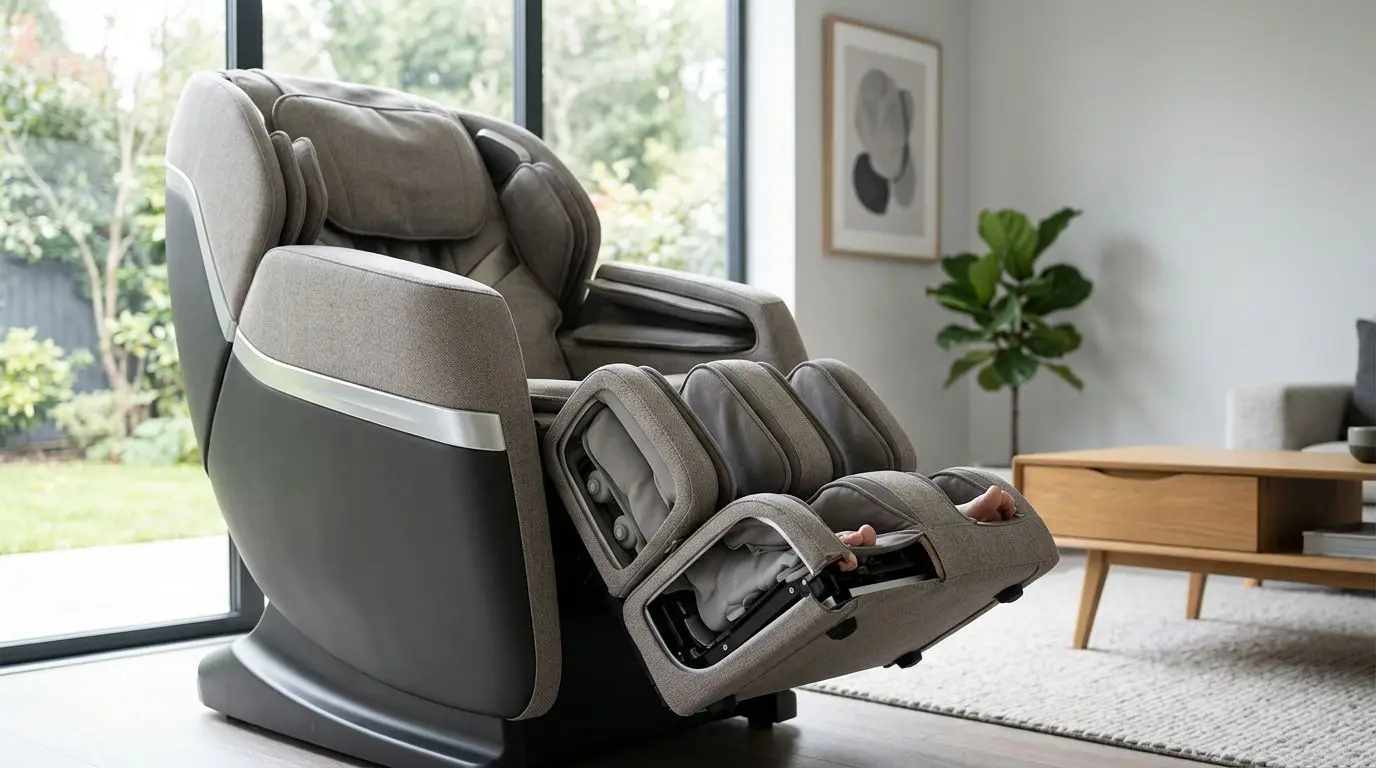
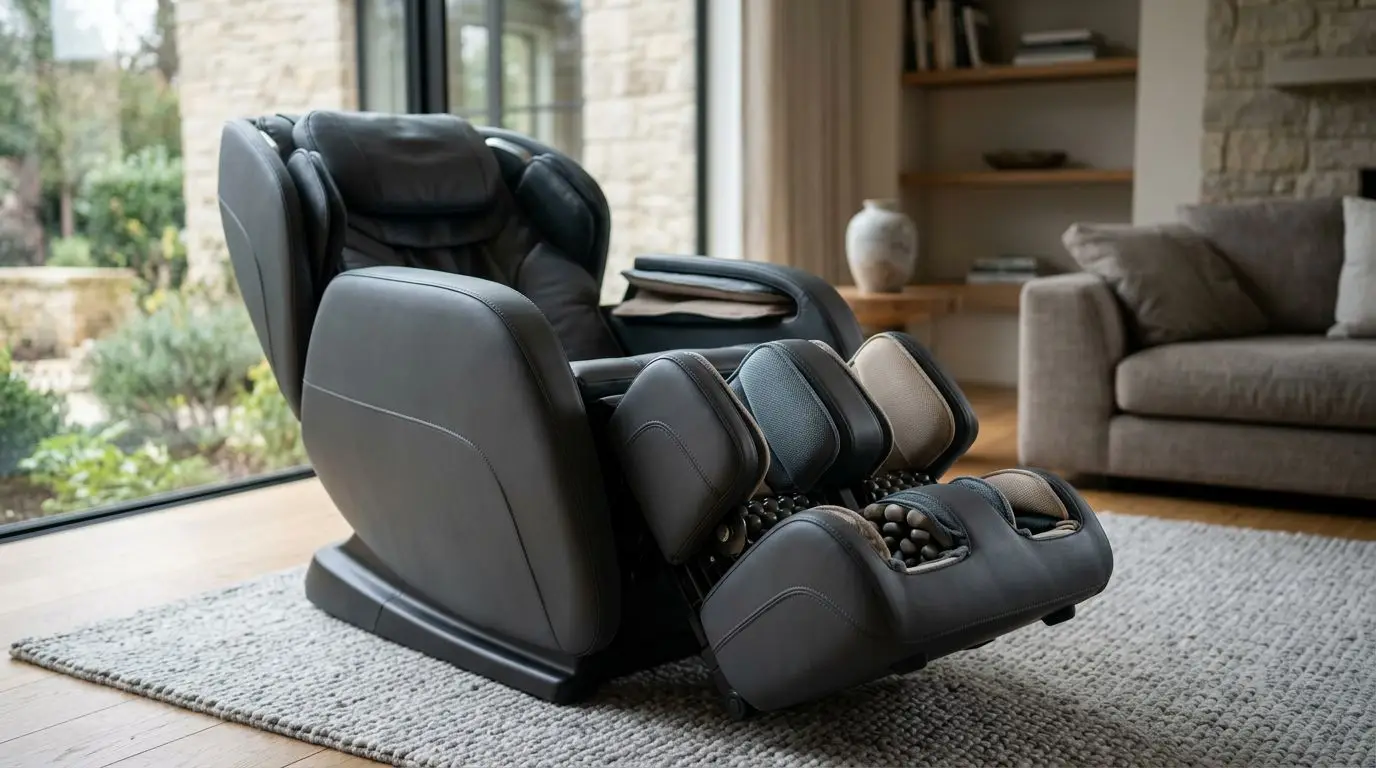
Most full-size massage chair footrests have 2 main zones: a calf section and a foot section. The calf area may use air cells, rollers, kneading nodes, or a smooth padded cradle. The foot area may include air compression, textured rollers under the sole, side pressure, heat in some designs, or simply a supportive platform.
The 3 fit points to check are foot length, calf length, and knee angle. Foot length determines whether your toes feel crowded. Calf length affects where pressure lands on the lower leg. Knee angle decides whether you feel relaxed or folded up when the chair reclines.
Many chairs use a spring-loaded or motorized footrest extension. A typical extension range is roughly 4 to 8 inches, though exact movement varies by design. Some footrests extend when you push with your heels; others scan or move automatically, then let you fine-tune the position with the remote.
Fit can change between upright and reclined positions. In zero-gravity-style recline, your knees usually rise and your weight shifts back, which can make a footrest feel shorter than it did while you were sitting upright. Test or measure based on the reclined position you expect to use most often.
Enclosed ottomans vs open-toe footrests: the 5-minute comparison
An enclosed ottoman surrounds more of the foot, often with side walls, toe coverage, and a deeper footwell. An open-toe footrest leaves the front of the foot area open, so toes can extend forward instead of pressing against a closed end. Both can be comfortable, but they solve different problems.
| Footrest type | How it is designed to feel | Best fit advantages | Common trade-offs |
|---|---|---|---|
| Enclosed ottoman | Wrapped, secure, more contained around the foot and calf | Good for users who like strong contact around the sides of the feet | May feel tight for long feet, wide feet, or thick socks |
| Open-toe design | Roomier at the front, less boxed-in | Helpful for taller users or anyone near a men’s US size 12 or above | Less enclosed sensation around the toes |
| Hybrid semi-open footwell | Some side containment with more front clearance | A middle ground for shared households | Fit depends heavily on extension range and footwell width |
Use a 5-minute sit test if possible. Spend at least 2 minutes upright and 3 minutes reclined, because toe pressure often appears only after the chair settles into a deeper recline. If your toes touch hard plastic, the arch roller lands too far forward, or you keep pulling your feet back to get comfortable, the footwell is not the right shape for you.
Enclosed designs often suit users who want a snug, structured feel. Open-toe designs tend to work better in mixed-height households because extra toe length has somewhere to go. That does not make open-toe designs automatically better; it simply makes them more forgiving when feet are long or leg length varies.
Footrest extensions and leg-length fit: measure in 3 simple steps
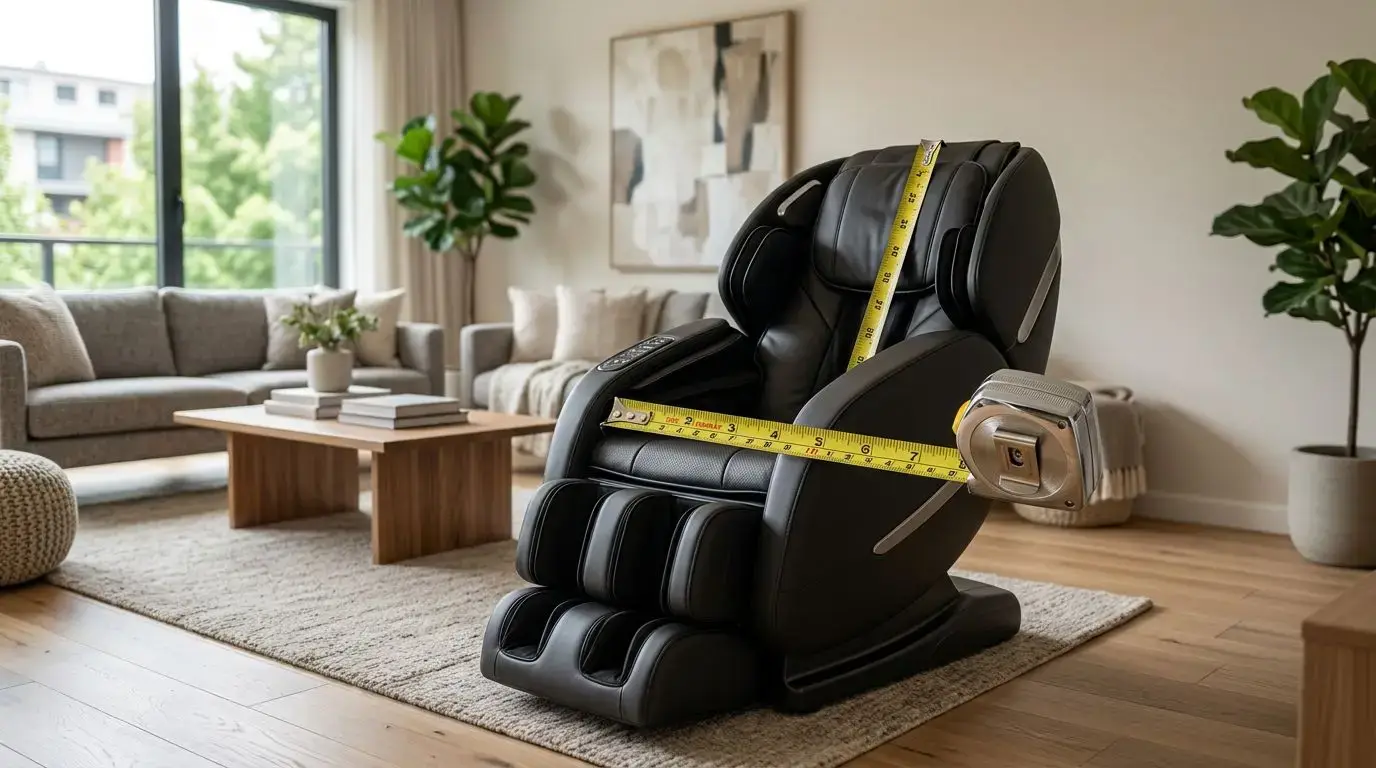
Do not shop by overall height alone. Two people who are both 5 feet 10 inches tall can have different leg lengths, shoe sizes, and calf proportions. A better approach is to measure seated lower-leg distance in 3 steps.
- Step 1: Sit upright in a dining chair with your knees bent at about 90 degrees and your feet flat on the floor.
- Step 2: Measure from the back of your knee to the bottom of your heel. This helps estimate calf cradle placement.
- Step 3: Measure your foot from heel to longest toe, then add about 0.5 to 1 inch for sock thickness and natural foot movement.
If the chair will be shared, measure the shortest and tallest regular users. A household with one user at 5 feet 2 inches and another at 6 feet 1 inch needs more flexible adjustment than a household where everyone is within 2 or 3 inches of each other. The widest fit gap is usually not height alone; it is the combination of lower-leg length and foot length.
Spring-loaded extensions are common because they are simple. You push down or outward with your legs until the footrest reaches a comfortable position. Motorized extensions may feel easier for users who do not want to apply much leg force, although the best experience depends on how responsive the controls are.
Auto-length systems can be convenient, but they are not magic. Thick socks, a reclined posture, or sliding slightly in the seat can change where the footrest thinks your feet are. Look for manual override controls so you can move the footrest by small increments after the chair has positioned itself.
Adjustability and entry: leave 18 inches to move comfortably
Getting into the chair matters as much as sitting in it. A bulky footrest can make entry awkward if it sits high, protrudes far into the room, or does not lower enough when the chair is upright. In many rooms, leaving at least 18 inches of clear walking space in front of the footrest makes daily use easier.
Compare 4 adjustability details. First, check whether the ottoman retracts smoothly when the chair returns upright. Second, see whether the footrest can stop at multiple angles, not just fully up or fully down. Third, confirm whether the leg extension can be adjusted after reclining. Fourth, look at the remote layout: footrest controls should be obvious, especially if more than one person will use the chair.
Entry is easier when the footrest sits low and close to the chair before reclining. Some designs require you to step around deep calf wells, which can be inconvenient in a narrow bedroom or home office. If the chair will be used by someone with limited balance or reduced mobility, a lower, simpler footrest is often more practical than the most enclosed design.
Think about the full footprint, not just the chair’s upright dimensions. A chair that is 30 to 36 inches wide can still need much more usable space once the back reclines and the footrest extends. Measure the path from the doorway to the final location, then measure the front clearance with the chair fully reclined.
Who each footrest style is best for: 6 common buyer scenarios
Footrest comfort is personal, but most buyers fall into a few recognizable groups. Matching your situation to the design can prevent a lot of frustration.
- Users with longer feet: Open-toe or semi-open footrests are usually the safer starting point, especially around men’s US size 12 and up or women’s US size 11 and up.
- Users who like a snug foot hold: Enclosed ottomans can feel more secure because the sides and front create more contact.
- Shared households: A footrest with 4 to 8 inches of extension and manual fine-tuning is usually more adaptable than a fixed-length design.
- Shorter users: Look for calf sections that do not force the knees upward or leave the feet floating away from the footbed.
- Users who dislike tight spaces: Open-toe designs and wider footwells tend to feel less restrictive.
- Small rooms: Prioritize smooth retraction, a lower entry position, and a design that does not require a large step-around area.
Width is easy to overlook. A footwell can be long enough but still feel tight across the forefoot. If you normally buy wide shoes, pay close attention to internal footwell width, not just the published user height range. Published height ranges are helpful screening tools, but they do not guarantee foot comfort.
Socks also change the experience. Bare feet may feel more direct contact from sole rollers, while thick socks soften the sensation and take up more room. If you plan to use the chair with socks, test or measure that way.
Foot rollers, air cells, and calf features: compare 7 common options
The footrest structure is only half the story. The internal features determine how much contact you feel and where that contact lands. Most footrest systems combine 2 or 3 of the features below.
| Feature | What it does | Comfort notes | Best for |
|---|---|---|---|
| Sole rollers | Move under the bottom of the foot | Can feel gentle or intense depending on roller shape and air pressure | Users who like focused sole contact |
| Foot air cells | Inflate around the foot to hold it in place | Higher settings can feel tight in narrow footwells | Users who want a secure hold |
| Calf air cells | Apply side pressure along the lower leg | Look for 3 or more intensity levels if you are pressure-sensitive | Shared homes with different comfort preferences |
| Calf rollers or kneading nodes | Add moving contact along the calf area | Can feel too direct if the calf cradle is narrow | Users who like more active lower-leg contact |
| Adjustable intensity | Changes air pressure, roller speed, or feature strength | At least 3 settings gives useful control | Couples and families |
| Removable liners | Add a washable barrier inside the footwell | Useful if several people use the chair weekly | Cleanliness and easier upkeep |
| Foot or calf heat | Adds warmth in the lower section | Check whether heat works independently or only during preset programs | Users who enjoy a warmer feel |
Sole rollers deserve special attention. If the air cells press your foot down while rollers move underneath, the sensation becomes stronger. Some users enjoy that; others find it too much. A chair with adjustable air pressure can make the same roller system feel very different at level 1 than at level 5.
Calf features also depend on alignment. If your legs are short for the chair, the calf mechanism may sit too low. If your legs are long, the top of the calf cradle may press near the back of the knee. Neither is ideal. Fit first; features second.
How to choose a footrest: a 10-point showroom or online checklist
Use this checklist before buying, whether you are trying a chair in person or comparing specifications online. It takes about 10 minutes in a showroom and a little longer if you are measuring at home.
- Check the stated user height range, then compare it with your seated lower-leg measurement.
- Confirm whether the footrest is enclosed, open-toe, or semi-open.
- Look for the extension range; 4 to 8 inches is common, but more is not always better if the chair starts too long for shorter users.
- Ask whether extension is spring-loaded, motorized, automatic, or manually adjustable.
- Test the chair reclined for at least 3 minutes, not just upright.
- Make sure your toes are not pressing against a hard end wall.
- Check whether your heels stay supported when the chair reclines.
- Try the lowest and highest foot or calf intensity settings.
- Stand up from the chair with the footrest fully retracted and note whether you need to twist or step wide.
- Measure front clearance in the room with the footrest extended, allowing at least 18 inches of walking space where possible.
Online buyers should read measurements carefully. If only outside dimensions are listed, ask for interior footwell dimensions or look for return terms that account for fit. A chair can meet the advertised height range and still feel uncomfortable for a specific foot shape.
If several people will use the chair, do not let the tallest person be the only test case. The shortest regular user should also sit in it, because an overly long footrest can make the legs feel unsupported. Good adjustability works in both directions.
Safety and comfort limits: start with 10 to 15 minutes
A massage chair is a consumer wellness product, not a medical device. Start conservatively, especially with strong foot rollers, calf compression, or heat. A 10- to 15-minute first session is a sensible way to learn how the footrest feels before using longer preset programs.
Some people should ask a physician before using strong lower-leg compression or heated footrest features. This includes people who are pregnant, have a pacemaker or other implanted cardiac device, have a history of blood clots, take anticoagulants, have osteoporosis, have had a recent fracture or surgery, have spinal disc problems, have neuropathy, or have uncontrolled hypertension. Do not treat the chair as a substitute for professional medical advice.
Stop using the footrest if you feel numbness, sharp discomfort, unusual tingling, dizziness, or a trapped feeling. Lower the intensity, change position, or turn off the foot and calf functions. Comfort should be adjustable, predictable, and easy to control.
Heat settings also deserve caution. Warmth can feel relaxing, but the user should be able to sense temperature normally and turn it off quickly. If sensation in the feet or legs is reduced, ask a physician before using heated features.
FAQ: 5 footrest fit questions buyers ask
Is an enclosed ottoman better than an open-toe footrest?
Not always. An enclosed ottoman is better if you like a snug, surrounded feel around the feet, while an open-toe footrest is often better for longer feet or easier entry. If you are near men’s US size 12 or larger, open-toe and semi-open designs are worth strong consideration.
How much footrest extension do I need?
Many chairs offer roughly 4 to 8 inches of extension, but the right amount depends on your seated lower-leg length and foot size. Measure from the back of your knee to your heel, then compare that with the chair’s stated fit range and extension design.
Are foot rollers supposed to feel intense?
They can feel intense, especially when air cells press the foot down onto the rollers. Look for adjustable intensity with at least 3 levels, and start on the lowest setting for the first 10 to 15 minutes.
Can a massage chair footrest fit both short and tall users?
Yes, but only if the extension and calf placement are flexible enough. A shared household with more than a 6-inch height difference should prioritize adjustable extension, manual fine-tuning, and a footrest that still supports the shortest user.
Should I use the chair barefoot or with socks?
Either can work. Bare feet usually feel more direct contact from sole rollers, while socks soften the sensation and add a little bulk inside the footwell. Test the chair the way you expect to use it most often.
The bottom line: footrest design is a fit feature, not a small add-on. Choose the style that matches your foot size, leg length, pressure preference, and room layout, then confirm that getting in and out feels simple. A well-matched footrest should feel supportive within the first few minutes and stay comfortable after the chair reclines.
Frequently asked questions
Is an enclosed ottoman better than an open-toe footrest? +
Not always. An enclosed ottoman is better if you like a snug, surrounded feel around the feet, while an open-toe footrest is often better for longer feet or easier entry. If you are near men’s US size 12 or larger, open-toe and semi-open designs are worth strong consideration.
How much footrest extension do I need? +
Many chairs offer roughly 4 to 8 inches of extension, but the right amount depends on your seated lower-leg length and foot size. Measure from the back of your knee to your heel, then compare that with the chair’s stated fit range and extension design.
Are foot rollers supposed to feel intense? +
They can feel intense, especially when air cells press the foot down onto the rollers. Look for adjustable intensity with at least 3 levels, and start on the lowest setting for the first 10 to 15 minutes.
Can a massage chair footrest fit both short and tall users? +
Yes, but only if the extension and calf placement are flexible enough. A shared household with more than a 6-inch height difference should prioritize adjustable extension, manual fine-tuning, and a footrest that still supports the shortest user.
Should I use the chair barefoot or with socks? +
Either can work. Bare feet usually feel more direct contact from sole rollers, while socks soften the sensation and add a little bulk inside the footwell. Test the chair the way you expect to use it most often.
Related guides
Foot Roller vs. Calf Kneading vs. Air Compression: Massage Chair Leg Features Explained
12 min read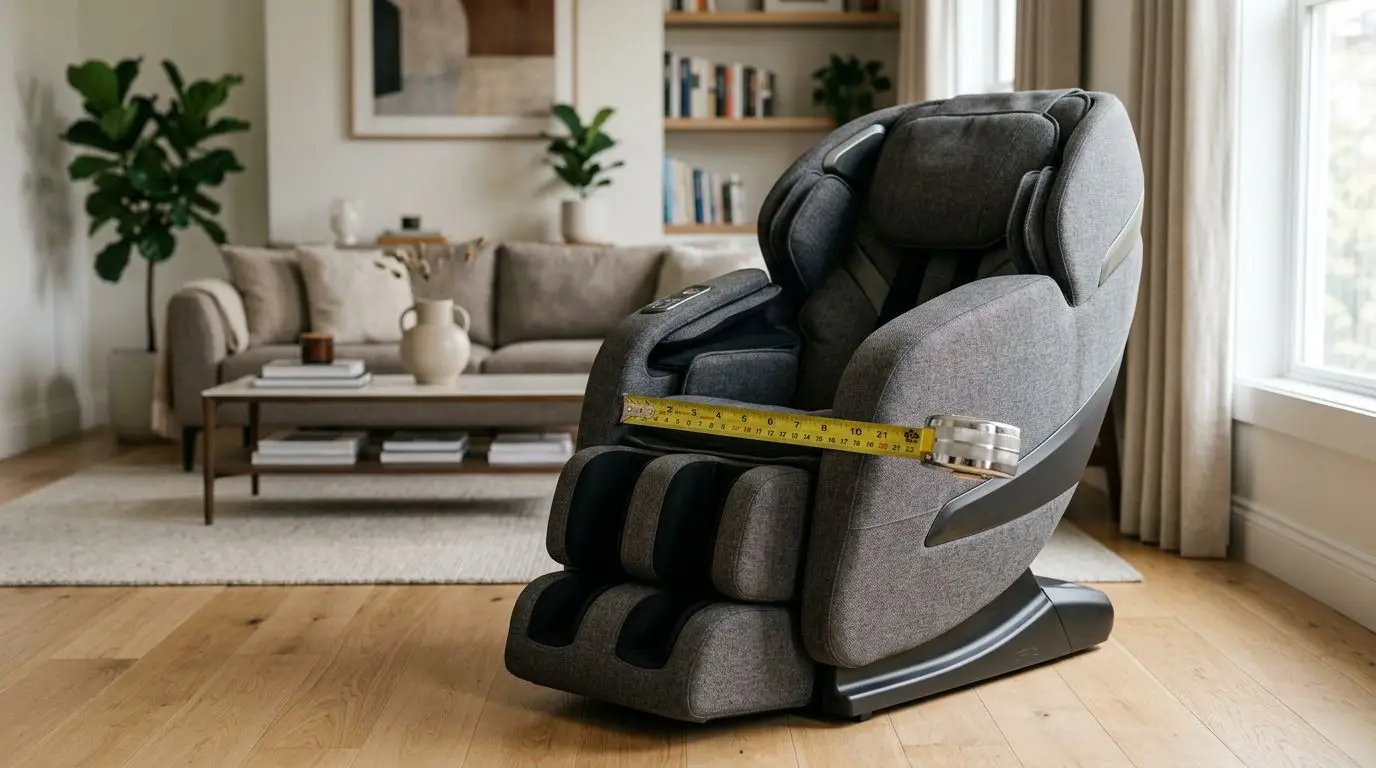
Massage Chair Fit Features for Tall and Short Users: Shoulder Scan, Seat Width, and Leg Extension Explained
13 min read
Can Massage Chairs Improve Circulation? What Leg Compression, Heat, and Movement May Do
13 min read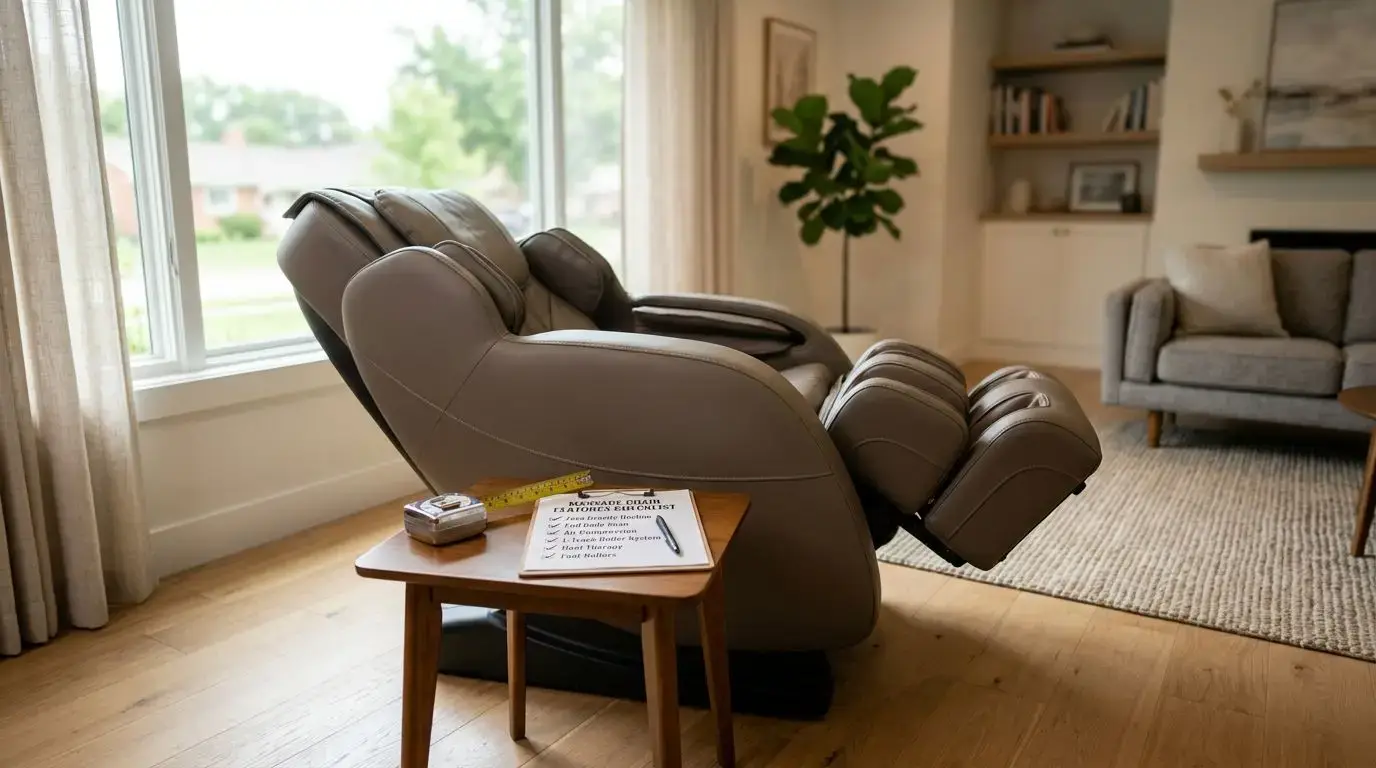
Best Massage Chair Features to Look For Before You Buy
13 min read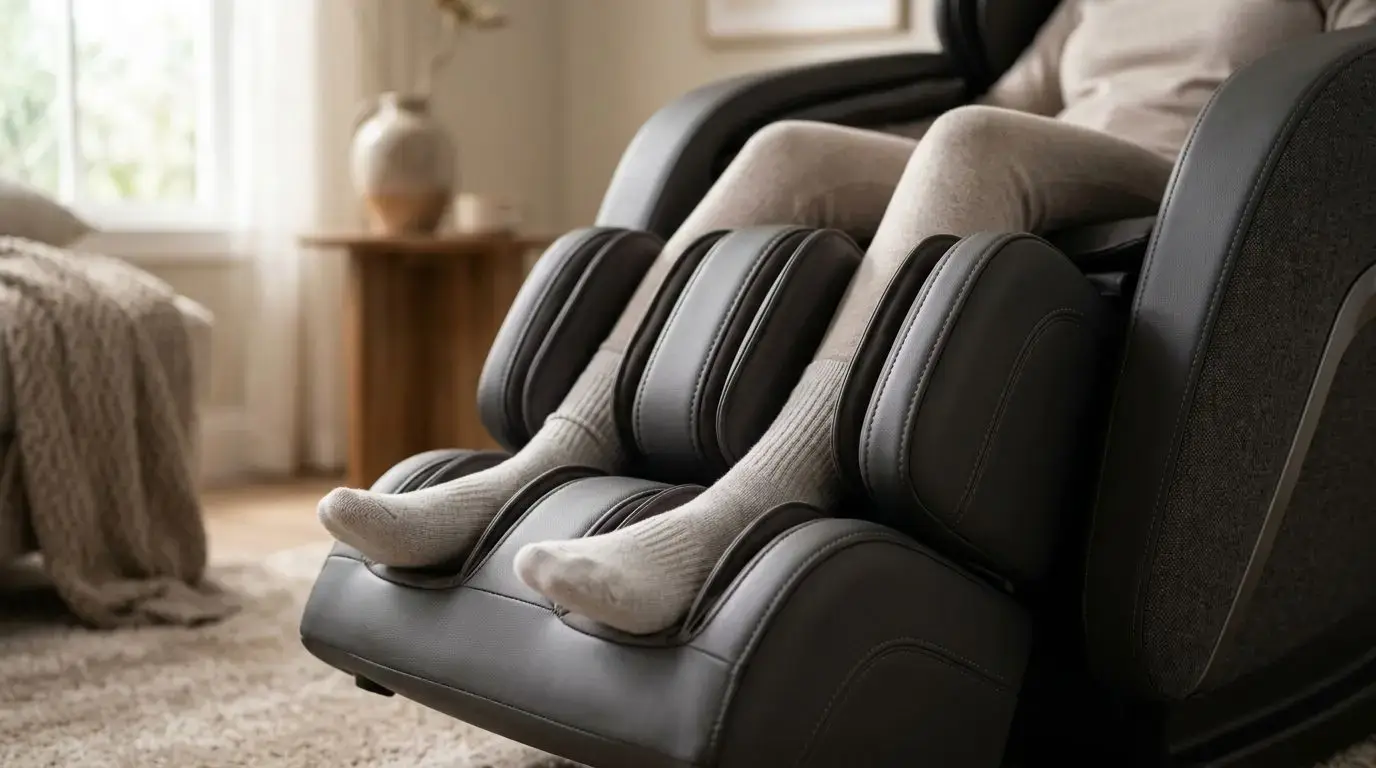
Foot and Calf Massage Chair Programs: When to Use Rolling, Kneading, and Air Compression
14 min read