Disclosure: We may earn a commission when you buy through links on this page, at no extra cost to you. We buy nothing, sell nothing and accept no payment for coverage — commissions never decide what we recommend. How we make money.
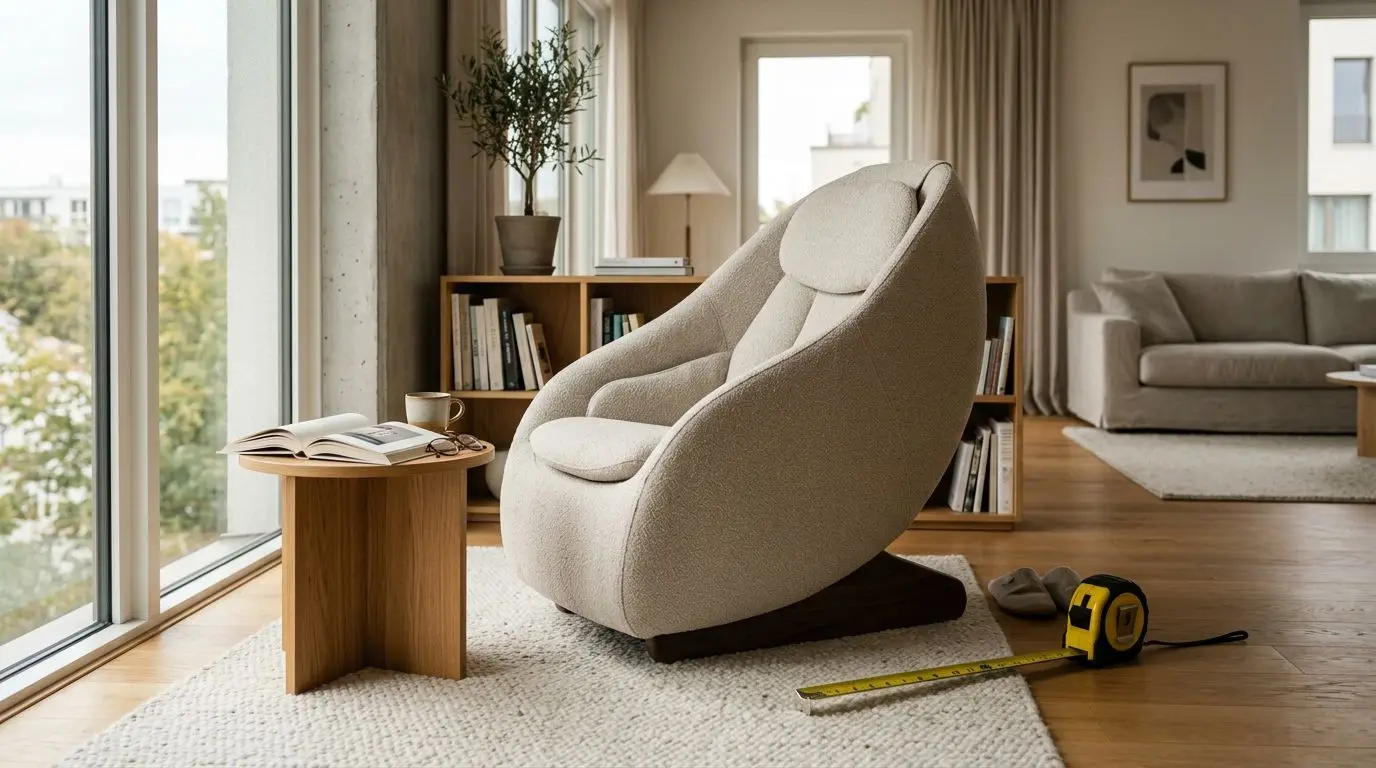
Egg-shaped massage chairs are best for shoppers who want a cozy, enclosed seat with a modern look and a focused back massage, rather than the widest possible full-body coverage. The cocoon design can feel private and calming, but it often gives up the long track length, open shoulder space, calf massage, or deep recline found on larger chairs. Before buying one, measure the room, check the roller path, and make sure the shell fits your body, not just your decor.
What an egg-shaped massage chair is, in about 30 seconds
An egg-shaped massage chair is a compact or semi-compact chair built around a rounded outer shell, usually with a high back and sides that curve around the user. Many are roughly 28 to 36 inches wide and may keep you more upright than a full-size recliner-style massage chair, though exact dimensions vary by design.
The main idea is enclosure. Rather than a broad, open recliner with visible arms, leg wells, and a long backrest, a cocoon-style chair uses a rounded frame to create a tucked-in seating position. Some designs resemble lounge pods. Others feel more like a small recliner with a sculpted back.
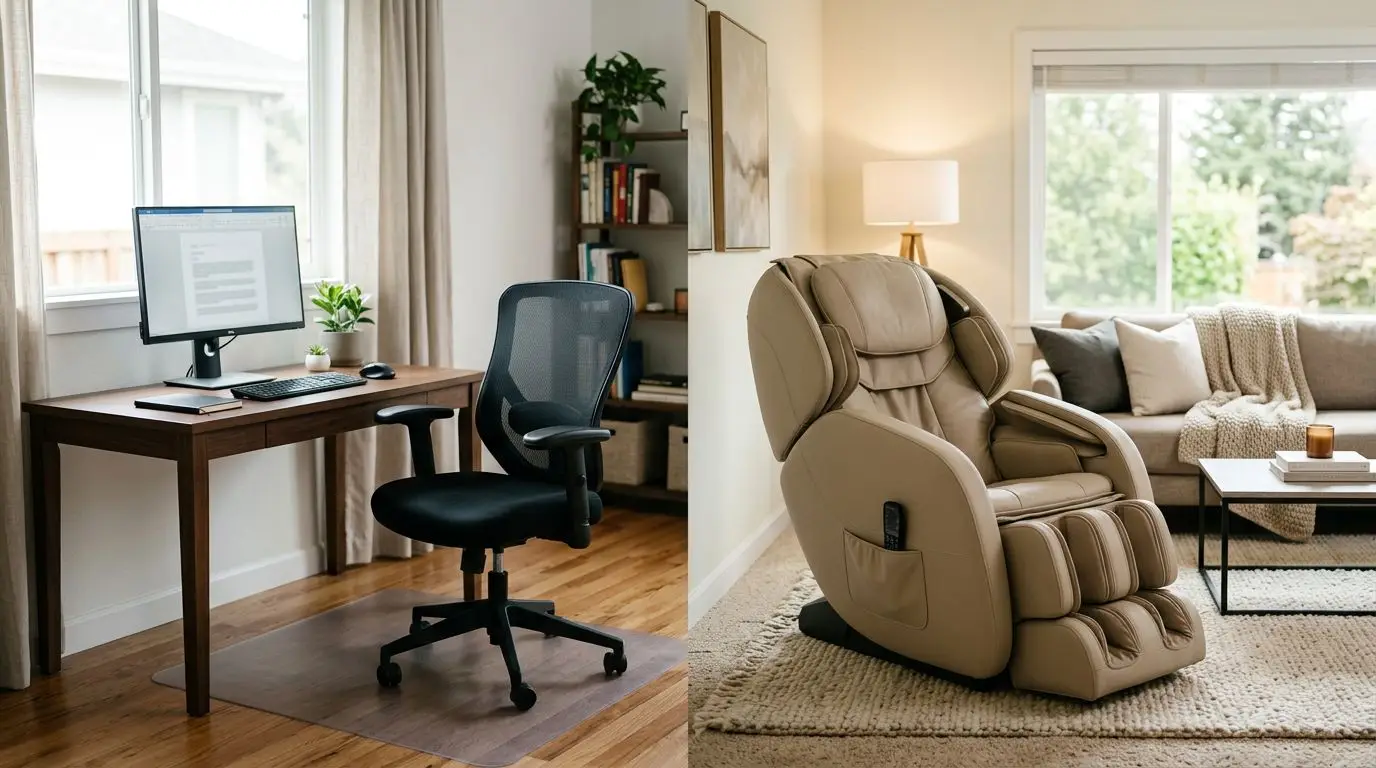
That shape can be appealing if you want a chair for a bedroom corner, reading nook, apartment living room, or home office. It can also be limiting. The same shell that creates the “egg” look may restrict shoulder width, arm position, recline angle, and how far the rollers can travel.
Think of this category as design-forward comfort seating with built-in massage features. Some chairs offer kneading, rolling, tapping, vibration, heat, Bluetooth audio, or a swivel base. Others are simpler and rely on fixed massage nodes instead of moving rollers. The label “egg-shaped” describes the body style, not a guaranteed level of massage performance.
Who it’s best for: 5 situations where the cocoon design makes sense
Egg-shaped chairs usually make the most sense for shoppers who value footprint, privacy, and style at least as much as massage coverage. If you typically use a chair for 10 to 20 minutes at a time while reading, listening to music, or taking a quiet break, the enclosed shape may suit you well.
- Apartment and condo owners: A cocoon chair can be easier to place than a full-body chair that may need 60 to 80 inches of reclined depth.
- Design-focused rooms: The rounded shell looks more like modern lounge furniture than many larger massage chairs.
- People who like a tucked-in feel: The side panels can create a sheltered seating experience without requiring a separate privacy nook.
- Shorter sessions: If your routine is a 15-minute back program, limited leg coverage may not matter.
- Secondary seating: It can work as a reading chair or office break chair when you do not want a large recliner dominating the room.
It is not the obvious choice for everyone. Broad-shouldered users may feel boxed in. Taller users may find that the headrest, neck area, or lower-back rollers do not line up well. Anyone who wants foot rollers, calf airbags, deep recline, or a long glute-to-neck roller path should compare options carefully before choosing a cocoon design.
Massage coverage: where egg chairs often stop short by 6 to 20 inches
The biggest trade-off is coverage. Many larger full-body massage chairs use extended roller tracks that can run about 45 to 53 inches from the upper back into the seat area, while compact cocoon chairs may use shorter back-only tracks or fixed massage nodes. That difference is easy to notice if you want pressure from the shoulders down into the glutes.
Coverage is not just about how many features a chair lists. A chair can advertise multiple programs and still have a short roller path. The practical question is simple: where do the moving parts actually contact your body?
| Area | Common in egg-shaped chairs | Common in larger full-body chairs | What to check |
|---|---|---|---|
| Neck and upper shoulders | Sometimes limited by fixed pillow height or shell shape | Often better adjusted through body scanning or taller backrests | Sit in the chair and see whether rollers land below, on, or above your shoulder line |
| Mid-back | Often the strongest coverage area | Usually strong coverage with more program variety | Check whether pressure feels centered or too narrow |
| Lower back | Varies; some short tracks stop high | Typically better on longer S-track and L-track chairs | Ask for track length and test the lowest roller position |
| Seat and glutes | Often vibration only, or no active coverage | Common on L-track designs | Confirm whether rollers enter the seat or only the backrest |
| Calves and feet | Often absent | Common on full-body designs with ottomans | Look for actual calf wells or foot rollers, not just a footrest |
| Arms and hands | Usually absent or minimal | Often available on larger chairs with arm airbags | Decide whether arm coverage matters before paying for extra bulk |
Roller type matters, too. A 2D roller moves up and down and can push in and out to a limited degree depending on design. A 3D roller adds more adjustable depth. A 4D system usually varies rhythm or speed in addition to depth, though definitions are not perfectly standardized across manufacturers. In a cocoon chair, even a capable roller system can feel constrained if the track is short or the seating angle does not fit your body.
Space trade-offs: how to measure a room with 3 clearance zones
Egg-shaped chairs look small, but the outer shell can be deceptive. Measure three zones before buying: the floor footprint, the recline or tilt path, and the delivery path through doors that may be only 28 to 32 inches wide.
Start with the footprint. Note the chair’s width, depth, and height in its upright position. Then check what happens when it reclines, rocks, swivels, or tilts. A cocoon chair on a pedestal base may need less rear clearance than a traditional recliner, but it may need side clearance if it swivels. A shell that is 34 inches wide can also look larger than a square chair of the same width because the curved sides take up more room at shoulder height.
Next, measure where your knees and feet will go. Some egg chairs keep the legs bent and close to the base. Others include a hidden or fold-out footrest. If the chair has any forward-moving foot support, measure from the back of the shell to the farthest forward point while someone is seated.
Finally, measure delivery access. Check the front door, hallway turns, stair landings, and elevator opening if you live in a multi-unit building. A chair that fits the room may still be hard to maneuver through a tight 90-degree turn. If it arrives in one large piece, doorway clearance matters more than it does for furniture that ships in small modular sections.
- Measure the intended spot at floor level and shoulder height.
- Allow at least a few inches on each side for hands, cords, and cleaning.
- Check the fully reclined or tilted depth, not only the upright depth.
- Confirm whether the base swivels 90, 180, or 360 degrees.
- Protect hard floors if the chair has a heavy pedestal or small contact points.
Egg-shaped vs full-body chairs: a 6-point comparison
A full-size massage chair can weigh well over 200 pounds, while many compact cocoon designs are lighter and easier to place. Weight alone does not determine quality, but it does hint at the structural difference between a design chair with massage features and a larger chair built around extended tracks, airbags, motors, and leg components.
| Category | Egg-shaped or cocoon chair | Larger full-body chair |
|---|---|---|
| Room presence | Modern, sculptural, often less bulky from the front | Larger recliner look, more dominant in the room |
| Back coverage | Often mid-back focused; track length varies widely | More likely to include long S-track or L-track coverage |
| Lower-body features | Frequently limited or absent | More likely to include calves, feet, and extendable ottomans |
| Recline | May tilt rather than fully recline | Often offers deeper recline and zero gravity-style positioning |
| Fit range | Can feel narrow at shoulders or short in the backrest | Usually more accommodating, though still size-dependent |
| Best use | Short sessions, reading nooks, design-first spaces | Dedicated massage sessions with broader body contact |
The better chair depends on your priorities. If your main goal is a stylish seat that gives moderate back pressure and blends into a smaller room, the egg shape can make sense. If you want consistent coverage from the upper back through the seat, plus leg and foot components, a larger full-body chair is usually the more practical category to shop.
Features worth checking before you buy: 8 items that matter
Feature lists can run 20 lines long, but only a handful affect day-to-day satisfaction. Before comparing extras, confirm these 8 basics: track style, roller depth, fit range, recline angle, foot support, heat location, controls, and warranty terms.
| Feature | Why it matters | Practical buying tip |
|---|---|---|
| Track style | Determines how far rollers travel | Ask whether it is back-only, S-track, L-track, or fixed-node |
| Roller intensity | Affects how firm the massage feels | Look for multiple intensity levels if several people will use it |
| Body scan or position adjustment | Helps align the program to your shoulder height | Test it twice; see if it finds the same shoulder area both times |
| Heat | Adds a warm surface sensation | Confirm the location: back, seat, or calf area if present |
| Air compression | Creates squeezing pressure in specific zones | Check whether it includes arms or only small back/seat areas |
| Footrest | Changes comfort for taller or shorter users | Make sure your feet do not dangle or jam against the frame |
| Controls | Impacts daily use | Simple buttons may beat a confusing app for shared households |
| Warranty and service | Matters because chairs include motors and moving parts | Read labor, parts, and in-home service coverage separately |
Be careful with broad labels. “Full body” may mean the chair has a back massage plus vibration in the seat. “Zero gravity” may describe a reclined position inspired by neutral-body posture, but angle and support vary. “Heat” may be a small pad rather than a full heated backrest. Read the specification sheet and, when possible, sit in the chair for a complete automatic program.
How to choose and measure: a 10-minute fit test
You can learn a lot in 10 minutes if you test the chair the same way you plan to use it at home. Wear normal indoor clothing, empty your back pockets, and run at least one full automatic program or the longest demo the retailer allows.
First, sit all the way back. Your hips should settle naturally into the seat without forcing your shoulders forward. If the shell pushes your arms inward or the headrest pushes your chin down, the chair may feel restrictive during longer sessions.
Second, pay attention to alignment. When the program begins, notice where the rollers locate your shoulders. If the highest point is too low, the neck and upper-back area may feel missed. If the rollers ride too high, pressure can feel awkward around the base of the skull or upper traps. Use the manual position buttons, if available, to see how much adjustment you really have.
Third, check the lowest coverage point. Wait until the rollers travel down the back. Do they stop around the waist, reach the top of the hips, or move into the seat? This one observation tells you more than many feature labels.
Fourth, test exit and entry. Cocoon sides can make it harder to step in and out, especially if the chair sits low or has a fixed pedestal. Stand up without using momentum. If that feels awkward in the store, it may feel more annoying at home.
At home, measure the room with painter’s tape. Mark the chair’s maximum width and depth on the floor, then add clearance for recline or swivel. Sit in a regular chair in that taped-off zone for a few minutes. If your knees block a walkway or the back of the shell would crowd a wall, choose a different location before you order.
Fit, intensity, and safety: 7 situations to discuss with a physician
Massage chairs are consumer wellness products, not medical devices, and they are designed to create sensations such as kneading, tapping, rolling, squeezing, vibration, and warmth. If you have any of the following 7 situations, ask your physician before using one: pregnancy, a pacemaker or other implanted cardiac device, blood clots or anticoagulant use, osteoporosis, recent fracture or surgery, spinal disc problems, neuropathy, or uncontrolled hypertension.
That guidance is not meant to scare you away from a chair. It is about matching a mechanical product to your body safely. Rollers, airbags, and heat pads create pressure and movement. For some people, that pressure may not be appropriate without individualized medical advice.
Intensity deserves the same honest attention. A cocoon chair can feel more concentrated because your body is held close to the rollers and side panels. If you prefer gentle pressure, choose a chair with low-intensity settings, removable padding, manual position control, and an easy stop button. If you like firm pressure, do not assume the egg shape will deliver it; compact designs can be either soft or surprisingly direct depending on roller travel and padding thickness.
Limit early sessions to about 10 minutes until you understand how the chair feels. Avoid falling asleep in a running program. Keep the power cord clear of the swivel base, and leave enough room for another person to help if the user has limited mobility.
FAQ: 5 quick answers about egg-shaped massage chairs
Are egg-shaped massage chairs as good as full-size massage chairs?
They can be good for a focused back massage and a cozy seating feel, but they are usually not equal to larger full-body chairs for coverage. Full-size designs are more likely to include longer tracks, deeper recline, calf components, foot rollers, and arm airbags.
Do cocoon massage chairs fit tall people?
Some do, but fit varies a lot. A person around 6 feet tall should pay close attention to shoulder alignment, headrest height, seat depth, and whether the rollers stop too high on the lower back. Testing in person is the safest way to judge fit.
Are egg-shaped chairs actually space-saving?
Sometimes. They may take less floor depth than a large recliner-style chair, but the rounded shell can be wide at shoulder height and some bases need swivel clearance. Measure upright size, reclined or tilted size, and delivery access before buying.
What massage coverage is most often missing?
Seat, glute, calf, foot, and arm coverage are the areas most often limited or absent. Many cocoon chairs focus on the mid-back and lower back, though exact coverage depends on track design and roller travel.
Should I choose an egg-shaped chair or an L-track chair?
Choose the egg-shaped chair if design, enclosure, and compact placement matter most. Choose an L-track chair if your priority is roller coverage that continues from the back into the seat area, provided the chair fits your room and body.
Frequently asked questions
Are egg-shaped massage chairs as good as full-size massage chairs? +
They can work well for focused back pressure and a cozy seating feel, but they usually offer less coverage than larger full-body chairs with longer tracks, leg components, and arm airbags.
Do cocoon massage chairs fit tall people? +
Some do, but fit varies widely. Taller users should check shoulder alignment, headrest height, seat depth, and the lowest roller position before buying.
Are egg-shaped massage chairs actually space-saving? +
Sometimes. They may use less reclined depth than a full-size chair, but the rounded shell and swivel base can still need extra side and rear clearance.
What coverage is often limited on egg-shaped massage chairs? +
Seat, glute, calf, foot, and arm coverage are commonly limited or missing. Many designs focus mainly on the mid-back and lower back.
Who should ask a physician before using a massage chair? +
Ask a physician first if you are pregnant or have a pacemaker or other implanted cardiac device, blood clots or anticoagulant use, osteoporosis, recent fracture or surgery, spinal disc problems, neuropathy, or uncontrolled hypertension.
Related guides
Full-Body Massage Chairs Explained: What They Massage, What They Miss, and Who They Fit Best
14 min read
Ergonomic Massage Chairs: What “Ergonomic” Really Means Before You Buy
13 min read
How to Compare Massage Chair Features: 2D, 3D, 4D, L-Track, SL-Track, Heat, and Airbags
13 min read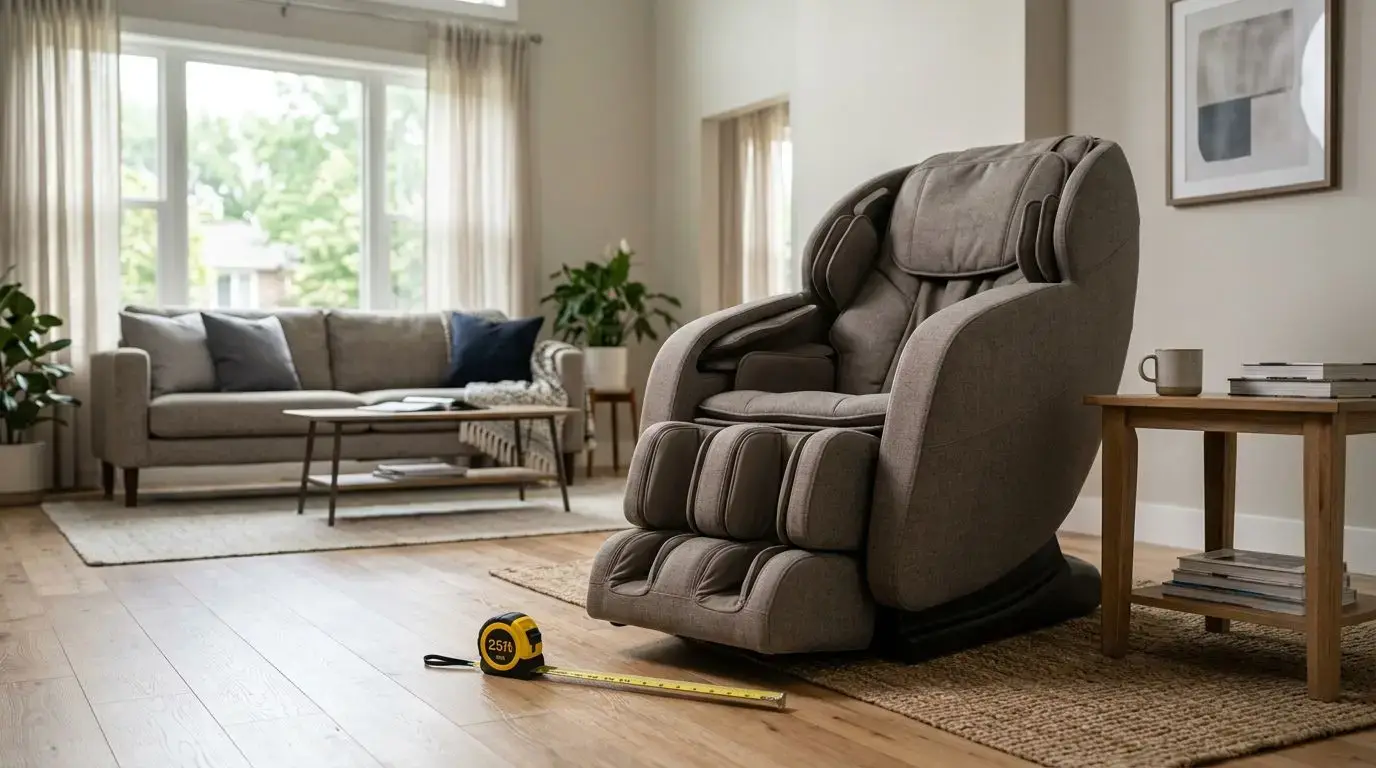
How to Choose a Massage Chair for Home Use
14 min read
Full-Body Massage Chair Benefits: What Head-to-Toe Massage Can and Can’t Do
12 min read