Disclosure: We may earn a commission when you buy through links on this page, at no extra cost to you. We buy nothing, sell nothing and accept no payment for coverage — commissions never decide what we recommend. How we make money.
A full-body massage chair usually works your back, neck area, seat, calves, and feet, but it does not massage every inch of the body. The best coverage comes from a long track, upper-body rollers, arm and leg airbags, calf kneading, and foot rollers. What you actually feel depends on the chair size, roller reach, body fit, and how well your shoulders, hips, calves, and feet line up with the chair.
That makes the term full-body helpful, but somewhat loose. In retail listings, it often means the chair offers more than a back massage: it may add shoulder compression, arm pockets, seat movement, leg airbags, and foot rollers. It does not mean the chair replaces a hands-on session or targets every small muscle with equal precision.
What full-body means in a massage chair: 5 main zones
Most full-body massage chairs are built around 5 practical zones: neck and shoulders, back, seat and hips, arms and hands, and calves and feet. The back is the core zone because it uses a motorized roller system inside the chair frame. The other zones usually rely on airbags, small rollers, vibration motors, or mechanical calf and foot parts.
Coverage varies widely. A basic chair may have a roller path of roughly 28 to 32 inches, ending near the lower back. A longer track may run about 45 to 53 inches from the neck area down under the seat, depending on the design. Leg rests may adjust several inches to fit different inseams, while arm pockets are fixed enough that posture often matters.
| Body zone | Common chair method | What it is designed to feel like | Common limitation |
|---|---|---|---|
| Neck and shoulders | Upper roller path, shoulder airbags, manual head pillow adjustment | Rolling or kneading pressure near the upper back and base of the neck | May miss the top of the shoulders or shorter necks |
| Back | 2D, 3D, or 4D rollers on an S, L, or SL track | Consistent movement along the spine-side muscles | Intensity depends heavily on body fit |
| Seat and hips | L-track rollers, seat airbags, vibration | Pressure under the glutes and around the sides of the hips | Not all chairs include true under-seat rollers |
| Arms and hands | Air compression sleeves or pockets | Firm squeezing and release along forearms and palms | Usually no detailed finger or wrist work |
| Calves and feet | Leg airbags, calf kneading, foot rollers, sole airbags | Compression around the lower legs and rolling under the arches | Fit can be tight for large calves or long feet |
The key point: full-body is a coverage category, not a promise of perfect contact. Two chairs can both be described that way and still feel completely different.
Back, neck, and shoulder coverage: track length matters by 20 inches or more
The track is the rail system that guides the back rollers. It affects coverage more than almost any menu label. A shorter S-track follows the curve of the back from the neck area to the lower back, often around 28 to 32 inches. An L-track extends below the back and under the seat. An SL-track combines a curved upper path with a longer seat-reaching path, commonly around 45 to 53 inches.
For the neck, most chairs do not reach the head itself. They are designed to contact the base of the neck, upper trapezius area, and upper back. If you are 5 feet 1 inch, the rollers may sit higher than expected unless the chair has a strong body scan and adjustable shoulder position. If you are 6 feet 3 inches, the rollers may not reach as high into the upper neck area as you want.
Shoulders are tricky. Many shoppers expect a chair to knead across the top of the shoulders like human thumbs. Most chairs instead work beside the spine and use airbags at the sides of the shoulders to hold the body in place or create a squeezing feel. A chair with shoulder airbags can feel more enveloping, but it still may not press directly down on the shoulder tops.
Roller depth: 2D, 3D, and 4D
Roller technology also changes the feel. A 2D roller moves up, down, left, and right. A 3D roller adds in-and-out depth adjustment, often in several intensity levels. A 4D system generally adds more variation in speed or rhythm, though the exact meaning varies by manufacturer. For sensitive users, a 3D chair with 5 or more intensity settings may be easier to fine-tune than a strong fixed-depth chair.
Padding matters too. A removable back pad or head pillow can soften the feel by adding a small barrier between your body and the rollers. Before deciding a chair is too intense, test it with the pad in place and with the lowest roller depth setting.
Arms, hands, hips, calves, and feet: what the chair adds beyond the back
Full-body shoppers often focus on the legs and arms because those features separate a basic recliner-style massager from a more complete chair. Arm coverage usually comes from airbags built into long pockets on each side. These pockets inflate and deflate around the forearms and palms, usually in cycles lasting 10 to 30 seconds per squeeze. The feel is broad and compressive, not detailed.
Hand coverage is limited. Most chairs do not individually massage fingers, knuckles, or wrists. If the air pocket is too far forward or too short for your arm length, the pressure may land more on the wrist or forearm than the palm. People with broad hands should check the pocket opening and whether jewelry, watches, or bracelets need to be removed before use.
Hips and seat coverage depend on the track. An L-track or SL-track can bring rollers under the glutes, while a shorter S-track usually cannot. Some chairs add seat airbags at the sides of the hips. Others include seat vibration, which is a simple buzzing sensation rather than a kneading motion. If hip coverage is a priority, look for a track that explicitly extends under the seat, not just a program named full body.
Leg systems vary even more. Calf airbags squeeze the lower legs. Some designs add a mechanical calf kneading unit or rollers behind the calves. Foot sections may include rollers under the arches, airbags over the top of the feet, and heel pockets. A typical foot roller covers the sole, not the toes in detail. The strongest sensation is often under the arch or ball of the foot.
| Feature | Best practical use | Fit check before buying |
|---|---|---|
| Arm airbags | Broad forearm and palm compression | Confirm your elbows and hands sit naturally in the pockets |
| Shoulder airbags | Upper-body hold and side pressure | Check width if you have broad shoulders |
| L-track or SL-track | Back plus seat and glute coverage | Confirm the roller path reaches under the seat |
| Calf airbags | Lower-leg compression | Measure calf circumference if leg rests run narrow |
| Foot rollers | Rolling pressure under the soles | Check maximum foot size and leg-rest extension |
What full-body chairs miss: at least 7 common gaps
Even a well-equipped chair has blind spots. The biggest misunderstanding is that full-body means all-over contact. It does not. A chair works where its rollers, airbags, and moving parts can physically reach while you sit in one fixed position.
Here are 7 common gaps shoppers should expect:
- Top of shoulders: Many chairs work near the upper back, not directly downward onto shoulder tops.
- Front of the body: Chest, abdomen, front shoulders, and face are not targeted.
- Outer arms: Arm airbags usually focus on the forearm and palm, not the upper arm or elbow joint.
- Fingers and toes: Air pressure may surround them, but detailed contact is rare.
- Side waist: Some hip airbags squeeze the sides, but there is usually no precise side-body kneading.
- Very high neck area: Taller users may find the rollers stop below their preferred neck position.
- Very specific knots or tight spots: Spot modes can pause rollers in one area, but the chair cannot adapt like a person using hands.
The chair also cannot see your posture. If you slouch, sit off-center, or wear thick clothing, the pressure can land differently. A 1-inch shift in shoulder position may change whether the rollers feel centered or too wide.
That does not make full-body chairs ineffective as comfort products. It simply means the phrase should be read as broad coverage, not complete coverage.
Who it is best for: 4 shopper profiles that usually fit well
A full-body massage chair is best for people who want a repeatable, at-home relaxation routine with broad pressure from neck area to feet. It is especially useful for shoppers who prefer structured programs lasting about 10 to 30 minutes and who like a reclined, enclosed feel. If you mainly want a precise neck-only or shoulder-top experience, a full-size chair may be more chair than you need.
1. The whole-back coverage shopper
If your main goal is a consistent rolling feel along the back, start with the track. A 3D SL-track chair is often the more adjustable direction because it can cover the upper back, lower back, and seat area while letting you reduce or increase depth. If you dislike strong pressure, prioritize softer padding and low intensity settings over maximum power.
2. The foot-and-calf focused shopper
If your feet matter as much as your back, focus on the leg rest. Look for foot rollers, calf airbags, leg-length adjustment, and a footwell that fits your shoe size. A person with size 13 feet or large calves should be especially careful because a narrow footwell can turn a premium feature into an uncomfortable squeeze.
3. The shared-household buyer
For two or more users, adjustability matters more than the longest feature list. A chair used by someone 5 feet 2 inches and someone 6 feet 2 inches needs a reliable body scan, shoulder height adjustment, extendable leg rest, and several intensity levels. Memory settings can help, but only if the chair still positions each person correctly.
4. The routine-driven relaxation user
Many people use these chairs because they like a predictable wind-down routine. Auto programs of 15 or 20 minutes are common. If you want something simple, look for clear controls, quick-start programs, and an easy way to turn off features you do not like, such as foot rollers or heat.
A full-body chair may not be the best choice if you dislike being held by airbags, have very limited room, need easy side transfers, or want a lightweight seat you can move often. Many full-size chairs weigh well over 150 pounds, and some require two adults or professional delivery to place safely.
How to choose and how to measure: use 6 numbers before you shop
Before comparing features, measure your body and the space. Six numbers will prevent many fit mistakes: your height, shoulder width, hip width, calf circumference, foot length or shoe size, and the floor space available for the chair fully reclined.
Start with body fit. Measure shoulder width across the upper back, not just jacket size. Measure hip width while seated. For calves, wrap a soft tape around the widest part of each calf; if one leg is larger, use that number. For foot length, trace your foot on paper and measure heel to longest toe, or use your usual US shoe size as a rough guide. If a chair lists a height range, treat it as guidance, not a guarantee.
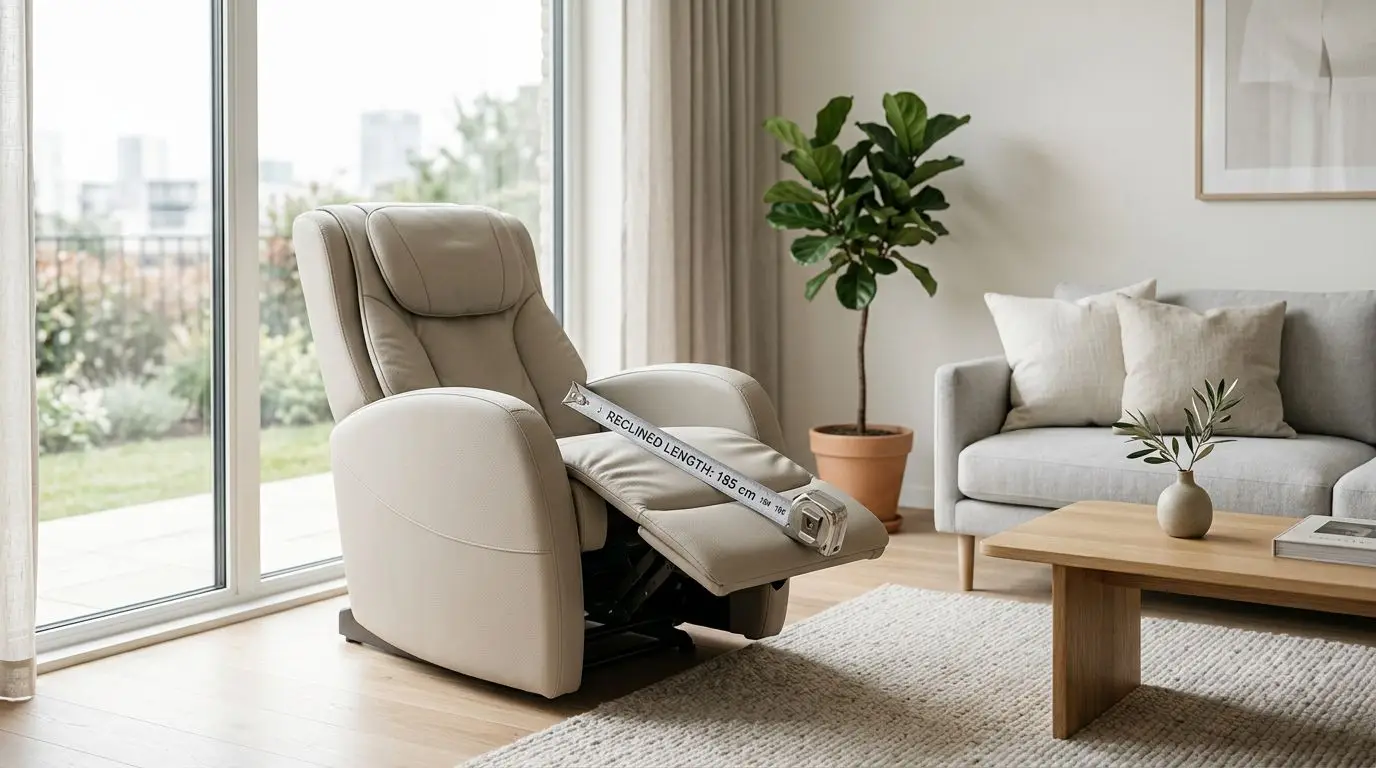
Then measure the room. A full-body chair can take roughly 5 to 6.5 feet of length when reclined, depending on the base and leg rest. Some wall-hugging designs may need only about 2 to 6 inches behind the chair, while others need much more clearance. Measure from the wall to the front edge of the fully extended leg rest, not just the upright chair footprint.
Doorways matter. Check the narrowest doorway, hallway turn, and stair landing. Many massage chairs ship in large cartons and may require a door width around 30 inches or more, but packaging varies. Also consider the final location: allow room on one side for getting in and out, especially if the chair has tall arm structures.
| Measurement | How to take it | Why it matters |
|---|---|---|
| Height | Stand barefoot against a wall | Determines shoulder scan and leg-rest fit |
| Shoulder width | Measure across the upper back | Affects shoulder airbags and roller alignment |
| Hip width | Sit on a flat chair and measure widest point | Checks seat comfort and side airbags |
| Calf circumference | Measure widest calf with a soft tape | Prevents tight leg-rest fit |
| Foot length | Measure heel to toe or note shoe size | Checks footwell and roller position |
| Room length | Measure wall to fully extended front area | Confirms recline clearance |
If you can test a chair in person, use a full 15-minute program, not a 2-minute sample. Wear normal indoor clothing, remove bulky items from pockets, and try the lowest and middle intensity settings. Notice whether your neck, lower back, calves, and feet land where the chair seems designed to work.
Safety and comfort limits: ask a physician in these 8 situations
Massage chairs are consumer wellness products. They are designed to provide pressure, movement, warmth, and a relaxing seated experience; they are not medical devices. If you have a health condition or are unsure whether compression, heat, reclining, or strong roller pressure is appropriate for you, ask your physician before using one.
Do not guess if any of these 8 situations apply: pregnancy, a pacemaker or other implanted cardiac device, a history of blood clots or use of anticoagulants, osteoporosis, recent fracture, recent surgery, spinal disc problems, neuropathy, or uncontrolled hypertension. That list includes more than 8 examples because several are closely related, and each can change what pressure or positioning may be safe for you.
Comfort settings also deserve respect. Start low. Use a 10- or 15-minute session before trying a longer program. Stop using the chair if you feel sharp pain, numbness, dizziness, unusual discomfort, or pressure that feels wrong. Heat should feel warm, not hot, and it should be turned off if you cannot judge temperature normally.
Children should not use a full-size massage chair without adult supervision. Pets should be kept away from moving leg rests and reclining bases. Check the floor too: a heavy chair on a soft surface may shift during recline, while a hard floor may need a mat to reduce scuffs.
FAQ: 5 common full-body massage chair questions
Does a full-body massage chair massage the neck?
Usually, yes, but mostly at the base of the neck and upper back. The rollers generally do not massage the head or the full length of the neck. Taller and shorter users should check shoulder height adjustment carefully.
Do full-body chairs massage the arms and hands?
Many do, but usually with airbags rather than rollers. Expect a squeezing and release sensation around the forearms and palms, not detailed work on each finger or wrist.
Are foot rollers worth it?
They can be worth it if you enjoy firm rolling pressure under the arches and soles. They may feel too intense for some users, so a chair that lets you reduce or turn off foot rollers is easier to live with.
What is better for full-body coverage, S-track or SL-track?
An SL-track usually provides broader coverage because it follows the back curve and extends under the seat. An S-track can still feel good on the back, but it typically does not provide the same seat and glute roller coverage.
How long should a session last?
Common auto programs run about 10 to 30 minutes. New users should start with a shorter session and low intensity, then adjust only if the pressure feels comfortable.
Can one chair fit both tall and short users?
Sometimes. Look for a reliable body scan, manual shoulder adjustment, an extendable leg rest, and multiple intensity levels. A chair that fits a 5-foot-2 user well may not automatically fit a 6-foot-2 user unless those adjustments work well.
Bottom line: full-body means broad coverage, not every body part
A full-body massage chair is the right category if you want back rollers plus added arm, hip, calf, and foot features in one large recliner-style product. The most complete designs combine an SL-track, adjustable roller depth, shoulder and arm airbags, seat or hip coverage, calf compression, and foot rollers. Still, the chair will miss some areas, especially shoulder tops, fingers, toes, front body, and highly specific spots.
Shop by fit first. Measure your body, measure the room, and compare the actual mechanisms instead of relying on the phrase full-body. The chair that feels best is usually the one that lines up with your height, shoulder position, hip width, leg length, and preferred pressure level.
Frequently asked questions
Does a full-body massage chair massage the neck? +
Usually, but mainly at the base of the neck and upper back. It generally does not massage the head or the full neck with the precision of hands.
Do full-body chairs massage the arms and hands? +
Many include arm pockets with airbags that squeeze and release around the forearms and palms. They usually do not provide detailed finger or wrist massage.
What body areas do full-body massage chairs usually miss? +
Common gaps include the top of the shoulders, front of the body, fingers, toes, side waist, and very specific spots that do not line up with the rollers.
Is an SL-track better than an S-track for full-body coverage? +
An SL-track usually covers more because it follows the back and extends under the seat. An S-track is mainly focused on the back and may not provide under-seat roller coverage.
How do I know if a full-body massage chair will fit me? +
Measure your height, shoulder width, hip width, calf circumference, foot length, and room clearance. Then compare those numbers with the chair dimensions and adjustment range.
Who should ask a physician before using a massage chair? +
Ask a physician if you are pregnant or have an implanted cardiac device, blood clot concerns, anticoagulant use, osteoporosis, recent fracture or surgery, spinal disc problems, neuropathy, or uncontrolled hypertension.
Related guides
Full-Body Massage Chair Benefits: What Head-to-Toe Massage Can and Can’t Do
12 min read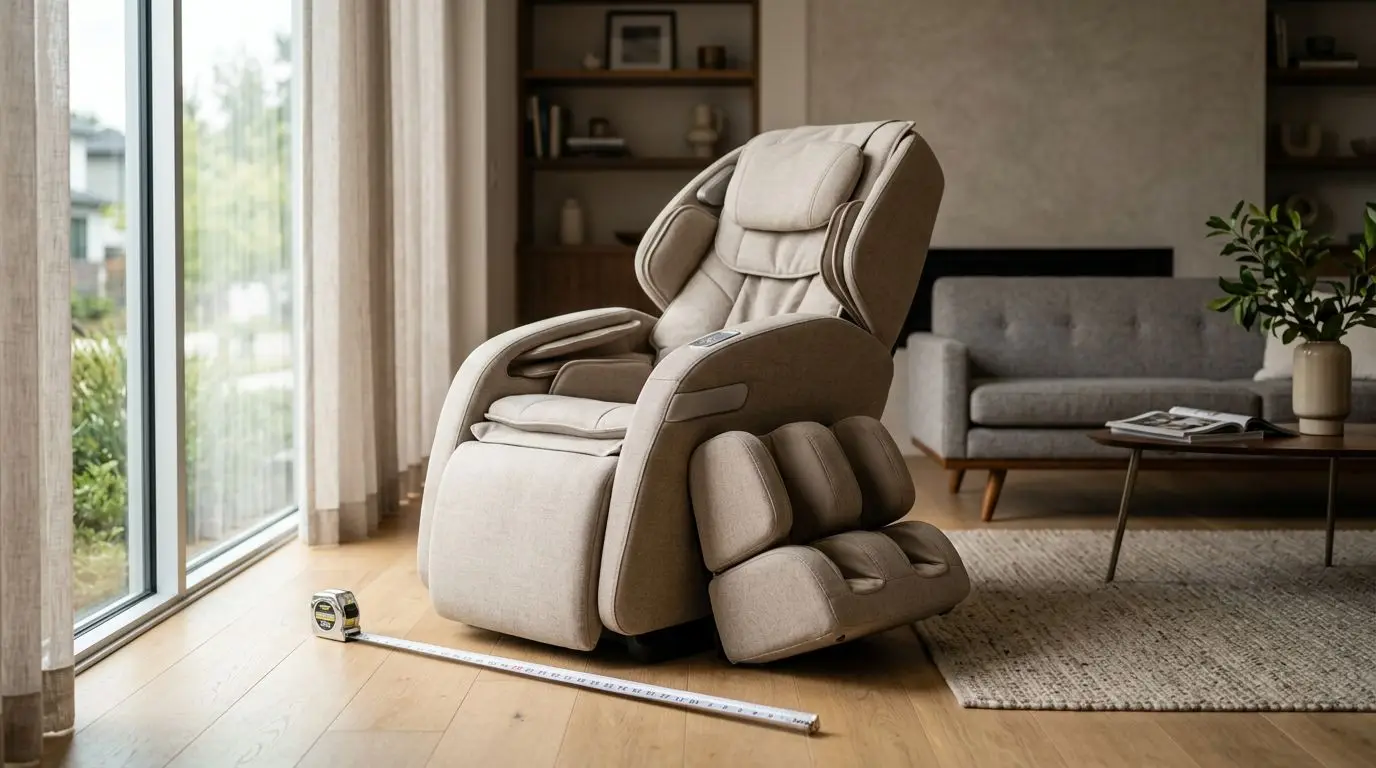
How to Compare Massage Chair Features: 2D, 3D, 4D, L-Track, SL-Track, Heat, and Airbags
13 min read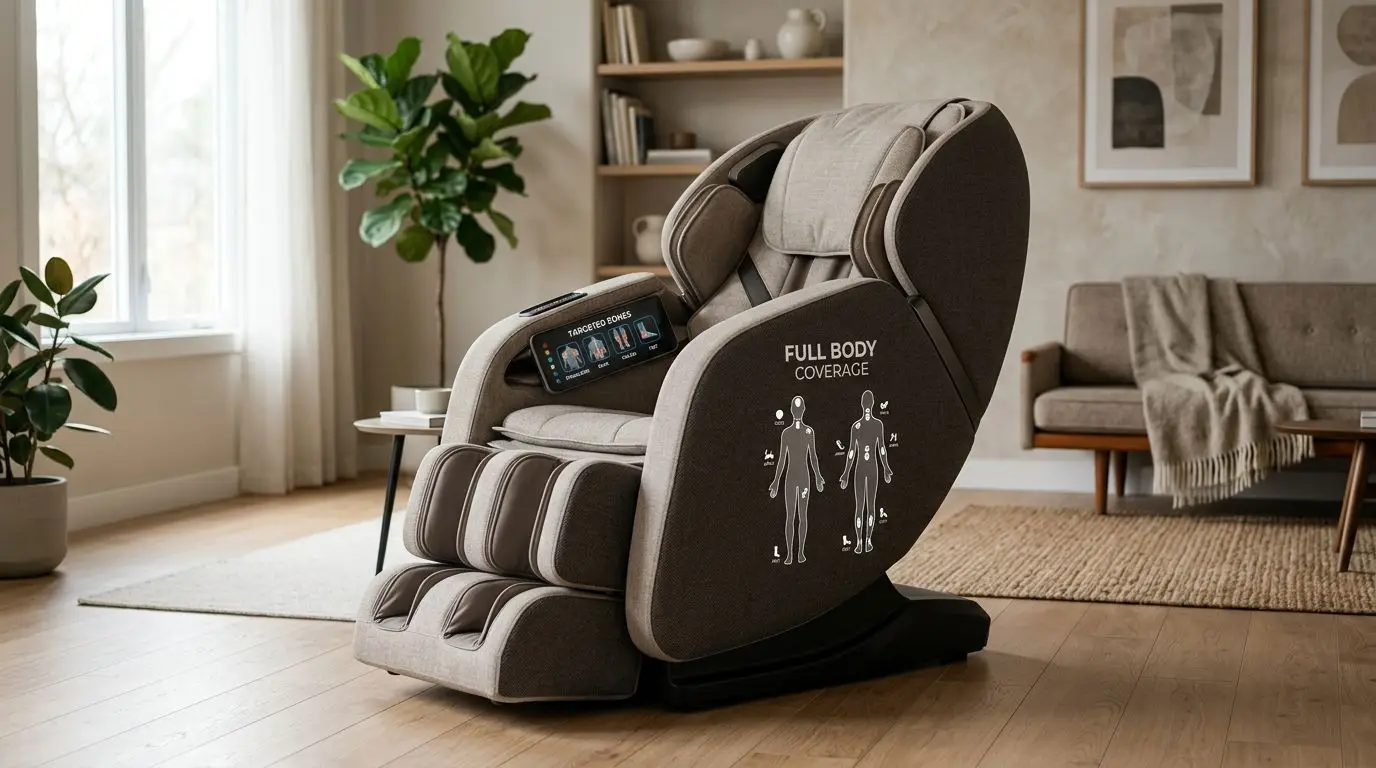
Full-Body vs. Targeted Massage Chair Programs: When to Use Each Type
14 min read
How to Buy a Massage Chair for Tall, Short, or Plus-Size Users
14 min read
How to Choose a Massage Chair for Home Use
14 min read