Disclosure: We may earn a commission when you buy through links on this page, at no extra cost to you. We buy nothing, sell nothing and accept no payment for coverage — commissions never decide what we recommend. How we make money.
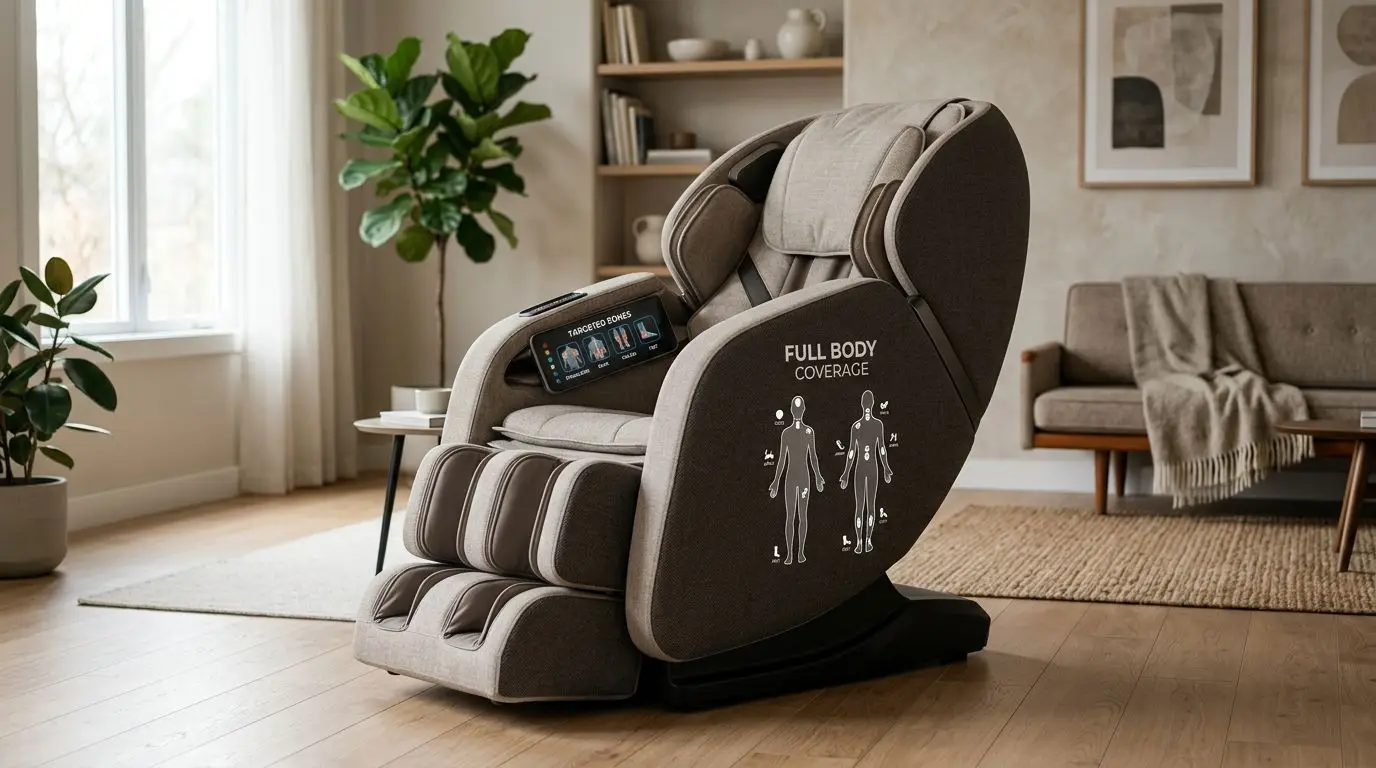
Use a full-body massage chair program when you want broad, balanced coverage in one automatic session, usually about 15 to 30 minutes. Choose a targeted program when one area feels tight, tired, or overworked and you want the chair to spend more time on the neck, shoulders, back, hips, calves, or feet. In simple terms: full-body is your default whole-chair routine; targeted is the better choice when you can name the exact area you want the chair to focus on.
The right choice also depends on the chair’s track design, roller reach, airbag layout, foot-and-calf hardware, and the intensity you prefer. A full-body program can feel more balanced, while a targeted setting may feel more useful after 8 hours at a desk, a long drive, a workout, or a day spent standing.
Full-body programs: what they do in a 15- to 30-minute session
A full-body program is an automatic routine that moves through several zones in one preset sequence. On many chairs, a standard session lasts 15, 20, or 30 minutes and may combine back rollers, air compression, foot rollers, calf kneading, heat, recline, and zero-gravity positioning.
The experience is usually paced. The chair may begin with a body scan, then work from the neck and shoulders down to the mid-back, low back, glutes, calves, and feet, depending on its hardware. Some chairs use an S-track that follows the curve of the spine, while others use an L-track or SL-track that extends under the seat toward the glutes and upper hamstrings. Track length often falls around 40 to 55 inches, though exact reach varies by chair.
Full-body programs are best when you do not want to adjust settings manually. They also help when you want a balanced feel instead of spending the entire session on one area. If you sit in the chair after dinner, press one button, and let the chair run, a full-body program is usually the most convenient option.
They are not always the most precise choice. If your shoulders feel tight after laptop work, a full-body routine may spend only 2 or 3 minutes in that area before moving on. If your feet feel tired after standing all day, a full-body program may include foot rollers, but it may not give your feet as much time as a dedicated foot or calf setting.
Targeted programs: focused chair time in 3- to 10-minute zones
A targeted program keeps the chair’s attention on one body area or a smaller range of movement. Common options include neck and shoulders, upper back, mid-back, low back, hips and glutes, calves, or feet. Some chairs call these zone, spot, manual, partial, or area programs.
Targeted sessions are often shorter or easier to repeat. A chair may let you hold the rollers at one point for 3 to 5 minutes, run a zone program for 10 minutes, or add a specific foot-and-calf cycle to a larger routine. On chairs with manual controls, you may be able to move the rollers up or down in small increments, adjust width, and choose techniques such as kneading, tapping, rolling, or a combination.
The main advantage is time on task. If your shoulders are the area you care about today, a targeted shoulder program gives that area more repeated contact than a general whole-chair cycle. If your feet feel worn out from 12,000 steps, a foot setting can keep the rollers and airbags active there without making you sit through a full automatic sequence.
The tradeoff is balance. Spending too long in one area can feel intense, especially with deep roller pressure or strong calf airbags. Most users are better off starting with a low or medium intensity setting, then increasing slowly over several sessions.
Quick comparison: full-body vs. targeted programs across 6 buying factors
The table below compares the two program types from a practical retail perspective. Exact settings vary, but these are the patterns most shoppers will see when comparing chairs with 6 to 12 automatic programs and several manual controls.
| Factor | Full-body program | Targeted program |
|---|---|---|
| Typical session length | 15 to 30 minutes | 3 to 15 minutes, depending on zone |
| Best use | Balanced coverage when you want the chair to run automatically | Focused comfort for one area, such as shoulders, low back, calves, or feet |
| User effort | Low; usually one button | Moderate; may require choosing zone, technique, roller position, or intensity |
| Coverage | Broad, limited by track and airbag layout | Narrower, with more repeated contact in one area |
| Intensity control | Often preset, with limited adjustments | Usually easier to fine-tune by area |
| Best chair features | Reliable body scan, long track, air compression, foot-and-calf system | Manual roller controls, zone selection, adjustable width, separate foot/calf settings |
If you are new to massage chairs, start with full-body programs for the first week. That gives you a baseline for pressure, roller reach, and fit. After that, targeted programs make more sense because you will know which zones the chair handles well and which areas need manual adjustment.
Who full-body programs are best for in real daily use
Full-body programs are the better fit for people who want a simple routine and consistent coverage. If you plan to use the chair 3 or 4 evenings per week, a full-body setting is usually easier to stick with because it does not require much decision-making.
They are especially useful for shared households. One person can select a gentle full-body program, while another chooses a stronger one, without learning the full manual-control menu. Many chairs include multiple automatic styles, such as gentle, stretch-style, deep-pressure, relax, or energy-style programs. The names vary, so focus less on the label and more on the actual settings: roller intensity, airbag strength, recline angle, heat, and whether foot rollers are active.
Full-body programs also work well when you want the chair to coordinate several systems at once. A session may recline the chair, inflate shoulder and arm airbags, move the rollers down the track, warm the back pad, and activate foot rollers in a sequence. That coordinated feel is harder to recreate manually.
Choose full-body when:
- You want a one-button session lasting about 15 to 30 minutes.
- You do not have one specific area in mind.
- Multiple people in the home will use the chair.
- You prefer a balanced feel from shoulders to feet.
- You want recline, air compression, heat, and rollers to work together automatically.
Skip or shorten the session if the program feels too strong. A 30-minute cycle is not automatically better than a 15-minute one, especially if the rollers are firm or the airbags squeeze more than you like.
Who targeted programs are best for after desk work, travel, or standing
Targeted programs are best when your goal is specific. If you spent 8 hours at a desk, you may want the neck and shoulder area. If you drove 300 miles, the low-back and hip area may be the focus. If you worked on your feet all day, calves and feet may deserve the chair’s full attention.
They also help when a full-body program misses your preferred spot. Body-scan systems are useful, but they are not perfect. A tall user, a short user, or someone with a longer torso may find that the rollers land slightly above or below the intended area. Manual positioning lets you correct that by moving the rollers up or down before starting the focused portion.
Targeted programs are also useful for intensity management. Many people can handle firm pressure on the upper back but want a gentler feel at the calves or feet. Others like strong foot rollers but prefer light contact near the neck. Separate area controls let you customize that mix instead of accepting one preset intensity for the entire body.
Choose targeted when:
- You can name one main area, such as shoulders, low back, hips, calves, or feet.
- You want a shorter 5- to 10-minute add-on after a full-body cycle.
- The chair’s automatic scan needs small corrections.
- You want different intensity levels for different body areas.
- You are comparing chairs and want to test roller precision, not just preset routines.
Use common sense with repeat sessions. If a focused program starts to feel sharp, pinchy, numbing, or uncomfortable, stop and adjust position, intensity, or duration.
How to choose and measure for the right program style
Before you compare programs, check fit. A massage chair can have 10 automatic routines and still feel wrong if the rollers, shoulder airbags, or footrest do not match your body. Most chairs list a recommended user height range, often somewhere around 5 feet to 6 feet 3 inches, and a maximum user weight, often in the 250- to 300-pound range. Always verify the actual chair’s specifications.
Start with shoulder alignment. Sit fully back with your hips against the seatback and run the body scan if the chair has one. The rollers should identify the shoulder area without stopping too high at the neck or too low at the upper back. If the chair lets you manually adjust shoulder position after the scan, test that feature. A 1- or 2-inch correction can change the feel significantly.
Next, check track reach. An S-track generally focuses on the back and spine curve. An L-track or SL-track extends beneath the seat and can contact the glute area. If hip and glute coverage matters to you, track length and seat coverage are more important than the number of automatic programs.
Then check the footrest. Your heels should sit naturally in the foot wells without your knees being jammed upward. Many footrests extend several inches, but the range varies. If your feet are larger than average, check the footwell length and width. If your calves are sensitive to squeeze, test airbag intensity at the lowest level before using a full foot-and-calf routine.
A simple way to decide:
| Your priority | What to check | Program style to favor |
|---|---|---|
| One easy routine | At least 3 automatic programs with clear intensity differences | Full-body |
| Desk-related shoulder tightness | Accurate shoulder scan and adjustable roller height | Targeted neck/shoulder |
| Low-back and hip coverage | L-track or SL-track reach under the seat | Targeted low-back/hip plus full-body |
| Tired feet after standing | Foot rollers, airbag strength, removable or washable liners | Targeted foot/calf |
| Multiple users | Height range, weight rating, memory settings if available | Full-body with manual adjustments |
If you are testing a chair in a store, do not judge it in the first 60 seconds. Run at least 5 minutes of a full-body program and 3 minutes of the most important targeted area. That gives the rollers enough time to move through their pattern.
Feature differences that matter: tracks, rollers, airbags, heat, and recline
Program names can sound similar, but the hardware makes the real difference. A chair with 12 automatic programs is not automatically better than one with 6 if the rollers do not reach the areas you care about or the controls are hard to adjust.
Track type is the first major feature. An S-track follows the back curve and is common on chairs focused on back coverage. An L-track continues under the seat, often reaching the glute area. An SL-track is a marketing term commonly used for a long track that follows the spine curve and extends under the seat. For full-body programs, longer track coverage can make the sequence feel more complete. For targeted low-back or hip work, the extension under the seat is especially important.
Roller design also matters. Two-dimensional rollers move up and down and side to side. Three-dimensional rollers add depth adjustment, so they can press more or less firmly. Some chairs describe four-dimensional rollers, usually meaning the chair varies speed or rhythm in addition to depth and movement. Do not buy by the number alone. Test whether the lightest setting is comfortable and whether the strongest setting feels controlled rather than harsh.
Airbags change the feel in areas rollers cannot reach well, such as arms, shoulders, calves, and feet. A chair may advertise 20, 40, or more airbags, but placement matters more than count. For targeted calf and foot programs, airbag positioning can affect whether the squeeze feels secure, uneven, or too tight.
Heat is usually limited to the back, lumbar area, calves, or feet. It is designed to feel warm and relaxing, not to serve a medical purpose. Check whether heat can be turned on or off separately, since some people enjoy it during a full-body routine but not during a focused foot or calf setting.
Zero-gravity recline changes body position by raising the legs and reclining the back. Many chairs offer 1 or 2 recline stages, while others allow more gradual adjustment. In a full-body program, recline can make the session feel more immersive. In a targeted back program, it can change how much body weight rests against the rollers.
Best program pairings: 5 common scenarios
Most owners do not have to choose one style forever. A better approach is to pair full-body and targeted programs based on the day. Try these examples as starting points, then adjust duration and intensity.
| Scenario | Suggested chair approach | Why it fits |
|---|---|---|
| After a normal workday | 15- or 20-minute full-body program at low or medium intensity | Balanced coverage with minimal setup |
| After long desk time | 10-minute neck/shoulder or upper-back zone, then stop | More time where posture-related tightness is usually noticed |
| After travel | Full-body program, then 5-minute low-back or hip focus if comfortable | Combines general coverage with a specific follow-up area |
| After standing most of the day | Targeted calf/foot program for 5 to 15 minutes | Keeps rollers and airbags focused below the knees |
| Shared family use | Default full-body program plus saved intensity preferences if available | Easy for different users to repeat |
Keep a short note on what works. For example: “Full-body, 20 minutes, air level 2, rollers medium” or “Feet only, 8 minutes, rollers low.” After 2 weeks, those notes are more useful than the chair’s program names.
Safety checks before any 15-minute massage chair session
Massage chairs are consumer wellness products, not medical devices. They are designed to provide mechanical pressure, movement, warmth, squeezing, and reclining comfort. They should not be used as a substitute for professional medical advice.
Ask your physician before using a massage chair if you are pregnant; have a pacemaker or other implanted cardiac device; have a history of blood clots or use anticoagulants; have osteoporosis; recently had a fracture, injury, or surgery; have spinal disc problems; have neuropathy or reduced sensation; or have uncontrolled hypertension. Do not bury this step. These are situations where mechanical pressure, heat, or reclining may not be appropriate for you.
Start conservatively even if you are healthy. Use the lowest or middle intensity for the first 5 to 10 minutes, especially with foot rollers, calf airbags, and 3D roller depth. Stop immediately if you feel sharp pain, numbness, dizziness, unusual discomfort, or a sensation that does not feel right.
Children should not use a massage chair without adult supervision, and pets should be kept away from moving leg rests, reclining bases, and foot wells. Leave clearance around the chair according to the manual; wall-hugging designs may need only a few inches behind them, while other recliners may need 12 inches or more.
FAQ: 5 questions about full-body and targeted programs
Is a full-body program better than a targeted program?
Not always. A full-body program is better for broad, automatic coverage in one 15- to 30-minute session. A targeted program is better when you want the chair to spend more time on one area, such as the shoulders, low back, calves, or feet.
Can I use a targeted program after a full-body program?
Yes, if it feels comfortable and you keep the total time reasonable. Many users run a 15- or 20-minute full-body routine, then add 5 minutes for feet, calves, or shoulders. Avoid repeating a strong focused program if the area feels tender or overstimulated.
Which program should I use first as a new owner?
Start with a gentle full-body program for 5 to 10 minutes so you can learn the chair’s pressure, airbag strength, recline angle, and roller reach. After a few sessions, try targeted programs one at a time so you can tell what each zone actually does.
Are foot and calf programs considered full-body or targeted?
They are targeted programs when used by themselves. In a full-body routine, the chair may include foot rollers and calf airbags as part of the sequence, but a dedicated foot-and-calf setting keeps the attention below the knees for a longer stretch.
What if the rollers miss my shoulders or low back?
Run the body scan again while sitting fully back in the chair. If the chair allows manual shoulder-position adjustment, move the rollers up or down by small increments. If the issue happens every time, the chair’s height range, track shape, or seat depth may not be a good match for your body.
How often should I switch between full-body and targeted programs?
Switch based on how you use the chair, not on a fixed rule. A practical routine is 3 or 4 full-body sessions per week, with short targeted sessions added only when one area needs extra attention and the pressure feels comfortable.
Frequently asked questions
Is a full-body program better than a targeted program? +
Not always. A full-body program is better for broad, automatic coverage in one 15- to 30-minute session. A targeted program is better when you want the chair to spend more time on one area, such as the shoulders, low back, calves, or feet.
Can I use a targeted program after a full-body program? +
Yes, if it feels comfortable and you keep the total time reasonable. Many users run a 15- or 20-minute full-body routine, then add 5 minutes for feet, calves, or shoulders. Avoid repeating a strong focused program if the area feels tender or overstimulated.
Which program should I use first as a new owner? +
Start with a gentle full-body program for 5 to 10 minutes so you can learn the chair’s pressure, airbag strength, recline angle, and roller reach. After a few sessions, try targeted programs one at a time so you can tell what each zone actually does.
Are foot and calf programs considered full-body or targeted? +
They are targeted programs when used by themselves. In a full-body routine, the chair may include foot rollers and calf airbags as part of the sequence, but a dedicated foot-and-calf setting keeps the attention below the knees for a longer stretch.
What if the rollers miss my shoulders or low back? +
Run the body scan again while sitting fully back in the chair. If the chair allows manual shoulder-position adjustment, move the rollers up or down by small increments. If the issue happens every time, the chair’s height range, track shape, or seat depth may not be a good match for your body.
How often should I switch between full-body and targeted programs? +
Switch based on how you use the chair, not on a fixed rule. A practical routine is 3 or 4 full-body sessions per week, with short targeted sessions added only when one area needs extra attention and the pressure feels comfortable.
Related guides
Massage Chair Auto Programs Explained: Relax, Stretch, Recovery, Sleep, and Deep Tissue Modes
14 min readFull-Body Massage Chairs Explained: What They Massage, What They Miss, and Who They Fit Best
14 min read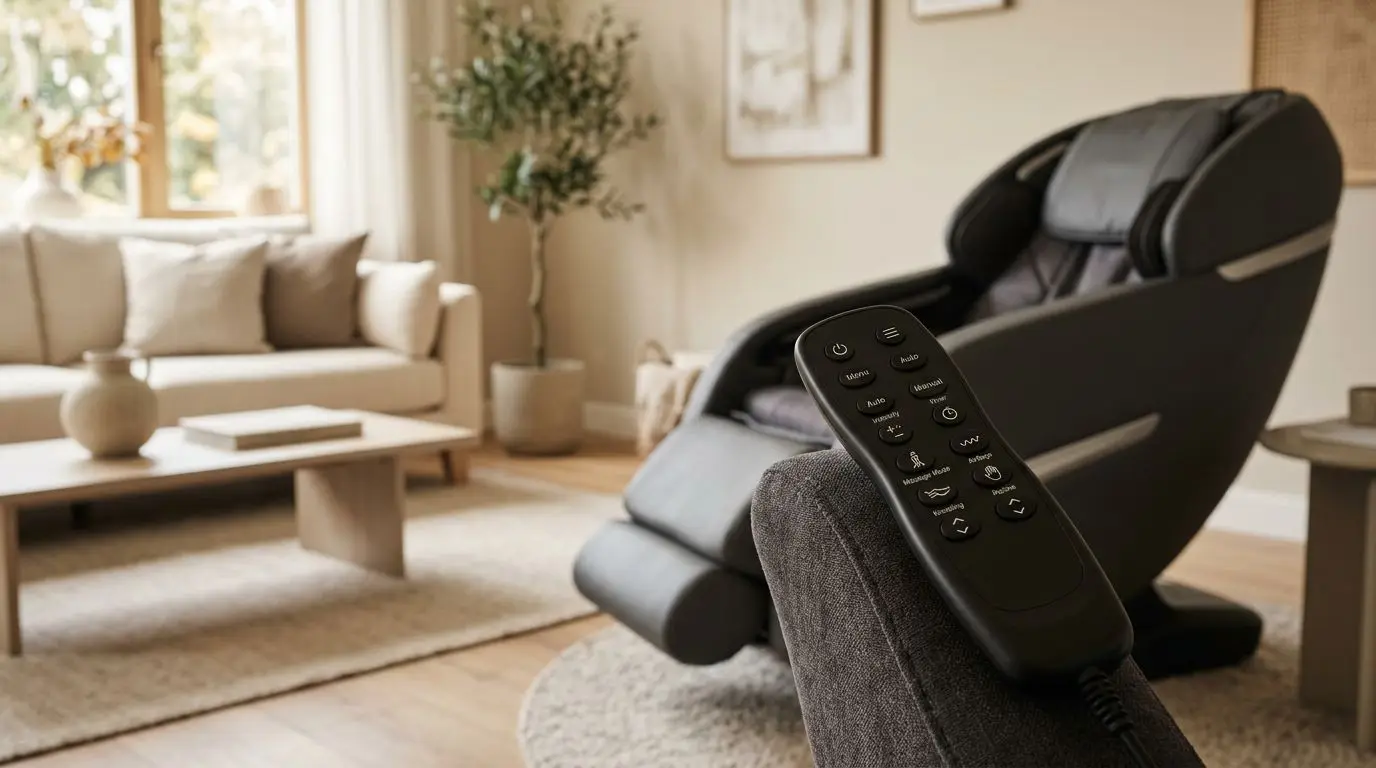
Massage Chair Programs Explained: Auto Modes, Manual Settings, Spot Massage, and Stretch Programs
12 min read
How to Adjust Massage Chair Intensity Without Overdoing It
13 min read
When to Use Manual Massage Chair Settings Instead of Auto Programs
14 min read