Disclosure: We may earn a commission when you buy through links on this page, at no extra cost to you. We buy nothing, sell nothing and accept no payment for coverage — commissions never decide what we recommend. How we make money.
A massage chair can be a comfort tool for some people with arthritis, but it works best when used gently, briefly, and with realistic expectations. Look for low-intensity programs, adjustable roller strength, mild heat, careful positioning, and easy exit features instead of the deepest or most aggressive massage.
It is not a medical device and should not replace care from a physician. If you have severe joint changes, osteoporosis, a pacemaker or other implanted cardiac device, blood clots, take anticoagulants, are pregnant, recently had surgery or a fracture, have spinal disc problems, neuropathy, or uncontrolled hypertension, ask your physician before using a massage chair.
What a massage chair can and cannot do for arthritis comfort
People with arthritis often shop for a massage chair because they want a gentler way to sit, warm up, and ease the feeling of day-to-day tension around stiff areas. A well-chosen chair may feel comforting because it can apply controlled pressure along the back, glutes, calves, or feet for a short session, often around 10 to 20 minutes. That comfort is about sensation and positioning, not a cure.
A chair cannot diagnose, treat, reverse, or prevent arthritis. It also cannot tell the difference between ordinary sensitivity and a joint or spine issue that needs medical attention. The safest approach is to start with the lightest setting, keep sessions short, and treat the chair as one part of a comfort routine, not as a health intervention.
For arthritis comfort, the best experience is usually not the strongest one. Deep roller pressure, tight air compression, aggressive foot rollers, or a high-stretch program can feel excessive, especially around knees, ankles, hips, shoulders, wrists, and the lower back. Many users do better by starting with a setting that feels like a 2 or 3 out of 10 in intensity, then adjusting only if the session remains comfortable.
Who it is best for, and who should ask a physician first
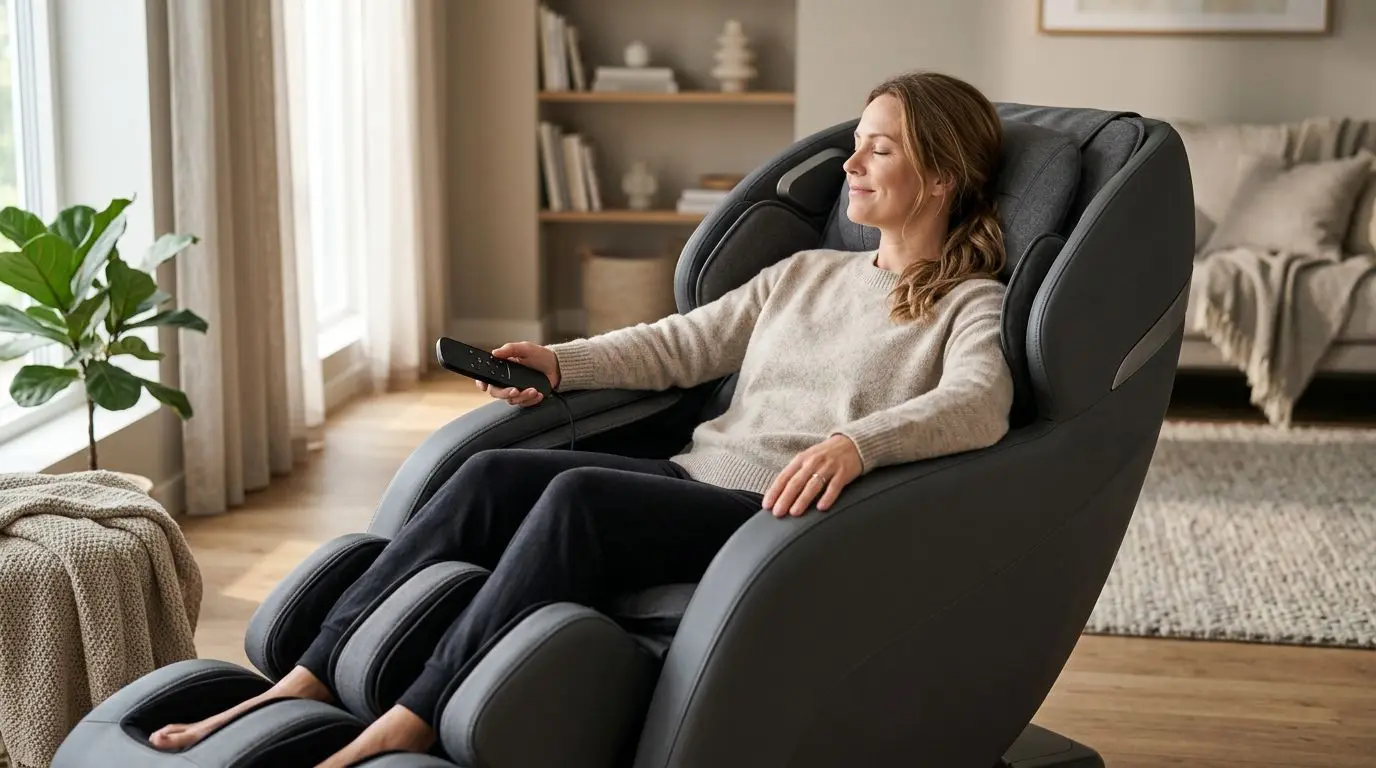
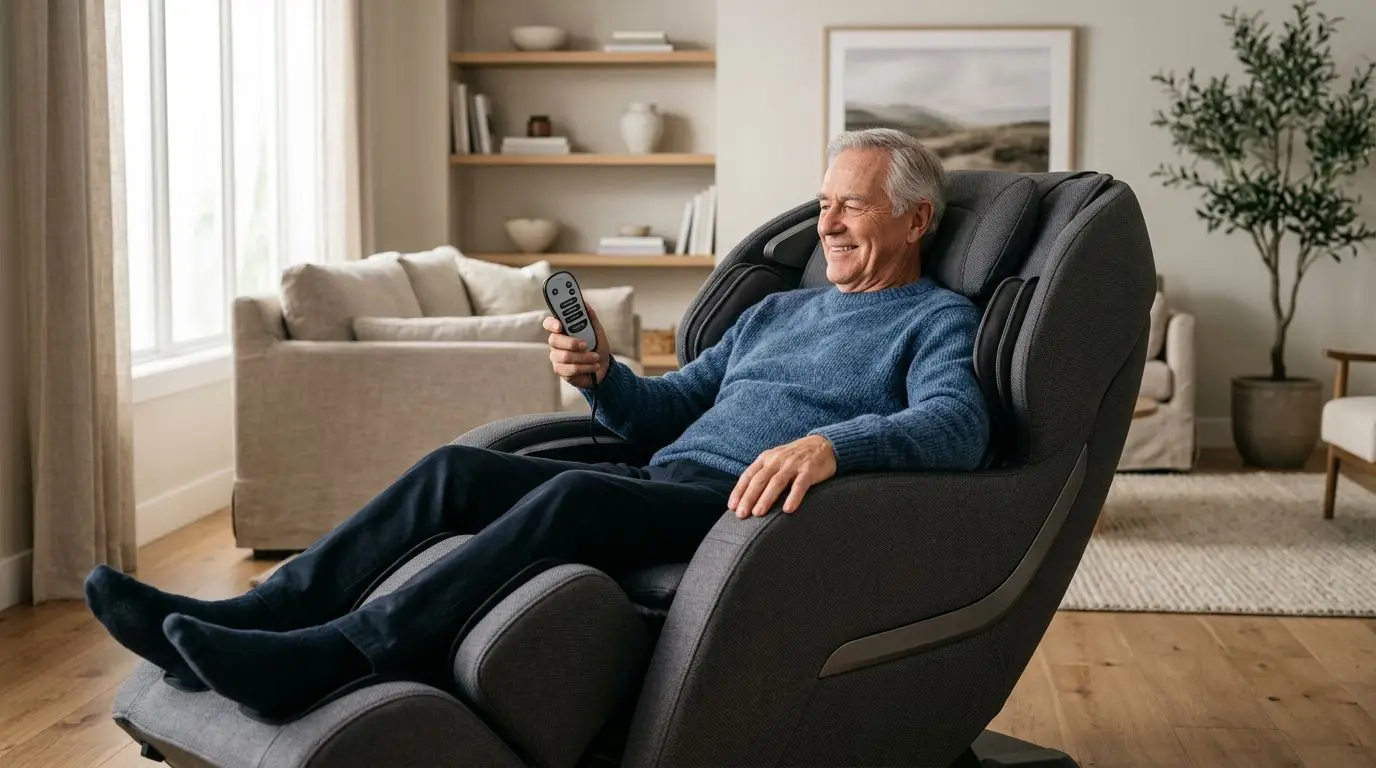
A massage chair may be best for someone who wants a predictable place to sit for 10 to 15 minutes, prefers lighter pressure, and can enter and exit the chair safely without twisting or pushing through joint discomfort. It may also suit someone who wants adjustable warmth, a supportive recline, or a consistent routine after non-strenuous daily activity.
It is less suitable for someone who dislikes pressure, has difficulty communicating discomfort, cannot safely transfer in and out of a reclined chair, or tends to keep using a device even when something feels wrong. If a chair has a deep stretch mode that strongly reclines the body and holds the legs, that mode may not be appropriate for sensitive joints unless a physician has said it is acceptable.
Ask your physician before using a massage chair if any of the following apply:
- Pregnancy, especially if using heat, deep recline, or strong compression.
- Pacemaker or other implanted cardiac device.
- Known or suspected blood clots, or use of anticoagulant medication.
- Osteoporosis or a history of low-impact fractures.
- Recent fracture, joint replacement, injection, or surgery.
- Spinal disc problems, significant spinal instability, or severe spinal curvature.
- Neuropathy, reduced sensation, or difficulty feeling heat and pressure accurately.
- Uncontrolled hypertension or another condition your physician has warned may require caution with heat, recline, or compression.
Stop a session right away if you feel sharp pain, numbness, dizziness, unusual shortness of breath, a racing heartbeat, burning heat, or a sense that a joint is being forced. Do not try to “push through” a massage chair session.
Helpful features to look for in a gentle arthritis comfort setup
The most helpful features are the ones that let you lower intensity. A chair with 5 manual intensity levels gives you more control than a chair with only “on” and “off” pressure. Likewise, a chair with separate controls for rollers, air compression, heat, foot rollers, and recline is easier to fine-tune than one where every feature runs at once.
For many arthritis-sensitive shoppers, mild heat is worth considering, but it should feel warm rather than hot. Many consumer massage chairs use timed sessions of about 15 minutes and may include auto shutoff in the 15- to 30-minute range. If you have reduced sensation, fragile skin, or a physician has told you to be cautious with heat, do not use the heat feature without medical guidance.
| Feature | What to look for | Why it matters for comfort |
|---|---|---|
| Adjustable roller intensity | At least 3 levels, ideally 5 or more | Lets you start light and avoid excessive back pressure |
| Air compression zones | Separate control for arms, legs, calves, or shoulders | Prevents one tight zone from making the whole session unusable |
| Heat | Low or medium warmth with timer control | Adds a warming sensation without requiring stronger massage |
| Manual positioning | Move rollers to upper back, mid-back, or lower back | Helps avoid sensitive areas instead of relying on a full routine |
| Foot roller on/off | Independent foot roller control | Important for tender feet, toes, and ankles |
| Easy-entry design | Stable armrests and a seat height around 18 to 22 inches | Makes sitting down and standing up less awkward for many adults |
One often-overlooked feature is the ability to pause or stop quickly. The remote should be readable, reachable, and simple enough to use without hunting through several menus. If the chair has a mobile app, make sure the physical remote still gives basic control, because a phone should not be the only way to stop a session.
Roller tracks, airbags, and foot systems compared
Massage chairs vary widely in how they contact the body. The biggest structural difference is often the track, which is the rail that guides the back rollers. A shorter track may cover the neck to lower back, while a longer L-shaped or SL-shaped track may continue under the seat toward the glutes, often reaching 45 to 55 inches in total path length depending on the chair design.
For arthritis comfort, longer coverage is not automatically better. A long track can feel useful if you like glute and hip-area pressure, but it can also feel too direct if those areas are sensitive. Adjustable intensity matters more than track length alone.
| Type or system | Typical coverage | Comfort notes for sensitive joints |
|---|---|---|
| S-track | Neck to lower back, often around 28 to 32 inches | Often simpler and may avoid direct seat pressure |
| L-track | Back plus seat/glute path, often around 45 to 50 inches | More coverage, but seat pressure may feel strong |
| SL-track | Curved back path plus under-seat coverage | Combines back contouring and longer reach |
| 2D rollers | Up/down and side-to-side motion | Often easier to tolerate at low intensity |
| 3D or 4D rollers | Rollers can press outward and vary rhythm | Good only if depth can be reduced substantially |
| Air compression | Arms, calves, shoulders, feet, or hips depending on chair | Look for low pressure and zone-by-zone shutoff |
| Foot rollers | Soles, arches, sometimes heel area | Can be intense; on/off control is important |
If you are sensitive around the neck, shoulders, or feet, do not assume the premium feature will be the best one. A basic low-pressure back program with heat may feel better than a complex full-body routine with strong calf squeeze, foot rolling, and shoulder airbags running together.
How to choose and measure before buying
Measure the person, the room, and the delivery path before comparing features. A massage chair can be roughly 28 to 36 inches wide, and some full-size chairs can weigh well over 200 pounds. Doorways, hallway turns, stairs, and flooring matter as much as the chair’s feature list.
Start with the user’s height and weight range. Most chairs publish a recommended height range and maximum user weight, and staying within both is important for fit. If the user is near the top or bottom of the stated range, pay close attention to shoulder roller placement, calf-rest length, and where the foot rollers land.
Next, measure the sitting area. You need the chair’s upright footprint, fully reclined footprint, and required rear clearance. Some space-saving recline systems need only about 2 to 6 inches behind the chair, while other designs may need 12 inches or more. Leave walking space around the chair so the user does not have to sidestep around the footrest.
- Seat height: Around 18 to 22 inches is familiar to many adults, but the right height depends on leg length and transfer ability.
- Seat width: Confirm usable interior width, not just exterior chair width.
- Footrest fit: Check calf length, foot size range, and whether the footrest can be extended or retracted manually.
- Remote visibility: Large text, backlighting, and simple buttons can matter more than extra programs.
- Power access: Use a grounded outlet within reach; avoid creating a trip hazard with the cord.
If possible, sit in a similar style of chair before buying. Spend at least 10 minutes trying the lowest roller setting, low air compression, and the recline position you expect to use at home. A quick 60-second test in a showroom is often not long enough to show whether a feature feels too strong.
A gentle 15-minute setup routine
The safest starting routine is short, simple, and easy to stop. Think of the first week as a fitting period, not a performance test. Begin with 10 to 15 minutes, no more than once per day unless your physician has given different guidance for your situation.
- Start upright. Sit down with the chair mostly upright and both feet supported. Keep the remote in your hand.
- Use the lowest intensity. Choose the lightest back roller setting and turn off foot rollers and strong air compression at first.
- Add mild heat only if appropriate. Use low warmth for a timed session, and stop if it feels hot or irritating.
- Recline gradually. Move back in small increments rather than going straight into the deepest recline or zero-gravity position.
- Check your joints after 5 minutes. If any area feels pinched, trapped, hot, numb, or sharply uncomfortable, stop.
- End slowly. Return upright before standing. Pause for a moment so you do not rush the transfer.
Zero-gravity positioning is a common feature that reclines the torso and raises the legs to spread body weight across the chair. Many chairs offer 1 to 3 preset recline positions. Some users like the supported feel; others find deep recline awkward for hips, knees, or getting up afterward. Use the shallowest position first.
Do not start with a stretch program. These routines can grip the calves or feet, recline the chair, and move the rollers in a way that creates a stronger pulling sensation. For sensitive joints, manual mode is often the better first choice because you decide where the rollers go and how long they stay there.
Positioning tips for common sensitive areas
Small changes of 1 or 2 inches can change how a massage chair feels. If the rollers hit a bony spot, do not tolerate it just because the program is not finished. Pause, reposition, reduce intensity, or choose a different zone.
Neck and shoulders
Neck rollers can feel too direct if they sit high behind the skull or press into the side of the neck. Use a low setting, keep the head supported, and avoid forcing the chin forward. If the chair allows shoulder height adjustment, set it carefully before the session starts.
Hands, wrists, and arms
Arm airbags can feel snug, especially around fingers, wrists, and elbows. Start with the lowest air level or leave arm compression off until you know how it feels. Remove watches, bracelets, and bulky rings before using arm pockets.
Hips, knees, and ankles
Deep recline and a locked-in footrest can make some people feel trapped. Keep the leg rest at a comfortable angle and avoid stretch modes until you have tested basic recline. If your knees or ankles are sensitive, choose a chair that lets you turn off calf and foot compression separately.
Feet and toes
Foot rollers can be among the strongest parts of a massage chair. If you have tender soles, toe changes, neuropathy, or reduced sensation, be especially cautious and ask your physician before using foot massage functions. Thick socks may soften the feel, but they do not make an unsafe setting safe.
Feature trade-offs for arthritis-sensitive shoppers
A longer feature list can be tempting, but comfort often comes from control rather than quantity. A chair with 12 automatic programs is not automatically better than one with 5 well-adjustable settings. For arthritis-sensitive use, the best feature is the one you can reduce, skip, or target precisely.
| Priority | Better choice | Use caution with |
|---|---|---|
| Back comfort | Manual zone control and low roller depth | Fixed deep-kneading programs |
| Warmth | Timed low heat in back or calves | Heat with no clear shutoff or level control |
| Leg comfort | Adjustable calf airbags | Strong calf squeeze that cannot be lowered |
| Foot comfort | Foot roller on/off and removable liner | Always-on foot rollers |
| Ease of use | Simple remote with a clear stop button | Complicated menus for basic controls |
| Transfers | Stable armrests and moderate seat height | Very low seats or awkward side entry |
Also think about noise and session length. A quieter chair may be easier to relax in, and a 10-minute manual session may be more comfortable than a 30-minute automatic routine. If you tend to overdo wellness gadgets, choose a chair with clear timers and use them.
Use limits, maintenance, and warning signs
Limit early sessions to 10 to 15 minutes and leave at least a day between setting changes. If you raise roller intensity, do not also raise air compression, heat, and recline depth during the same session. Change one variable at a time so you know what caused an uncomfortable reaction.
Keep the chair clean and dry. Wipe contact surfaces according to the owner’s manual, check fabric or synthetic leather for tears, and make sure zippers, liners, and footwell covers are secure. A loose liner near moving rollers should be fixed before the chair is used again.
Do not use a massage chair while sleeping, after drinking alcohol, or when taking a medication that makes you unusually drowsy unless your physician says it is safe. Do not place blankets, heating pads, or extra cushions in a way that interferes with moving parts. A thin towel behind the back may soften pressure, but it should not bunch up or block the rollers.
Stop using the chair and contact a physician if you notice new numbness, unusual swelling, skin irritation, bruising, sharp discomfort, or symptoms that worry you. The goal is comfortable, controlled use. If the chair repeatedly creates a bad experience, it may not be the right product for you.
Frequently asked questions: 6 practical answers
Can a massage chair help with arthritis?
A massage chair may feel comfortable for some people with arthritis because it offers warmth, supported sitting, and adjustable pressure. It does not treat arthritis, and anyone with significant joint, spine, circulation, bone, or nerve concerns should ask a physician before use.
Is heat a good feature for arthritis-sensitive users?
Heat can add a gentle warming sensation, but it should be low, timed, and easy to turn off. Avoid heat or ask your physician first if you have reduced sensation, fragile skin, neuropathy, uncontrolled hypertension, are pregnant, or have been told to avoid heat.
Are zero-gravity chairs better for stiff joints?
Not always. Zero-gravity recline can feel supportive for some users, but deep recline may be awkward for hips, knees, backs, or standing up afterward. Start with the shallowest recline for 5 to 10 minutes before trying a deeper position.
Should I use foot rollers if I have arthritis in my feet?
Use caution. Foot rollers can feel intense because they contact a small area of the sole. Choose a chair with foot roller on/off control, start at the lowest setting, and ask your physician first if you have neuropathy, reduced sensation, fragile skin, or significant foot problems.
How often should a beginner use a massage chair?
A cautious starting point is 10 to 15 minutes, no more than once per day, using the lowest intensity. If you have medical concerns, follow your physician’s guidance instead of a general schedule.
What is the most important feature for arthritis comfort?
Adjustability is the most important feature. Look for low roller intensity, zone control, separate air compression settings, heat that can be turned off, and a clear stop button within easy reach.
Frequently asked questions
Can a massage chair help with arthritis? +
A massage chair may feel comfortable for some people with arthritis because it offers warmth, supported sitting, and adjustable pressure. It does not treat arthritis, and anyone with significant joint, spine, circulation, bone, or nerve concerns should ask a physician before use.
Is heat a good feature for arthritis-sensitive users? +
Heat can add a gentle warming sensation, but it should be low, timed, and easy to turn off. Avoid heat or ask your physician first if you have reduced sensation, fragile skin, neuropathy, uncontrolled hypertension, are pregnant, or have been told to avoid heat.
Are zero-gravity chairs better for stiff joints? +
Not always. Zero-gravity recline can feel supportive for some users, but deep recline may be awkward for hips, knees, backs, or standing up afterward. Start with the shallowest recline for 5 to 10 minutes before trying a deeper position.
Should I use foot rollers if I have arthritis in my feet? +
Use caution. Foot rollers can feel intense because they contact a small area of the sole. Choose a chair with foot roller on/off control, start at the lowest setting, and ask your physician first if you have neuropathy, reduced sensation, fragile skin, or significant foot problems.
How often should a beginner use a massage chair? +
A cautious starting point is 10 to 15 minutes, no more than once per day, using the lowest intensity. If you have medical concerns, follow your physician’s guidance instead of a general schedule.
What is the most important feature for arthritis comfort? +
Adjustability is the most important feature. Look for low roller intensity, zone control, separate air compression settings, heat that can be turned off, and a clear stop button within easy reach.
Related guides
Are Massage Chairs Good or Bad for You? Benefits, Risks, and Safe Use Guidelines
13 min read
Morning, Afternoon, or Night: When Is the Best Time to Use a Massage Chair?
14 min read
How to Use a Massage Chair at Home: A Simple First-Week Routine for Comfort and Consistency
10 min read
Massage Chairs for Back Pain: When They May Help and When to Be Cautious
12 min read
How to Choose a Massage Chair for Home Use
14 min read