Disclosure: We may earn a commission when you buy through links on this page, at no extra cost to you. We buy nothing, sell nothing and accept no payment for coverage — commissions never decide what we recommend. How we make money.
A massage chair is the better choice if you want full-back coverage, hands-free sessions, and a consistent 10- to 20-minute routine. A massage gun is the better choice if you want a compact tool for targeted pressure on specific areas such as calves, quads, glutes, or shoulders. For many shoppers, the decision comes down to one question: do you want broad, seated comfort or precise, manual control?
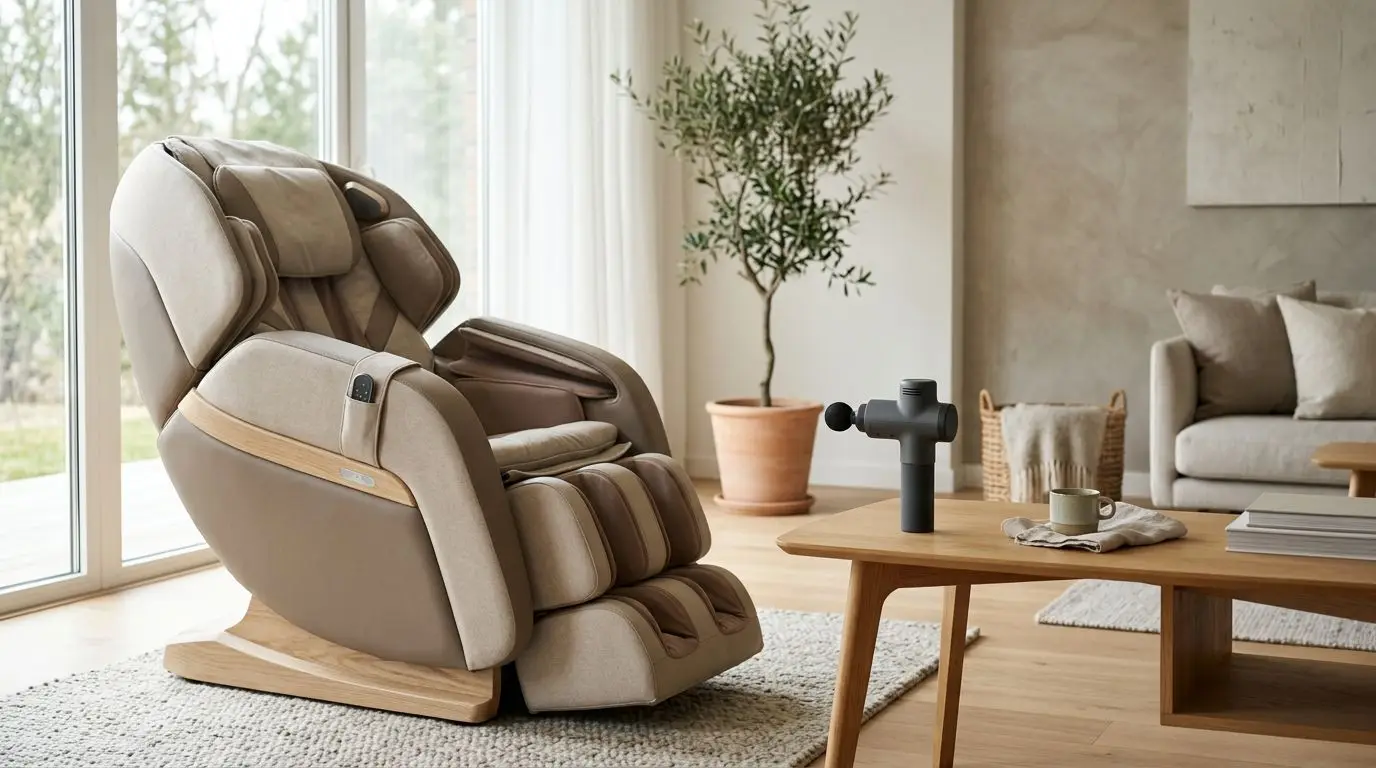
Both tools can fit into a home wellness routine, but they feel very different. A chair uses rollers, airbags, heat, reclining positions, and preset programs to create a whole-body experience. A massage gun uses a motorized head that pulses against one spot at a time, so the user controls placement, angle, and pressure directly.
Massage chair vs. massage gun in 60 seconds
If you only have 60 seconds to compare them, focus on coverage, effort, and control. A massage chair covers larger zones automatically, usually from the neck or upper back down to the glutes depending on the track design. A massage gun covers a smaller area, often a circle of just a few inches, but it lets you choose the exact spot and pressure.
| Factor | Massage chair | Massage gun |
|---|---|---|
| Best basic use | Hands-free full-back or full-body-style sessions | Targeted pressure on one muscle area at a time |
| Typical session length | 10 to 20 minutes | 30 seconds to 2 minutes per area |
| Body coverage | Back, neck area, glutes, calves, feet, arms depending on design | Any reachable area, or hard-to-reach areas with help |
| User effort | Low once seated and adjusted | Moderate; you hold and move the tool |
| Space needed | Often 30 to 36 inches wide, plus recline clearance | Fits in a drawer or gym bag |
| Intensity style | Broad pressure, rolling, kneading, compression | Concentrated pulsing or tapping pressure |
Neither option is automatically better. The better buy is the one you will use correctly and comfortably. If your main issue is overall back and leg tension after long workdays, a chair is usually easier to live with. If your main issue is one tight-feeling spot after a workout or yard work, a gun is simpler and more direct.
Body coverage: 1 chair session covers more area
A massage chair wins on coverage because it is designed to contact several body zones in one seated session. Track length matters. A shorter fixed back track may focus from the upper back to the lower back, while a longer L-track or SL-track design can continue under the seat toward the glutes. Many chairs also add air compression around the calves, feet, shoulders, arms, or hips.
A massage gun is the opposite. It is not a whole-chair experience; it is a spot tool. That can be a strength. If you want pressure on the right calf for 45 seconds and then on the left quad for 45 seconds, a gun makes that easy. If you want your full back addressed without twisting, reaching, or asking someone else to help, a gun is less convenient.
| Body area | Massage chair fit | Massage gun fit |
|---|---|---|
| Upper back | Strong fit when rollers reach the shoulder blade area | Good if you can reach safely or have help |
| Lower back | Strong fit, especially with adjustable roller position | Possible, but awkward for many users |
| Neck area | Depends heavily on user height and roller alignment | Use caution; avoid the front and side of the neck |
| Glutes | Best with an L-track or SL-track | Good, with easy pressure control |
| Calves | Good when the chair includes calf airbags or rollers | Very good for targeted use |
| Feet | Good when foot rollers are included | Possible, but may feel too sharp for some users |
For home use, the chair feels more like a scheduled routine. Sit down, choose a program, and let it run. The gun is more like a handheld tool from a drawer: pick it up, use it on a defined area, and put it away.
Intensity and feel: broad pressure vs. pinpoint force across 3 to 6 speeds
Massage guns commonly offer 3 to 6 speed settings, and some include several attachment heads for different sensations. A round head may feel general-purpose, a softer head may feel gentler, and a narrow head may feel much more concentrated. That focused feel is exactly why some people like massage guns and why others find them too intense.
Massage chairs manage intensity differently. Instead of one pulsing head in your hand, the chair may adjust roller depth, roller width, airbag pressure, recline angle, and program type. A 3D-style roller mechanism can move inward and outward to change pressure more noticeably than a basic 2D-style mechanism. Air compression zones may also have low, medium, and high settings.
The key difference is control. With a gun, you can lighten pressure instantly by lifting your hand. You can also stop in one second. With a chair, intensity changes through buttons, body position, padding, recline, or program selection. The upside is consistency; the downside is that a chair may press too firmly in one area if the fit is wrong.
- Choose a chair if you prefer steady, structured pressure without holding a device.
- Choose a gun if you want to control the exact angle and pressure in real time.
- Choose gentler settings first with either tool; more intensity is not automatically better.
- Stop if a sensation feels sharp, alarming, numb, or uncomfortable rather than simply firm.
Back, neck, and legs: the 3 most common decision points
Most shoppers compare these tools because of back, neck, or leg tension. Those 3 areas lead to very different buying decisions. The right answer depends less on the tool category and more on where you want pressure and how easily you can position the tool.
For back tension
A massage chair is usually the more practical back option. It can work across both sides of the spine in a repeatable pattern, often with kneading, rolling, tapping, or a combination program. Many chairs include body scanning, which is designed to estimate shoulder position and roller travel before the session begins.
A massage gun can work on the back, but self-use has limits. The mid-back and upper-back areas are hard to reach without twisting the wrist or shoulder. If someone else can operate the gun carefully, it becomes more useful for the back, but it is still a targeted tool rather than a broad seated session.
For neck and shoulder tension
This is where fit matters. Chair neck rollers can feel excellent when they land in the right place, but a chair built for a broad height range may not align perfectly with every user. If the rollers hit the skull base too firmly or miss the neck entirely, the feature may not be useful.
A massage gun should be used very carefully around the neck. Do not use it on the front or side of the neck, over the throat, or directly on bony areas of the spine. For many people, the safer practical use is on the upper shoulder muscle area, not the neck itself, and only at a comfortable setting.
For legs and feet
A massage gun is often excellent for legs because calves, quads, hamstrings, and glutes are easy to reach. Short sessions of 30 to 90 seconds per area are common for casual home use. A chair is more convenient if you want calves and feet handled while you sit, especially if it has enclosed foot wells, foot rollers, and calf airbags.
For feet, be honest about sensitivity. Foot rollers can feel intense because body weight increases contact pressure. Massage guns can also feel too sharp on the soles if you use a small or hard attachment. Start low.
Convenience, setup, and space: 15 minutes seated vs. 2 minutes handheld
A massage chair is convenient once it is in place, but getting it there is the bigger commitment. Many full-size chairs weigh well over 150 pounds, and some require a doorway clearance around 30 inches or more depending on the chair and packaging. You also need floor space, access to an outlet, and enough clearance for recline unless the chair has a wall-hugging design.
A massage gun has almost no setup burden. Charge it, choose an attachment, and use it for a short session. The trade-off is that you must hold the tool the entire time, and the buzzing sound can be noticeable in a quiet room. Battery life varies by design and use setting, but the real advantage is portability: it can live in a drawer, closet, suitcase, or gym bag.
| Convenience factor | Massage chair | Massage gun |
|---|---|---|
| Daily use | Easy if placed in a room you use often | Easy if charged and stored nearby |
| Setup time | Delivery, placement, possible assembly | A few minutes to charge and attach a head |
| Hands-free | Yes | No |
| Shared household use | Good, but fit varies by height and body shape | Good, with easy personal control |
| Small apartment fit | Challenging | Excellent |
Think about friction. If a chair is buried in a guest room behind storage boxes, it will not get much use. If a massage gun is always dead or missing its charger, it will not get much use either.
How to choose and measure before you buy: 5 checks
Before buying either product, run through 5 practical checks: body area, reach, intensity preference, storage space, and safety. These checks help prevent the most common mismatch, which is buying a feature-rich product that does not fit your body or routine.
1. Map the main body area
If your priority is the full back, lean chair. If your priority is calves, quads, glutes, or one specific shoulder area, lean massage gun. If you want both broad coverage and spot work, the two tools can complement each other, but most people should start with the one that matches their main use case.
2. Measure for a massage chair
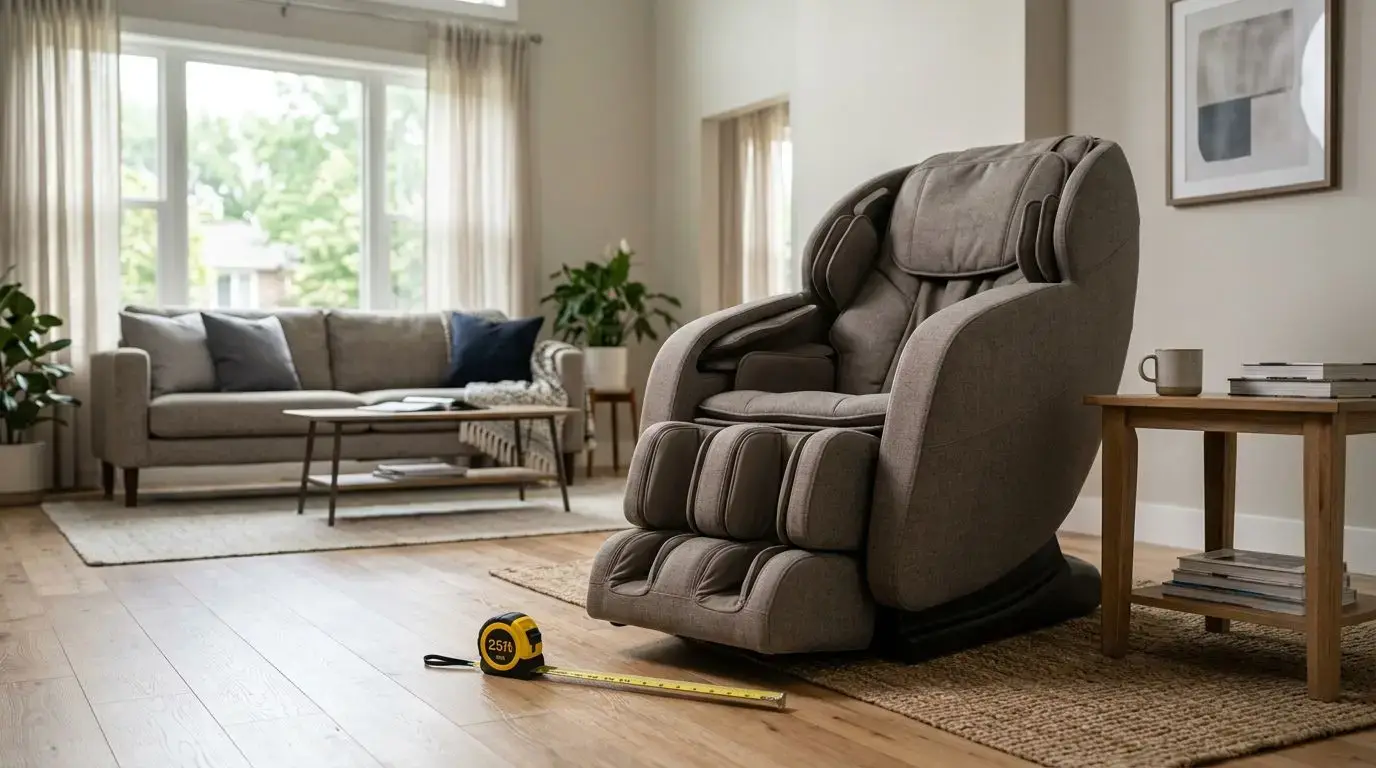
Measure the room, the path into the room, and the user. Check doorway width, hallway turns, stair access, and recline clearance. A full-size chair may need a footprint roughly comparable to a recliner, and the width can be around 30 to 36 inches. Also check the listed user height range and weight capacity if available.
3. Check reach for a massage gun
Hold your hand behind your back and see what areas you can reach comfortably for 60 seconds. If reaching the mid-back strains your shoulder, a gun may not be ideal for solo back use. Longer handles can help, but they do not solve every angle.
4. Start with lower intensity
Whether you choose rollers or a handheld motor, begin at the lowest comfortable setting. Use shorter sessions first, such as 5 minutes in a chair program or 30 seconds on one area with a gun. Increase only if the sensation stays comfortable.
5. Consider noise and household timing
Chairs make motor and air-pump sounds. Massage guns make a pulsing motor sound close to the body. If you plan to use either tool while someone sleeps nearby, noise may matter more than the feature list.
Who it is best for: 6 shopper profiles
These 6 shopper profiles make the decision clearer. Match yourself to the closest description instead of chasing the longest specification list.
| Shopper profile | Better fit | Why |
|---|---|---|
| Wants a nightly 15-minute wind-down | Massage chair | Hands-free programs are easy to repeat |
| Lives in a studio apartment | Massage gun | Minimal storage and no floor-space commitment |
| Mostly wants calf and quad pressure after activity | Massage gun | Legs are easy to reach and control |
| Wants broad back coverage without effort | Massage chair | Rollers cover more area automatically |
| Shares with several household members | Depends | Chair fit varies; gun control is more personal |
| Dislikes strong pinpoint pressure | Massage chair | Broad contact may feel more comfortable |
A massage chair is best for someone who values routine, comfort, and coverage. It suits a person who will sit down after work, choose a preset program, and let the chair do the moving. It is also better for users who do not want to hold a tool or ask someone else for help reaching the back.
A massage gun is best for someone who wants portability, speed, and exact placement. It suits a person who already knows the area they want to work on and prefers direct control. It is also the easier first purchase for renters, travelers, and anyone with limited floor space.
Safety checks: ask a physician before use in these 8 cases
Massage chairs and massage guns are consumer wellness products, not medical devices. Ask your physician before using either tool if you are pregnant, have a pacemaker or other implanted cardiac device, have a history of blood clots, take anticoagulant medication, have osteoporosis, recently had a fracture or surgery, have spinal disc problems, have neuropathy, or have uncontrolled hypertension. Do not treat manufacturer health claims as personal medical advice.
Use common sense with placement. Do not use a massage gun on the head, throat, front or side of the neck, chest, abdomen, bruised skin, open skin, or directly over bones and joints. With a chair, avoid forcing your body into a position that feels wrong, and do not continue a program just because it is supposed to be advanced or deep.
Discomfort is a useful signal. Firm pressure can be acceptable if you like the sensation, but sharp pain, tingling, numbness, dizziness, or unusual symptoms are reasons to stop and seek professional guidance. More time and more force do not make a better session.
Feature comparison: 10 specs that actually matter
Spec sheets can get crowded, so focus on 10 features that change day-to-day use. For chairs, track type, roller adjustability, body scanning, airbag zones, heat location, recline style, and user fit matter more than flashy program names. For massage guns, amplitude, stall force, speed range, attachment shape, handle comfort, noise, weight, and battery practicality are the key details.
| Feature | Why it matters | Chair or gun? |
|---|---|---|
| Track type | Changes how far rollers travel on the back and seat area | Chair |
| Roller depth control | Helps adjust pressure from gentle to stronger | Chair |
| Airbag zones | Adds compression feel at calves, arms, shoulders, or hips | Chair |
| Recline clearance | Affects where the chair can fit in a room | Chair |
| Heat location | Usually felt at the back, calves, or feet depending on design | Chair |
| Speed settings | Lets you reduce or increase pulsing intensity | Gun |
| Attachment heads | Change the contact feel from broad to concentrated | Gun |
| Handle shape | Determines how easily you reach legs, glutes, and shoulders | Gun |
| Weight | A heavy handheld tool can tire the wrist in 2 minutes | Gun |
| Noise | Can affect TV watching, shared rooms, and nighttime use | Both |
Do not buy by feature count alone. A chair with 20 programs is not automatically better than one with fewer well-designed controls. A gun with the highest force rating is not automatically better if it feels harsh or is tiring to hold.
FAQ: 5 practical questions before you decide
Can a massage gun replace a massage chair?
Not exactly. A massage gun can replace some targeted uses, especially on the legs and shoulders, but it does not replace the hands-free, broad coverage of a chair. If your priority is full-back coverage, the chair has the advantage.
Which is better for lower back use?
For most solo users, a massage chair is easier for the lower back because you do not have to twist or hold a tool behind you. A massage gun can be used around the glutes and nearby soft tissue, but avoid direct pressure on the spine and bony areas.
Is a massage chair or massage gun better for small spaces?
A massage gun is better for small spaces. It can fit in a drawer and does not require a dedicated floor area. A massage chair needs room for the chair body, the recline path, and safe access around it.
How long should a session be?
For chairs, many preset sessions run about 10 to 20 minutes. For massage guns, many users keep it short, around 30 seconds to 2 minutes per area. Start with less time and lower intensity until you know what feels comfortable.
Can two people share the same tool?
Yes, but the experience will vary. A massage gun is easy to adjust because each person controls the spot and pressure. A massage chair may fit one person better than another because roller height, shoulder position, and leg length all affect comfort.
Bottom line: choose coverage or control
Choose a massage chair if you want broad coverage, a hands-free routine, and a seated session that can include the back, seat area, calves, and feet depending on the design. Choose a massage gun if you want a compact, lower-commitment tool for targeted pressure on specific areas you can reach comfortably.
The smartest choice is the one that matches your actual routine. If you picture yourself relaxing in the same chair for 15 minutes most evenings, buy for fit, track design, and comfort controls. If you picture yourself spending 90 seconds on a calf or shoulder area after activity, buy for handle comfort, gentler speed options, and attachments that feel good on your body.
Frequently asked questions
Can a massage gun replace a massage chair? +
Not exactly. A massage gun is useful for targeted pressure on specific areas, especially the legs and shoulders, but it does not provide the same hands-free, broad back coverage as a massage chair.
Which is better for lower back use? +
For most solo users, a massage chair is easier for the lower back because it does not require twisting or reaching behind the body. A massage gun can be useful around nearby soft tissue, but avoid direct pressure on the spine and bony areas.
Which tool is better for small spaces? +
A massage gun is better for small spaces because it fits in a drawer or bag. A massage chair needs dedicated floor space, recline clearance, and access to an outlet.
How long should you use a massage chair or massage gun? +
Many massage chair programs run about 10 to 20 minutes. For massage guns, short use of about 30 seconds to 2 minutes per area is common. Start with lower intensity and shorter sessions.
Are massage chairs and massage guns safe for everyone? +
Not for everyone. Ask your physician before use if you are pregnant, have a pacemaker or implanted cardiac device, have blood clot concerns, take anticoagulants, have osteoporosis, recently had surgery or a fracture, have spinal disc problems, neuropathy, or uncontrolled hypertension.
Related guides
Massage Chair vs. Foam Roller: Which Works Better for Muscle Tightness?
12 min read
Full-Size Massage Chair vs. Portable Massage Pad: Comfort, Coverage, Cost, and Space Compared
15 min read
Best Massage Chair Features to Look For Before You Buy
13 min read
Massage Chair Benefits for Stress Relief and Relaxation at Home
11 min read
Are Massage Chairs Good or Bad for You? Benefits, Risks, and Safe Use Guidelines
13 min read