Disclosure: We may earn a commission when you buy through links on this page, at no extra cost to you. We buy nothing, sell nothing and accept no payment for coverage — commissions never decide what we recommend. How we make money.
The best post-workout choice depends on what you need most: a massage chair is easiest for consistent full-back work, a massage gun is best for targeted pressure, a foam roller is inexpensive and active, and stretching is the simplest daily baseline. For most people, the strongest routine is not a single tool but a mix: 5 to 15 minutes of stretching plus either broad chair coverage or targeted work on specific tight areas.
If you want the least effort, choose a massage chair. If you want pinpoint intensity on calves, quads, glutes, or shoulders, choose a massage gun. If you want a low-cost tool that makes you participate, choose a foam roller. If you want something you can do anywhere with no equipment, choose stretching.
Quick comparison: 4 recovery tools in 60 seconds
Each tool feels different because it applies force in a different way. A massage chair uses rollers, airbags, vibration, heat, and preset programs while you sit or recline. A massage gun uses fast percussive pulses on a small area, often for 30 to 120 seconds per muscle group. A foam roller uses your body weight across a cylinder that is commonly 12 to 36 inches long. Stretching uses positions held for time, often 15 to 60 seconds per stretch.
| Option | Best strength | Main limitation | Typical session | Effort level |
|---|---|---|---|---|
| Massage chair | Consistent full-back and leg coverage, depending on features | Higher cost and requires space | 10 to 30 minutes | Low |
| Massage gun | Targeted pressure on specific muscle areas | Easy to overdo intensity or time | 5 to 10 minutes total | Medium |
| Foam roller | Large muscle groups at low equipment cost | Requires floor mobility and body control | 5 to 15 minutes | Medium to high |
| Stretching | No equipment, easy daily habit | Less mechanical pressure than tools | 5 to 20 minutes | Low to medium |
For post-workout comfort, do not chase the hardest sensation. A tool should feel firm, controlled, and tolerable, not sharp, numbing, or bruising. More pressure is not automatically better.
Massage chair: best for low-effort, repeatable sessions of 10 to 30 minutes
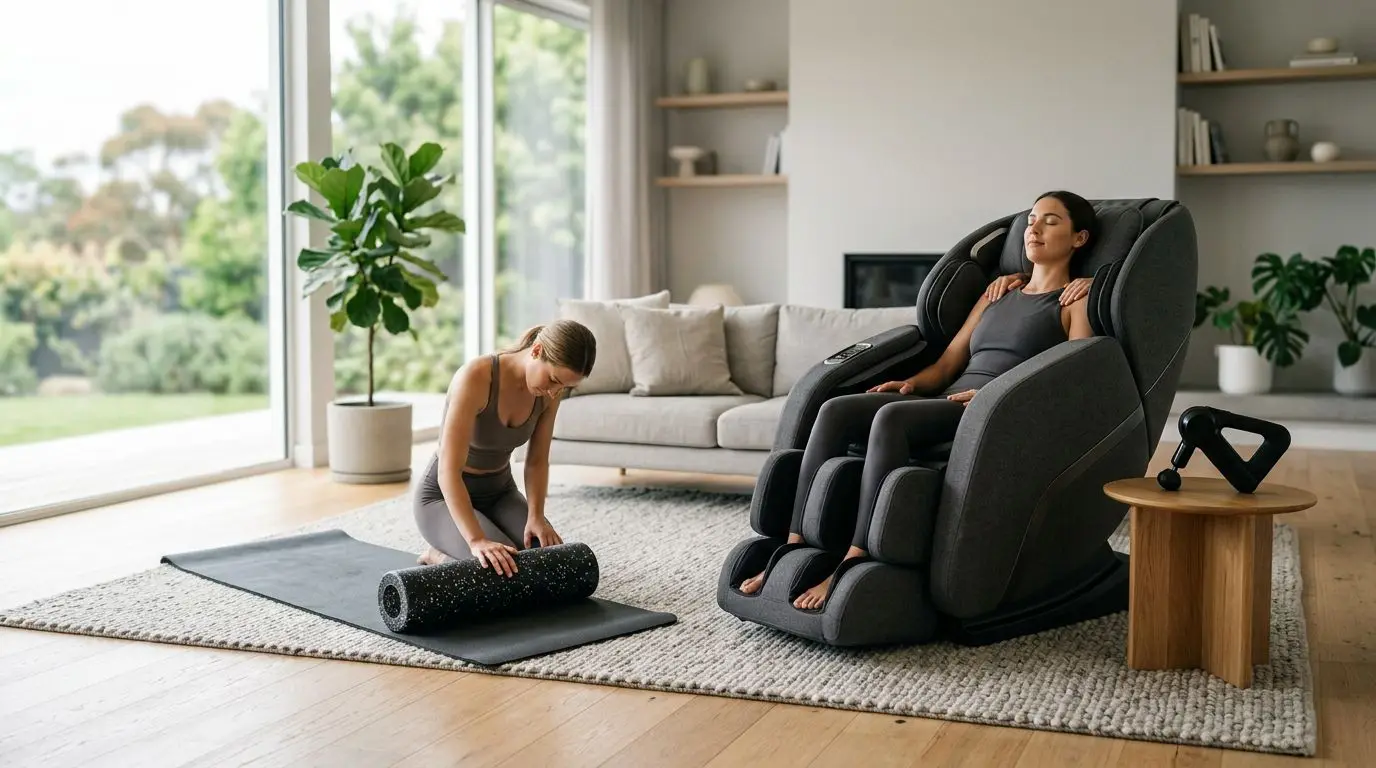
A massage chair is the easiest option when consistency is your biggest problem. You sit down, choose a program, and let the chair move through a set pattern. Most full-size chairs use a back track with rollers and may add airbags around the calves, feet, arms, or hips. Common auto programs run about 10, 15, or 20 minutes, though some chairs allow longer sessions.
The main advantage is coverage. A chair with an S-track follows the curve of the back, while an L-track extends below the lower back and into the glute area. Some longer tracks are described as SL-track designs because they combine a curved back path with lower-body extension. That difference matters if running, cycling, lifting, or court sports leave your lower back, glutes, or hamstrings feeling tight.
Massage chairs also win on repeatability. A preset program gives you the same general pattern every time, which helps if you want a routine after evening workouts. The chair can feel more relaxing than active tools because you do not have to hold a position, balance on the floor, or keep your arm raised with a device.
The tradeoff is control. Even with strength settings, a chair cannot read your exact anatomy. Rollers may land slightly high or low depending on torso length, shoulder height, and seating position. Foot rollers may feel great to one person and too intense to another. Airbags can also squeeze firmly, especially around calves and feet.
Who it is best for: people who want a low-effort routine, prefer seated comfort, dislike floor work, or want broad back and leg coverage after exercise. It is also practical for households where several adults will use the same product, as long as the chair fits each person reasonably well.
Who should think twice: people with limited space, very specific trigger points they want to address manually, or a preference for active mobility work. A full-size chair can weigh well over 150 pounds and may need several inches of clearance behind it, even when marketed as a wall-saving design.
Massage gun: best for targeted pressure in 30 to 120 seconds per area
A massage gun, also called a percussive massager, is a handheld device that moves a small attachment rapidly in and out. It is built for focused work. Instead of automatically covering your whole back, it lets you spend 30 to 120 seconds on a calf, quad, hamstring, glute, upper trap, or forearm.
The biggest advantage is precision. If your calves feel tight after a 3-mile run, or your quads feel loaded after squats, you can aim the attachment exactly where you want pressure. Many devices offer multiple speed levels and interchangeable heads, such as a round head for general use or a softer attachment for more sensitive areas.
The limitation is effort and judgment. You have to hold the device, reach the area, choose the speed, and decide when to stop. Because the device feels powerful, it is easy to press too hard. For post-workout use, a lighter touch is usually more comfortable than grinding the attachment into the tissue. Glide slowly and avoid bony areas, joints, the front of the neck, the spine, and areas with numbness or unusual sensitivity.
Massage guns are not ideal for broad, passive relaxation. They work one small zone at a time. Reaching your upper back can be awkward unless another person helps. Battery life and noise also matter. A device may be easy for 2 minutes on the quads but annoying during a longer full-body session.
Who it is best for: exercisers who know exactly where they want pressure, lifters who want targeted work on large muscle groups, and athletes who travel and need a compact tool. It is also useful when a massage chair misses the exact spot you care about.
Who should think twice: anyone tempted to use maximum speed for long periods, anyone with reduced sensation in the area, or anyone who cannot comfortably reach the target muscle without twisting. Start short. A practical upper limit is about 1 to 2 minutes per area before reassessing how it feels.
Foam roller: best low-cost coverage for large muscles in 5 to 15 minutes
A foam roller is the most common floor-based tool because it is simple, durable, and inexpensive compared with powered equipment. Standard rollers are often about 6 inches in diameter and 12, 18, or 36 inches long. Short rollers store easily; long rollers are more stable for upper-back work and full-length positioning.
Foam rolling gives you broad pressure across large muscle groups. You control intensity by shifting body weight. Put more weight on the roller and it feels stronger; support yourself with your arms or opposite leg and it feels lighter. That makes it adjustable without buttons, batteries, or settings.
The downside is that rolling requires mobility. You may need to get down to the floor, support your body with your hands, and move slowly across the roller. For some people, the arm and core effort becomes more noticeable than the rolling itself. A dense roller can also feel too aggressive, especially on the IT band area, calves, and upper back.
Foam rollers vary by firmness and surface. A softer smooth roller is usually better for beginners. A dense or textured roller feels more intense because the contact points are firmer or more concentrated. Longer is not automatically better, but a 36-inch roller is easier to lie on lengthwise for chest-opening positions and upper-back mobility drills.
Who it is best for: people who want an affordable tool, like active recovery routines, and can comfortably get on and off the floor. It works well for quads, hamstrings, calves, glutes, lats, and upper back when used with control.
Who should think twice: anyone with wrist, shoulder, or balance limitations that make floor work difficult, or anyone who tends to force pressure through discomfort. Keep the movement slow, about 1 inch per second, and avoid rolling directly over joints, the lower spine, or bony points.
Stretching: best no-equipment baseline for 5 to 20 minutes
Stretching is the easiest habit to keep because it needs no device, outlet, or storage space. A simple post-workout routine might include 5 stretches held for 30 seconds per side, which takes about 5 minutes. A longer routine can run 15 to 20 minutes if you include hips, hamstrings, calves, chest, shoulders, and upper back.
Stretching is different from mechanical pressure. A chair, gun, or roller presses into tissue. Stretching positions a joint and muscle group through a comfortable range and holds it there. For general wellness use, the goal is controlled lengthening and relaxation, not forcing a dramatic range of motion.
Static stretching generally fits best after a workout or during a separate mobility session. Before intense exercise, many people prefer dynamic movements such as leg swings, arm circles, hip hinges, or walking lunges because they feel more active. After a workout, slower holds can help create a calmer transition from training to the rest of the day.
The limitation is that stretching does not provide the same pressure sensation as a roller or device. If you specifically like kneading, tapping, or compression, stretching may feel incomplete on its own. It also requires patience. A rushed 10-second stretch rarely feels as useful as a steady 30- to 60-second hold.
Who it is best for: nearly everyone who wants a simple routine, especially people who travel, train at a gym, or do not want to buy equipment. It is also the best starting point if you are unsure which tool to add later.
Who should think twice: people with joint instability, recent injury, or instructions from a clinician to limit certain movements. Stretching should feel like mild to moderate tension, not pinching, sharp pulling, or nerve-like tingling.
Ease of use: the chair wins for effort, stretching wins for access
If ease means the least physical effort, a massage chair is the clear winner. Sit down, select a 15-minute program, and the chair does the work. That matters after a hard training session when getting on the floor feels like one more workout.
If ease means available anywhere, stretching wins. You can do a calf stretch at a wall, a hip flexor stretch on a mat, or a chest stretch in a doorway. No charging. No assembly. No floor tool to carry.
Massage guns fall in the middle. They are portable but require decision-making and arm effort. Foam rollers are simple, but they require floor access and body positioning, which can be a barrier for some users.
| Ease factor | Massage chair | Massage gun | Foam roller | Stretching |
|---|---|---|---|---|
| Setup time | About 1 minute once installed | 1 to 2 minutes | 1 minute | 0 to 1 minute |
| Physical effort | Very low | Medium | Medium to high | Low to medium |
| Portability | Very low | High | Medium | High |
| Learning curve | Low | Medium | Medium | Low to medium |
The practical answer: choose the tool you will actually use 3 or 4 times per week. An ideal tool that stays in a closet does not help your routine.
Coverage area: chairs cover the back, guns and rollers fill the gaps
Coverage is where massage chairs stand apart. A back track may cover from the neck and shoulders to the lower back, and an L-track may continue into the glutes. Airbags can add compression around calves, feet, arms, or hips. A full session can address multiple regions in one 20-minute program.
But coverage is not the same as accuracy. A chair follows a programmed path. If the rollers miss the exact edge of your shoulder blade or the outside of your calf, you cannot reposition them as freely as a handheld or floor tool.
A massage gun is the most targeted option. It covers only a small contact area at once, often less than 3 inches wide depending on the attachment, but you choose the exact location. A foam roller covers a wider strip, though the pressure is less pinpoint. Stretching can cover entire movement patterns, such as hip flexors and quads together, but without kneading or percussion.
For post-workout routines, think in zones. Back and glutes: massage chair or foam roller. Quads and calves: gun or roller. Chest and shoulders: stretching, gun with care, or chair airbags if available. Feet: chair foot rollers if you like strong pressure, or stretching if you prefer gentle movement.
Intensity and comfort: use a 1-to-10 scale, not maximum settings
A smart recovery routine uses intensity you can repeat. On a 1-to-10 comfort scale, many people should stay around 4 to 7: noticeable, firm, and controlled, but not sharp or overwhelming. If you brace your body, hold your breath, or feel numbness, back off.
Massage chairs vary by roller depth, body scanning, padding, airbag strength, and whether the chair allows intensity control. Foot rollers and calf airbags can be surprisingly strong. Add a folded towel or wear thicker socks if the pressure feels too direct.
Massage guns can become intense quickly because the contact area is small and the motion is rapid. Use light pressure first. Let the device float over the muscle rather than pushing hard. Foam rollers are controlled by body weight, so beginners should support more weight with their hands or opposite leg. Stretching should never be forced; a steady hold beats bouncing.
Consistency matters more than hero sessions. A comfortable 10-minute routine repeated 4 times a week is usually more sustainable than an aggressive 45-minute session once every two weeks.
How to choose: measure space, body fit, time, and target zones
Start with your top 2 target zones. If they are back and glutes, a chair or foam roller makes sense. If they are calves, quads, and shoulders, a massage gun may fit better. If your main goal is daily mobility and winding down, stretching may be enough.
For a massage chair
- Measure the floor space. Many chairs need roughly 30 to 36 inches of width and 55 to 65 inches of length when upright, with more length when reclined.
- Check clearance. Some wall-saving designs still need about 2 to 6 inches behind the chair.
- Compare user height and weight ranges. A chair that fits a 5-foot-2 user may not align the same way for someone 6-foot-3.
- Decide on track type. S-track focuses on the back; L-track or SL-track designs extend into the glute area.
- Try lower intensity first. Rollers, airbags, and foot nodes can feel stronger than expected.
For a massage gun
- Look for multiple speeds, a comfortable handle, and attachments you will actually use.
- Consider noise if you plan to use it while watching TV or in a shared space.
- Plan short sessions: about 30 to 120 seconds per area is a sensible starting range.
For a foam roller
- Choose a softer smooth roller if you are new to rolling.
- Pick 36 inches for more stability, or 12 to 18 inches for storage and travel.
- Use a mat if hard floors make positions uncomfortable.
For stretching
- Build a 5- to 10-minute routine around your sport or workout.
- Hold most static stretches for 15 to 60 seconds without bouncing.
- Stop if the sensation changes from stretch tension to sharpness, pinching, or tingling.
Safety: ask your physician first if any of these 8 issues apply
Self-care tools are consumer wellness products, not medical devices. If you are pregnant, have a pacemaker or other implanted cardiac device, have a history of blood clots or take anticoagulants, have osteoporosis, recently had a fracture or surgery, have spinal disc problems, have neuropathy, or have uncontrolled hypertension, ask your physician before using a massage chair, massage gun, foam roller, or aggressive stretching routine.
Also avoid direct pressure over bruises, open skin, inflamed areas, joints, the front of the neck, or areas where sensation is reduced. Stop using any tool if you feel dizziness, numbness, unusual weakness, sharp pain, or symptoms that do not feel like ordinary exercise fatigue.
For post-workout use, wait until your breathing and heart rate feel settled. Hydrate normally, use moderate settings, and keep the first session short. A 5-minute trial teaches you more than jumping into the longest program available.
Best option by user: 6 practical scenarios
The best choice depends on your routine, space, and tolerance for hands-on work. Use these scenarios as a shortcut.
| User situation | Best first choice | Why |
|---|---|---|
| You want the easiest routine after workouts | Massage chair | Low effort, preset programs, broad back coverage |
| You lift weights and want focused pressure | Massage gun | Targets quads, glutes, calves, shoulders, and forearms |
| You want the lowest-cost tool | Foam roller | Simple, durable, and effective for large areas |
| You travel often | Stretching or massage gun | No space needed for stretching; gun fits in a bag |
| You dislike floor work | Massage chair | No need to kneel, plank, or balance on a roller |
| You want a daily habit with no equipment | Stretching | Works at home, gym, office, or hotel |
If you can combine tools, the most balanced setup is simple: stretch daily, then use one pressure-based tool 3 to 4 times per week based on the areas that feel most worked from training.
Sample 15-minute post-workout routine using 2 tools
A short routine is easier to keep than a long one. Here are four examples that stay around 15 minutes.
- Chair plus stretching: 10 minutes in the chair on a moderate program, then 5 minutes of calves, hip flexors, chest, and hamstrings.
- Gun plus stretching: 1 minute each on both calves, both quads, and both glutes, then 5 to 7 minutes of stretching.
- Foam roller plus stretching: 2 minutes each on quads, glutes, upper back, and calves, then 5 minutes of easy static holds.
- Stretching only: 30 seconds per side for calves, hamstrings, hip flexors, glutes, chest, and lats.
Keep the session moderate. The best routine is the one that leaves you feeling comfortable enough to repeat tomorrow.
FAQ: 5 common questions about post-workout recovery tools
Is a massage chair better than a massage gun after workouts?
A massage chair is better for low-effort, broad coverage, especially along the back and sometimes the glutes, calves, and feet. A massage gun is better for targeted pressure on a specific muscle area for about 30 to 120 seconds.
Can I use a massage chair and foam roller on the same day?
Yes, many people use both, but keep the total intensity reasonable. For example, use a 10-minute chair program and a few minutes of light rolling rather than doing the strongest version of each tool back to back.
Should I stretch before or after using a massage gun?
Either order can work for general comfort. A common approach is light movement first, brief massage gun use on selected areas, then easy static stretching for 15 to 60 seconds per position.
How often should I use these tools?
Start with 2 to 4 sessions per week for powered or pressure-based tools, plus short stretching more often if it feels good. Increase slowly and reduce intensity if you feel lingering tenderness.
What should I avoid with any recovery tool?
Avoid sharp pain, numbness, bruising pressure, direct pressure on joints, and long sessions at maximum intensity. Ask your physician first if you have pregnancy, an implanted cardiac device, blood clot concerns, anticoagulant use, osteoporosis, recent fracture or surgery, spinal disc problems, neuropathy, or uncontrolled hypertension.
Frequently asked questions
Is a massage chair better than a massage gun after workouts? +
A massage chair is better for low-effort, broad coverage, especially along the back and sometimes the glutes, calves, and feet. A massage gun is better for targeted pressure on a specific muscle area for about 30 to 120 seconds.
Can I use a massage chair and foam roller on the same day? +
Yes, many people use both, but keep the total intensity reasonable. For example, use a 10-minute chair program and a few minutes of light rolling rather than doing the strongest version of each tool back to back.
Should I stretch before or after using a massage gun? +
Either order can work for general comfort. A common approach is light movement first, brief massage gun use on selected areas, then easy static stretching for 15 to 60 seconds per position.
How often should I use these tools? +
Start with 2 to 4 sessions per week for powered or pressure-based tools, plus short stretching more often if it feels good. Increase slowly and reduce intensity if you feel lingering tenderness.
What should I avoid with any recovery tool? +
Avoid sharp pain, numbness, bruising pressure, direct pressure on joints, and long sessions at maximum intensity. Ask your physician first if you have pregnancy, an implanted cardiac device, blood clot concerns, anticoagulant use, osteoporosis, recent fracture or surgery, spinal disc problems, neuropathy, or uncontrolled hypertension.
Related guides
Massage Chair Use Before or After a Workout: Which Is Better for Recovery?
13 min read
Massage Chair vs. Foam Roller: Which Works Better for Muscle Tightness?
12 min read
Post-Workout Massage Chair Routine: Heat, Compression, and Recovery Settings
13 min read
Massage Chair vs. Heat Pad, TENS Unit, or Stretching Routine: Which At-Home Option Fits Your Goal?
13 min read
How to Use a Massage Chair at Home: A Simple First-Week Routine for Comfort and Consistency
10 min read