Disclosure: We may earn a commission when you buy through links on this page, at no extra cost to you. We buy nothing, sell nothing and accept no payment for coverage — commissions never decide what we recommend. How we make money.
For most shoppers focused on everyday back comfort, a massage chair is the easier, more user-friendly choice: you sit upright, choose a preset program, and stop whenever you want. An inversion table may deliver a stronger whole-back stretching sensation, but it requires tipping your body partly or fully upside down and comes with more safety considerations. Neither option is a medical device, and neither should be expected to diagnose, treat, cure, prevent, or manage back pain or any condition.
The better choice depends on the sensation you want. If you prefer kneading pressure, heat-like warmth, rolling along the spine area, and a 10- to 20-minute wind-down routine, consider a massage chair. If you want a traction-style stretch using your body weight and are medically cleared to invert, an inversion table may make sense.
Quick comparison: 15 minutes in a chair vs. 1 to 3 minutes inverted
A typical massage chair session lasts about 10 to 20 minutes, while many inversion table users begin with short sessions of about 1 to 3 minutes at a mild angle. That difference matters. A chair is built around comfort and convenience; an inversion table is built around body positioning and controlled tilt.
| Category | Massage chair | Inversion table |
|---|---|---|
| Main sensation | Kneading, rolling, tapping, compression, and warmth depending on features | Full-body stretch from ankle support and angled body position |
| Typical session length | 10 to 20 minutes | 1 to 5 minutes for many beginners, depending on comfort and medical guidance |
| Effort required | Low; sit down and select a program | Moderate; secure ankles, control tilt, and return upright slowly |
| Back coverage | Depends on track length: neck-to-lower-back or neck-to-glute area | Whole-body positioning, not targeted roller contact |
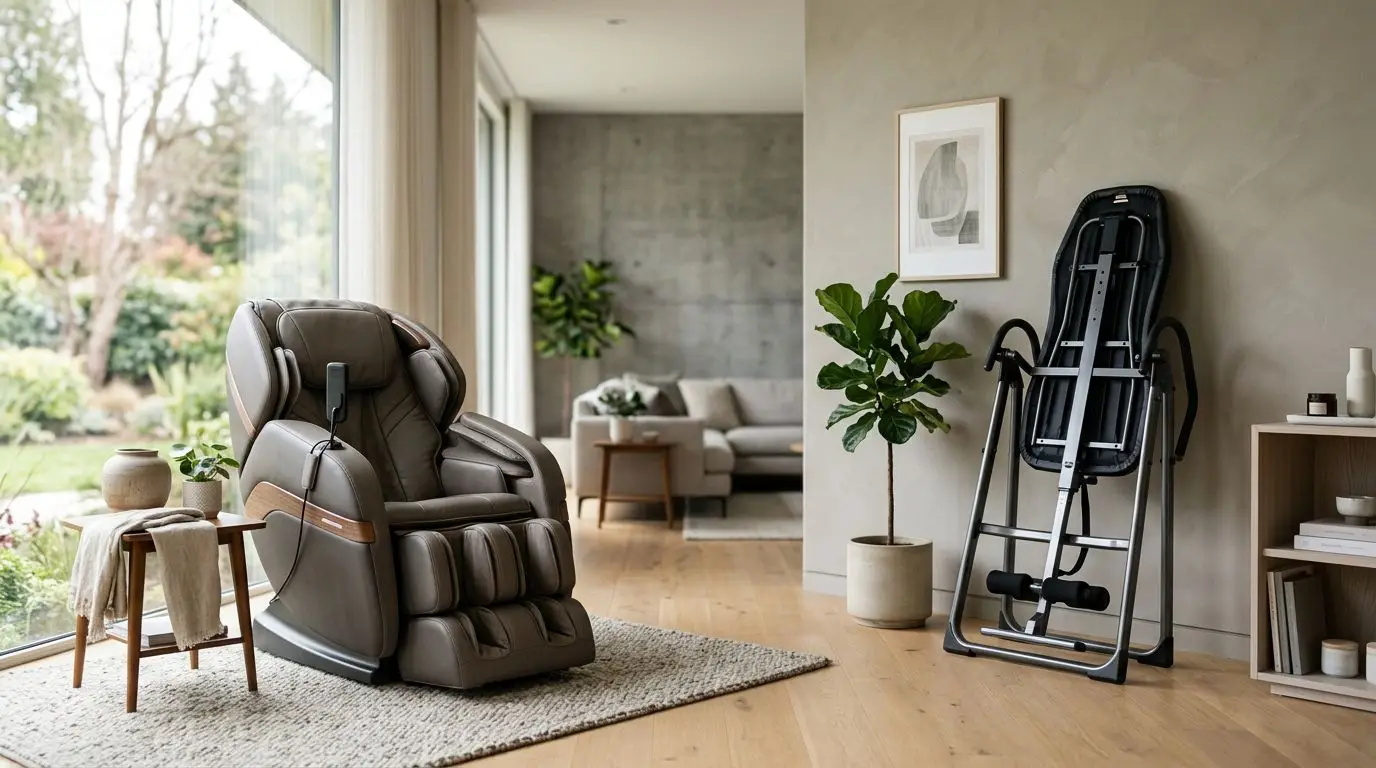
| Space needs | Often 30 to 36 inches wide, plus recline clearance | Often about 28 to 36 inches wide and 46 to 60 inches long when open |
| Best fit | Daily relaxation, pressure control, shared households | People who specifically like inversion-style stretching and are medically cleared |
| Main limitation | Bulky, heavy, and not a medical solution | Not appropriate for many health situations and can feel intense quickly |
If you are choosing for a household with two or more users, a massage chair usually wins on accessibility. If one medically cleared adult wants a deep stretch and feels comfortable getting in and out of the equipment, an inversion table can be considered.
How each option feels: rollers, air cells, and 20 to 60 degrees of inversion
A massage chair uses mechanical rollers that move along a track, air compression in selected areas, or both. Common roller movements include kneading, rolling, tapping, and shiatsu-style circular pressure. Many chairs let you start with a lower intensity setting, which helps if firm pressure makes you tense rather than relaxed.
Track design changes the experience. An S-track follows the general curve of the back from the neck and shoulders toward the lower back. An L-track continues under the seat area, allowing the rollers to move into the glute area. Some chairs advertise SL-track designs, which are generally intended to combine a curved back path with longer lower-body coverage. Track length varies, but many full-body chairs offer somewhere around 45 to 55 inches of roller travel.
Inversion tables feel entirely different. You secure your ankles, lean back, and let the table rotate. A mild angle, such as 20 or 30 degrees, may feel like a gentle whole-body stretch. Steeper angles, such as 60 degrees or more, feel much more intense and are not a beginner setting. Full inversion is not necessary for most shoppers comparing home comfort equipment.
| Feature | What it is designed to feel like | Useful shopper note |
|---|---|---|
| S-track rollers | Pressure following the back curve from upper to lower back | Good if you mostly want back-focused contact |
| L-track rollers | Back contact plus roller travel into the seat area | Helpful if you want more lower-body coverage |
| Air compression | Squeezing and releasing around calves, feet, arms, or shoulders | Check whether intensity can be lowered |
| Heat function | Localized warmth, commonly near the lower back | Warmth coverage varies widely by chair |
| Zero-gravity recline | Reclined position with legs elevated | Often used to spread body weight across the chair |
| Inversion angle | Stretching sensation that increases as the angle gets steeper | Beginners often start below 30 degrees |
Neither feel is automatically better. A chair provides repeated contact. An inversion table provides positional stretch. Your preference may be clear after just 5 minutes with each style.
Who it is best for: daily comfort, shared use, and 2 very different routines
A massage chair is best for people who want a repeatable seated routine with minimal setup. It suits shoppers who want adjustable pressure, a defined session timer, and the option to read, listen to music, or close their eyes while the chair does the work. Many people use a chair for 10 or 15 minutes at the end of the day because getting started is easy.
A massage chair may be the better fit if:
- You want a sit-down routine that takes less than 1 minute to start.
- Multiple adults in the home will use the same equipment.
- You prefer adjustable intensity rather than an all-or-nothing stretch.
- You want features such as foot rollers, calf compression, or a reclined position.
- You dislike being upside down or have balance concerns.
An inversion table is best for a narrower group: adults who enjoy the feeling of spinal traction-style stretching, can secure themselves safely, and have medical clearance if any risk factor applies. It is not a casual recliner. Getting on and off takes coordination, and returning upright too quickly can be uncomfortable for some users.
An inversion table may be the better fit if:
- You specifically want a body-weight stretch rather than roller pressure.
- You are comfortable starting with mild angles, such as 20 to 30 degrees.
- You have enough space to open, mount, rotate, and dismount the table safely.
- You will use it attentively, not while distracted or sleepy.
- Your physician has said inversion is reasonable for you if you have any relevant health history.
If you are buying for someone else, avoid surprising them with inversion equipment. A massage chair is easier to share; inversion is more personal and depends more on comfort with the position.
Safety considerations: 8 situations where you should ask a physician first
Safety should guide this decision before features do. A massage chair and an inversion table both apply force to the body, but inversion changes body position in a way that can be inappropriate for some people. If any of the situations below apply, ask your physician before using either product, and be especially cautious with inversion.
- Pregnancy.
- Pacemaker or other implanted cardiac device.
- History of blood clots or use of anticoagulant medication.
- Osteoporosis or fragile bones.
- Recent fracture, recent surgery, or an injury that has not been cleared for normal activity.
- Known spinal disc problems or significant spinal instability.
- Neuropathy, reduced sensation, or difficulty judging pressure.
- Uncontrolled hypertension or other cardiovascular concerns.
Inversion tables also call for extra caution for people with eye pressure concerns, dizziness, balance problems, or difficulty getting up from the floor. Being angled head-down can feel disorienting, and ankle support can place concentrated pressure around the lower legs and feet.
Massage chairs have fit and pressure concerns of their own. Strong rollers can feel too aggressive over bony areas. Foot rollers may be uncomfortable for people with sensitive feet. Air compression can feel tight around calves or arms. Choose a chair with a clear stop button, multiple intensity levels, and a manual mode that lets you avoid areas that do not feel good.
Stop using either product if you feel sharp pain, numbness, unusual dizziness, chest discomfort, shortness of breath, or symptoms that concern you. Those are not features to push through. Get medical advice instead of changing settings and hoping it passes.
How to choose and measure: 3 fit checks before you buy
Before comparing features, measure your room and check your body fit. Many massage chairs weigh well over 150 pounds, and some exceed 250 pounds, so placement is not a minor detail. Inversion tables are lighter in many cases, but they need open space around the rotating frame.
1. Measure floor space and recline clearance
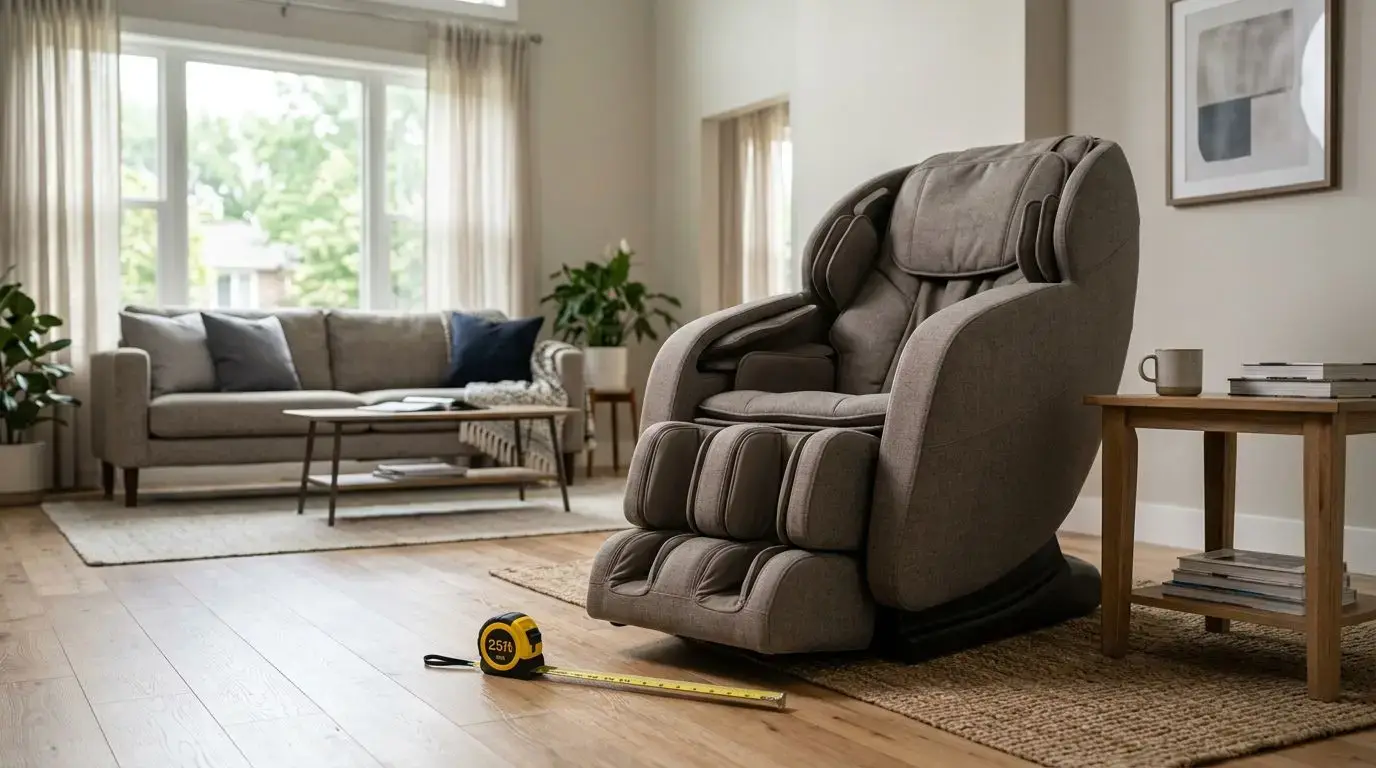
For a massage chair, measure both the chair footprint and the fully reclined position. Some space-saving designs may need only a few inches behind the chair, while others need 12 inches or more. A practical planning zone is often around 3 feet wide by 5 to 6 feet long, but always check the dimensions of the exact unit you are considering.
For an inversion table, measure the open footprint, not just the folded dimensions. Many require a length around 4 to 5 feet when set up. You also need side clearance so your arms and shoulders do not hit furniture as the table rotates.
2. Check height and weight ranges
Both products list user height and weight ranges. A chair that does not fit your torso can place rollers too high on the neck or too low on the back. A table that does not fit your height can rotate unpredictably or feel hard to control. Do not treat these numbers as suggestions; they are part of the safe-use design.
3. Plan the path into the room
Measure doorways, hallways, and turns. A massage chair may arrive in a large carton, and a 30-inch doorway can become a real obstacle depending on packaging and chair width. If stairs are involved, factor in the weight and whether you will need delivery help. Inversion tables are usually easier to move, but assembly still requires stable floor space and careful tightening of hardware.
If you rent or live above another unit, consider the flooring. Place heavy chairs on a mat or furniture sliders rated for the surface, and avoid dragging metal frames across hardwood or vinyl.
Realistic expectations after 2 to 4 weeks of home use
The most realistic expectation is a more consistent comfort routine, not a guaranteed change in a medical condition. After 2 to 4 weeks, you should know whether the product feels pleasant, whether you actually use it, and whether the setup is convenient enough to keep in your life.
With a massage chair, success might mean choosing a 15-minute low- or medium-intensity program several evenings per week because it helps you unwind and makes your back feel attended to. That is a comfort experience, not a clinical result. If a chair makes you tense, sore, or irritated, lower the intensity, shorten the session, or stop using that program.
With an inversion table, success might mean using a mild angle for a short, controlled session and returning upright slowly without dizziness or anxiety. Some people enjoy that stretched-out feeling right away. Others dislike ankle pressure or the sensation of being tilted. Both reactions are normal shopping information.
Track your response in plain language for 14 days. Write down session length, setting or angle, and how you felt during and after. A simple note such as “10 minutes, medium roller, lower back felt too firm” is more useful than chasing vague promises.
Feature priorities: 6 chair features and 5 inversion table details that matter
Feature lists can get long, but only a few details change daily use. For a massage chair, prioritize control. For an inversion table, prioritize stable adjustment and an easy return to upright.
| Product type | Feature to check | Why it matters |
|---|---|---|
| Massage chair | Intensity levels | Lets you start gently instead of accepting one firm setting |
| Massage chair | Track type | Changes whether coverage is back-only or extends under the seat |
| Massage chair | Manual zone control | Helps you avoid sensitive areas and focus on comfortable contact |
| Massage chair | Body scan adjustment | Attempts to align rollers to your shoulder height and back shape |
| Massage chair | Easy stop button | Important if pressure feels too strong |
| Massage chair | Upholstery access | Removable or wipeable surfaces make routine cleaning easier |
| Inversion table | Angle limiter | Helps keep beginners at a mild tilt, such as 20 or 30 degrees |
| Inversion table | Ankle support design | Affects comfort and security during rotation |
| Inversion table | Height adjustment | Needed for controlled balance and rotation |
| Inversion table | Frame stability | Reduces wobble when mounting and returning upright |
| Inversion table | Folded storage size | Matters if it will live in a closet between uses |
Be skeptical of feature overload. A chair with 20 programs is not automatically more comfortable than one with fewer, clearer controls. An inversion table with extra handles and pads still needs the basics right: fit, balance, stability, and safe angle control.
Cost, ownership, and daily convenience over 5 years
Prices vary too much to quote responsibly without a live catalog, but the ownership pattern is clear. Massage chairs usually cost more, weigh more, and include more electronics. Inversion tables are mechanically simpler, often easier to store, and usually less complicated to maintain.
Over 5 years, convenience may matter more than the initial feature list. A massage chair placed in a living room may get used because it is always ready. A folding inversion table stored behind boxes may be ignored, even if setup takes only a few minutes. The best equipment is the one you can use safely and consistently without turning it into a project.
For a massage chair, ask about delivery method, in-home placement, return rules, warranty coverage, and what happens if the chair needs service. For an inversion table, ask about assembly, replacement parts, weight rating, angle stops, and how securely it locks when folded.
Noise is another daily factor. Chairs make motor, roller, and air pump sounds. Inversion tables are mostly quiet, but they can creak if hardware loosens or the floor is uneven. In shared spaces, a 15-minute chair program may be more noticeable than a brief stretching session.
Bottom line: choose the option you can use safely 3 to 5 days a week
Pick a massage chair if you want an easy comfort routine, adjustable back pressure, and a product that several people can use with minimal setup. It is usually the more practical choice for everyday relaxation and back-focused contact, especially when safety or balance concerns make inversion unappealing.
Pick an inversion table only if you specifically want an angled body-weight stretch, are comfortable with the mounting process, and have no medical reason to avoid inversion or have been cleared by your physician. Start low, go slow, and treat the first few sessions as fit testing rather than a challenge.
If you are unsure, choose the lower-risk routine you are most likely to repeat. A comfortable 10-minute seated session used regularly is more valuable than equipment that feels intimidating, inconvenient, or medically questionable.
FAQs: 5 common questions before choosing
Is a massage chair safer than an inversion table?
For many shoppers, a massage chair is simpler to use because it keeps you seated instead of tilted head-down. That does not make it risk-free. Strong pressure, tight compression, and poor fit can still be uncomfortable, and people with relevant medical concerns should ask a physician first.
Can either product fix back pain?
No. These are consumer wellness products, not medical devices. They may be designed to provide pleasant pressure, warmth, stretching sensation, or relaxation, but they should not be expected to diagnose, treat, cure, prevent, or manage back pain or any condition.
How long should a beginner use each one?
For a massage chair, many beginners start with 10 minutes on low intensity. For an inversion table, beginners often start at a mild angle for 1 to 3 minutes, then return upright slowly. Follow the product instructions and your physician’s guidance if you have any health concerns.
Which is better for a small apartment?
An inversion table may fold smaller, but it still needs open space while in use. A massage chair takes more permanent floor space, often around 3 feet by 5 to 6 feet when planning for recline. Measure the open, usable footprint rather than relying on showroom photos.
What should I stop using immediately?
Stop if you feel sharp pain, unusual dizziness, numbness, chest discomfort, shortness of breath, or any symptom that concerns you. Do not increase intensity or angle to push through discomfort. Ask a qualified medical professional what is appropriate for your situation.
Frequently asked questions
Is a massage chair safer than an inversion table? +
For many shoppers, a massage chair is simpler because you remain seated instead of tilting head-down. It still requires caution with strong pressure, tight compression, poor fit, and relevant medical concerns.
Can either product fix back pain? +
No. Massage chairs and inversion tables are consumer wellness products, not medical devices. They are designed for sensations such as pressure, warmth, stretching, and relaxation, not to diagnose, treat, cure, prevent, or manage back pain or any condition.
How long should a beginner use each option? +
Many beginners start with about 10 minutes on a low-intensity massage chair program. For inversion, many start at a mild angle for 1 to 3 minutes and return upright slowly, following product instructions and medical guidance when needed.
Which option is better for a shared household? +
A massage chair is usually easier to share because users can sit down, choose a setting, and stop quickly. An inversion table depends more on individual comfort with ankle locking, balance, tilt angle, and medical suitability.
Who should ask a physician before using either product? +
Ask a physician first if you are pregnant, have a pacemaker or implanted cardiac device, use anticoagulants, have a history of blood clots, osteoporosis, recent surgery or fracture, spinal disc problems, neuropathy, uncontrolled hypertension, or other significant health concerns.
Related guides
How to Choose a Massage Chair for Home Use
14 min read
Massage Chair vs. Professional Massage: Which Is Better for Your Routine and Budget?
10 min read
Massage Chair vs. Heat Pad, TENS Unit, or Stretching Routine: Which At-Home Option Fits Your Goal?
13 min read
Are Massage Chairs Good or Bad for You? Benefits, Risks, and Safe Use Guidelines
13 min read
Is a Massage Chair Worth It? Benefits, Limitations, and Who Should Buy One
13 min read