Disclosure: We may earn a commission when you buy through links on this page, at no extra cost to you. We buy nothing, sell nothing and accept no payment for coverage — commissions never decide what we recommend. How we make money.
For most buyers, a 2D massage chair is the best choice if you want moderate, predictable pressure at a lower cost. A 3D chair is a better match if you want to adjust roller depth from gentle to firm. A 4D chair usually adds more speed and rhythm variation on top of 3D depth control, which can feel more hand-like, though it is not automatically better for everyone.
The right choice depends on pressure tolerance, body fit, and how much control you will actually use. If you are pressure-sensitive, start with 2D or a mild 3D setting. If you often wish chairs pressed deeper into your back, 3D is usually the practical upgrade. If you value nuanced pacing and are willing to pay for it, 4D may be worth considering.
Quick answer in 60 seconds: what 2D, 3D, and 4D rollers mean
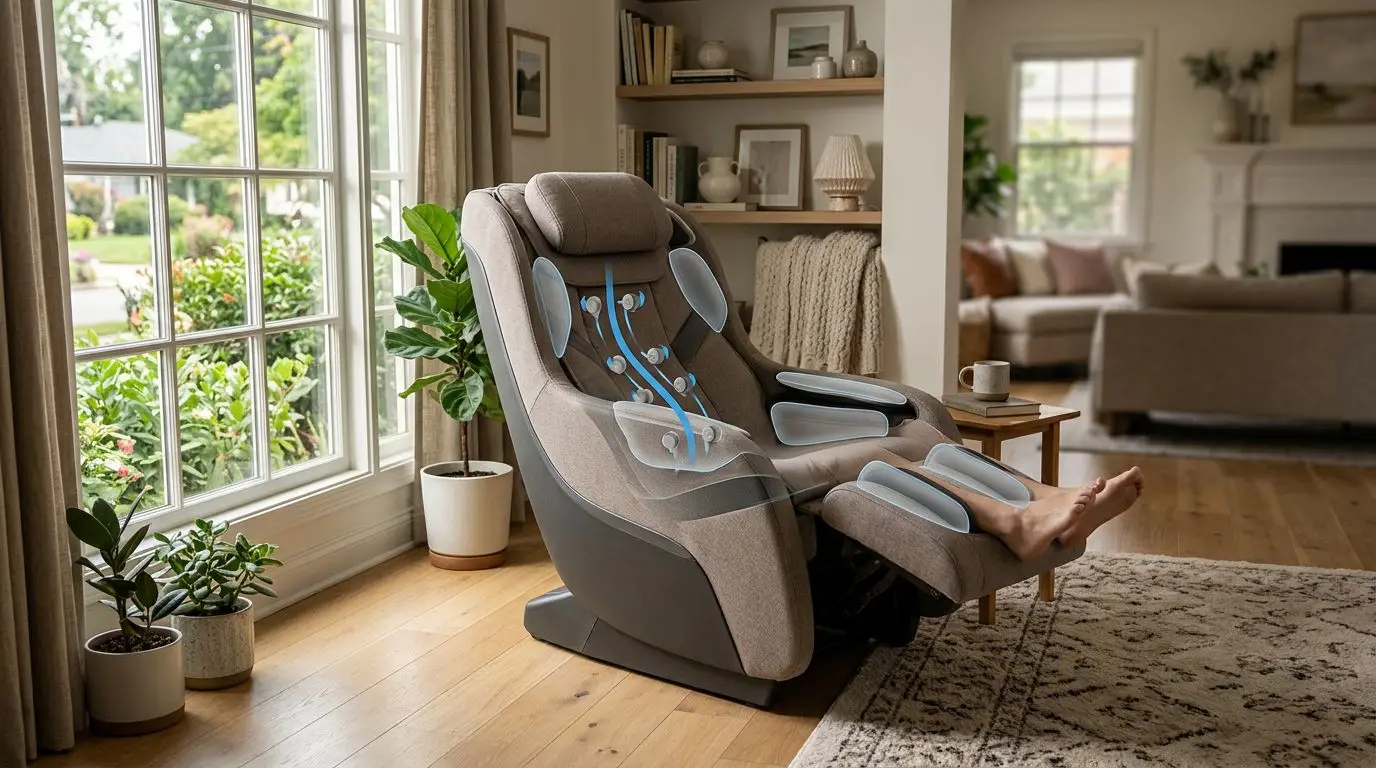
Massage chair roller systems are often described by the directions the rollers can move. A 2D system moves along the back track in two basic directions: up and down, and side to side. That provides coverage across the spine area, shoulders, and lower back, but the rollers do not actively push farther out toward your body.
A 3D system adds a third direction: in and out. In everyday terms, the rollers can protrude more or less, often across several depth levels controlled from the remote. The exact range varies by chair, but the idea is simple: 3D gives you more say over how firm the back rollers feel.
A 4D system is usually a 3D roller system with added variation in speed, rhythm, and roller timing. The fourth dimension is not a physical direction like an extra track; it is typically the way roller motion changes during a routine. On some chairs, this means slower, more deliberate kneading in one zone and quicker tapping or rolling in another.
| Roller type | Basic movement | Pressure control | Typical buyer fit |
|---|---|---|---|
| 2D | Up/down and side-to-side | Limited; adjusted mostly through programs, padding, and body position | Budget-focused buyers and people who prefer moderate pressure |
| 3D | 2D movement plus in/out depth | Better; often multiple depth levels | Buyers who want adjustable firmness |
| 4D | 3D depth plus variable speed/rhythm | Highest control in many chairs | Buyers who want a more nuanced, varied feel |
How 2D rollers feel: steady pressure with fewer adjustments
A 2D massage chair can still feel very satisfying. The rollers travel along the chair’s back track and move side to side to create kneading, rolling, or tapping patterns. Many 2D chairs also scan the back before starting, which helps position the roller path around your shoulder height and spine line.
The main limitation is depth. Since the rollers do not actively extend outward, pressure depends heavily on the chair’s padding, your body shape, the recline angle, and how much body weight rests into the backrest. Two people can sit in the same 2D chair and describe the firmness differently because one person’s back contacts the rollers more directly.
For someone who dislikes intense pressure, that can be a benefit. A 2D system is usually easier to tolerate on the first try, especially in the upper back, where hard rollers can feel sharp. It also tends to be simpler to use, with fewer settings to adjust before every session.
There are tradeoffs. If you are broad-backed, very muscular, or regularly prefer strong pressure, a 2D system may feel too surface-level. You may end up reclining farther back or using more intense preset programs just to get the force you want.
How 3D rollers feel: adjustable depth across 3 to 5 common levels
A 3D roller system is the most important upgrade for buyers who care about pressure. Instead of only moving along the back, the rollers can move inward and outward. Many chairs offer several depth settings, commonly labeled with simple levels such as 1 through 3 or 1 through 5, though the names and actual travel distance vary.
That extra dimension matters because pressure needs change by body area. You might want light contact around the neck and shoulders, medium pressure through the mid-back, and stronger pressure at the lower back. A well-designed 3D chair lets you reduce or increase roller protrusion without switching chairs or adding cushions.
3D also helps when multiple people use the same chair. A 120-pound user and a 220-pound user may not want the same roller depth. Adjustable depth gives the household more flexibility, especially if one person prefers a gentle feel and another wants firm contact.
The downside is cost and complexity. You are paying for additional motor control, mechanics, and programming. A 3D chair is also not guaranteed to feel better simply because it has depth control. If the track does not fit your height, the body scan is inaccurate, or the rollers feel too narrow for your frame, the extra depth may only make the mismatch more obvious.
How 4D rollers feel: depth plus rhythm changes over a 15-minute session
A 4D massage chair generally starts with 3D depth control and then adds more variation in how the rollers move. During a typical 10- to 20-minute session, a 4D program may slow down in a tight-feeling area, change tapping cadence, alternate between shallow and deeper contact, or vary roller speed in a way that feels less mechanical.
This is where 4D can feel more realistic than basic roller movement. Human hands do not move at one constant speed or pressure, and 4D programming is designed to create more variation. It may feel more fluid, especially during kneading and rolling combinations.
Still, 4D is not a universal upgrade. The term is not standardized across the industry, so one chair’s 4D system may feel dramatically different from another’s. In some cases, the difference between a strong 3D chair and an entry 4D chair may be subtle. Read the feature description closely: if 4D only means a few extra speed settings, decide whether that matters to you.
Buyers who are sensitive to changing intensity may prefer a simpler 3D or 2D chair. More variation can feel engaging to one person and distracting to another. Test the lowest settings first whenever possible.
Pressure needs: who each roller system is best for by body type and preference
The best roller system is the one that matches your pressure comfort, not the one with the highest number. A chair used for 15 minutes several times a week should feel inviting, not like something you have to brace against.
| Your preference or situation | Likely best fit | Why |
|---|---|---|
| You prefer mild to moderate pressure | 2D or gentle 3D | Less aggressive contact and fewer intensity surprises |
| You want firm back pressure | 3D | Depth adjustment gives more control than 2D |
| Multiple adults will use the chair | 3D or 4D | Adjustable depth can better fit different pressure preferences |
| You dislike repetitive, machine-like motion | 4D | Speed and rhythm variation can feel more dynamic |
| You are buying mainly for value | 2D or 3D | 4D often costs more, and not every buyer uses the extra controls |
| You are very pressure-sensitive | 2D or low-depth 3D | Start with gentler contact and use padding if needed |
Height also matters. Many chairs are designed for a user range, such as roughly 5 feet to 6 feet 2 inches, but the real fit depends on shoulder detection, seat depth, and where the rollers land. If the neck rollers sit too high or too low, even the best 3D or 4D system can feel off.
Body weight changes the feel too. A heavier user may sink farther into the chair and experience stronger pressure, while a lighter user may sit more on top of the padding and feel less roller contact. That is another reason adjustable depth can be useful in a shared home.
Track design matters as much as roller type: S-track, L-track, and SL-track coverage
Roller depth is only part of the story. The track determines where the rollers can travel. A common S-track follows the natural curve of the back from the neck area to the lower back. It is shaped to keep roller contact closer through the spine’s curve.
An L-track extends beyond the lower back and under the seat, often reaching into the glute area and sometimes the upper hamstrings. Track lengths vary, but many full-back tracks fall somewhere around 30 to 50 inches depending on design. An SL-track combines a curved back path with extended seat coverage.
If you are comparing a 2D L-track chair with a 3D S-track chair, do not assume the 3D chair is automatically better. The 3D chair may offer more depth, while the L-track chair may offer more lower-body roller coverage. Your preference should decide the winner.
| Track type | Coverage focus | Best for |
|---|---|---|
| S-track | Neck to lower back | Buyers focused on back contour and upper-body coverage |
| L-track | Back plus under-seat path | Buyers who want extended coverage below the lower back |
| SL-track | Curved back path plus seat extension | Buyers who want both contour and longer coverage |
Pair the track with the roller system. A 3D SL-track chair may offer both adjustable depth and longer coverage, while a 2D S-track chair may be simpler, smaller, and more affordable. Neither is wrong. They serve different priorities.
How to choose: measure your space, body fit, and pressure tolerance in 5 steps
Before comparing advanced roller claims, take 15 minutes to measure the basics. This helps you avoid buying a chair with impressive features but poor day-to-day fit.
1. Measure your room footprint
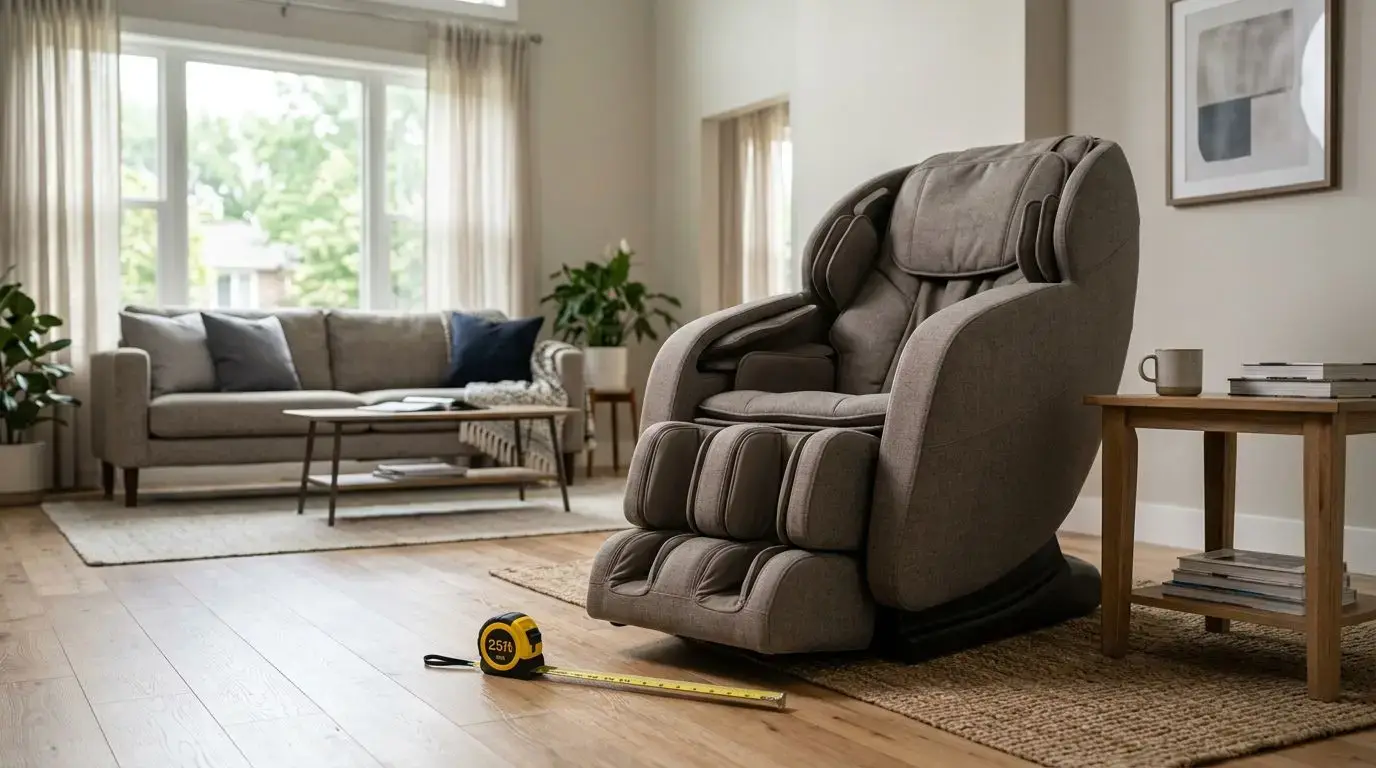
Check the chair’s upright and fully reclined dimensions. Many full-size massage chairs need roughly 5 to 6 feet of length when reclined, though wall-hugging designs may require only a few inches behind the backrest. Measure doorways too; a chair that fits the room still has to get through the hall.
2. Check user height range
Look for a stated height range and compare it with the tallest and shortest users. If you are near either end of the range, body scanning and manual shoulder adjustment become more important. A difference of 2 or 3 inches in shoulder position can change how neck rollers feel.
3. Decide your pressure ceiling
Ask yourself what you usually prefer in a chair: gentle, medium, or firm. If firm pressure sounds appealing but you are unsure, choose adjustable 3D over fixed high intensity. Depth control gives you an escape route.
4. Compare remote controls
Count how many steps it takes to change roller depth, speed, and zone focus. A feature is less valuable if it is buried in a confusing menu. For shared households, saved user settings can be useful, but they are not essential.
5. Plan for padding adjustments
A removable back pad or extra towel can noticeably soften roller contact. This is a simple way to fine-tune pressure, especially during the first week. If a chair feels slightly too strong at level 1, padding may help; if it feels far too strong, choose a gentler system.
Value check: when 4D is worth paying extra and when 3D is enough
Advanced roller systems cost more because they add motors, sensors, programming, and more complicated control. The value question is not whether 4D is newer. It is whether you will notice and use the difference at least once or twice a week.
Choose 3D if your main goal is pressure adjustment. For many buyers, 3D is the sweet spot because it solves the biggest comfort issue: too light versus too firm. If you can set the depth lower on sensitive days and higher when you want more contact, you may not need 4D at all.
Consider 4D if you are picky about pacing. If constant-speed kneading feels repetitive to you, 4D’s changing rhythm may make sessions more enjoyable. It is also more appealing for households where several users want different speeds and intensities.
Stay with 2D if you want simplicity, lower cost, and moderate pressure. A well-fitting 2D chair with a good track can be more enjoyable than a poorly fitting 4D chair. Roller technology should never outrank comfort, fit, and ease of use.
Safety and comfort checks before using any roller system for 10 to 20 minutes
Massage chairs are consumer wellness products, not medical devices. They are designed to provide mechanical pressure, motion, heat, and comfort features, but they should not be used as a substitute for advice from a licensed clinician.
Ask your physician before using a massage chair if you are pregnant; have a pacemaker or other implanted cardiac device; have a history of blood clots or take anticoagulants; have osteoporosis; recently had a fracture, surgery, or significant injury; have spinal disc problems; have neuropathy; or have uncontrolled hypertension. These situations can change what type of pressure, vibration, heat, or recline is appropriate for you.
Start conservatively. Use the lowest roller depth and a short session, such as 5 to 10 minutes, until you know how the chair feels. Stop if the pressure is painful, causes numbness, or feels wrong in a specific area. Discomfort is a useful signal, not something to push through.
Heat and calf compression deserve the same caution. Keep heat sessions moderate, and do not overtighten air compression just because the chair allows it. Comfort should be the standard.
Feature comparison: which upgrades matter beyond 2D, 3D, and 4D
Roller type gets much of the attention, but several supporting features affect daily comfort. Before paying for a higher roller category, compare the chair as a whole.
| Feature | Why it matters | What to check |
|---|---|---|
| Body scan | Helps align rollers with shoulder height and back shape | Manual adjustment if the scan misses by 1 to 2 inches |
| Zone control | Lets you focus on one area instead of a full routine | Neck, shoulder, mid-back, and lower-back options |
| Roller width | Affects whether pressure lands close to the spine or wider across the back | Narrow, medium, and wide settings if available |
| Recline angle | Changes how much body weight presses into the rollers | Easy adjustment during a session |
| Air compression | Adds squeezing pressure in areas like arms, calves, or feet | Separate intensity levels, ideally 3 or more |
| Foot rollers | Can feel intense because feet have less padding | On/off control and removable socks or inserts |
Pay special attention to independent controls. A chair that lets you adjust back roller depth but not foot roller intensity may still feel too aggressive overall. The best setup gives you control over each major contact point.
Bottom line after comparing 2D, 3D, and 4D roller systems
Choose 2D if you want a straightforward chair with moderate pressure and fewer settings. It is often the most sensible choice for buyers who value simplicity and are not chasing deep roller contact.
Choose 3D if pressure control is your main concern. For most shoppers comparing roller systems, 3D is the practical upgrade because it changes how firmly the rollers meet your back. It is especially useful in a shared household.
Choose 4D if you already know you like adjustable depth and want more variation in speed and rhythm. It can feel more natural and less repetitive, but it is worth paying for only if those differences improve your comfort enough to justify the added cost.
The smartest test is simple: sit in the chair, start at the lowest intensity, adjust depth one level at a time, and notice whether the controls make the chair easier to enjoy. If the answer is yes, the technology is doing its job.
FAQ: 5 common questions about 2D, 3D, and 4D massage chairs
Is 4D always stronger than 3D?
No. 4D usually means added speed and rhythm variation, not automatically higher force. Some 3D chairs can feel firmer than some 4D chairs, depending on roller design, padding, recline angle, and depth range.
Can a 2D massage chair still be a good buy?
Yes. A 2D chair can be a smart buy if you prefer moderate pressure, want simpler controls, or are working with a tighter budget. Fit and comfort matter more than the highest feature label.
What is the biggest reason to choose 3D?
The main reason is adjustable roller depth. If you want to change back pressure from light to firm without relying only on recline angle or padding, 3D is usually the most useful upgrade.
Do 4D rollers feel like human hands?
They are designed to feel more varied than basic mechanical movement, especially because speed and rhythm can change during a session. They still use rollers, motors, and programmed patterns, so they do not truly duplicate human touch.
Should pressure ever feel painful?
No. Strong pressure and painful pressure are not the same. Start with a low setting, shorten the session if needed, and stop using the chair if a specific motion causes pain, numbness, or unusual discomfort.
Frequently asked questions
Is 4D always stronger than 3D? +
No. 4D usually adds speed and rhythm variation to 3D-style depth control. Actual firmness depends on roller design, padding, recline angle, and depth range.
Can a 2D massage chair still be a good buy? +
Yes. A 2D chair can be a good choice if you want moderate pressure, simpler controls, and better value. Fit and comfort matter more than the highest feature label.
What is the biggest reason to choose 3D rollers? +
Choose 3D if you want adjustable roller depth. It gives you more control over whether the back rollers feel light, medium, or firm.
Do 4D rollers feel like human hands? +
They are designed to feel more varied than basic roller motion because speed and rhythm can change. They still use mechanical rollers and programmed patterns.
Should massage chair pressure ever feel painful? +
No. Start at the lowest setting and stop if pressure causes pain, numbness, or unusual discomfort. Strong pressure should still feel comfortable.
Related guides
How to Compare Massage Chair Features: 2D, 3D, 4D, L-Track, SL-Track, Heat, and Airbags
13 min read
2D vs. 3D vs. 4D Massage Chairs: What the Roller Technology Really Means
13 min read
How to Adjust Massage Chair Intensity Without Overdoing It
13 min read
Shiatsu Massage Chairs: What the Term Means Before You Buy
13 min read
Massage Chair Roller Techniques Explained: Kneading, Tapping, Rolling, Knocking, and Combination Modes
12 min read