Disclosure: We may earn a commission when you buy through links on this page, at no extra cost to you. We buy nothing, sell nothing and accept no payment for coverage — commissions never decide what we recommend. How we make money.
2D, 3D, and 4D massage chairs differ mainly in how the back rollers move. A 2D chair moves rollers up/down and side-to-side, a 3D chair adds in-and-out depth control, and a 4D chair typically adds variable speed or rhythm on top of 3D depth. For most buyers, 3D is the biggest performance jump; 4D can feel more lifelike, but only when the chair also has good roller design, body scanning, and adjustability.
The terms sound technical, but they are also used in marketing. A higher “D” number does not automatically make a massage chair better. What matters is whether the roller system can match your body size, pressure preference, and daily use pattern without feeling too weak or too aggressive.
2D, 3D, and 4D Massage Chairs in 60 Seconds
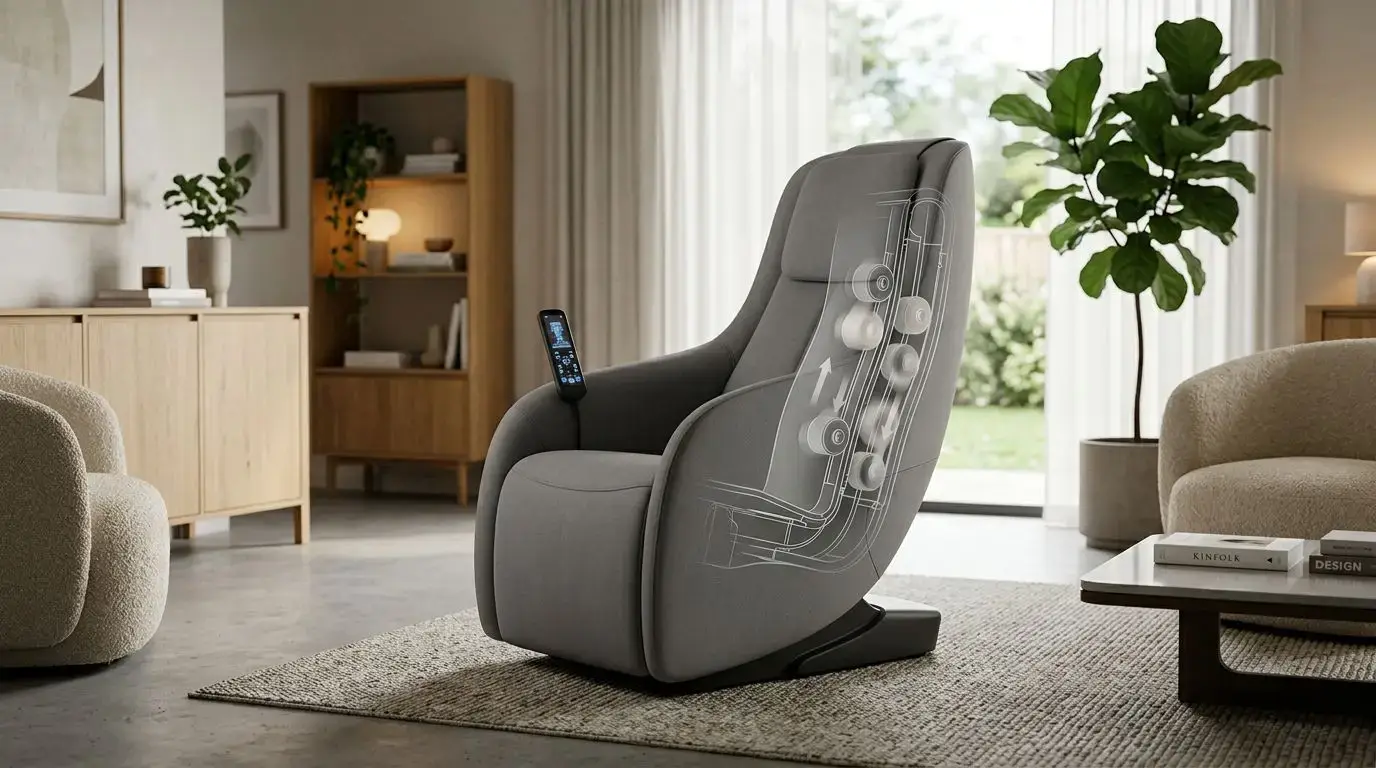
Think of the “D” rating as a quick label for roller movement, not a complete quality grade. In a typical massage chair, rollers travel along a track in the backrest, which may run from the neck to the lower back or continue under the seat toward the glutes and hamstrings. Roller technology describes how those rollers move against your back during a session that often lasts about 15 to 30 minutes.
| Roller type | What it means | Typical feel | Best use case |
|---|---|---|---|
| 2D | Moves up/down and left/right | Consistent, lighter to moderate pressure | Basic relaxation and budget-conscious buyers |
| 3D | Adds in/out depth adjustment | More pressure range; can feel deeper | Buyers who want adjustable intensity |
| 4D | Usually 3D depth plus variable speed or rhythm | More dynamic and human-like when well executed | Enthusiasts who value realism and fine tuning |
The key word is “typically.” There is no single industry-wide standard that requires every manufacturer to define 4D the same way. One chair may use the term for variable roller speed, another for more complex rhythm changes, and another for a combination of depth, speed, and timing. Read the feature description instead of relying on the label alone.
How 2D Rollers Work: 2 Axes of Motion
A 2D massage chair moves its rollers along two basic axes: vertically along your back and horizontally across the muscle groups near your spine. This allows the chair to perform common massage actions such as kneading, tapping, rolling, and shiatsu-style patterns. The rollers do not intentionally move forward and backward to change depth, so intensity is usually shaped by program design, roller shape, body position, and padding thickness.
For many people, that is enough. A 2D chair can still feel good for loosening general back tension after a long workday, especially when combined with heat, air compression, and a decent recline angle. The pressure tends to be predictable because the rollers stay at a fixed protrusion from the track.
The tradeoff is limited intensity control. If the chair feels too light, there may be little you can do besides reclining farther back or choosing a stronger preset. If it feels too firm over the shoulder blades or lower back, your options may be limited to adding a folded towel or switching to a gentler mode. That narrow adjustment range is the main reason some shoppers move up to 3D.
2D is not automatically “cheap” or bad. A well-built 2D chair with accurate body scanning and a comfortable track can outperform a poorly designed chair with a more impressive label. Still, if you want deep tissue-style pressure or a wide range of intensity levels, 2D may feel restrictive after the first few weeks.
How 3D Rollers Work: Up to About 3 Inches of Depth
A 3D massage chair adds a third movement: the rollers can move in and out from the backrest. Depending on the chair design, the depth range may be roughly 1 to 3 inches, though the exact amount varies. That extra forward movement lets the rollers press more firmly into the muscles instead of simply gliding along the track.
This is the most meaningful upgrade for many buyers. With 3D control, you can often reduce the intensity for the neck and upper shoulders, then increase it for the mid-back or lower back. Some chairs let you adjust depth across several levels, while others tie depth changes to specific massage programs. Either way, the chair has more room to adapt.
3D also matters when two people in the same household use the chair. A 120 lb user and a 220 lb user may have very different pressure preferences, even if they are the same height. Depth control gives the chair a better chance of serving both users without one person finding it too soft and the other finding it too intense.
There is one caution. Deeper does not always mean better. Aggressive pressure over bony areas, recent injuries, inflamed tissue, or sensitive lower backs can be uncomfortable. A good 3D chair should make it easy to reduce intensity quickly, not hide that control in a complicated menu. If you are sensitive to pressure, check whether the chair allows manual depth adjustment during an active session.
How 4D Rollers Work: 3D Depth Plus Variable Speed
In massage chairs, 4D usually means the chair has 3D depth control plus changes in roller speed, rhythm, or timing. The “fourth dimension” is not a literal physical dimension. It is a way of saying the massage does more than move deeper; it also changes how fast and how dynamically the rollers work during a 15-minute or 20-minute program.
A well-executed 4D system can feel less mechanical. For example, the rollers may slow down as they press into a tight area, then speed up through a lighter stroke. They may vary tapping tempo or pause briefly near pressure points. Those small timing changes can make the massage feel closer to hands-on bodywork, though it is still a machine and should not be treated as a medical therapy.
The problem is that 4D is one of the least consistent terms in the category. Some chairs labeled 4D have genuinely flexible control over depth, speed, and rhythm. Others use the term for a modest change in roller tempo. Without a clear explanation, “4D” can become a premium-sounding label rather than a dependable performance promise.
If you are considering a 4D chair, look beyond the word itself. Check how many intensity levels are available, whether speed can be adjusted separately from depth, whether manual mode gives you control over a specific back zone, and whether the chair can store preferences for repeat use. Those details matter more than the label on the spec sheet.
2D vs. 3D vs. 4D Comparison Table: 7 Buying Factors
The best roller type depends on how you plan to use the chair at least 3 to 5 times per week. A chair used occasionally for light relaxation has different requirements than one shared by a household with very different body types and pressure preferences.
| Buying factor | 2D | 3D | 4D |
|---|---|---|---|
| Intensity range | Limited to moderate | Wide, with depth control | Wide, with more dynamic feel |
| Realism | More mechanical | More pressure variation | Most lifelike when well designed |
| Ease of use | Usually simple | Moderate learning curve | May require more adjustment |
| Shared household fit | Good if users like similar pressure | Better for mixed preferences | Best for users who want fine control |
| Sensitive users | Can be gentler | Good if depth lowers enough | Good if controls are easy to access |
| Value | Strong for basic relaxation | Often the best balance | Best if you will use advanced settings |
| What to verify | Track comfort and padding | Depth levels and manual control | Separate speed, rhythm, and depth settings |
For many shoppers, 3D is the practical sweet spot. It creates the biggest functional difference because the rollers can actually change pressure into the body. 4D can be worth it, but only when the chair gives you real control over speed and rhythm instead of simply adding another label.
Who Each Roller Type Is Best For: 3 Buyer Profiles
2D is best for light-to-moderate massage users. Choose it if you want a straightforward chair for general relaxation, do not enjoy deep pressure, or plan to use the chair a few times a week for 10 to 20 minutes. It can also be a sensible choice for a guest room or shared living space where simplicity matters more than customization.
3D is best for buyers who care about adjustable intensity. If you want the option to go deeper on some days and lighter on others, 3D is usually the first level to consider. It is also a strong fit for households with two or more regular users because depth control helps the chair adapt to different body weights, shoulder shapes, and pressure tolerance.
4D is best for experienced users who notice rhythm and realism. If you already know you like massage chairs and want a more varied feel, 4D may be worth considering. It makes the most sense for people who will actually use manual controls, adjust speed, compare massage styles, and fine-tune programs instead of pressing the same preset button every time.
If you are buying your first chair and feel unsure, do not assume the most advanced roller system is the safest choice. A chair that is too intense or too complicated may get less use. Comfort on day 30 matters more than excitement on day 1.
How to Choose and Measure Before You Buy: 5 Checks
1. Measure your user height range. Many full-size massage chairs are designed around adult users somewhere near 5 feet to 6 feet 3 inches tall, but fit varies by chair. Pay attention to shoulder detection, neck roller reach, and footrest adjustment. If the rollers stop too low or too high, even an advanced 4D system will miss the target.
2. Check seat width and shoulder room. Look at the interior seat width, not just the outside chair width. A difference of 1 or 2 inches can affect comfort, especially in chairs with bulky side panels or arm massage compartments. Users with broad shoulders should also check whether the upper back area feels restrictive.
3. Confirm the track type. An S-track follows the natural curve of the spine and usually ends around the lower back. An L-track extends under the seat toward the glutes and upper hamstrings, often adding 20 inches or more of roller travel compared with a shorter back-only path. Track shape affects coverage as much as roller dimension does.
4. Look for manual zone control. The ability to stop the rollers on a 3-inch or 6-inch area can be more useful than having many automatic programs. If your tension tends to sit between the shoulder blades or at the beltline, zone control keeps the massage where you need it instead of making you wait for the program cycle to return there.
5. Test the lowest and highest intensity if possible. Do not only test the default program. Try the gentlest setting and the strongest setting for at least a few minutes each. A good chair should offer a usable range, not one perfect setting surrounded by extremes.
Features That Matter More Than the D Label: 6 Items
Roller technology is important, but it is only one part of the chair. A well-balanced 3D chair can feel better than a poorly tuned 4D chair, especially when the supporting features are stronger.
| Feature | Why it matters | What to look for |
|---|---|---|
| Body scanning | Helps locate shoulders and back shape | Adjustable shoulder position after scan |
| Track length | Determines roller coverage | S-track for back focus; L-track for glute coverage |
| Heat | Adds comfort and relaxation | Clear heat zones, often lower back or calves |
| Air compression | Provides squeezing pressure outside the roller path | Adjustable intensity for arms, calves, feet, or shoulders |
| Foot rollers | Can strongly affect daily satisfaction | Separate foot intensity or removable pads |
| Remote and controls | Determines whether features get used | Quick access to intensity, recline, and pause |
Body scanning deserves special attention. A scan that misreads your shoulders by even 2 inches can make the neck massage feel awkward and the upper-back work feel misplaced. The best systems let you manually correct shoulder position before the program begins.
Heat is another feature to view realistically. It may help the session feel more relaxing and comfortable, but it should not be described as treating an injury or medical condition. If you have circulation problems, nerve sensitivity, or a condition affected by heat, ask a healthcare professional before using heated massage.
Value and Longevity: What to Pay Attention to After 5 Years
A massage chair is a mechanical product with motors, rollers, airbags, tracks, wiring, and upholstery. The roller label tells you how it should feel today, but ownership value depends on how the chair performs after hundreds of sessions over 3 to 5 years.
Start with the warranty terms. Look for clear coverage on parts, labor, structural frame, and in-home service if available. Roller mechanisms and recline motors are not simple cosmetic components, so vague coverage can matter later. Also check whether the warranty changes between residential and commercial use.
Then consider complexity. A 4D chair may have more motors and control logic than a basic 2D chair. That does not mean it is unreliable, but it does make build quality, service access, and documentation more important. If two chairs feel similar to you, the one with clearer support terms may be the better buy.
Upholstery and padding matter too. Rollers that feel good through new padding may feel sharper if padding compresses over time. Removable back pads or adjustable cushioning can extend comfort because they let you fine-tune pressure without changing the chair itself.
The best value is not always the chair with the longest feature list. It is the chair you will comfortably use on a regular schedule, with controls you understand and intensity settings that match your body. If 2D gives you the comfort you want, paying for 4D may not improve your daily life. If 2D feels flat and you crave deeper work, 3D or well-defined 4D is likely worth a closer look.
FAQ: 5 Common Questions About 2D, 3D, and 4D Rollers
Is 4D always better than 3D?
No. 4D can feel more realistic because it may vary speed and rhythm, but it is not automatically better. A strong 3D chair with accurate body scanning, good track design, and easy intensity controls can be more satisfying than a poorly executed 4D chair.
Does 3D mean deep tissue massage?
Not exactly. 3D means the rollers can move in and out to change pressure, which can feel deeper than 2D. It should not be treated as the same as professional deep tissue bodywork, and it may not be appropriate for everyone or every sensitive area.
Are 2D massage chairs worth buying?
Yes, for the right user. A 2D chair can be a good fit if you prefer lighter pressure, want simple controls, or mainly use massage for relaxation. It is less ideal if you want strong pressure control or a highly customized massage.
What matters more: roller type or track type?
Both matter. Roller type affects pressure and motion, while track type affects coverage. For example, a 3D S-track may provide excellent back intensity, while a 2D or 3D L-track may cover more of the glutes and upper hamstrings.
How long should I test a massage chair?
If possible, test it for at least 15 minutes, which is long enough to feel a typical program cycle. Try more than one intensity level, adjust the recline, and make sure the rollers line up with your shoulders, mid-back, and lower back.
Can a massage chair help with pain?
A massage chair may help some people feel temporary relief from everyday muscle tension and stress, but it should not be used to diagnose, treat, or cure pain or medical conditions. If you have persistent pain, recent injury, numbness, or a diagnosed condition, check with a healthcare professional before using strong massage settings.
Frequently asked questions
Is 4D always better than 3D? +
No. 4D can feel more realistic because it may vary speed and rhythm, but a well-designed 3D chair with accurate body scanning and strong intensity controls can be more satisfying than a poorly executed 4D chair.
Does 3D mean deep tissue massage? +
Not exactly. 3D means the rollers can move in and out to adjust pressure. It can feel deeper than 2D, but it is not the same as professional deep tissue bodywork.
Are 2D massage chairs worth buying? +
Yes. A 2D chair can be worthwhile if you prefer lighter pressure, simple controls, and general relaxation. It is less ideal if you want broad intensity adjustment.
What matters more: roller type or track type? +
Both matter. Roller type affects pressure and motion, while track type affects coverage. An L-track may reach the glutes and upper hamstrings, while an S-track focuses more on the back.
How long should I test a massage chair? +
If possible, test it for at least 15 minutes. Try the lowest and highest usable intensity settings, adjust the recline, and confirm the rollers align with your shoulders and lower back.
Can a massage chair help with pain? +
A massage chair may provide temporary comfort for everyday muscle tension, but it should not be used to diagnose, treat, or cure pain. For persistent pain, recent injury, numbness, or medical conditions, consult a healthcare professional.
Related guides
Best Massage Chair Features to Look For Before You Buy
13 min read
How to Choose a Massage Chair for Home Use
14 min read
How to Compare Massage Chair Features: 2D, 3D, 4D, L-Track, SL-Track, Heat, and Airbags
13 min read
Are Massage Chairs Good or Bad for You? Benefits, Risks, and Safe Use Guidelines
13 min read
Shiatsu Massage Chairs: What the Term Means Before You Buy
13 min read