Disclosure: We may earn a commission when you buy through links on this page, at no extra cost to you. We buy nothing, sell nothing and accept no payment for coverage — commissions never decide what we recommend. How we make money.
Renting a massage chair usually makes the most financial sense for short-term needs, events, uncertain fit, or a trial period of less than a few months. Buying tends to make more sense when you expect regular home use for 12 months or longer, have the space, and want control over features, condition, and availability.
The best choice is not simply the lowest monthly payment. Compare the total rental cost, delivery and pickup fees, purchase price, warranty coverage, resale value, maintenance responsibilities, and how many people in your household will actually use the chair.
Rental vs. buying at a glance: the 30-day, 6-month, and 3-year view
A massage chair rental is a temporary arrangement: you pay to use the chair for a defined period, often with delivery and pickup handled by the rental provider. Buying is a long-term purchase: you pay upfront or finance the chair, keep it at home, and take responsibility for the space, upkeep, and eventual resale or removal.
The financial answer changes quickly by time frame. For a 1-day corporate event, renting is almost always more practical than buying. For a 30-day home trial, renting can be a smart way to see whether the chair fits your body, room, and routine. For 3 years of frequent household use, buying often becomes the stronger value if the chair is used consistently and stays in good working order.
| Use case | Typical time frame | Usually better financial fit | Why |
|---|---|---|---|
| Party, open house, office wellness day, trade show booth | 1 to 7 days | Rental | You avoid storage, transport, and a large purchase for a one-time need. |
| At-home trial before committing | 2 to 8 weeks | Rental or retailer trial | You learn whether the chair’s size, pressure, and controls work for you. |
| Temporary apartment, short job assignment, seasonal stay | 2 to 6 months | Rental | Moving a large chair twice can erase the value of owning. |
| Regular household use | 12 months or more | Buying | The cost per use can fall over time, especially with multiple users. |
| Uncertain health or comfort tolerance | 1 to 3 months | Rental first | You can stop without owning a bulky item that may not suit you. |
Short time frame? Rent. Long time frame and repeated use? Buying deserves a serious look.
The break-even formula: compare monthly rent to net purchase cost over 12 months
The simplest way to compare rental and purchase is to find the break-even point. Use this formula:
Break-even months = net purchase cost ÷ total monthly rental cost
Net purchase cost means the chair price plus tax, delivery, setup, accessories, and any financing cost, minus expected resale value if you plan to sell it later. Total monthly rental cost means the monthly rental charge plus delivery, pickup, deposits, insurance, cleaning fees, or minimum-term charges spread across the rental period.
Here is a simple example. If your all-in purchase cost is $4,000 and a rental costs $250 per month after delivery and pickup fees are averaged in, the break-even point is 16 months. If you need that same rental for only 3 months, renting is cheaper. If you use the chair for 3 years, buying may cost less per month even before resale is considered.
Do not stop at the headline rental rate. A low monthly number can look appealing until you add a 2-month minimum, a round-trip delivery charge, or a damage deposit. Likewise, a purchase price can look high until you divide it across hundreds of uses.
Cost-per-use makes the decision clearer
Cost-per-use is especially helpful for households. If a chair costs $4,000 all-in and is used 4 times per week for 3 years, that is about 624 uses. The rough cost per use is about $6.41 before any resale value. If two adults each use it 4 times per week, the number of uses doubles and the cost per use drops sharply.
With rental, cost-per-use can be high if the chair sits unused. A 1-month rental used twice is expensive. A 1-month rental used by 20 employees at a company event may be a much better value.
When renting makes financial sense: under 6 months, events, and trial use
Renting is strongest when your time frame is short, your need is temporary, or you want to avoid ownership risk. A massage chair is a large appliance-like item; many full-size chairs are roughly 28 to 35 inches wide and can weigh 150 to 300 pounds. That matters if you live up stairs, move often, or do not have a permanent room for it.
Rental can be the practical choice for events. For a 2-day conference, renting shifts the transportation and pickup problem to the provider. For a wedding lounge, pop-up showroom, employee appreciation day, or real estate open house, you need the experience for a fixed window, not a chair in your garage for years.
Rental also helps when fit is uncertain. Some people like firm rollers along the back; others prefer a gentler chair with air compression and less focused pressure. A rental period lets you test the actual feeling over multiple sessions instead of deciding after 10 minutes in a showroom.
Who rental is best for
- Short-term users: People who need a chair for 1 day to 6 months.
- Event planners: Offices, trade shows, parties, real estate events, and hospitality spaces.
- Apartment renters: Anyone with limited space, stairs, or a likely move within the year.
- First-time shoppers: Buyers who want to test pressure, noise, heat, recline, and controls at home.
- People unsure about body fit: Taller, shorter, broader, or more sensitive users may benefit from a trial before buying.
The downside is that rental selection may be limited. You may not get to choose the track type, roller style, upholstery color, calf coverage, or app controls. You may also be using a chair handled by many previous renters, so ask how it is cleaned, inspected, and serviced between placements.
When buying makes financial sense: 12 months or longer with steady use
Buying tends to win when the chair becomes part of your home routine. If you expect to use it several times a week for at least 12 to 24 months, the math usually moves toward ownership, especially when more than one household member uses it.
Ownership gives you a broader choice of features. You can choose a track design, roller intensity, recline style, upholstery color, and chair size that match your preferences. You also know the chair’s full use history, which can matter with moving parts, upholstery wear, and remote controls.
The biggest financial risk is underuse. A chair that is exciting for 3 weeks and ignored for 3 years is not a good buy. Before purchasing, estimate realistic usage. If your honest answer is “maybe once on Sundays,” renting or a trial period may be safer.
Who buying is best for
- Daily or weekly users: People likely to use the chair 3 or more times per week.
- Multi-person households: Two or more regular users improve the cost-per-use math.
- Stable homes: Owners or long-term renters who do not expect to move within 12 months.
- Feature-specific shoppers: People who care about an L-track, S-track, 3D rollers, quiet operation, or a certain recline footprint.
- Design-conscious buyers: Anyone who wants the chair to match a room rather than accept the available rental unit.
Buying also gives you availability. You do not need to reserve dates, extend a rental, or coordinate pickup. If regular access matters, ownership is more convenient.
Feature comparison: what you get with rental vs. purchase in 2D, 3D, S-track, and L-track chairs
Financial value depends on the chair being compared. A basic rental chair and a higher-feature purchased chair are not the same product experience. Massage chairs vary by track shape, roller movement, body coverage, recline design, and adjustability.
| Feature | What it means | Rental consideration | Buying consideration |
|---|---|---|---|
| 2D rollers | Rollers move up/down and side-to-side | Common and simpler; may be enough for light to moderate pressure | Usually lower complexity and may cost less than advanced roller systems |
| 3D rollers | Rollers can move in and out to change pressure depth | May be harder to find in rental inventory | Useful if you want more control over intensity |
| S-track | Track follows the natural curve of the back | Common in many chairs | Good option for focused back coverage |
| L-track | Track extends from the back under the seat area | May be available but not guaranteed | Better if you want roller coverage beyond the back and into the seat area |
| Air compression | Airbags inflate and deflate around areas like arms, calves, or shoulders | Ask which zones work and whether intensity adjusts | Compare number of zones, comfort, and ease of entry/exit |
| Heat | Warming elements, often in the back area | Confirm placement and temperature controls | Choose based on where warmth feels comfortable, not health claims |
| Zero-gravity recline | A reclined position with legs elevated | Check ceiling and wall clearance before delivery | Measure carefully; some chairs need several inches behind them |
If you are renting to decide whether to buy, try to rent a chair type close to what you might purchase. Testing a basic S-track chair does not fully show how you will like a larger L-track chair with deeper 3D rollers.
How to measure your room before renting or buying: allow 30 to 36 inches of width
Space mistakes are expensive. Before you rent or buy, measure the route from the front door to the final location, not just the room. Include doorways, hallway turns, stair landings, elevator openings, and ceiling height on stairs.
Many full-size massage chairs need a doorway close to 30 inches wide, though exact requirements vary. Some chairs can be partially disassembled for delivery, while others cannot. Ask the provider for the chair’s upright dimensions, reclined dimensions, box dimensions, and minimum doorway clearance.
Measuring checklist
- Doorways: Measure the narrowest point, including trim and door hinges.
- Hallways: Check width and turning space, especially at 90-degree corners.
- Stairs: Measure stair width, landing depth, and overhead clearance.
- Room footprint: Confirm chair width, depth upright, and depth fully reclined.
- Wall clearance: Some chairs need only a few inches behind them; others need more.
- Floor surface: Consider a mat on wood or delicate flooring to reduce marks.
- Outlet location: Use a nearby grounded outlet; avoid creating a trip hazard with cords.
For rentals, ask what happens if the chair does not fit. Will the provider charge a failed delivery fee? Can they swap in a smaller chair? For purchases, confirm the return policy before delivery day, especially if you live in a walk-up, older home, or apartment building with tight turns.
Rental contract details: 5 fees and terms that can change the final bill
The rental quote is only useful if it includes all required charges. Before you sign, ask for a written total, not just a monthly rate. A rental that looks affordable can change once delivery, pickup, cleaning, damage responsibility, and minimum terms are added.
| Contract item | What to ask | Why it matters |
|---|---|---|
| Minimum rental period | Is there a 1-month, 2-month, or longer minimum? | A short trial may cost more than expected if the minimum is long. |
| Delivery and pickup | Are both included? What about stairs? | Large chairs can require extra labor and scheduling. |
| Damage deposit | How much is refundable, and what counts as damage? | Upholstery scuffs, pet damage, or remote issues may reduce the refund. |
| Service response | What happens if the chair stops working during the rental? | You should know whether they repair, replace, or pause billing. |
| Extension terms | Can you extend by week or month? | A flexible extension helps if the trial is useful but you are not ready to buy. |
For event rentals, confirm setup time and power needs. One chair may be fine on a standard household outlet, but a multi-chair event should be planned with the venue. Also ask whether an attendant is required, optional, or not provided.
Buying costs beyond the sticker price: delivery, warranty, moving, and resale over 3 years
A purchase has costs after checkout. White-glove delivery, in-room setup, stair carries, extended service plans, and future moves can all affect the real price. If you may move within 3 years, include professional moving or disassembly in your math.
Warranty coverage matters, but read the details. Look for what is covered for parts, labor, frame, electronics, upholstery, and in-home service. A long parts term is not the same as a long in-home labor term. If you live far from service areas, ask how repairs are handled.
Resale can reduce net ownership cost, but it is not guaranteed. Large chairs are harder to sell than small furniture because buyers need transport, space, and confidence that the chair works. Keep manuals, receipts, and any service records if you expect to resell later.
Financing also changes the equation. A low monthly payment can hide the total cost if the term is long or the interest rate is high. Compare the total financed amount to the cash price, not just the payment.
Safety and comfort limits: start with 10 to 15 minutes and ask a physician when needed
A massage chair is a consumer wellness product designed for comfort, pressure, warmth, and relaxation. It is not a medical device. Do not use rental or purchase decisions as a substitute for medical advice, and be cautious with strong pressure, heat, or tight air compression if you have health concerns.
Ask your physician before using a massage chair if you are pregnant; have a pacemaker or other implanted cardiac device; have a history of blood clots or take anticoagulants; have osteoporosis; recently had a fracture or surgery; have spinal disc problems; have neuropathy; or have uncontrolled hypertension. If any setting feels painful, causes numbness, or makes you feel unwell, stop using the chair.
For a first session, 10 to 15 minutes is enough to judge fit and intensity. You can adjust from there based on comfort and the chair’s user manual. More time is not automatically better, and aggressive settings are not right for everyone.
A practical decision guide: choose rental, trial, or purchase in 4 steps
Use a simple 4-step process before spending money. It keeps the decision grounded in actual use rather than wishful thinking.
Step 1: Set your time horizon
If you need the chair for less than 3 months, start with rental quotes. If you expect regular use beyond 12 months, price ownership. For 3 to 12 months, run both sets of numbers.
Step 2: Estimate real usage
Write down who will use the chair and how often. A household with 2 users at 4 sessions per week each has a very different cost-per-use than one person using it twice a month.
Step 3: Match the chair type to your preferences
Decide whether you want gentle pressure, deeper adjustable rollers, seat-area roller coverage, calf and foot features, heat, or a compact footprint. Do not pay for features you dislike or will not use.
Step 4: Compare all-in costs
For rental, include every fee through pickup. For purchase, include delivery, tax, warranty, financing, likely moving costs, and possible resale. Then compare the break-even month with your expected ownership period.
Here is the quick rule: rent for events, temporary living situations, and uncertainty; buy for stable homes, repeated use, and specific feature needs. If you are on the fence, a short rental or trial can prevent a much more expensive mistake.
FAQ: 5 common questions about massage chair rental vs. buying
Is renting a massage chair worth it for one month?
Yes, renting can be worth it for one month if you are testing fit, hosting an event, or need temporary access without moving a heavy chair yourself. Ask about minimum terms, delivery, pickup, and cleaning fees before comparing it with buying.
How long should I rent before deciding to buy?
Two to 8 weeks is usually enough to learn whether the chair fits your body, room, schedule, and comfort preferences. Use it at realistic times of day, not just during the first excited weekend.
Is it cheaper to buy a used massage chair instead of renting?
Sometimes, but used chairs add risk. Check condition, remote function, upholstery wear, transport requirements, and whether any service coverage transfers. A low used price is not a bargain if the chair is difficult to move or repair.
Can I rent a massage chair for an office or event?
Often, yes. Event rentals are one of the clearest cases for renting because the need may last only 1 to 3 days. Confirm delivery schedule, setup, power access, cleaning, and whether staff supervision is required.
What is the biggest mistake people make when buying?
The biggest mistake is overestimating use. Before buying, calculate cost-per-use with a realistic weekly schedule and measure the delivery path. A chair that does not fit the home or routine is poor value at any price.
Frequently asked questions
Is renting a massage chair worth it for one month? +
Yes, renting can be worth it for one month if you are testing fit, hosting an event, or need temporary access without moving a heavy chair yourself. Ask about minimum terms, delivery, pickup, and cleaning fees.
How long should I rent before deciding to buy? +
Two to 8 weeks is usually enough to learn whether the chair fits your body, room, schedule, and comfort preferences. Use it under normal conditions so the trial reflects real life.
When does buying make more financial sense than renting? +
Buying usually makes more sense when you expect regular use for 12 months or longer, have a stable place for the chair, and want specific features or control over condition and availability.
Can I rent a massage chair for an office or event? +
Often, yes. Event rentals are a strong use case for renting because the need may last only 1 to 3 days. Confirm delivery, setup, power access, cleaning, and supervision requirements.
What should I measure before renting or buying? +
Measure doorways, hallway turns, stairs, elevator openings, the final room footprint, wall clearance, and outlet location. Many full-size chairs are large and heavy, so delivery access matters.
Related guides

Is a Massage Chair Worth It? Cost, Use Frequency, and Break-Even Math for U.S. Buyers
12 min read
Massage Chair vs. Professional Massage: Which Is Better for Your Routine and Budget?
10 min read
At-Home Massage Chair vs. Gym or Mall Massage Chair: Which Option Makes More Sense?
13 min read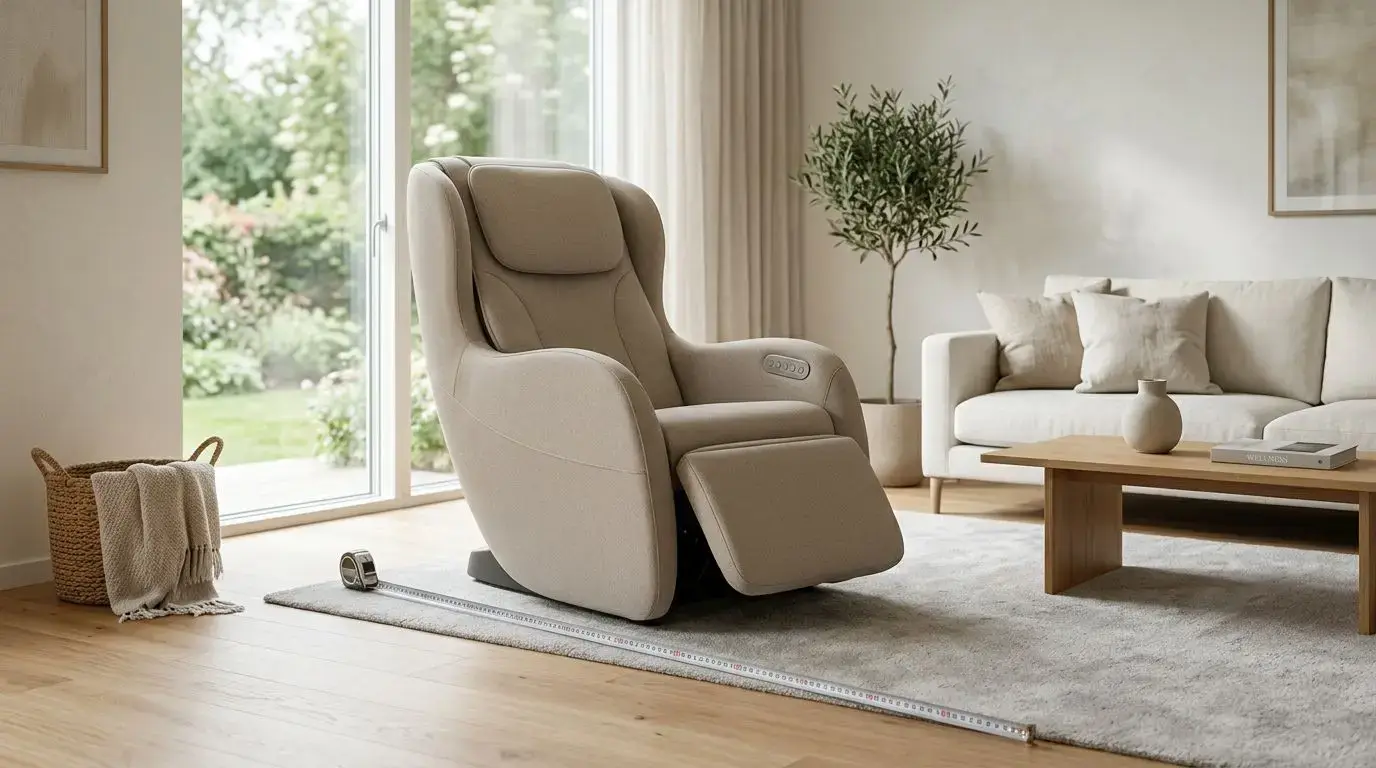
Is a Massage Chair Worth It? Benefits, Limitations, and Who Should Buy One
13 min read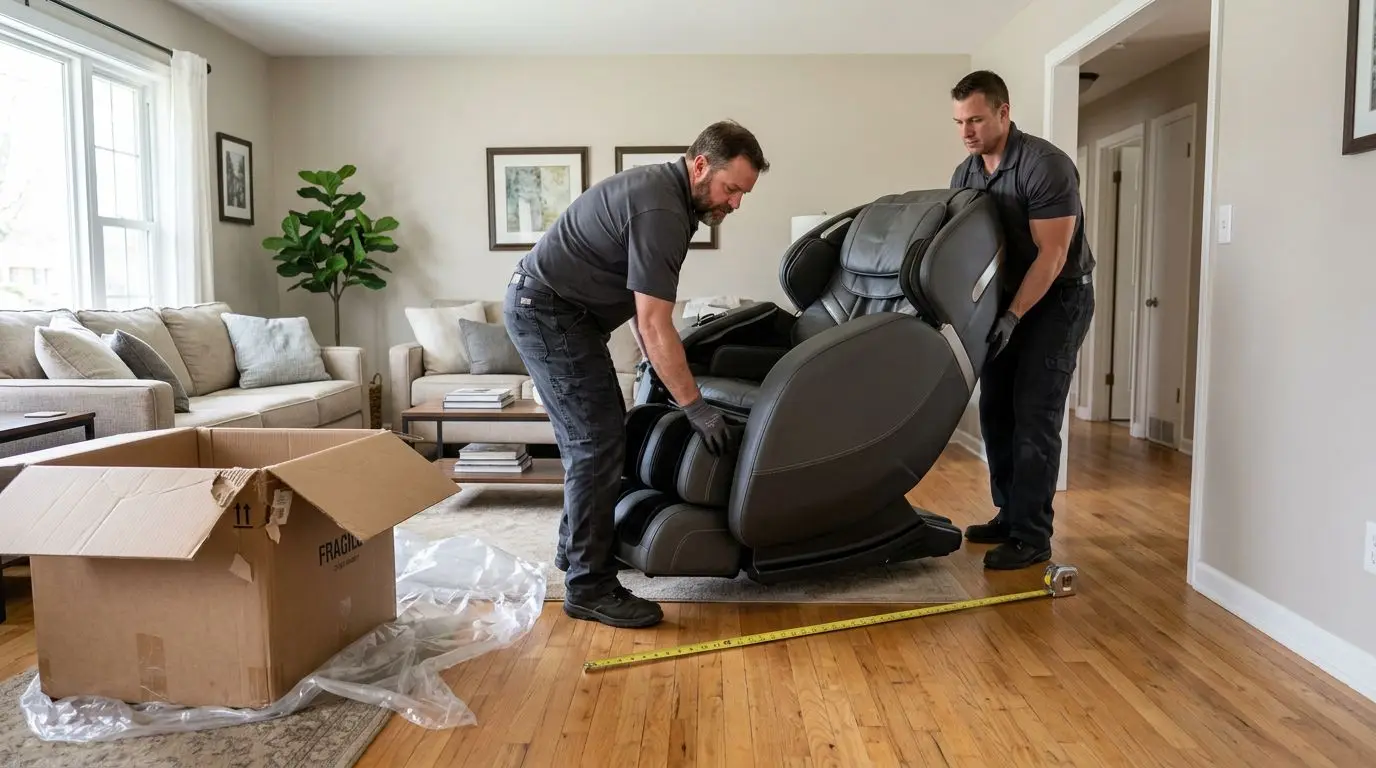
The Hidden Costs of Buying a Massage Chair: Delivery, Setup, Repairs, and Moving
15 min read