Disclosure: We may earn a commission when you buy through links on this page, at no extra cost to you. We buy nothing, sell nothing and accept no payment for coverage — commissions never decide what we recommend. How we make money.
The best home massage chair depends on your space, how much body coverage you want, and whether you need a dedicated chair or a flexible add-on. Full-size chairs provide the most coverage and features, compact chairs give up some reach for easier placement, recliner-style chairs blend more naturally into living rooms, and pad-style massagers are the simplest to store.
Think of the decision less as “which chair is best?” and more as “which format fits my room and habits?” A chair that needs 6 inches of wall clearance may work well in a den, while a foldable pad may be smarter for a small apartment or shared space.
4 main home massage chair types, compared
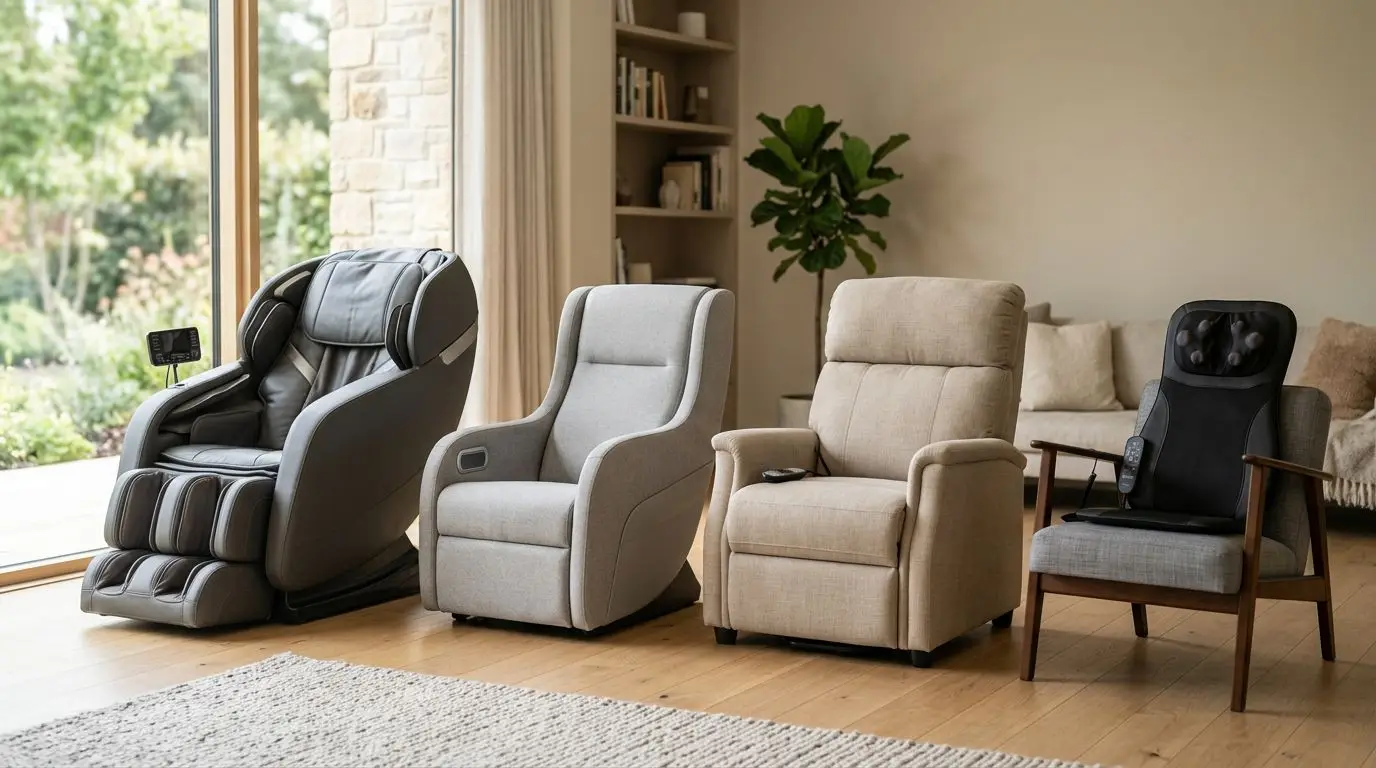
Most home shoppers choose among 4 formats: full-size massage chairs, compact massage chairs, recliner-style massage chairs, and pad-style massagers that sit on an existing chair. They overlap in purpose, but they feel and fit very differently.
A full-size chair is the most purpose-built option. It usually has a tall back, built-in leg and foot sections, powered recline, and a roller track inside the backrest. Some include air-cell compression around the shoulders, arms, calves, or feet. These chairs are meant to stay in one spot and become a regular part of a room.
Compact chairs are still dedicated furniture, but they reduce the footprint, height, or size of the leg section. Some skip enclosed foot massage. Others use a shorter frame or simpler recline system. They can make sense in a bedroom, office, or apartment where a large chair would overwhelm the room.
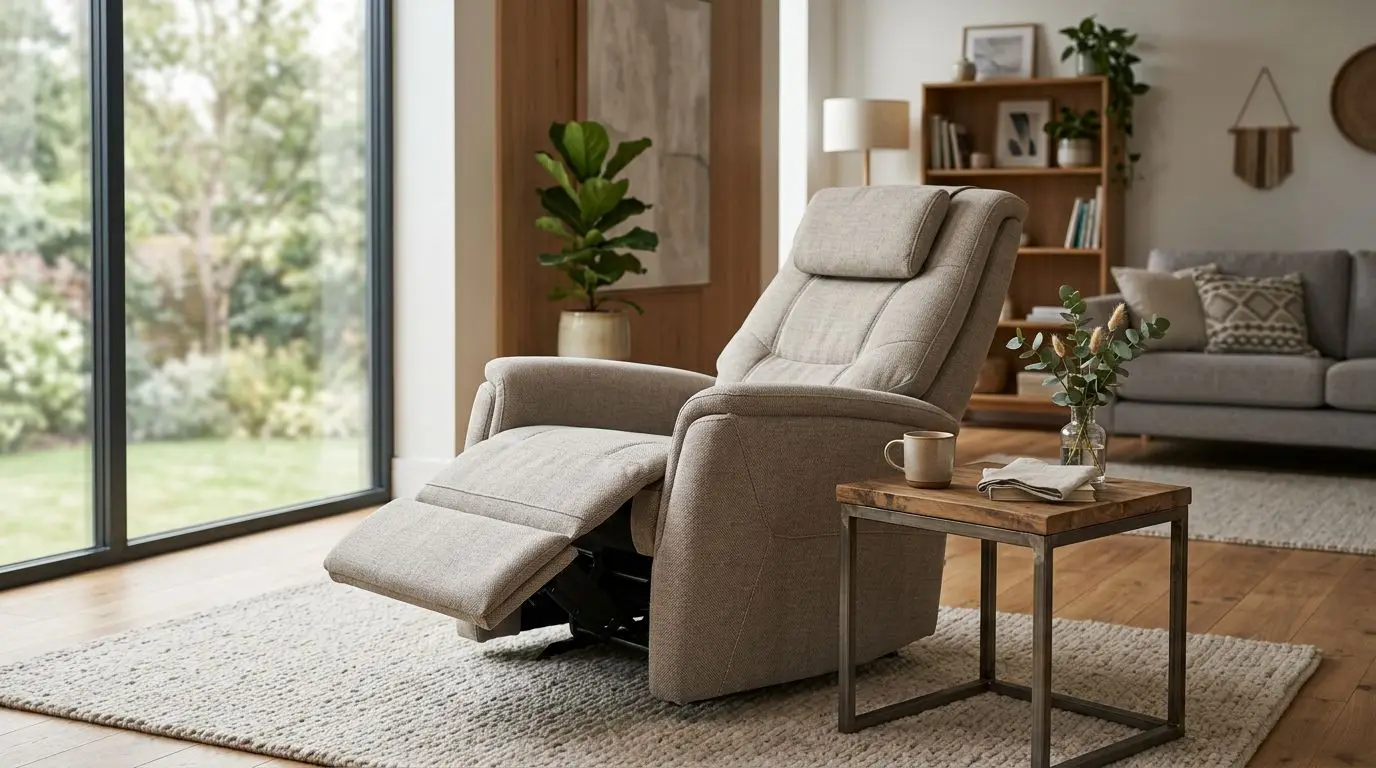
Recliner-style massage chairs look more like conventional living room seating. They may have softer upholstery, less sculpted plastic, and a simpler silhouette. Some use vibration motors rather than a full roller track; others include rollers but keep the design more furniture-like. The tradeoff is that these chairs often favor appearance and everyday comfort over maximum massage coverage.
Pad-style massagers are not chairs at all. They strap onto a dining chair, office chair, sofa, or recliner and usually cover the back, seat, or neck area. They are inexpensive to place, simple to move, and easy to store, but they cannot match the structure, body positioning, or lower-body coverage of a dedicated chair.
| Type | Typical footprint | Coverage | Best home use | Main tradeoff |
|---|---|---|---|---|
| Full-size chair | Often about 30–36 in. wide and 55–75 in. long when reclined | Back, seat, legs, feet depending on features | Dedicated relaxation space | Largest and heaviest |
| Compact chair | Often about 26–32 in. wide | Back and sometimes calves or feet | Apartment, bedroom, home office | Less stretch-out room |
| Recliner-style chair | Similar to a small recliner, often 30–38 in. wide | Varies from vibration only to roller-based back massage | Living room seating that also massages | Features vary widely |
| Pad-style massager | Usually stores flat or folded, often under 20 lb | Back, seat, neck depending on pad | Occasional use and small spaces | No true chair fit or leg section |
Full-size chairs: best for 60–80 inches of usable length
A full-size home massage chair is best for shoppers who want the broadest coverage and have a permanent place for it. When reclined, many full-size chairs need roughly 60 to 80 inches of total usable length, including room for the backrest to move and the leg section to extend.
This format is where you usually find the most advanced track designs. An S-track follows the curve of the spine from the neck area down toward the lower back. An L-track continues under the seat to reach the glute area and upper hamstrings. Some long hybrid tracks are described as SL-tracks because they combine a contoured back path with under-seat travel.
Roller feel matters, too. Two-dimensional rollers generally move up, down, and side to side. Three-dimensional rollers add depth adjustment, so pressure can feel lighter or firmer. Some chairs describe 4D action, which usually means variable rhythm or speed layered onto 3D depth changes. Those labels are not standardized across every maker, so treat them as feature categories rather than guarantees of identical feel.
Full-size chairs may include body scanning, auto programs, heat in the back or legs, foot rollers, calf kneading, arm air cells, speakers, and touchscreen or remote controls. More features do not automatically create a better experience. A simple, well-fitting chair with a pressure level you actually enjoy can be more useful than a complex chair that feels too intense.
Who full-size chairs are best for
- Households with a spare bedroom, den, finished basement, or large living room corner.
- People who want back, seat, calf, and foot coverage in one piece of furniture.
- Shoppers who expect to use the chair several times per week, not just occasionally.
- Homes with a clear delivery path wide enough for a bulky item, often 30 inches or more depending on packaging.
The main caution is commitment. Many full-size chairs weigh 150 to 300 pounds or more. Moving one upstairs, through tight turns, or across delicate flooring takes planning. If you rent, move often, or rearrange rooms frequently, the chair’s weight may matter as much as its features.
Compact chairs: better when width is under 32 inches
Compact massage chairs are designed for homes where a full-size chair feels too imposing. Many are around 26 to 32 inches wide, which can be the difference between fitting beside a bed and blocking a walkway.
These chairs vary more than many shoppers expect. Some are scaled-down versions of full-size chairs with a shorter leg rest. Others are upright chairs with a massage back and no extended foot section. A few focus mainly on the back and seat, using a smaller track and fewer air cells to keep the footprint down.
The advantage is placement flexibility. A compact chair can work in a home office where a full recliner would look out of place. It can also fit in a bedroom corner, guest room, or reading nook. If the chair has a wall-hugging recline mechanism, it may need only a few inches behind it, but you still need space in front for the footrest or your legs.
There is a comfort tradeoff. Taller users may feel that the shoulder rollers do not reach high enough or that the calf section lands in the wrong place. People with broader shoulders may find the side panels or arm sections snug. If possible, compare the chair’s stated height range with the users in your household and leave room for everyday movement around it.
Who compact chairs are best for
- Apartment dwellers who can dedicate one corner but not a whole room.
- Home office users who want a separate relaxation chair near a desk.
- Shorter to average-height users who fit within the chair’s stated size range.
- Shoppers who want rollers but can skip a large enclosed foot section.
Compact does not always mean light. Some still weigh over 100 pounds, and the shape can be awkward. Measure doorways, stair turns, and elevator openings before assuming it will be easy to bring inside.
Recliner-style chairs: ideal when one seat has to do 2 jobs
A recliner-style massage chair is a practical middle ground when the same seat needs to look acceptable in a living room and offer massage functions. In many homes, that means one chair has to serve 2 jobs: everyday seating and occasional massage.
The first thing to check is the massage mechanism. Some recliner-style options use vibration motors in the back, seat, or legs. Vibration can feel pleasant and low-key, but it is not the same as roller kneading. Other recliner-style chairs include a back roller track, which gives more targeted moving pressure along the back.
Recliner-style chairs are often more approachable for people who dislike the cockpit feel of a large massage chair. They may have padded arms, a simpler footrest, and upholstery that coordinates with other furniture. They can also be easier for guests to use as normal seating when the massage functions are off.
The tradeoff is inconsistency. Two chairs that both look like recliners can have completely different internal systems. One may offer only basic vibration and heat, while another may include rollers, air compression, and a powered recline. Read the mechanism description carefully instead of relying on the word recliner.
Who recliner-style chairs are best for
- Living rooms where appearance matters as much as feature depth.
- Shoppers who want one comfortable seat for TV, reading, and short massage sessions.
- People who prefer a less enclosed chair shape.
- Homes where guests may use the chair as ordinary seating.
Look closely at seat height as well. A seat height around 18 to 20 inches is familiar for many adults, but very low or very deep recliners can be harder to enter and exit. If multiple family members will use the chair, the simplest-looking option may be the most livable.
Pad-style massagers: the easiest option under 20 pounds
Pad-style massagers are best when space, storage, or budget matters more than full-body coverage. Many weigh less than 20 pounds, and some can be moved from an office chair to a sofa in under a minute.
A pad usually includes a back section with rotating nodes, vibration zones, or both. Some add a seat cushion with vibration. Others include a neck section that can be adjusted up or down a few inches. The feel depends heavily on the chair underneath it. A firm dining chair will make pressure feel more direct, while a soft sofa may absorb some of the movement.
This format is useful for renters, dorm rooms, small apartments, and people who do not want another piece of furniture. It also works well for shoppers who are not sure how often they will use massage at home. If the habit sticks, a pad can help clarify whether a larger chair is worth the space.
The limitations are clear. A pad cannot position your body the way a dedicated recliner can. It usually does not include a true leg or foot system, and the rollers may not line up perfectly with every user. You also need a stable chair with a back tall enough to support the pad safely.
Who pad-style massagers are best for
- Small apartments, shared homes, dorms, and multipurpose rooms.
- People who want something they can store in a closet.
- Occasional users who prefer 10- to 20-minute sessions.
- Shoppers testing whether home massage fits their routine.
Do not use a pad on a chair that rocks, tips easily, or has a weak back. The safest setup is stable, flat, and matched to the pad’s straps or placement design.
How to measure your room in 5 steps
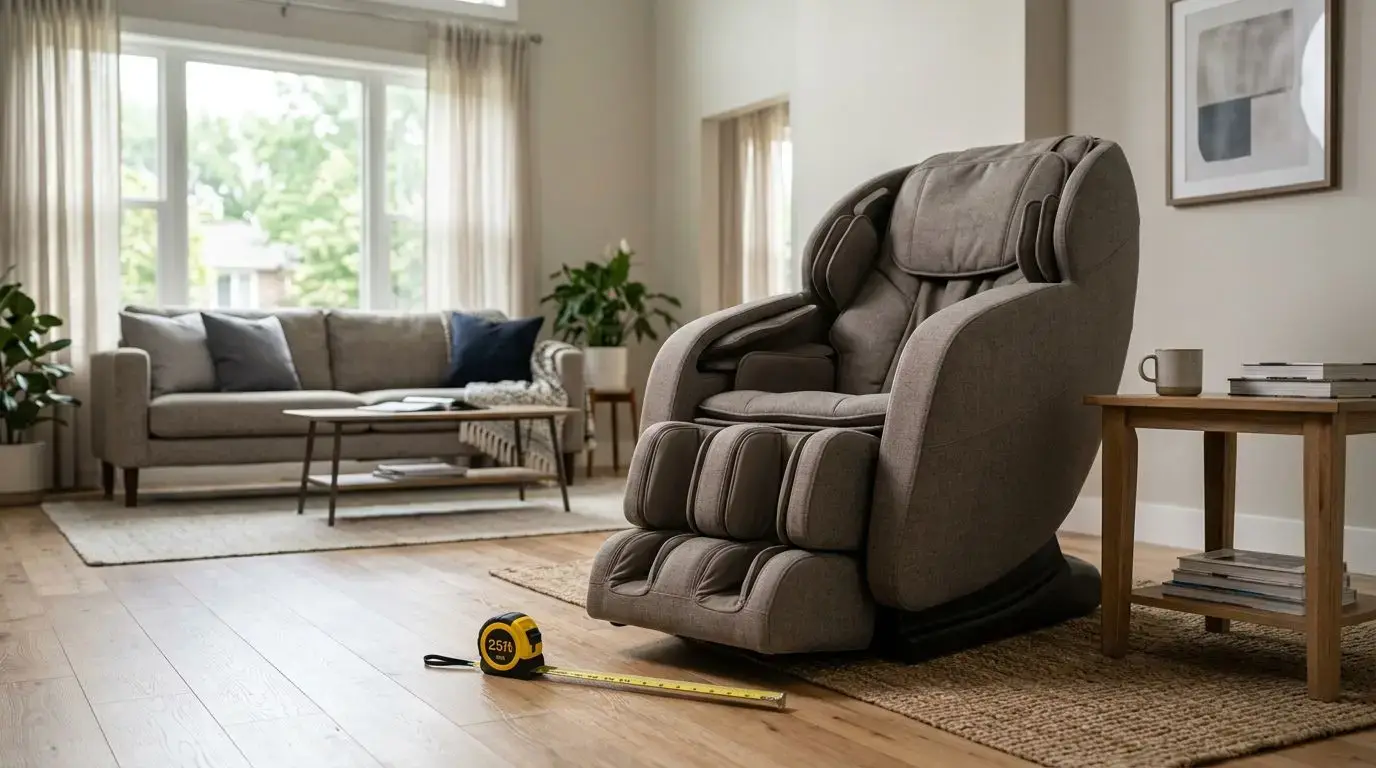
Before comparing features, measure the room. A chair that technically fits can still be frustrating if it blocks a closet door, walkway, outlet, or window. Set aside 10 minutes with a tape measure and map the chair as if it were already delivered.
- Measure width. Add at least 3 inches on each side for hand clearance, remote access, and cleaning.
- Measure reclined length. Check the chair’s fully reclined depth, not just its upright depth. Many chairs gain 15 to 30 inches when extended.
- Check rear clearance. Some wall-hugging designs need about 2 to 6 inches behind them; others need much more.
- Check front clearance. Leave room for the footrest and for a person to walk around it without stepping over the base.
- Confirm delivery path. Measure the narrowest doorway, hallway turn, stair landing, or elevator opening between the entrance and the room.
Use painter’s tape on the floor to mark the chair’s footprint. Then tape the reclined footprint. This simple test catches problems that specification sheets do not show, such as a chair colliding with a nightstand or forcing a walkway below 24 inches.
Also consider flooring. Heavy chairs can leave impressions in carpet and may scratch wood or vinyl if dragged. A sturdy mat or furniture sliders can help distribute weight, but the best protection is placing the chair correctly the first time.
Feature fit: 6 functions that change the feel
Once you know which type fits your room, focus on features that change the feel of the session. These 6 functions are more useful to compare than long lists of minor extras.
| Feature | What it changes | Who may prefer it | Watch for |
|---|---|---|---|
| S-track | Roller path follows the back curve | Users focused on neck-to-lower-back coverage | May stop before the seat |
| L-track or SL-track | Rollers continue under the seat | Users wanting back and glute coverage | Can feel firm in the seat area |
| 3D roller depth | Adjusts pressure in and out | Households with different intensity preferences | Lowest setting may still feel strong on some chairs |
| Air compression | Inflatable cells squeeze arms, calves, feet, or shoulders | People who like a held, wrapped sensation | Fit can be tight for larger limbs |
| Heat | Adds localized warmth | Users who enjoy a warm back or calves | Warmth level and location vary |
| Zero-gravity recline | Tilts the body with legs elevated | People who like a reclined, weight-distributed position | Needs enough recline space |
Zero-gravity is a positioning term, not a promise of a specific sensation. In home chairs, it usually means the back reclines and the legs rise so body weight feels more evenly supported. Some people love that posture; others prefer a more upright seat for reading or TV.
Auto programs are convenient, but manual controls matter. A good home setup should let you adjust area, intensity, recline, and session time without fighting the remote. Many default sessions run about 10 to 20 minutes, which is enough for most casual use.
Safety checks: ask a physician in these 8 situations
Massage chairs are consumer wellness products, not medical devices. They are designed to provide pressure, motion, warmth, and a relaxing seating experience; they should not be used as a substitute for medical advice.
Ask your physician before using a massage chair, pad, heat function, strong compression, or deep roller setting if any of these apply to you: pregnancy, a pacemaker or other implanted cardiac device, a history of blood clots or use of anticoagulants, osteoporosis, recent fracture, recent surgery, spinal disc problems, neuropathy, or uncontrolled hypertension. If a chair’s manual lists additional restrictions, follow those as well.
Start conservatively. Use the lowest intensity, avoid very long first sessions, and stop if the pressure feels sharp, pinching, dizzying, or uncomfortable. Children should not use powered massage furniture without close adult supervision, and pets should be kept away from moving footrests and reclining mechanisms.
Fit is part of safety. If your shoulders, calves, or feet do not land where the chair expects them to, the pressure can feel awkward. A chair that fits a 5 ft 4 in user may not fit a 6 ft 3 in user the same way, even if both are within a broad stated range.
Best use cases by home setup: 5 common scenarios
Different homes point toward different formats. These 5 practical scenarios can narrow the choice without turning it into a brand-by-brand shopping list.
Small apartment under 800 square feet
Start with a pad-style massager or a compact chair. A full-size chair can work only if you have a dedicated corner and a delivery path that supports it. Storage and walkway clearance matter more than feature count.
Finished basement or spare room
A full-size chair makes sense if the room can spare 6 feet or more of reclined length. This is the easiest setting for a larger chair because it does not have to blend with primary living room furniture.
Living room with shared seating
Consider a recliner-style chair. It gives you everyday seating first, massage functions second. Make sure the mechanism is what you expect, especially if you want rollers rather than vibration.
Home office or reading nook
A compact chair often fits best. Look for a moderate footprint, quiet operation, and controls that are easy to use between work sessions or while reading.
Multi-user household
Prioritize adjustability. A chair with body scanning, manual roller positioning, several intensity levels, and a clear height range is easier to share among 2 or more adults with different preferences.
If you are split between two formats, choose the one that fits your room and routine with the least friction. The chair you can place comfortably, reach easily, and use for 15 minutes without rearranging furniture is usually the better home choice.
5 home massage chair FAQs
How much space do I need for a home massage chair?
For many full-size chairs, plan for roughly 30 to 36 inches of width and 60 to 80 inches of usable length when reclined. Compact and recliner-style chairs may need less, while pad-style options need only a stable chair underneath. Always measure the fully reclined depth, not just the upright footprint.
Is a compact massage chair less effective than a full-size chair?
It is not automatically less useful, but it usually provides less coverage. A compact chair may be excellent for back-focused sessions in a tight room, while a full-size chair is better if you want built-in calf and foot sections, a longer track, and a more enclosed reclined position.
What is the difference between a massage chair and a massage pad?
A massage chair is dedicated furniture with its own frame, recline angle, and built-in mechanisms. A pad attaches to or rests on an existing chair. Pads are easier to store and move, but they depend on the chair underneath and typically offer less body coverage.
Do I need an L-track or SL-track at home?
You may prefer an L-track or SL-track if you want rollers to continue below the lower back and into the seat area. If you mostly want neck, mid-back, and lower-back coverage, an S-track may be enough. Track length is only one factor; roller intensity and chair fit matter just as much.
Can a massage chair go on hardwood or carpet?
Yes, but protect the floor and avoid dragging the chair. Heavy chairs can mark carpet and may scratch hard flooring if moved carelessly. Use a sturdy mat or furniture glides where appropriate, and place the chair where it will not need frequent repositioning.
Frequently asked questions
How much space do I need for a home massage chair? +
For many full-size chairs, plan for roughly 30 to 36 inches of width and 60 to 80 inches of usable length when reclined. Compact and recliner-style chairs may need less, while pad-style options need only a stable chair underneath. Always measure the fully reclined depth, not just the upright footprint.
Is a compact massage chair less effective than a full-size chair? +
It is not automatically less useful, but it usually provides less coverage. A compact chair may be excellent for back-focused sessions in a tight room, while a full-size chair is better if you want built-in calf and foot sections, a longer track, and a more enclosed reclined position.
What is the difference between a massage chair and a massage pad? +
A massage chair is dedicated furniture with its own frame, recline angle, and built-in mechanisms. A pad attaches to or rests on an existing chair. Pads are easier to store and move, but they depend on the chair underneath and typically offer less body coverage.
Do I need an L-track or SL-track at home? +
You may prefer an L-track or SL-track if you want rollers to continue below the lower back and into the seat area. If you mostly want neck, mid-back, and lower-back coverage, an S-track may be enough. Track length is only one factor; roller intensity and chair fit matter just as much.
Can a massage chair go on hardwood or carpet? +
Yes, but protect the floor and avoid dragging the chair. Heavy chairs can mark carpet and may scratch hard flooring if moved carelessly. Use a sturdy mat or furniture glides where appropriate, and place the chair where it will not need frequent repositioning.
Related guides
How to Choose a Massage Chair for Home Use
14 min read
Massage Chair vs. Massage Recliner: Which Seating Option Fits Your Comfort and Relief Goals?
10 min read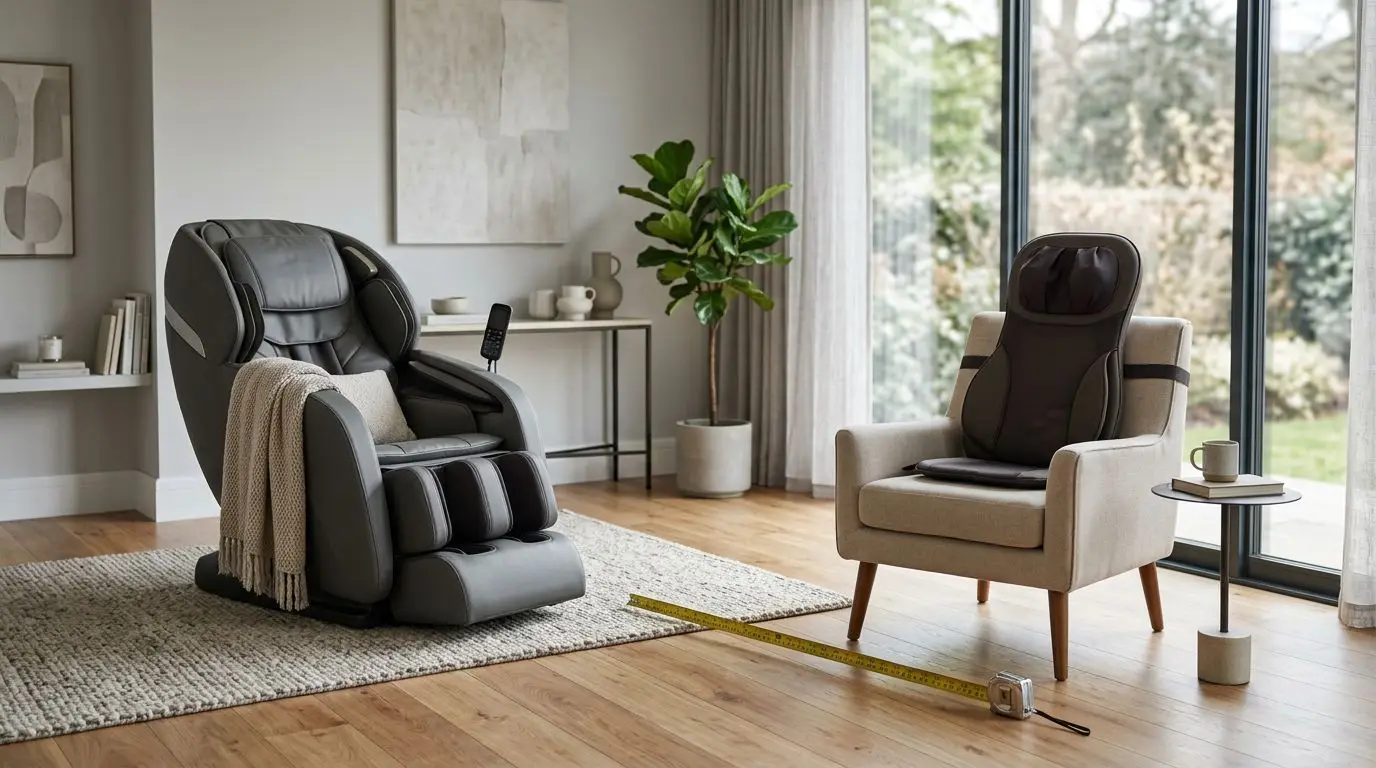
Full-Size Massage Chair vs. Portable Massage Pad: Comfort, Coverage, Cost, and Space Compared
15 min read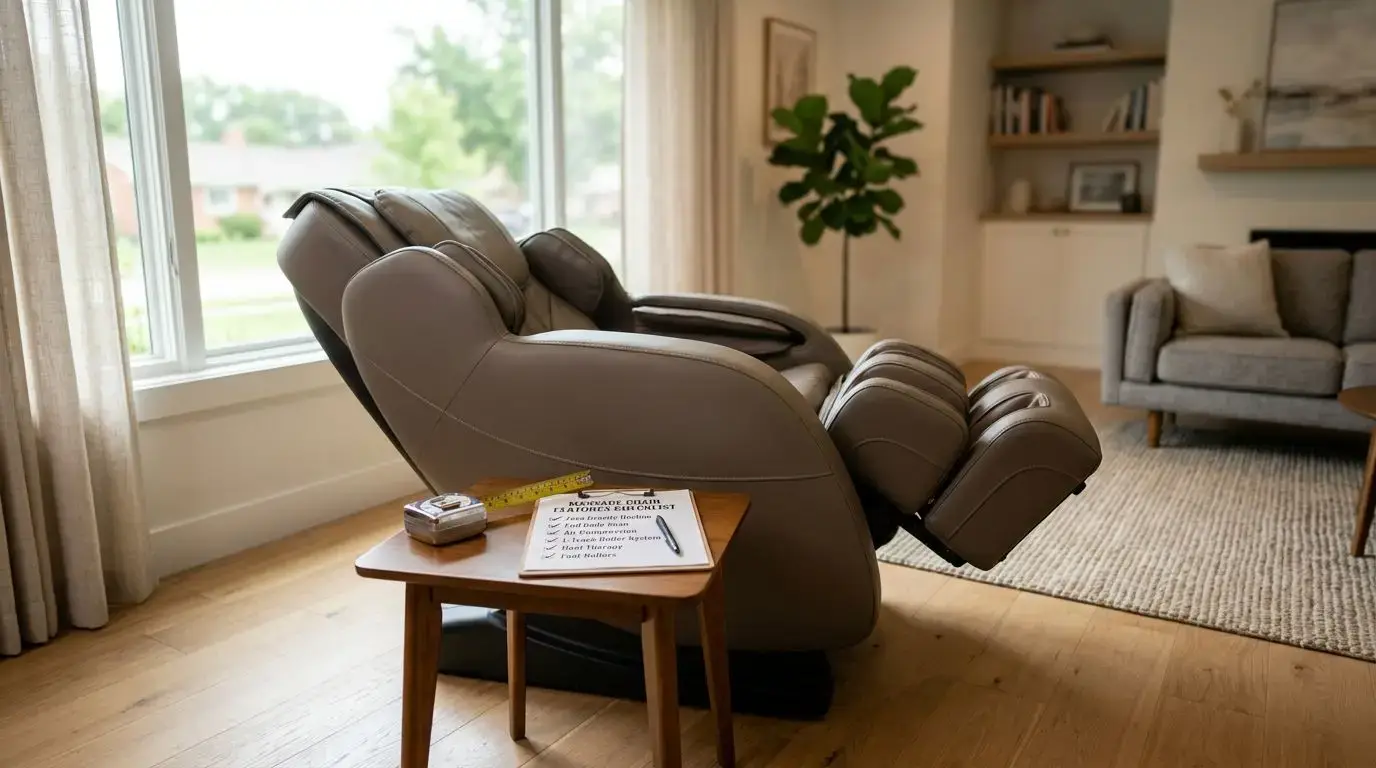
Best Massage Chair Features to Look For Before You Buy
13 min read
Office Massage Chairs vs. Home Massage Chairs: Key Differences Before You Buy
13 min read