Disclosure: We may earn a commission when you buy through links on this page, at no extra cost to you. We buy nothing, sell nothing and accept no payment for coverage — commissions never decide what we recommend. How we make money.
Car massage seats work best for light, portable vibration and gentle heat during parked breaks. Home massage chairs are better for deeper, more consistent full-body massage at home. If you want travel-friendly comfort, a plug-in vehicle seat pad can help during short sessions, but it should not be treated as a replacement for a true massage chair or used in any way that distracts from driving.
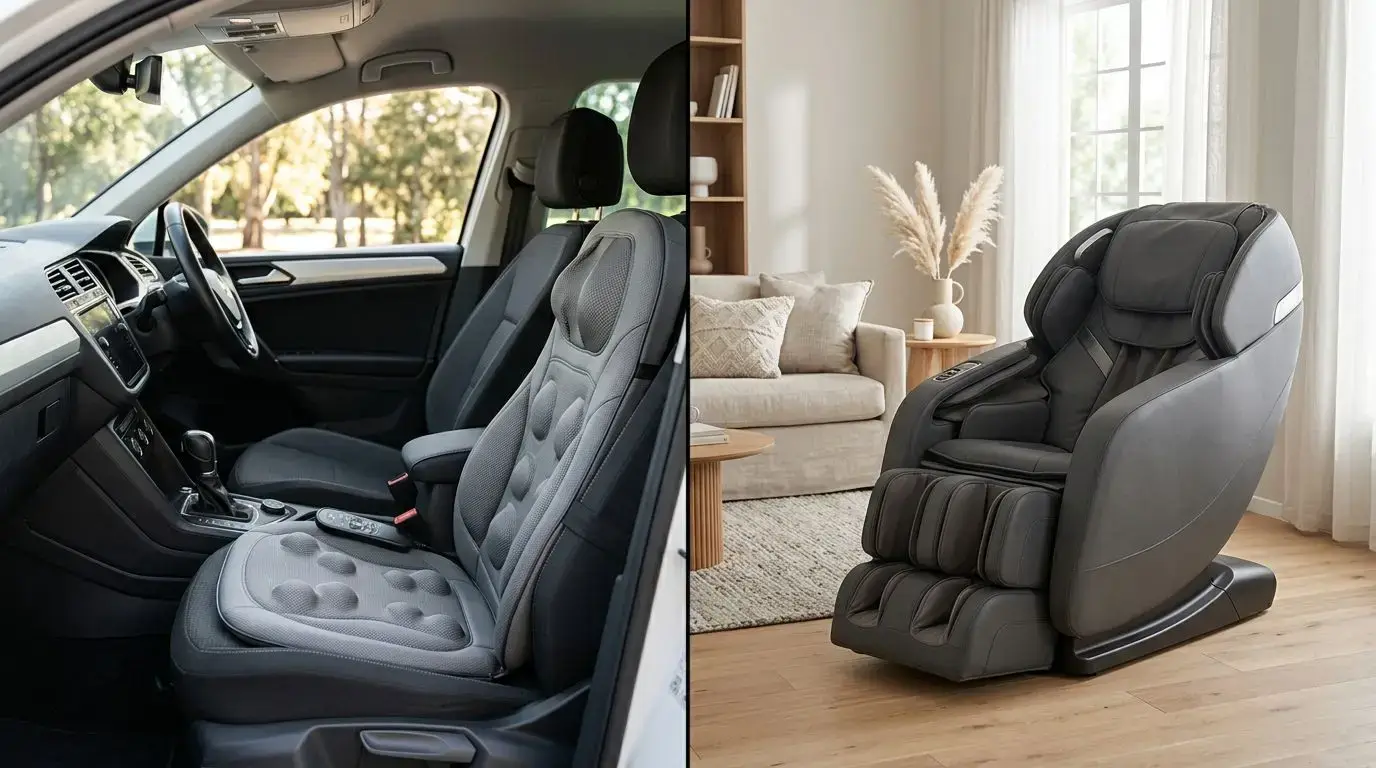
The biggest differences are hardware, body coverage, and safety context. A vehicle massage seat usually runs on 12-volt power and rests on top of an existing car seat. A home massage chair is dedicated furniture with rollers, tracks, airbags, recline systems, and a higher weight capacity.
Quick comparison: 12-volt seat pad vs. full-size chair
A typical car massage seat is a thin cushion that plugs into a vehicle outlet, often with vibration motors and a small heat panel. A home massage chair is much larger, commonly weighing well over 150 lb and using a standard household outlet. That size difference is not just cosmetic. It changes pressure, body positioning, stability, and how much of your body the unit can reach.
Many vehicle pads are marketed as portable because they can be carried between a car, office chair, or hotel room if they include the right adapter. Home chairs are not portable in the same way. Once placed in a room, they usually stay there, and some need several inches of wall clearance unless they have a space-saving recline design.
| Category | Plug-in vehicle massage seat | Home massage chair |
|---|---|---|
| Typical power | 12-volt vehicle outlet, sometimes household adapter | Standard home outlet |
| Massage mechanism | Usually vibration, sometimes heat | Rollers, tracks, airbags, heat, recline, foot/calf systems |
| Body coverage | Back and seat area, limited neck or thigh support | Neck, back, glutes, calves, feet depending on design |
| Session length | Commonly 10 to 20 minutes | Commonly 10 to 30 minutes |
| Portability | High; can fit in a trunk or back seat | Low; furniture-sized and heavy |
| Best use | Parked breaks, travel comfort, light relaxation | Regular at-home massage routine |
Neither type is automatically better for everyone. The right choice depends on whether portability matters more than massage depth, and whether you need occasional comfort or a predictable daily wellness routine.
Comfort: what the hardware can and cannot do
Comfort starts with mechanics. Most car massage seats use small vibration motors placed in zones such as the upper back, lower back, hips, or thighs. Vibration can feel pleasant, especially during a 10-minute break, but it does not knead muscle tissue the way moving rollers do. If you expect a car pad to replicate a hands-on massage, you will probably be disappointed.
Home massage chairs use more substantial mechanisms. A basic roller chair may move up and down the back on a straight track. More advanced designs use longer tracks that may extend from the neck area down toward the glutes. In general terms, S-track chairs follow the curve of the spine, L-track chairs extend under the seat, and SL-track chairs combine a curved spinal path with longer glute coverage. Track lengths vary, but full-back systems are often in the 28- to 50-inch range depending on chair style.
That added structure creates steadier contact. A roller can press, knead, tap, and move along the back. Airbags can compress the shoulders, arms, calves, or feet. Foot rollers, when included, add pressure under the soles. These parts make a home chair feel more complete, but also more intense. For sensitive users, that may be too much unless the chair offers multiple intensity levels.
A vehicle pad has a different comfort profile. It is thin enough to sit on an existing seat, so it must work around the shape of the car seat, headrest, bolsters, and your driving posture. A thick cushion can change how your hips sit in the seat or how your shoulders contact the seatback. That can feel awkward if the pad is not secured tightly. Home chairs avoid this because the whole chair is designed around the massage system.
Safety in a vehicle: the 10-minute parked-break rule
Safety is where the comparison becomes less subjective. A massage seat in a car should be treated as a comfort accessory for parked use, not an active driving aid. Even light vibration can pull attention away from the road, and heat can make some people drowsy. If you use a vehicle massage seat, the safest habit is simple: use it when the vehicle is parked, limit the session to about 10 to 15 minutes, then turn it off before driving.
Fit matters too. Nothing added to a vehicle seat should interfere with the seat belt, head restraint, side airbags, seat controls, or your ability to sit fully back in the seat. Some vehicles have side-impact airbags built into the seatback. A thick pad or poorly routed strap may be a problem if it covers areas meant to deploy or flex. Because vehicle interiors vary, check the car owner manual and the accessory instructions before installing any seat pad.
Heat deserves extra caution. Many massage pads include a warming function, but sensation can be reduced if you have nerve issues, circulation problems, or take medication that affects alertness. Avoid falling asleep on a heated pad in a vehicle. Use a timer if the pad has one, and do not place blankets or heavy layers between the heat source and your body unless the instructions allow it.
Home chairs have safety considerations as well. They are not toys, and moving footrests, reclining backs, and airbags can pinch if a child or pet gets too close. A practical rule is to leave at least 2 to 3 ft of clear space around moving parts while someone is using the chair. Users with implanted medical devices, recent surgery, pregnancy, osteoporosis, blood clot concerns, or significant pain should ask a clinician before using strong massage or heat.
Who each option is best for: 3 common user profiles
A car massage seat is best for someone who wants occasional, low-intensity comfort and values portability. Think of a commuter taking a 15-minute break in a parking lot before work, a road-trip passenger relaxing at a rest stop, or a traveler who wants one accessory that can move from vehicle to guest room. The appeal is convenience, not deep tissue-style pressure.
A home massage chair is better for someone who wants a repeatable routine several days a week. It suits users who prefer reclined positioning, broader body coverage, and more control over massage style. If you want back rollers, calf compression, foot rollers, body scanning, or preset programs, a seat pad will not provide the same experience.
There is also a middle ground: people in apartments, small homes, or shared spaces. A vehicle pad or portable massage cushion may make sense if you have no room for a full chair. Many home massage chairs need a footprint roughly comparable to a recliner, and some require doorways wide enough for large furniture delivery. If floor space is under 30 sq ft in the intended area, measure carefully before assuming a chair will fit comfortably.
| User need | Better fit | Why |
|---|---|---|
| Travel-friendly comfort | Vehicle massage seat | Lightweight, easy to store, uses car power |
| Daily full-back massage | Home massage chair | Rollers and track provide more consistent coverage |
| Small budget and minimal space | Vehicle massage seat | Less furniture commitment and easier storage |
| Foot and calf massage | Home massage chair | Dedicated lower-body systems are common in full chairs |
| Sensitive users | Either, with caution | Choose low intensity, short sessions, and easy controls |
If you are buying for an older adult, keep the controls simple. Large buttons, auto shutoff, and clearly labeled heat settings matter more than a long list of modes. A complex remote can reduce real-world use.
How to choose and measure before you buy
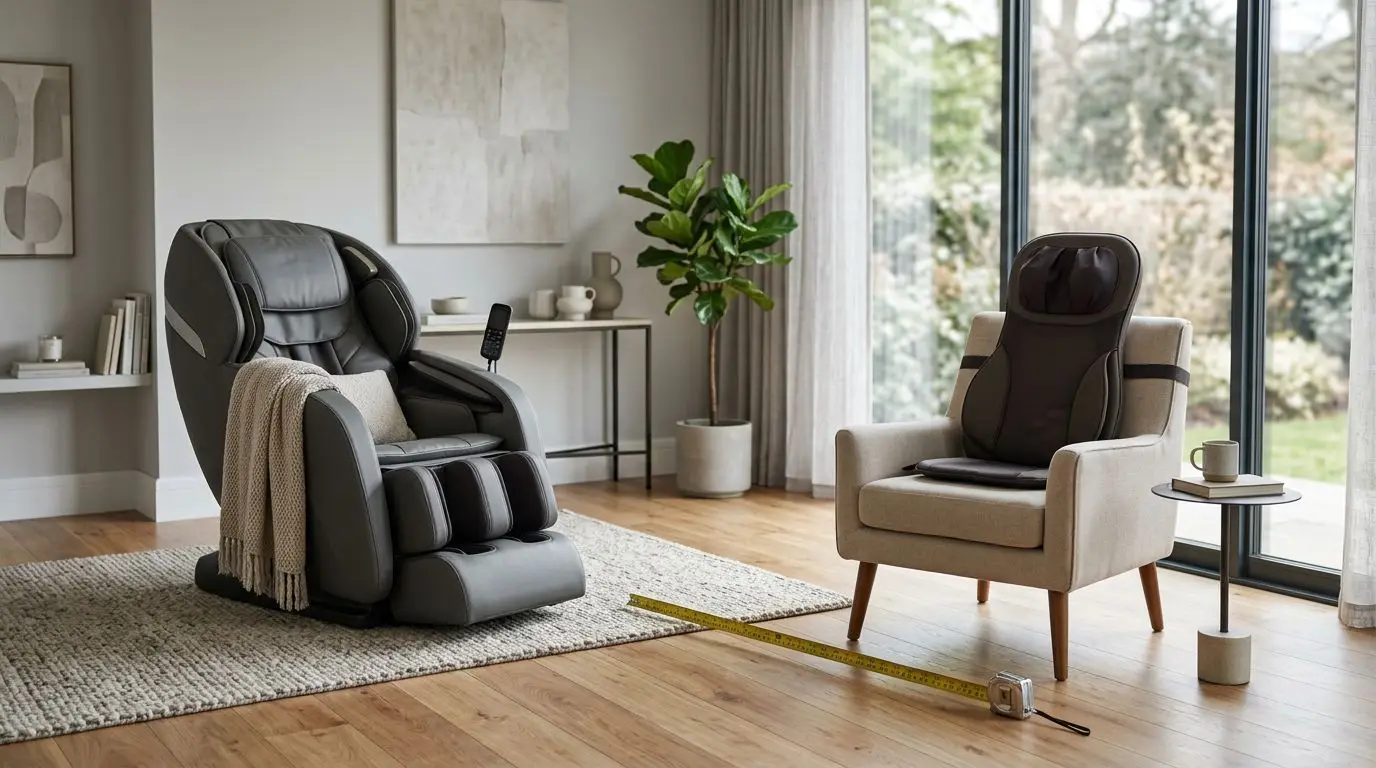
Start with the place you will actually use the product. For a car massage seat, measure the vehicle seatback from the seat crease to the top of the shoulder area, then measure the seat width between bolsters. Many car seats are narrower than they look, often around 18 to 22 inches across the usable seating surface. A pad that is too wide may bunch at the sides; one that is too tall may push your head forward.
Check attachment points. A pad should stay flat without sliding under you when you enter or exit the vehicle. Straps should not cross airbag seams or interfere with seat belt routing. The power cord should reach the outlet without hanging near pedals, gear selectors, or seat tracks. A loose cord in the driver footwell is a real hazard.
For a home massage chair, measure the room in three states: upright, fully reclined, and with the footrest extended. Some chairs recline to nearly the length of a small sofa when in use. Note the wall clearance requirement, doorway width, hallway turns, stair access, and ceiling height if the chair arrives in a large box. Also compare the chair user-height range and weight rating with the people who will use it. Do not assume one size fits all.
- For vehicle pads: confirm 12-volt compatibility, cord routing, seat-belt clearance, heat controls, auto shutoff, and return policy.
- For home chairs: compare track type, user height range, weight rating, recline clearance, program length, intensity settings, and warranty terms.
- For shared households: prioritize adjustable intensity and manual zone control so one user can choose gentle vibration while another uses stronger kneading.
Noise is worth considering. A vibration pad can buzz through a quiet car interior. A home chair can make roller, air pump, and footrest sounds. If you plan to use either option during a call, while watching TV, or near a sleeping child, look for owner comments about quiet operation instead of relying on vague marketing language.
Feature trade-offs: 6 functions that matter in real life
Feature lists can be long, but a few functions affect daily satisfaction more than the rest. A 20-mode vehicle pad is not automatically more comfortable than a simple one if all 20 modes are variations of buzzing. Likewise, a home chair with many preset programs is less useful if the roller intensity is uncomfortable and cannot be adjusted.
| Feature | In a vehicle massage seat | In a home massage chair | Why it matters |
|---|---|---|---|
| Heat | Usually localized, often lower back or seat | May cover back, calves, or feet depending on design | Can feel soothing, but should be timer-controlled |
| Rollers | Uncommon in thin car pads | Core feature in most true chairs | Creates kneading and tracking pressure |
| Air compression | Rare or very limited | Common in shoulders, arms, calves, feet | Adds squeezing sensation and body hold |
| Recline | Depends on vehicle seat, not pad | Built into the chair | Changes pressure distribution and comfort |
| Auto programs | Usually short vibration cycles | May target relax, stretch, back, or recovery-style routines | Simplifies repeat use |
| Portability | Often the main advantage | Limited after setup | Important for travel and storage |
For many shoppers, the most useful feature is not the fanciest one. It is control. Look for the ability to turn heat off separately, choose a lower intensity, stop a specific zone, and end a session quickly. This is especially important in a vehicle, where the product should never compete with safe vehicle operation.
Realistic expectations for soreness, stress, and recovery
Massage chairs and seat pads can support relaxation, temporary comfort, and a more pleasant routine. They should not be presented as cures for back pain, circulation problems, injuries, or sleep disorders. If your pain is sharp, spreading, associated with numbness, or lasting more than a few days, treat that as a medical question rather than a shopping problem.
For general stiffness, short and consistent sessions usually beat long, aggressive ones. Start with 5 to 10 minutes on the lowest setting, especially if you are new to massage devices. If you feel fine later that day and the next morning, you can slowly increase duration. Many people do best with 10 to 20 minutes, a few times per week, instead of maximum intensity every night.
Home chairs may create more next-day tenderness because rollers apply concentrated pressure. That does not mean the chair is working better. It may mean the intensity is too high, the roller is hitting a sensitive area, or the session is too long. Use padding, reduce intensity, skip bony areas, or choose a gentler program if discomfort lingers.
Vehicle pads are less likely to deliver deep pressure, but they can still cause irritation if used too long or with heat that is too warm. Pay attention to skin redness, tingling, lightheadedness, or drowsiness. Stop use if anything feels off.
Bottom line: choose portability or performance first
If you need something that can travel in a car and provide light comfort during parked breaks, a plug-in vehicle massage seat is the practical choice. It is easier to store, easier to move, and usually simpler for short sessions. Its limits are just as clear: most pads vibrate more than they massage, and they cannot offer the body positioning or roller coverage of a true chair.
If you want a reliable home routine with stronger back work, longer track coverage, recline, and possible calf or foot massage, a home massage chair is the better category. Measure your room, check user fit, and choose adjustability over novelty features. The safest purchase is the one that matches your actual use pattern, not the one with the longest feature list.
FAQs: 5 common questions about car massage seats and home chairs
Can I use a car massage seat while driving?
It is safer not to. Use it only when parked, ideally for 10 to 15 minutes, then turn it off before driving. Vibration, heat, cords, and controls can all become distractions.
Do car massage seats really massage, or do they just vibrate?
Most vehicle seat pads primarily vibrate. Some may include heat or moving parts, but they usually do not provide the same kneading roller action found in full-size home massage chairs.
Will a massage seat affect my car seat airbags?
It can, depending on the vehicle and how the pad attaches. Avoid covering airbag seams or routing straps across deployment areas, and check the vehicle manual before use.
How much space does a home massage chair need?
Plan for recliner-sized floor space plus room for full recline and footrest extension. Some chairs need only a few inches behind them, while others require much more, so measure the chair upright and reclined before delivery.
Which is better for back stiffness after travel?
For quick relief during a trip, a portable pad may be convenient. For deeper, more controlled back massage after you get home, a full-size chair usually offers better coverage and adjustability.
Frequently asked questions
Can I use a car massage seat while driving? +
It is safer not to. Use a car massage seat only while parked, ideally for a short 10- to 15-minute break, then turn it off before driving.
Do car massage seats really massage? +
Most car massage seats use vibration motors and heat rather than true kneading rollers. They can feel relaxing, but they do not match the pressure or coverage of a full-size home massage chair.
Are home massage chairs better for back stiffness? +
They usually provide better back coverage because they use rollers and tracks, but intensity should be adjustable. Start with short, gentle sessions and avoid treating persistent pain as a product problem.
Can a massage pad interfere with vehicle safety features? +
Yes, it can if it blocks seat belts, side-airbag areas, head restraints, seat controls, or safe posture. Check your vehicle manual and route straps and cords carefully.
What should I measure before buying a massage chair or seat pad? +
For a vehicle pad, measure seat width, seatback height, strap routing, and cord reach. For a home chair, measure floor space, doorway width, recline clearance, and the intended users' height and weight fit.
Related guides
Massage Chair Pad, Cushion, or Full-Size Chair: Which Type Should You Choose?
15 min read
Heated Massage Chair vs. Heating Pad: Which Is Better for Sore Muscles?
14 min read
How to Choose a Massage Chair for Home Use
14 min read
Massage Chair vs. Heat Pad, TENS Unit, or Stretching Routine: Which At-Home Option Fits Your Goal?
13 min read
Office Massage Chairs vs. Home Massage Chairs: Key Differences Before You Buy
13 min read