Disclosure: We may earn a commission when you buy through links on this page, at no extra cost to you. We buy nothing, sell nothing and accept no payment for coverage — commissions never decide what we recommend. How we make money.
A heating pad is usually the better first choice when you want simple, targeted warmth on one sore-feeling area for 15 to 30 minutes. A heated massage chair is better when you want full-back or full-body coverage, mechanical kneading or rolling pressure, and a repeatable seated routine without holding a pad in place. The right choice depends on coverage, intensity, safety, space, and budget.
Both products are consumer wellness tools, not medical devices. They are made to feel warm, comfortable, and relaxing, but they should not replace medical advice. If your soreness is new, severe, one-sided, related to an injury, or comes with numbness, swelling, weakness, chest symptoms, fever, or unexplained pain, check with a physician before using heat or mechanical massage.
Quick verdict: 1 sore spot or a 30-minute full-back routine?
Choose a heating pad when the job is specific: one shoulder, the low back, the upper traps, or a tight-feeling thigh. Most standard pads cover roughly 12 by 15 inches, while larger wrap-style pads may cover more of the back or neck area. They are easy to store, easy to move, and usually provide direct heat without rollers, airbags, or vibration.
Choose a heated massage chair when you want a seated routine that covers more of the body. Depending on the chair type, a track may run from the neck area to the low back, or from the neck down through the glutes and upper hamstrings. Many chairs also add calf, foot, arm, or shoulder airbags, so the sensation is broader than a single pad.
The simplest rule is this: if you keep moving a heating pad around to cover 3 or more areas, a chair may make more sense for comfort and convenience. If you use heat only occasionally on one area, a pad is usually enough.
| Need | Heating pad | Heated massage chair |
|---|---|---|
| Target area | Best for 1 small to medium area | Best for back plus legs, hips, arms, or feet depending on design |
| Typical session | 15 to 30 minutes | 10 to 30 minutes depending on program |
| Sensation | Warmth only, unless it has vibration | Warmth plus rolling, kneading, tapping, compression, or foot rollers |
| Setup | Plug in, place, and adjust | Sit down, select a program, adjust intensity |
| Space | Fits in a drawer | Requires floor space, clearance, and an outlet |
| Cost category | Often a low-cost purchase | Usually a major furniture purchase |
Coverage area: 12-by-15 inches vs. full chair tracks
Coverage is the biggest practical difference. A heating pad works where it touches. That can be ideal when discomfort is localized, but frustrating if your whole back, hips, calves, or feet feel tight after a long workday.
Massage chairs vary widely, but their coverage is usually defined by the roller track. A shorter back track focuses on the neck, shoulders, mid-back, and low back. An extended track can continue under the seat, letting the rollers reach the glute area and sometimes the upper hamstrings. The shape of the track matters, too.
- S-track: Follows the curve of the spine from upper back to low back. Common in many upright chairs.
- L-track: Extends from the back into the seat area. Useful if you want roller contact under the hips.
- SL-track: Combines a curved back path with an extended seat path. It is common in chairs designed for broader back-to-seat coverage.
Heat placement is more limited than many shoppers expect. On a massage chair, heat is often located in the lower back, seat, calf area, or footwell rather than across every surface. A heating pad can sometimes be more precise because you can place it exactly where you want it, including over the upper back, abdomen, or thigh, as long as you follow the pad instructions.
If your main complaint is one tight-feeling spot between the shoulder blades, a pad may be more direct. If you want the back, seat, calves, and feet included in the same 20-minute routine, a chair provides broader coverage.
Massage plus heat: what the chair adds in a 15-minute session
A heated massage chair adds motion and pressure. That is the real difference. Heat by itself is passive; rollers and airbags create a changing sensation that can feel like kneading, gliding, tapping, squeezing, or stretching, depending on the chair.
Common roller actions include kneading, tapping, knocking, rolling, and shiatsu-style circular pressure. Some chairs use 2D rollers, which move up and down and side to side. More advanced 3D rollers can also move in and out to increase or reduce pressure. A few designs use 4D-style programming, which generally means the roller speed and depth vary during the routine.
Air compression adds another layer. Airbags may gently squeeze the calves, feet, arms, shoulders, or hips. For some users, that enclosed feeling is relaxing. For others, it feels too tight, especially at higher settings. The ability to lower air intensity matters.
Heat can make the surface feel more comfortable and less abrupt when rollers first contact the body. On many chairs, the heat is mild rather than hot, and it may take 5 to 10 minutes to feel noticeable through clothing. That is normal for many chair designs.
A heating pad is simpler. It can feel warmer faster and more directly because it sits against the target area. If you mainly want steady warmth, the pad may be the better experience. If you want warmth plus moving pressure, the chair offers a wider range of sensations.
Safety: use 15 to 30 minutes and know when to ask a physician
Heat and mechanical massage should be used carefully. Follow the product manual, start on the lowest comfortable setting, and avoid falling asleep with a heating product on. Many heating pads and chairs include auto-shutoff timers, commonly around 15 to 30 minutes, but you should still pay attention to how your skin and body feel.
Do not use heat or strong mechanical massage on numb skin, broken skin, swollen areas, or areas where you cannot judge temperature well. A pad that feels merely warm to one person can be too hot for someone with reduced sensation. Place fabric between skin and a heating pad if the instructions call for it, and never fold a pad unless the manufacturer specifically says it is safe to do so.
Ask your physician before using a heated massage chair or heating pad if you are pregnant; have a pacemaker or other implanted cardiac device; have a history of blood clots or take anticoagulants; have osteoporosis; recently had a fracture or surgery; have spinal disc problems; have neuropathy or reduced sensation; or have uncontrolled hypertension. These are not minor footnotes. They can affect whether heat, compression, rollers, or vibration are appropriate for you.
Intensity is another safety issue. A deep roller setting is not better simply because it is stronger. If a chair causes sharp pain, tingling, dizziness, bruising, or lingering discomfort, stop using it and reassess. With a heating pad, stop if the skin becomes very red, irritated, blistered, or uncomfortably hot.
Cost and value: under $100 simplicity vs. a four-figure chair
Heating pads are commonly a small purchase, often sold in the under-$100 range depending on size and features. Larger weighted pads, moist-heat styles, wraps, or cordless designs can cost more, but they remain a simple accessory rather than a furniture investment.
A heated massage chair is usually a four-figure purchase, and premium feature sets can move well beyond that. The purchase also involves delivery considerations, warranty terms, possible return shipping rules, and long-term ownership questions. It is furniture, an appliance, and a comfort product at the same time.
Value depends on use. A heating pad used 3 times a week is easy to justify because it is inexpensive and convenient. A chair needs a stronger use case: multiple household members, frequent full-back routines, interest in foot or calf features, or a preference for hands-free pressure after work.
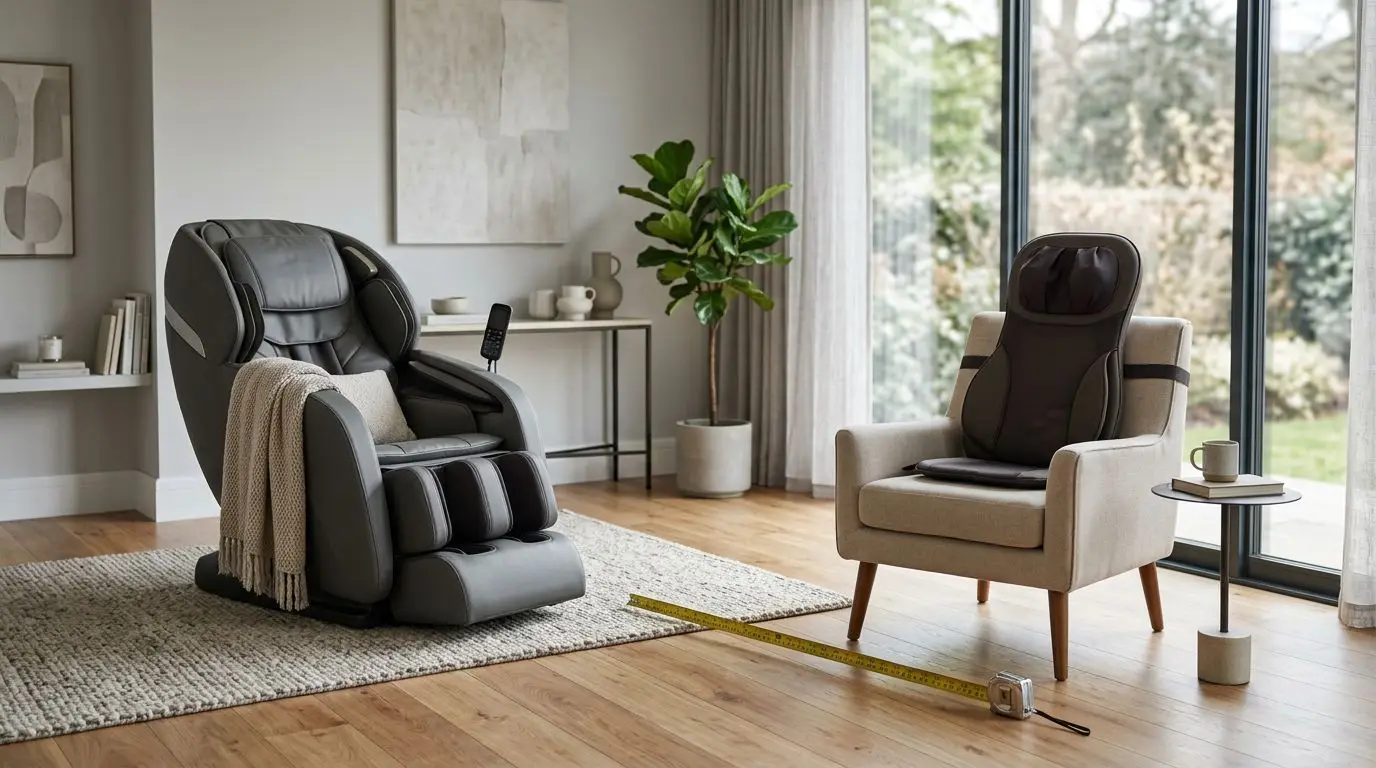
Space has value, too. A pad disappears into a drawer. A chair may weigh well over 150 pounds and may need several inches of rear clearance unless it has a wall-hugging design. Measure before you buy. A chair that blocks a walkway or looks oversized in the room will not feel like a good purchase for long.
| Cost factor | Heating pad | Heated massage chair |
|---|---|---|
| Purchase size | Small accessory | Large furniture/appliance purchase |
| Typical price category | Often under $100 | Usually four figures |
| Maintenance | Low; inspect cord and cover | Clean upholstery, protect moving parts, follow service guidance |
| Return difficulty | Usually simple | Can be complicated due to weight and freight shipping |
| Best value when | You need targeted warmth | You use broad massage features often |
Who it is best for: 5 common buyer profiles
Not every sore-muscle situation calls for a massage chair. Match the product to how you will actually use it, not how impressive a feature list sounds.
Best for heating pad users
- You have one main target area. If your low back or shoulder is the usual spot, a pad is direct and easy.
- You want heat without pressure. Some people do not enjoy rollers, squeezing airbags, or foot kneading.
- You need portability. A pad can move from sofa to desk chair to bed, depending on safe-use instructions.
- You are testing whether heat feels good. It is a low-commitment way to learn your preference.
- You have very limited space. A 12-by-15-inch pad is easier to own than a large recliner-style chair.
Best for heated massage chair users
- You want repeatable full-back coverage. A chair can run a set 15- or 20-minute program without repositioning a pad.
- You like mechanical pressure. Rollers and airbags create a more active experience than heat alone.
- Your feet and calves matter. Many chairs include calf airbags and foot rollers, which pads usually do not replace well.
- More than one person will use it. Household use can make the large purchase more reasonable.
- You want a dedicated relaxation routine. A chair creates a specific place and process, which some people actually use more consistently.
A quick reality check helps: if you would not sit in the chair 3 or 4 times per week, the heating pad may be the smarter buy. If you already use a pad often and wish it covered more area with less effort, a chair is worth comparing.
How to choose: measure your body, room, and heat preferences in 10 minutes
Before choosing, measure 3 things: your target area, your room, and the people who will use the product. This takes about 10 minutes and can prevent a poor fit.
Measure for a heating pad
Use a tape measure to check the area you want to cover. If your target zone is the low back, a medium pad may be enough. If you want shoulder-to-mid-back coverage, look for a larger pad or wrap shape. Check cord length if your outlet is more than 4 to 6 feet from the sofa or chair where you plan to sit.
Look closely at controls. Basic pads may have 3 heat settings. Others offer more temperature steps, timers, washable covers, or moist-heat options. Auto-shutoff is important, especially if you tend to relax deeply while using heat.
Measure for a heated massage chair
Measure the intended floor space, including width, depth, and recline clearance. Many massage chairs need room to recline, and even wall-hugging designs still need some space behind and in front. Check the doorway path, stairs, hallway turns, and elevator size if delivery is involved.
Body fit matters as much as room fit. Check the chair's stated height and weight ranges before buying. Tall users may need a longer track and adjustable shoulder position. Shorter users may need a chair with a body scan feature or manual roller adjustment so the rollers do not sit too high at the neck. Footrests with extension help households with different leg lengths.
Test or review the intensity controls. Look for adjustable roller depth, airbag intensity, heat on/off, foot roller on/off, and a manual mode. A chair that cannot be softened may be too aggressive for everyday use.
| Feature | Why it matters | Best if you... |
|---|---|---|
| Auto-shutoff | Limits session length, often around 15 to 30 minutes | Use heat while reading or watching TV |
| Adjustable heat | Lets you avoid too much warmth | Are temperature-sensitive |
| 3D roller depth | Changes pressure intensity | Want stronger or softer massage on demand |
| Extended L or SL track | Reaches into the seat area | Want glute and upper-hamstring contact |
| Airbag intensity control | Adjusts squeezing sensation | Dislike tight compression |
| Removable pad cover | Makes cleaning easier | Use a heating pad several times a week |
When a simple heating pad is enough for 1 to 2 areas
A heating pad is enough when you want predictable warmth on a limited area. That covers many everyday situations: sitting too long, a hard workout, yard work, a long drive, or a cold evening when your back feels tight. You do not need a large chair to solve a small comfort problem.
It is also enough if you dislike pressure. Some users buy massage products expecting a gentle spa-like feel and discover that rollers feel too pointed, airbags feel too snug, or foot rollers feel too intense. A pad avoids those issues.
Choose a pad if you share a small apartment, move often, or do not want a large chair in the living room. It is the practical tool. You can replace it easily, travel with some compact versions, and use it in different rooms.
A pad may not be enough if you constantly reposition it, use it on the back and legs during the same evening, or wish someone could knead your shoulders while the heat is on. Those are signs that a chair may better match your routine.
When a heated massage chair is worth considering for 3 or more zones
A heated massage chair becomes more compelling when your comfort routine involves multiple zones: neck, shoulders, back, glutes, calves, and feet. Instead of shifting a pad 4 times, you sit down and let the program move through the chair's available areas.
The chair also adds consistency. A 20-minute program can be repeated the same way each day, with the same recline angle, heat setting, roller path, and air intensity. That repeatability is part of the appeal for people who want an at-home relaxation ritual.
Do not buy solely for heat. Chair heat is often secondary to the massage system, and it may be concentrated in the back or legs. If heat is your only priority, a good pad or heated wrap may feel warmer and more direct.
Buy a chair for the combined experience: recline, rollers, airbags, foot features, heat, and hands-free operation. If those features sound useful and you have the space, a chair can make sense. If they sound excessive, stay with the pad.
FAQ: 6 practical questions before you buy
Can I use a heating pad and a massage chair on the same day?
Many people do, but keep total heat exposure reasonable and pay attention to skin comfort. Avoid stacking heat sources on the same area for long periods. If you have any of the safety conditions listed above, ask your physician first.
How long should a heat or chair session last?
Follow the product manual. Many heating pads and chairs use 15- to 30-minute timers, which is a sensible range for most comfort routines. Longer is not automatically better, especially with heat or strong pressure.
Is a heated massage chair better for the low back?
It depends on what you like. A chair can provide rolling pressure and mild heat over the low back, while a pad provides direct warmth exactly where you place it. If you want pressure plus heat, try a chair. If you want only warmth, use a pad.
Are foot rollers worth it?
They are worth considering if your feet feel tired after standing or walking for hours. Foot rollers can feel intense, so look for an on/off control or intensity adjustment. If you are sensitive on the soles of your feet, test carefully.
What is the biggest mistake when buying a massage chair?
The biggest mistake is buying by feature count instead of fit. Measure the room, check the user height and weight range, confirm recline clearance, and make sure intensity can be adjusted. A chair that is too strong or too large will not get used.
When should I avoid heat or mechanical massage?
Ask a physician first if you are pregnant; have a pacemaker or implanted cardiac device; have blood clot concerns or take anticoagulants; have osteoporosis, neuropathy, uncontrolled hypertension, spinal disc problems, or a recent fracture or surgery. Also avoid using heat on numb, irritated, broken, or swollen skin unless a physician tells you it is appropriate.
Bottom line: Start with a heating pad if your need is targeted, occasional, and mostly about warmth. Consider a heated massage chair if you want a larger, hands-free routine with rollers, airbags, recline, and heat across multiple body zones. The best choice is the one you will use safely and consistently.
Frequently asked questions
Can I use a heating pad and a massage chair on the same day? +
Many people do, but keep total heat exposure reasonable and avoid using multiple heat sources on the same area for long periods. If you are pregnant or have an implanted cardiac device, blood clot concerns, neuropathy, osteoporosis, uncontrolled hypertension, spinal disc problems, or a recent fracture or surgery, ask your physician first.
How long should a heat or massage chair session last? +
Follow the product manual. Many heating pads and massage chairs use 15- to 30-minute timers, which is a practical range for most comfort routines. Longer sessions are not automatically better.
Is a heated massage chair better than a heating pad for the low back? +
It depends on the sensation you want. A heated massage chair adds rolling or kneading pressure plus mild heat, while a heating pad provides direct warmth exactly where you place it. If you want only warmth, a pad may be enough.
When is a heating pad enough? +
A heating pad is usually enough when you have one main target area, want simple warmth without mechanical pressure, have limited space, or only use heat occasionally.
When is a heated massage chair worth considering? +
A heated massage chair is worth considering if you want a hands-free routine for multiple zones, such as the back, glutes, calves, and feet, and you will use the chair several times per week.
What safety issues should I consider before using heat or mechanical massage? +
Avoid heat on numb, broken, irritated, or swollen skin, and do not fall asleep with a heating product on. Ask a physician first if you are pregnant; have a pacemaker or other implanted cardiac device; have blood clot concerns or take anticoagulants; have osteoporosis, neuropathy, uncontrolled hypertension, spinal disc problems, or a recent fracture or surgery.
Related guides
Massage Chair vs. Heat Pad, TENS Unit, or Stretching Routine: Which At-Home Option Fits Your Goal?
13 min read
Massage Chair Pad, Cushion, or Full-Size Chair: Which Type Should You Choose?
15 min read
Heat Therapy in Massage Chairs: What It Does, Where It Matters, and What to Expect
12 min read
How to Choose a Massage Chair for Home Use
14 min read
Massage Chairs for Back Pain: When They May Help and When to Be Cautious
12 min read