Disclosure: We may earn a commission when you buy through links on this page, at no extra cost to you. We buy nothing, sell nothing and accept no payment for coverage — commissions never decide what we recommend. How we make money.
To choose a massage chair for everyday use without overbuying, focus on fit, comfort at low-to-medium intensity, durable construction, and the features you will actually use for 15–20 minutes at a time. Most homes do not need every premium add-on. They need a chair that fits the user, fits the room, and feels good on ordinary days.
A good everyday chair should be easy to get into, simple to control, and comfortable enough that you do not have to brace against the rollers or airbags. Start with the basics: track type, roller feel, recline clearance, weight capacity, session timer, and a realistic intensity range.
The everyday-use baseline: 15–20 minutes, 1–2 sessions, comfortable pressure
Daily use changes the buying decision. A chair that feels impressive for 3 minutes in a showroom can feel too forceful after a full 20-minute cycle at home. For most shoppers, the better everyday choice is not the strongest chair; it is the one that feels comfortable at a repeatable setting.
Look for automatic programs in the 10-, 15-, and 20-minute range, along with a manual mode that lets you stay in one area briefly. A session timer matters because it makes the chair easier to use consistently without guessing how long you have been in it. If the chair allows only one long preset or feels intense even on its lowest setting, it may be a poor match for daily use.
Everyday comfort also depends on how the chair feels between features. The rollers should not dig into your spine, the calf area should not pinch, and the shoulder position should not push you forward. If you plan to use the chair 5–7 days per week, small annoyances become big ones.
A practical daily-use checklist looks like this:
- At least 3 intensity levels that feel meaningfully different.
- A 15- or 20-minute automatic session option.
- Manual control for back, shoulders, seat, calves, or feet.
- A recline position you can sit in without neck strain.
- A remote or control panel that can be understood in under 2 minutes.
Skip any chair that wins on feature count but loses on comfort. You will notice comfort every day. You may use the flashier extras only once.
Who a home massage chair is best for — and who should ask a physician first
A massage chair at home is best for people who want a convenient, repeatable way to unwind, stretch out, and enjoy mechanical pressure without scheduling appointments or leaving the house. It can be especially practical for households where 2 or more adults will use the chair regularly, because the cost and space tradeoff are easier to justify when the chair is not sitting idle.
It is also a good fit for people who prefer predictable routines. A chair gives the same general program every time, with changes in intensity, recline, heat, airbags, and roller position depending on the model. That predictability can be a strength if you want a 15-minute reset after work or a short session while watching TV.
It is not automatically right for everyone. Ask your physician before using a massage chair if you are pregnant, have a pacemaker or other implanted cardiac device, have blood clots or take anticoagulants, have osteoporosis, recently had a fracture or surgery, have spinal disc problems, neuropathy, or uncontrolled hypertension. Do not treat the chair as a medical device or a substitute for professional medical advice.
| Best fit | Why it makes sense | What to check first |
|---|---|---|
| Daily relaxation at home | Convenient 10–20 minute sessions | Low intensity comfort |
| Shared household use | Multiple users can save preferred settings on some chairs | Height range and shoulder scan accuracy |
| Small living room or den | Space-saving recline designs can reduce rear clearance | Wall clearance and chair width |
| Occasional deep pressure preference | Manual roller control can target a specific area briefly | Whether the lowest setting is still comfortable |
If you have any condition where pressure, vibration, heat, or reclining position could be a concern, get individualized medical guidance first. That is the honest answer, even if the chair looks gentle.
Choose the right track: about 28–50 inches of roller coverage
The track is the rail system the back rollers travel on. It determines where the chair can apply roller pressure, and it is one of the most important choices for everyday use. Common track lengths range from roughly 28 inches on simpler S-track chairs to about 45–50 inches on longer L-track or SL-track designs.
An S-track follows the curve of the back from the neck or upper shoulders down toward the lower back. It can be a smart choice if you mainly want back coverage and a chair that may feel less enclosing. An L-track continues under the seat, so the roller path can reach the glute area. An SL-track combines a curved back path with an extended seat path, aiming for both contour and coverage.
Longer is not always better. If you only care about back comfort, an extended track may be unnecessary. If you like the feeling of seat coverage, a longer L- or SL-style track is worth considering. The key is buying the coverage you will use, not the longest number on the spec sheet.
| Track type | Typical coverage | Everyday-use advantage | Possible drawback |
|---|---|---|---|
| S-track | Upper back to lower back, often around 28–32 inches | Good for focused back sessions | No roller travel under the seat |
| L-track | Back and under-seat path, often around 45–50 inches | More lower-body coverage while seated | Can feel more intense at the seat for some users |
| SL-track | Curved back path plus extended seat path | Balanced contour and coverage | Often appears on more feature-heavy chairs |
For a massage chair you use every day, the best track is the one that matches your most common routine. If 80 percent of your sessions will be shoulders and lower back, prioritize roller quality and adjustability over maximum track length.
Rollers and intensity: aim for 3–5 useful levels, not maximum force
Roller design affects how the chair feels more than many shoppers expect. Basic chairs may use fixed or 2D roller movement, while more advanced designs add depth control often described as 3D or, in some cases, 4D. These labels are not standardized across the industry, so treat them as general clues rather than guarantees.
For everyday use, usable range matters most. A chair with 5 intensity settings is not helpful if levels 1 and 2 are still too strong or levels 4 and 5 feel nearly identical. The chair should offer a gentle setting, a medium setting, and a firmer setting that you can tolerate without tensing up.
Pay attention to the roller heads, padding, and body scan. A body scan attempts to locate shoulder height and back shape before the program starts. It will not be perfect for every body, so the chair should also let you adjust shoulder position manually, ideally in small increments.
| Roller feature | What it changes | Worth it for daily use? |
|---|---|---|
| 2D movement | Up/down and side-to-side roller action | Yes, if comfort and coverage are good |
| Depth adjustment | Can make pressure feel lighter or stronger | Very useful for shared households |
| Body scan | Attempts to align rollers with shoulder height | Useful, but manual correction still matters |
| Spot or zone control | Focuses on a smaller back area for a few minutes | Useful when you do not want a full program |
If two chairs feel similar, choose the one with better low-end control. A gentle setting extends everyday usability, especially when you are tired, sensitive, or sharing the chair with someone who prefers less pressure.
How to measure your room and body before buying: 30–36 inches, 2–12 inches, and the door test
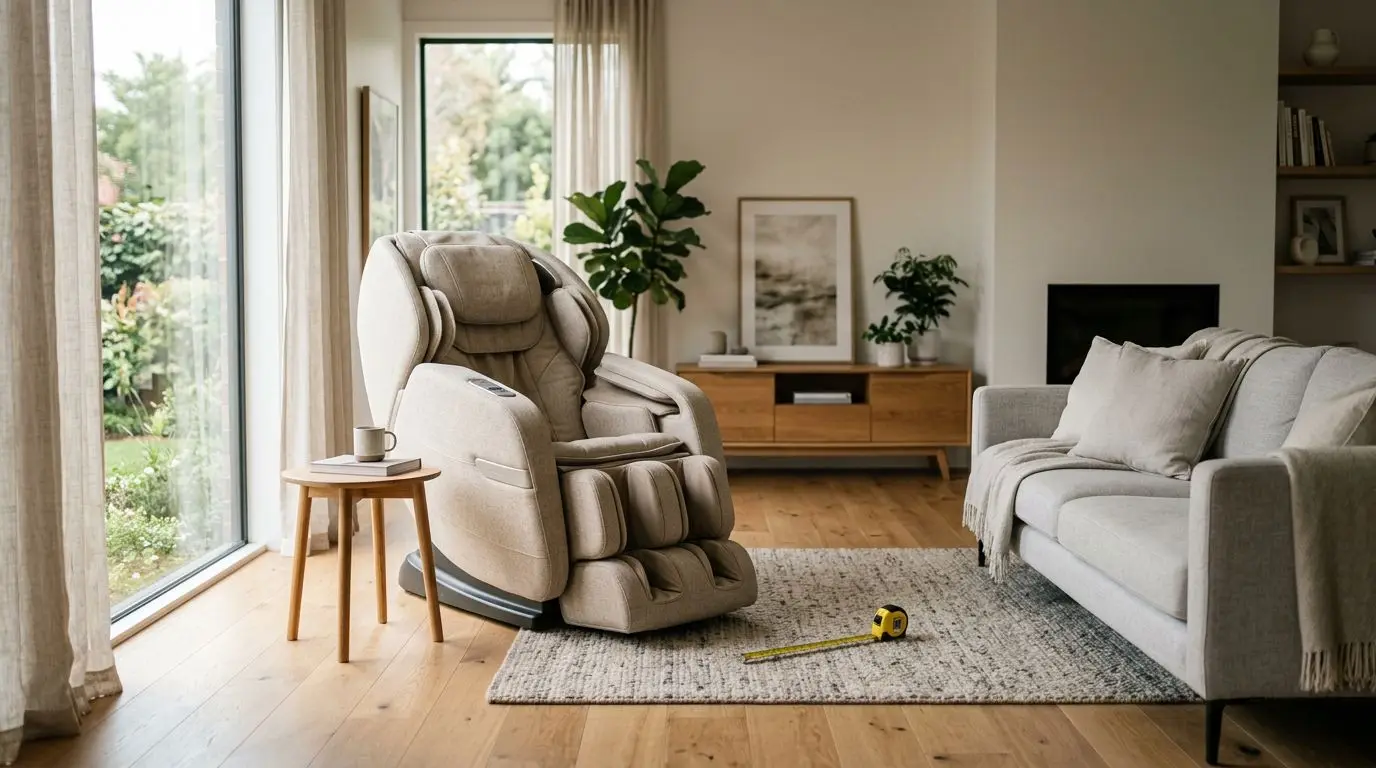
Massage chairs for home use are large pieces of furniture. Many are around 30–36 inches wide, and some need extra side clearance for arm panels, controls, or safe entry and exit. Before comparing features, measure the room, the path into the room, and the user fit.
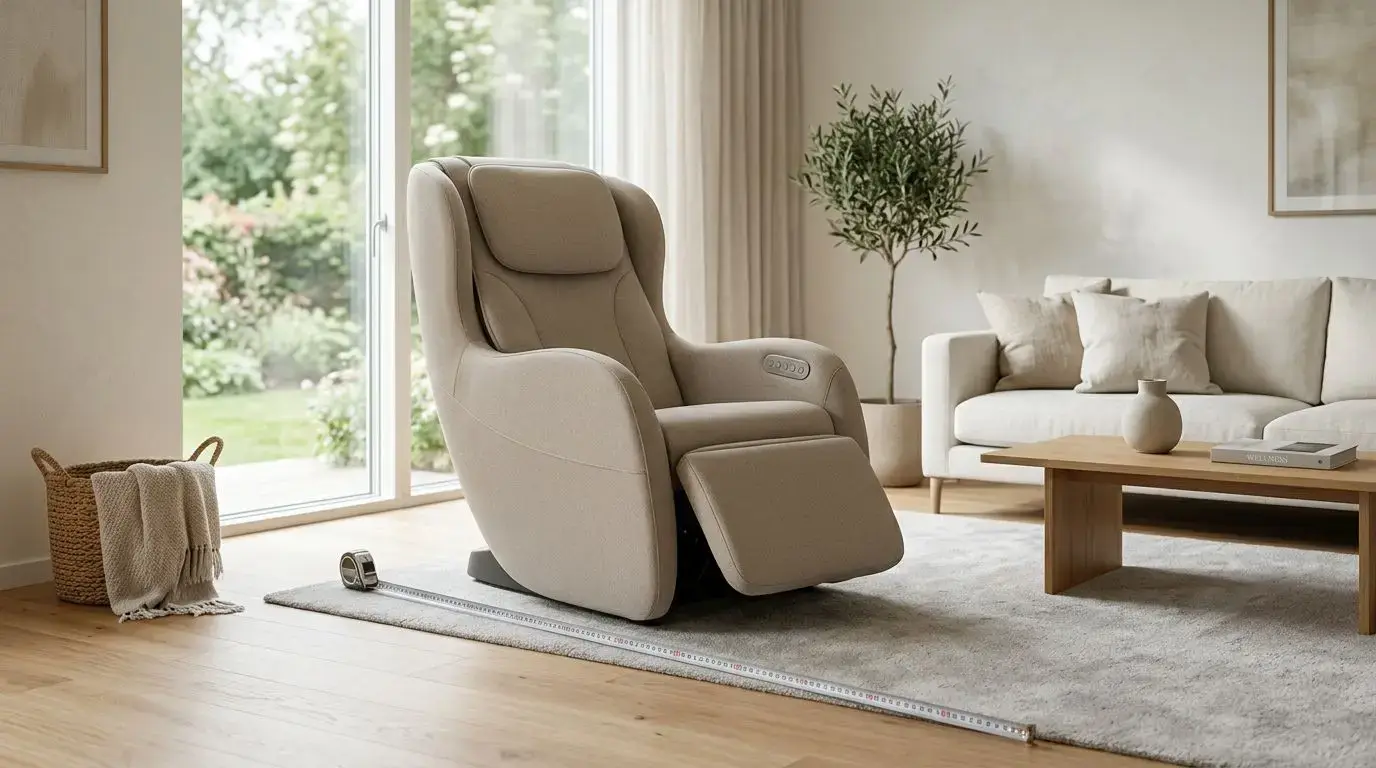
Start with the chair location. Measure the floor area with the chair upright and fully reclined. Some space-saving recline systems may need only about 2–6 inches behind the chair, while traditional recliners may need closer to 8–12 inches or more. You still need walking space around it, especially if the chair sits near a sofa, wall, coffee table, or doorway.
Next, measure the delivery path. Check the front door, hallway corners, stair landings, and the room doorway. Interior doorways are often around 30 inches wide, while some exterior doors are wider. If the chair arrives in a large box or requires partial assembly, the delivery details matter.
Then measure the user. Height range, shoulder width, leg length, and foot size all affect comfort. A tall user may need an extendable footrest with several inches of travel. A shorter user may need rollers that can scan accurately at a lower shoulder position.
- Measure wall-to-front clearance with the chair fully reclined.
- Leave at least a few inches on both sides for arms and controls.
- Compare the chair width with every doorway on the delivery path.
- Check stated height and weight capacity against the actual users.
- Sit with knees, calves, and feet aligned, not twisted to fit.
Also check flooring. A heavy chair can leave impressions in carpet or scuff softer floors if moved carelessly. A flat furniture mat or protective pads can be sensible if the chair will stay in one spot for years.
Features worth paying for for daily use — and extras to skip after the first week
The best feature set for daily use is practical, not crowded. A chair with 6–12 well-designed programs, adjustable intensity, heat in one or more zones, and simple manual controls will serve many households better than a chair loaded with features that complicate every session.
Heat is a good example. Many chairs include warming pads in the back, seat, calves, or feet. The warmth is designed for comfort; it is not a medical feature. If you like warmth while sitting, it may make the chair feel more pleasant during a 15-minute session. If you run warm or live in a hot climate, it may matter less.
Airbags can add compression around the arms, shoulders, calves, feet, or hips. More airbags do not automatically mean a better chair. Placement, pressure adjustment, and comfort matter more than the total count. A chair with 20 comfortable, well-placed airbags may feel better than one with a much higher count and limited control.
| Feature | Everyday value | When to skip it |
|---|---|---|
| Zero gravity recline | Changes body angle and can make pressure feel more even | If you dislike deep recline or have trouble standing up from reclined positions |
| Heat | Adds gentle warmth during 10–20 minute sessions | If you rarely use heated seats or blankets |
| Foot rollers | Adds under-foot pressure and texture | If you are sensitive on the soles of your feet |
| Air compression | Adds squeezing pressure to arms, legs, or feet | If you dislike being held in place |
| Voice control or app control | Can be convenient if implemented simply | If the physical remote is already easy |
| Built-in speakers | Nice for background audio | If you already use earbuds, a TV, or a room speaker |
To avoid overbuying, rank features as daily, occasional, or novelty. Daily features deserve budget priority. Occasional features are nice if they come with the chair. Novelty features should not drive the purchase.
Durability and comfort clues for 5–7 days a week
An everyday chair needs to feel stable, not just feature-rich. Check the stated weight capacity, frame feel, upholstery quality, warranty terms, and availability of service. Many full-size chairs list weight capacities in the 250–300 pound range, though exact limits vary. Choose a chair with a margin above the heaviest regular user rather than sitting right at the limit.
Upholstery is another daily-use issue. Synthetic leather-like materials are common because they are smooth, flexible, and easier to wipe than fabric. Look for even stitching, no sharp seams near the arms or calves, and padding that does not bottom out when you recline. If the head pillow is removable or adjustable, that is a plus because neck comfort varies a lot by height.
Controls should also hold up to real life. A remote with clear buttons may be better than a complicated screen if several family members will use it. If the chair relies on an app, make sure the main functions can still be used from the chair itself.
Noise matters. A chair does not have to be silent, but roller motors, air pumps, and foot rollers should not be so loud that a 20-minute session becomes irritating. If you plan to use it in a shared living room, ask about sound level or test it while a TV is playing at normal volume.
Warranty language can be more useful than a feature list. Read what is covered for parts, labor, frame, electronics, and in-home service, and note the time periods. A longer-looking warranty may still exclude wear items or require shipping heavy components. The details matter.
A 10-minute test plan before you commit
If you can test a chair in person, use a structured 10-minute plan instead of trying random buttons. Sit normally, place your head back, keep your shoulders relaxed, and notice whether you can breathe and rest without bracing. The goal is not to find the most intense setting; it is to find the setting you would choose on an ordinary Tuesday.
Use this quick test:
- Minute 1: Sit upright and check shoulder, neck, and arm comfort.
- Minutes 2–3: Run the lightest automatic setting and notice roller contact.
- Minutes 4–5: Recline and check whether your head and lower back feel supported.
- Minutes 6–7: Try medium intensity, then return to low and compare.
- Minute 8: Test calf and foot areas; look for pinching or awkward angles.
- Minute 9: Use manual controls for one back zone.
- Minute 10: Exit the chair and decide whether standing up feels easy.
If you cannot test in person, study the return policy, delivery terms, and restocking conditions before buying. Large chairs are expensive and inconvenient to send back, even when a return is technically allowed. Do not assume free pickup or free return freight unless it is clearly stated.
The best everyday massage chair is the one you will use regularly because it is comfortable, understandable, and correctly sized. Buy enough adjustability to suit your body and routine, but do not pay extra for features that solve problems you do not have.
FAQ: 5 common questions about everyday massage chair use
Can I use a massage chair every day?
Many people use a massage chair daily for short comfort sessions, often around 10–20 minutes. Start with lower intensity and shorter sessions so you can judge how the pressure feels over time. Ask your physician first if you have pregnancy, an implanted cardiac device, blood clots, anticoagulant use, osteoporosis, recent fracture or surgery, spinal disc problems, neuropathy, or uncontrolled hypertension.
Is a bigger massage chair always better for home use?
No. A bigger chair may offer more coverage, but it can also be harder to place, move, and fit through doorways. Measure the room, recline clearance, and delivery path before assuming a larger chair is the smarter buy.
What features matter most for daily use?
Prioritize comfortable low-to-medium intensity, a track that covers the areas you use most, adjustable recline, a simple remote, a 15- or 20-minute timer, and clear warranty terms. Heat, foot rollers, and airbags are useful only if you like how they feel.
Should I choose an S-track or L-track chair?
Choose an S-track if you mostly want back coverage and a simpler feel. Consider an L-track or SL-track if you want the rollers to continue under the seat. Track lengths vary, but many S-tracks are around 28–32 inches and many extended tracks are around 45–50 inches.
How do I avoid overbuying?
List the features you would use at least 4 days per week, then separate them from features you might try once. Spend on fit, adjustability, comfort, and service support before paying for novelty controls, extra programs, or a longer feature list.
Frequently asked questions
Can I use a massage chair every day? +
Many people use a massage chair daily for short comfort sessions, often around 10–20 minutes. Start with lower intensity and shorter sessions, and ask your physician first if pregnancy, an implanted cardiac device, blood clots, anticoagulant use, osteoporosis, recent fracture or surgery, spinal disc problems, neuropathy, or uncontrolled hypertension applies to you.
Is a bigger massage chair always better for home use? +
No. A bigger chair may offer more coverage, but it can also be harder to place, move, and fit through doorways. Measure the room, recline clearance, and delivery path before choosing size.
What features matter most for daily use? +
Prioritize comfortable low-to-medium intensity, the right track coverage, adjustable recline, a simple remote, a 15- or 20-minute timer, and clear warranty terms. Heat, foot rollers, and airbags are useful only if you like how they feel.
Should I choose an S-track or L-track chair? +
Choose an S-track if you mostly want back coverage and a simpler feel. Consider an L-track or SL-track if you want roller coverage to continue under the seat. Many S-tracks are around 28–32 inches, while extended tracks are often around 45–50 inches.
How do I avoid overbuying? +
List the features you would use at least 4 days per week and separate them from features you might only try once. Spend on fit, adjustability, comfort, and service support before paying for novelty controls or extra programs.
Related guides
Can You Use a Massage Chair Every Day? Benefits, Time Limits, and When to Take a Break
12 min read
How to Choose a Massage Chair for Home Use
14 min read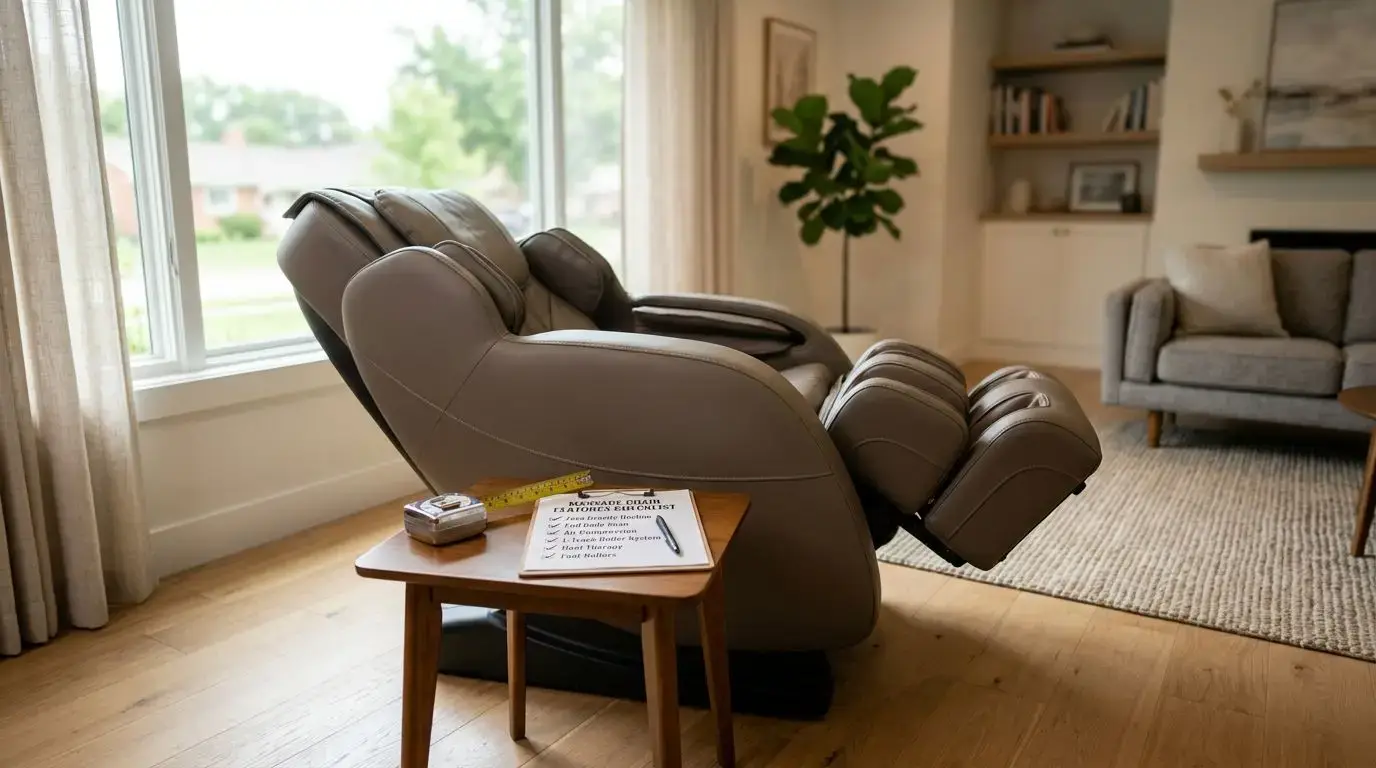
Best Massage Chair Features to Look For Before You Buy
13 min read
Home Massage Chairs Explained: Main Types, Room Fit, and Best Use Cases
15 min read
Are Massage Chairs Good or Bad for You? Benefits, Risks, and Safe Use Guidelines
13 min read