Disclosure: We may earn a commission when you buy through links on this page, at no extra cost to you. We buy nothing, sell nothing and accept no payment for coverage — commissions never decide what we recommend. How we make money.
Portable massage chairs for therapists are foldable, unpowered support chairs used for hands-on seated massage, usually focused on the neck, shoulders, upper back, arms, and hands. Electric home massage chairs are powered recliners with rollers, motors, airbags, heat, and preset programs made for self-use at home. They share a name, but they differ in posture, pressure control, portability, setup, and purpose.
If you are shopping because you saw a chair at an airport, office event, trade show, or corporate wellness day, you are probably picturing a portable practitioner chair. If you want a chair that reclines, plugs into a wall outlet, and runs a 10- to 30-minute automatic program while you sit back, you are looking for an electric home massage chair.
What a portable practitioner chair is: a 15- to 30-minute seated setup
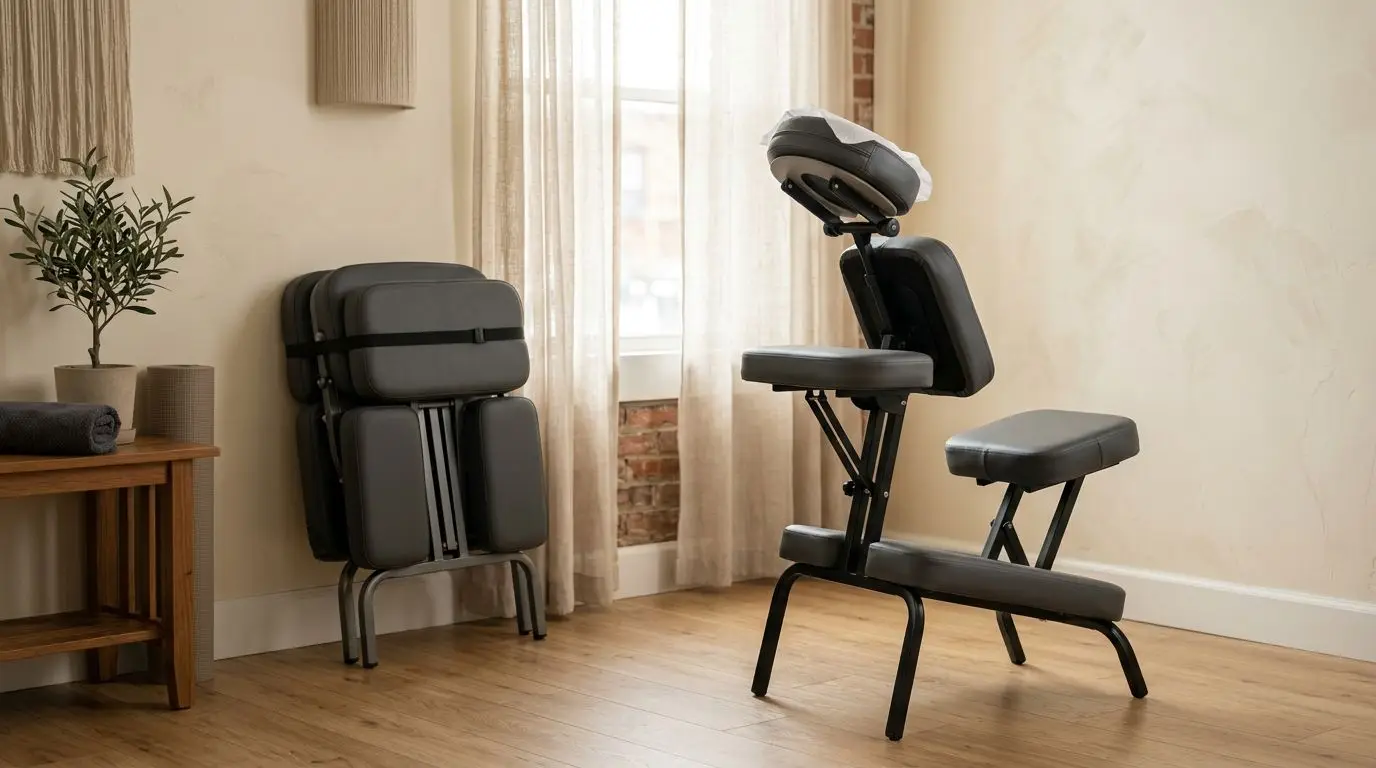
A portable practitioner chair is a folding frame with a padded seat, chest pad, arm shelf, knee supports, and an adjustable face cradle. The client sits facing forward and leans into the support pads while the massage therapist stands or sits nearby and applies manual pressure. A typical session in this format may run 15, 20, or 30 minutes, depending on the setting.
These chairs are built around access and body positioning. They hold the client in a forward-leaning seated posture so the practitioner can reach the neck, shoulders, upper back, arms, and sometimes the hands without asking the client to lie on a table. The chair does not knead, roll, vibrate, heat, recline on a motor, scan the body, or inflate air cells.
The key point is simple: the practitioner is the working mechanism. The chair is support equipment. Its job is to keep the client reasonably comfortable and stable while the professional controls pressure, speed, angle, and coverage by hand.
That is why portable chairs are common in on-site settings. They can be used in offices, sports event waiting areas, convention booths, backstage spaces, and short seated sessions where a full massage table would be too large or too slow to set up. They are not meant to replace a powered home chair, and a powered home chair cannot do the same job for a working practitioner.
Portable chair vs electric home massage chair: 6 key differences
The easiest way to separate the two categories is to compare what moves, who controls the pressure, and how much space the chair needs. A portable practitioner chair may weigh around 15 to 25 pounds, while a full-size electric home massage chair can weigh well over 150 pounds and may require several inches of wall clearance unless it has a space-saving recline design.
| Category | Portable practitioner chair | Electric home massage chair |
|---|---|---|
| Power | Unpowered; no outlet required | Powered; plugs into a standard wall outlet |
| Who creates pressure | Massage therapist or trained practitioner | Internal rollers, airbags, motors, and vibration modules |
| Body position | Forward-leaning seated posture | Reclined or upright seated posture |
| Typical use length | Often 10 to 30 minutes per seated session | Often preset programs around 10 to 30 minutes |
| Portability | Folds for carrying and transport | Installed in one room; usually moved by two adults |
| Main coverage | Neck, shoulders, upper back, arms, hands | Back, hips, calves, feet, and shoulders depending on track and features |
An electric home chair is a consumer wellness appliance. Its feel comes from mechanical systems: roller tracks, airbags, motors, heat pads, foot rollers, and programmed sequences. A portable practitioner chair is closer to a specialized support stand for seated bodywork.
That difference shapes expectations. A powered chair can repeat the same program every night. A practitioner chair does nothing on its own. Its value comes from adjustability, stability, comfort, and how well it lets a professional work safely and efficiently around a client’s seated posture.
Frame, face cradle, and chest support: where 2 inches can matter
Portable massage chairs look simple, but their geometry is the product. Small adjustments can make a big difference. A face cradle that moves up or down by 2 inches may determine whether a shorter or taller client can rest their head without craning the neck. A chest pad angle that changes by a few degrees can alter how much body weight lands on the sternum, shoulders, and knees.
The basic components are consistent across the category. The face cradle supports the head and usually has a horseshoe-shaped cushion or layered pad with an opening for the face. The chest pad supports the torso. The armrest or arm shelf gives the client a place to relax the forearms. Knee pads or shin supports help distribute weight, and the seat carries part of the load.
For the practitioner, adjustability is not a luxury feature. It determines working access. A higher face cradle may create more room around the shoulders, while a lower chest pad can change the client’s forward lean. If the arm shelf is too high, the shoulders may stay elevated. If it is too low, the client may feel pulled forward.
Stability begins with the frame. Many portable chairs use aluminum or steel tubing with a folding scissor-style layout. Aluminum is generally favored for lighter carry weight, while steel may feel very planted but can add pounds. Either material can work if the hinges, locks, welds, and pad mounts feel secure under load.
Weight capacity is another specification to read carefully. Many portable practitioner chairs list a maximum user weight, often somewhere in the 250- to 350-pound range, though the exact number varies by design. That rating is not a comfort guarantee; it is a manufacturer limit. A chair also needs enough pad width and frame stability for the person using it.
Portability and setup: 15 to 25 lb frames and 60-second folds
Portability is the main reason this category exists. A good portable practitioner chair folds into a narrow package, fits into a carry case, and can be moved from a vehicle to a work site without a dolly. Many chairs in this class weigh roughly 15 to 25 pounds before accessories, while a carry case, paper face cradle covers, sanitizer, and small supplies add to the real walking weight.
Setup speed matters in professional environments. At an office event or expo booth, a practitioner may need to unfold the frame, lock the legs, set the face cradle, adjust the seat or chest pad, and be ready for the first client in about 1 to 3 minutes. A chair that technically folds but relies on fussy knobs and unclear locking points can slow the whole day.
Carry comfort counts, too. A shoulder strap may be fine for a short hallway. For longer distances, a backpack-style case or wheeled bag may be easier. The folded size should fit your vehicle, storage closet, and work site. A few inches can be the difference between a smooth setup and an awkward load-in.
Portability also brings tradeoffs. Lighter frames are easier to carry but may feel less substantial if the frame geometry is not well braced. Extra-wide pads may feel more accommodating but increase bulk. More adjustments can improve fit yet add knobs and possible failure points. The best chair is not always the lightest one; it is the one you can transport repeatedly and set up confidently.
Who it’s best for—and who should choose a powered home chair instead
A portable practitioner chair is best for people who need a foldable, non-electric chair for hands-on work in short seated sessions. It is not the right purchase for someone who wants to sit down alone at 9 p.m., press a button, and run an automatic roller program.
Portable practitioner chairs are best for:
- Licensed massage therapists and trained bodywork professionals doing seated sessions in offices, events, and mobile settings.
- Wellness teams that need a chair that sets up in a small footprint, often around 4 by 6 feet including practitioner space.
- Practitioners who want access to the neck, shoulders, upper back, arms, and hands without using a full table.
- Training environments where students need to learn seated positioning and safe manual pressure control.
Electric home massage chairs are better for:
- Home users who want powered rollers, airbags, heat, and preset programs.
- People who prefer reclined support rather than a forward-leaning seated posture.
- Users who want lower-body features such as calf airbags, foot rollers, or a leg rest.
- Households with a dedicated space where a large chair can remain plugged in and ready.
There is overlap in the word “massage,” but not in the experience. A portable practitioner chair depends on human skill. A powered home chair depends on mechanical coverage, track design, and program logic. One is professional support equipment; the other is a home wellness appliance.
How to choose and measure: 7 checks before you buy
Before buying a portable practitioner chair, measure the realities around the chair, not just the chair itself. A folded size listed online may look manageable, but you also need room for a practitioner to stand, move, clean the pads, and help clients enter and exit safely.
1. Check the folded size
Measure your vehicle trunk, back seat, closet, or storage shelf. If the folded chair is 40 inches long and your trunk opening is narrower than that, the stated portability will not help much.
2. Weigh the full carry load
Do not look only at frame weight. Add the carry case, face cradle covers, cleaning supplies, intake forms, a small stool if used, and personal gear. A 21-pound chair can become a 28-pound load quickly.
3. Confirm user weight capacity
Read the manufacturer’s stated maximum user weight. Leave practical margin for movement and comfort. A chair near its limit may not feel as stable as one used well within its rating.
4. Test adjustability for height range
If possible, set the chair for a shorter adult around 5 feet tall and a taller adult around 6 feet 2 inches tall. The face cradle, seat, chest pad, and armrest should adjust without forcing either person into an awkward posture.
5. Look at pad density and vinyl quality
Very soft pads can bottom out during a 20-minute session. Very firm pads can feel unforgiving. Upholstery should wipe clean, resist cracking, and have tight seams around high-contact areas.
6. Inspect locks and hinges
Open and close the chair several times. Listen and feel for positive locking points. Loose hinges, vague clicks, and wobble under gentle pressure are warning signs.
7. Plan the working footprint
Allow space around the chair. Even if the frame itself is compact, a practitioner needs room to stand at the head, side, and back. For many on-site settings, a working area of about 4 by 6 feet is a realistic minimum.
Features that matter: compare 8 specs, not brand names
Since this category is not about motors or software, the feature list is short but important. Focus on what affects setup, client fit, cleaning, and daily durability. Eight specifications deserve close attention.
| Feature | Why it matters | What to check |
|---|---|---|
| Frame material | Affects weight and rigidity | Aluminum for lighter carry; steel for heavier feel |
| Chair weight | Impacts mobile work | Commonly around 15 to 25 lb before supplies |
| Weight capacity | Defines the rated limit | Look for the stated maximum user weight |
| Face cradle adjustment | Controls neck and head position | Height, angle, and secure locking |
| Chest pad angle | Changes torso support | Multiple positions without wobble |
| Armrest design | Affects shoulder comfort | Width, height, and pad firmness |
| Upholstery | Impacts cleaning and durability | Wipeable surface and reinforced seams |
| Carry case | Protects the chair in transit | Straps, handles, zippers, and optional wheels |
For electric home massage chairs, the comparison would be completely different. You would be looking at an S-track, L-track, or SL-track; 2D, 3D, or 4D rollers; shoulder detection; airbag zones; heat location; foot rollers; and recline clearance. Those features are valuable in the powered category, but they do not apply to a folding practitioner chair.
A common buying mistake is expecting a portable chair to deliver a “massage chair experience” by itself. It will not. No roller track is hidden inside the frame. There are no airbags in the arm pads. There is no remote control. If you need automated kneading and rolling, shop the powered home category instead.
Safety boundaries before a 10-minute chair session
Portable massage chairs are consumer and professional wellness support products, not medical devices. They are designed to position a person for hands-on pressure and comfort, not to diagnose, treat, cure, prevent, or manage any health condition. If a manufacturer makes a health-related claim, treat it as a claim from that manufacturer and look for substantiation rather than assuming it is true.
Some people should ask their physician before using a portable massage chair or receiving seated bodywork. This includes people who are pregnant; have a pacemaker or other implanted cardiac device; have a history of blood clots or take anticoagulant medication; have osteoporosis; have had a recent fracture or surgery; have spinal disc problems; have neuropathy or reduced sensation; or have uncontrolled hypertension. Do not treat these as minor footnotes.
Comfort feedback matters, too. A client should be able to say when pressure feels too intense, when a position feels strained, or when they want to stop. Numbness, sharp discomfort, dizziness, or a sense of being trapped in the posture are reasons to stop immediately and reassess the setup.
For practitioners, sanitation and body mechanics are part of safe use. Use fresh face cradle covers, clean contact surfaces between clients, and keep the chair on a level floor. Avoid placing the frame on thick carpet, uneven outdoor surfaces, or slick flooring where the legs can shift.
FAQ: 5 practical questions about portable massage chairs
Are portable massage chairs electric?
No. Most portable practitioner chairs are unpowered folding frames. They do not have rollers, airbags, heat, motors, or automatic programs. The massage therapist or practitioner provides the manual pressure.
Can I use a portable practitioner chair at home by myself?
Not in the way you would use an electric home massage chair. A portable practitioner chair needs another person to perform the hands-on work. If you want solo use, a powered home chair is the appropriate category.
How much space does a portable chair need?
The chair itself is compact, but the working area matters more. Plan for roughly 4 by 6 feet so the practitioner can move around the seated client, adjust the chair, and maintain a safe entry and exit path.
What body areas are easiest to access?
Portable chairs are mainly designed for the neck, shoulders, upper back, arms, and hands. They are not ideal for full-body work, lower-back access, calves, or feet compared with other setups.
Is a heavier portable chair always more stable?
Not always. Weight can help, but frame geometry, locks, hinge quality, foot design, and weight capacity matter just as much. A lighter chair with a rigid frame can feel more secure than a heavier chair with loose joints.
Frequently asked questions
Are portable massage chairs for therapists electric? +
Usually no. They are unpowered folding support chairs used by a practitioner for hands-on seated massage, without rollers, airbags, heat, or preset programs.
How are portable practitioner chairs different from electric home massage chairs? +
Portable practitioner chairs position a client leaning forward so another person can work manually. Electric home massage chairs are powered recliners that use rollers, airbags, motors, and programs for self-use.
How much does a portable massage chair weigh? +
Many portable practitioner chairs weigh roughly 15 to 25 pounds before accessories, though the total carry load can be higher once you add a case and supplies.
Who should buy a portable massage chair? +
They are best for licensed massage therapists, trained bodywork practitioners, mobile wellness providers, and on-site event setups that need a foldable, non-electric chair.
Can a portable massage chair replace a full electric massage chair at home? +
No. A portable chair does not work by itself. If you want automated kneading, rolling, heat, airbags, or recline programs for solo use, shop for an electric home massage chair instead.
Related guides
Massage Chair vs. Professional Massage: Which Is Better for Your Routine and Budget?
10 min readPortable Massage Chair vs. Massage Table: Which Setup Works Better for Massage Therapists?
13 min read
Office Massage Chairs vs. Home Massage Chairs: Key Differences Before You Buy
13 min read
How to Choose a Massage Chair for Home Use
14 min read
Car Massage Seats vs. Home Massage Chairs: Comfort, Safety, and Realistic Expectations
12 min read