Disclosure: We may earn a commission when you buy through links on this page, at no extra cost to you. We buy nothing, sell nothing and accept no payment for coverage — commissions never decide what we recommend. How we make money.
A portable massage chair is usually the better choice for short, clothed sessions, events, offices, and therapists who need the quickest setup. A massage table is better for longer appointments, full-body work, draping, broader positioning, and clients who need more support. For many mobile therapists, the decision comes down to session length: roughly 10 to 30 minutes favors a chair, while 45 to 90 minutes usually favors a table.
Both setups can be professional. The right choice is the one that fits your treatment style, vehicle, storage space, client population, and the time you can spend loading, setting up, sanitizing, and packing down between appointments.
Quick verdict: choose by session length, from 10 minutes to 90 minutes
If you remember only one rule, use this one: shorter, clothed, upper-body sessions point toward a portable massage chair; longer, full-body sessions point toward a massage table. A chair shines when you need to work efficiently in 10, 15, or 20-minute blocks. A table gives you more positioning options when a client is booked for 60 or 90 minutes.
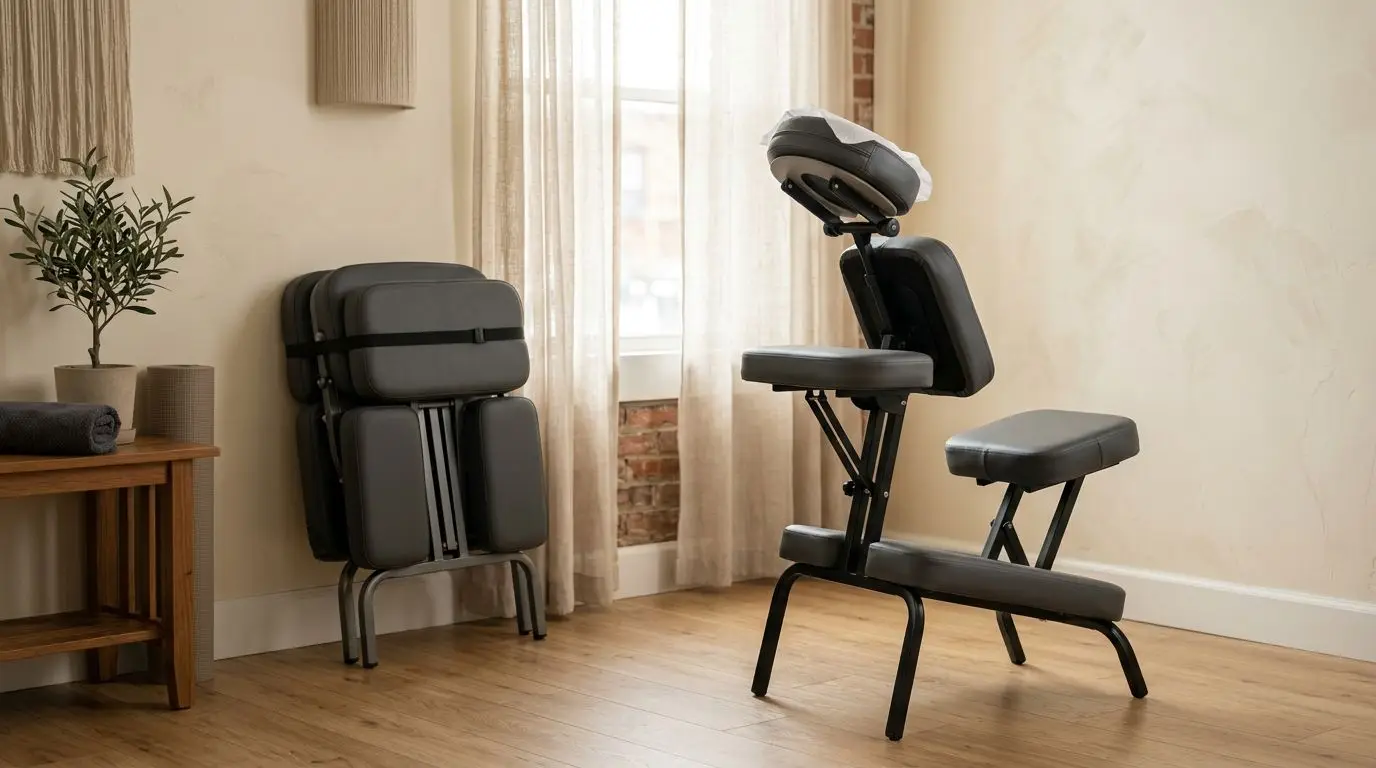
A portable massage chair is not the same as a consumer electric massage recliner. For therapists, it usually means a folding, manually adjusted chair with a face cradle, chest pad, arm support, and kneeling or seated support. It is designed for hands-on bodywork, not automated massage.
A portable massage table is a folding padded table, commonly around 28 to 32 inches wide and roughly 72 to 84 inches long with a face cradle attached. It supports prone, supine, side-lying, and sometimes semi-reclined positions, depending on the accessories and the client’s tolerance.
| Setup | Best fit | Common session length | Main tradeoff |
|---|---|---|---|
| Portable massage chair | Events, offices, short mobile visits, upper back/neck/shoulders | 10 to 30 minutes | Limited full-body access and less comfort for long sessions |
| Portable massage table | In-home appointments, spa-style work, full-body massage, detailed treatment plans | 45 to 90 minutes | Heavier, bulkier, and slower to set up |
| Owning both | Therapists who do events and private sessions | 10 to 90 minutes | More storage space and higher total equipment cost |
Portability and setup: 15 to 35 lb chair vs. 25 to 40 lb table
Portable massage chairs are generally easier to carry through office buildings, parking lots, elevators, and event spaces. Many weigh about 15 to 35 pounds, depending on frame material, padding, and accessories. Their folded shape is usually compact enough to carry at your side or over one shoulder in a case.
Portable massage tables often weigh about 25 to 40 pounds before you add bolsters, linens, oil or lotion, a stool, a face cradle, and sanitation supplies. That difference matters after three flights of stairs or when you are making five appointments in one day. Even a 10-pound difference can feel significant by the last stop.
Setup time also favors the chair. With practice, a portable massage chair can often be opened, adjusted, and ready in about 1 to 3 minutes. A table may take 3 to 7 minutes once you include unfolding it, attaching the face cradle, setting the height, laying linens, placing bolsters, and organizing supplies.
| Factor | Portable massage chair | Portable massage table |
|---|---|---|
| Typical equipment weight | About 15 to 35 lb | About 25 to 40 lb, plus accessories |
| Setup time with practice | About 1 to 3 minutes | About 3 to 7 minutes |
| Carry difficulty | Easier in tight spaces | Bulkier through doors, stairs, and elevators |
| Extra supplies | Often minimal | Linens, bolsters, face cradle cover, lotion, blanket |
The table is not impractical. It is simply less nimble. If your workday includes parking garages, long hallways, weather, and apartment stairs, measure the full route instead of judging weight alone.
Client positioning: seated access vs. 72- to 84-inch full-body support
A portable chair positions the client forward, usually with the face supported in a cradle, the chest resting against a pad, the arms supported, and the hips and knees flexed. This setup is excellent for the neck, shoulders, upper back, mid-back, arms, and hands. It is less useful when you need full access to the legs, glutes, abdomen, or front of the body.
A massage table supports the entire body over a long surface, commonly 72 to 84 inches including the face cradle. That length gives you room to work in prone, supine, and side-lying positions. You can also use bolsters under the knees, ankles, or chest to improve comfort and reduce strain.
Positioning affects more than technique. It shapes whether a client feels secure. Some clients dislike lying face down. Others cannot comfortably sit forward in a chair because of abdominal pressure, shoulder restrictions, breathing comfort, pregnancy, body size, dizziness, or knee limitations. A professional setup should give you a way to adapt without forcing the client into one position.
| Positioning need | Chair performance | Table performance |
|---|---|---|
| Neck and shoulders | Very strong access | Strong access |
| Full back | Good, especially upper and mid-back | Very strong |
| Legs and feet | Limited | Strong |
| Side-lying work | Not practical | Practical with pillows or bolsters |
| Clients who cannot lie flat | Sometimes helpful | Depends on bolstering and table accessories |
Treatment style: 10- to 30-minute chair work vs. 60-minute table sessions
Portable chair massage is built for focus. It works especially well for brief sessions where the client remains clothed and the therapist concentrates on common tension areas: neck, shoulders, back, arms, and hands. This format fits corporate wellness days, conferences, gyms, airports, senior centers, and community events where several clients may be scheduled back-to-back.
Table work supports a wider range of session structures. A 60-minute appointment can include the back, legs, feet, arms, hands, neck, and scalp, with time for turning over and repositioning. It also allows draping, lubricant use when appropriate, slower pacing, and more detailed work across larger muscle groups.
Neither format is automatically more therapeutic. The therapist’s training, intake process, pressure control, communication, and boundaries matter more than the furniture. Even so, the setup determines what you can realistically do in the time booked.
| Treatment feature | Portable chair | Massage table |
|---|---|---|
| Clothed work | Excellent | Possible, but less typical for spa-style sessions |
| Draping | Usually not used | Standard for undressed or partially undressed work |
| Lubricant use | Usually none | Common when appropriate |
| Detailed full-body sequence | Limited | Strong |
| High-volume event flow | Excellent | Slower |
For a therapist building a mobile private practice, a table often matches client expectations for full appointments. For a therapist building event contracts, the chair may create a smoother workflow and less fatigue between clients.
Space, storage, and transport: allow 4 by 6 feet or more
A massage chair needs less floor space. In many cases, a clear area of about 4 by 6 feet is workable for the chair, client, and therapist movement. That makes it easier to use in office corners, break rooms, expo booths, and small treatment rooms.
A massage table needs more clearance. The table itself may be about 2.5 feet wide and 6 to 7 feet long, but the therapist also needs room to stand, lunge, walk around, and reach supplies. A practical working area is often closer to 6 by 9 feet, and more is better if the client uses mobility aids or if you need space for a stool and bolsters.
Storage is another real-world issue. A folded chair may fit in a closet, car trunk, or behind a door. A folded table is longer and more rectangular, often easier to store flat under a bed or upright in a closet, but harder to hide in a small apartment or shared office.
Transport depends on your vehicle. Before buying either setup, measure your trunk opening, back seat width, and diagonal clearance through doors. A table that technically fits in the car may still be frustrating if it has to be angled around a child seat, work bags, or winter gear every day.
Comfort, draping, and accessibility: what changes after 20 minutes
Most clients tolerate chair positioning well for short sessions. After about 20 to 30 minutes, some begin to feel pressure at the chest, knees, shins, or face cradle. A well-adjusted chair helps, but the seated forward position is still more constrained than lying on a table.
Tables usually win for longer comfort because the client’s weight is spread over a larger padded surface. You can support the ankles, knees, chest, shoulders, and head with bolsters and pillows. This matters for older clients, larger-bodied clients, pregnant clients, and anyone who needs extra time getting on or off equipment.
Draping is another major difference. Chair massage is generally performed over clothing, which can feel approachable in public or workplace settings. Table massage may involve undressing to the client’s comfort level and professional draping, which creates better access for some techniques but requires a private space and clear communication.
Accessibility is not one-size-fits-all. A chair may be easier for a client who does not want to climb onto a table, but it may be difficult for someone with knee pain or limited hip flexion. A table may be easier once the client is lying down, yet harder to mount if it is set too high. Adjustable height and careful intake are non-negotiable.
How to choose and measure your setup in 6 steps
Use a practical checklist before deciding. Do not start with what looks more professional in photos. Start with your service menu, your clients, and your travel pattern.
- Define your main session length. If most bookings are 10 to 30 minutes, a chair is likely more efficient. If most are 45 to 90 minutes, a table is usually the better core setup.
- Measure your vehicle. Check trunk width, trunk depth, back seat space, and door opening height in inches. Measure the real opening, not just the interior storage area.
- Measure your treatment space. For chair work, aim for at least 4 by 6 feet. For table work, aim for about 6 by 9 feet or more.
- Test the carry distance. Walk 200 feet carrying a similar weight if possible. Add stairs if your clients commonly live in walk-ups.
- List required accessories. A table may need sheets, face cradle covers, bolsters, disinfectant, lubricant, a blanket, and a laundry bag. A chair may need fewer items, but you still need sanitation supplies and disposable or washable face covers.
- Match equipment to body mechanics. Choose a working height that lets your shoulders stay relaxed and your wrists neutral. If you fight the equipment, your own fatigue will show up quickly.
A simple tape measure can prevent a bad purchase. For table height, many therapists start around knuckle height when standing beside the table, then adjust based on modality, client size, and pressure style. For chair work, check whether the face cradle, chest pad, armrest, and seat angle adjust enough for a range of client heights.
Who each setup is best for: 5 common practice scenarios
Different therapists need different tools. A setup that is perfect for a corporate event may be frustrating for a 90-minute in-home relaxation session.
1. Corporate and event massage
A portable chair is usually the stronger choice. It supports fast turnover, clothed work, and a small footprint. If you are seeing 12 people for 15 minutes each, a table adds setup time and privacy requirements that may slow the event.
2. Mobile in-home massage
A table is usually better for private appointments of 60 minutes or longer. Clients often expect a full-body session, draping, and the option to lie prone or supine. The tradeoff is heavier transport and more laundry.
3. Sports and recovery settings
It depends on the service. A chair can work for quick pre-event or post-event upper-body sessions. A table is better when you need access to legs, hips, calves, hamstrings, or longer assisted positioning. Keep claims conservative: massage may help clients feel looser or more relaxed, but it should not be presented as a cure for injuries.
4. Therapists with limited storage
A chair may be easier to live with in a small apartment, shared office, or compact vehicle. If your storage space is only a narrow closet, compare folded dimensions carefully. A table can still work, but you need a plan for linens, bolsters, and cleaning supplies.
5. New therapists building a service menu
If you plan to offer full private sessions, start with a table. If your first clients are offices, fairs, and pop-up events, start with a chair. If your budget and storage allow, owning both gives you the most flexibility, but it is not required on day one.
Practical limitations, safety, and hygiene checks in under 5 minutes
Before every session, take a short safety pass. Check that the chair or table is fully opened, locked, level, and stable. Confirm that the face cradle is secure. Look for loose knobs, frayed straps, cracked frame parts, or padding tears. This takes less than 5 minutes and prevents awkward or unsafe sessions.
Respect working weight limits. Professional equipment often lists a static or working weight capacity, and the two may not mean the same thing. Do not guess. Follow the equipment documentation, and remember that dynamic pressure from the therapist adds force beyond the client’s body weight.
Sanitation is part of the client experience. Use clean face covers, wipeable surfaces where appropriate, fresh linens for table work, and a separate bag for used laundry. At events, build in enough time to reset the face cradle and contact surfaces between clients. A 15-minute booking can become a 12-minute massage if you need 3 minutes for intake and cleaning.
Privacy and consent matter too. Chair massage in a public setting should still include a brief intake, clear pressure communication, and professional boundaries. Table massage requires a private area for dressing and undressing, proper draping, and extra attention to client comfort.
Cost and value: compare total kit, not just 1 item
It is tempting to compare only the chair against the table, but professionals should compare the full kit. A chair setup may include the chair, carry case, face covers, disinfectant, appointment materials, and perhaps a small stool. A table setup may include the table, carry case, face cradle, sheets, blanket, bolsters, lubricant, holster, laundry bag, and cleaning supplies.
Because prices vary widely by construction, padding, warranty, and accessory quality, it is better to think in categories rather than fixed numbers. Lightweight frames may cost more. Thicker padding may feel better but add bulk. Cheaper equipment can be fine for light use, but daily mobile work quickly exposes weak hinges, stitching, knobs, cables, and vinyl.
Value comes from fit. If a chair lets you complete a 3-hour office event smoothly, it is valuable. If a table helps you deliver the 75-minute session your client booked, it is valuable. The wrong setup costs time even if the purchase price looks attractive.
FAQ: 5 questions therapists ask before buying
Can I use a portable massage chair for full-body massage?
Only in a limited way. A chair is strongest for the neck, shoulders, back, arms, and hands. It does not provide the same access to legs, feet, hips, or front-of-body work that a table provides.
Is a massage table too heavy for mobile therapists?
Not necessarily. Many mobile therapists use tables every day, but the total load matters. A 30-pound table plus linens, bolsters, and supplies can feel very different from carrying the table alone.
Which setup is more comfortable for clients?
For 10 to 20 minutes, many clients are comfortable in a chair. For 45 to 90 minutes, a table usually offers better full-body support and more options for bolstering and position changes.
Do I need both a chair and a table?
You do not need both at the start. Choose based on your main service. Event and workplace massage favors a chair; private full-length appointments favor a table. Add the second setup when your bookings justify it.
Which is better for small spaces?
A portable chair usually needs less room, often around 4 by 6 feet. A table needs more working clearance, commonly closer to 6 by 9 feet when you include therapist movement and supplies.
Bottom line: choose a portable massage chair if your practice is built around speed, clothed work, events, and upper-body focus. Choose a massage table if your practice is built around longer sessions, full-body access, draping, and client positioning flexibility. If you do both kinds of work regularly, the most professional answer may eventually be both.
Frequently asked questions
Can I use a portable massage chair for full-body massage? +
Only in a limited way. A portable chair is best for the neck, shoulders, back, arms, and hands. A table is better for legs, feet, hips, side-lying work, and full-body sessions.
Is a massage table too heavy for mobile therapists? +
Not necessarily. Many mobile therapists use tables daily, but the total load matters. A table plus linens, bolsters, cleaning supplies, and lubricant can be much heavier than the table alone.
Which setup is more comfortable for longer sessions? +
For sessions longer than about 30 minutes, a massage table usually provides better comfort because the client can lie down fully and be supported with bolsters or pillows.
Do new massage therapists need both a chair and a table? +
No. Start with the setup that matches your main service. Choose a chair for events and workplace massage, or a table for private 45- to 90-minute appointments.
How much floor space do I need? +
For chair massage, plan for at least about 4 by 6 feet. For table massage, a more workable area is often around 6 by 9 feet so the therapist can move safely around the client.
Related guides
Portable Massage Chairs for Therapists: How They Differ From Electric Home Massage Chairs
12 min read
Full-Size Massage Chair vs. Portable Massage Pad: Comfort, Coverage, Cost, and Space Compared
15 min read
Massage Chair vs. Professional Massage: Which Is Better for Your Routine and Budget?
10 min read
Buying a Massage Chair Online vs. In Store: Price, Testing, Delivery, and Return Trade-Offs
14 min read
Massage Chair vs. Massage Gun: Which At-Home Recovery Tool Should You Choose?
14 min read