Disclosure: We may earn a commission when you buy through links on this page, at no extra cost to you. We buy nothing, sell nothing and accept no payment for coverage — commissions never decide what we recommend. How we make money.
To compare massage chair financing, look beyond the monthly payment and calculate the true total cost: chair price, sales tax, delivery, setup, interest, fees, and any discount you give up by financing. A low payment can still be expensive if the term is long, the APR is high, or a 0% promotion becomes deferred interest after 12 or 24 months.
The best payment plan is one you can pay on time without straining your monthly budget, while keeping the chair’s features aligned with how you will actually use it. For many shoppers, financing can make sense for a well-chosen chair used several times a week; it is less appealing when the plan pushes you toward more chair than you need.
Start with the full purchase price, not the $99 monthly payment
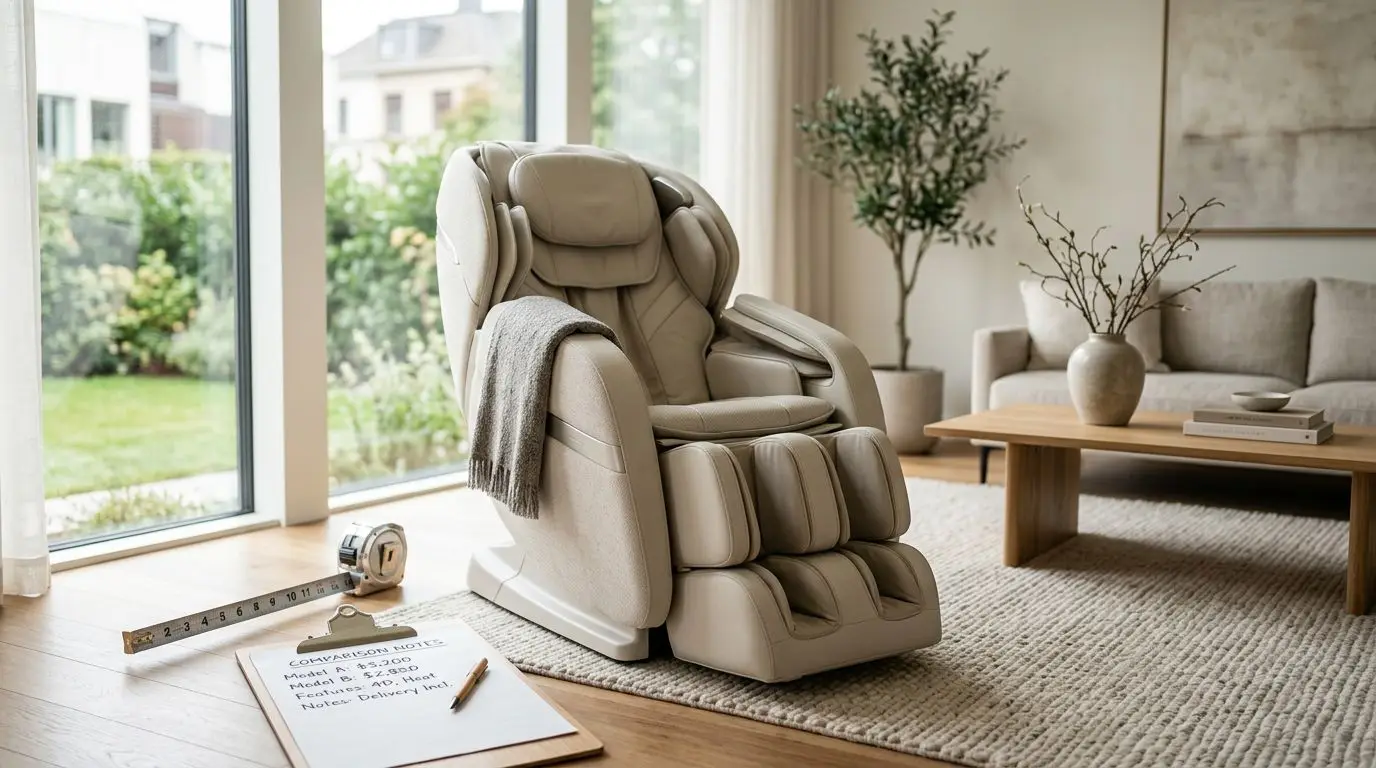
A monthly payment is only one part of the deal. Before comparing offers, write down the full amount you would pay if you bought the chair today: the advertised chair price, sales tax, delivery, in-home setup if offered, old furniture removal if needed, and any accessories or extended service plans. On a $4,000 chair, an 8% sales tax adds $320 before financing even begins.
This matters because financing is usually based on the financed balance, not just the number on the product page. A chair advertised at one price may cost more once shipping or white-glove delivery is included. Some sellers include delivery in the price; others list it separately. If you compare one offer at $4,000 delivered with another at $3,850 plus $250 delivery, the second offer is not cheaper.
Ask for an itemized checkout total before applying for credit. You should see every charge in writing. If the salesperson can only quote the payment, slow down.
- Chair price before tax
- Sales tax based on your delivery address
- Shipping or freight charges
- Room-of-choice delivery or in-home setup fees
- Removal or stair-carry fees, if applicable
- Service plan or extended coverage costs
- Any financing fee, origination fee, or account fee
Then compare that full total with the financed total. The difference between those numbers is the cost of borrowing.
Know the 5 main payment plan types before you compare APR
Massage chair retailers and financing providers commonly use a few payment structures. The names vary, but the math usually falls into 5 buckets: pay in full, equal-pay 0% APR, deferred-interest promotions, fixed-rate installment loans, and rent-to-own or lease-style plans. Each can work in the right situation, but they are not interchangeable.
| Payment type | How it usually works | What to watch | Who it may fit |
|---|---|---|---|
| Pay in full | You pay the entire checkout total at purchase. | Ties up cash; fewer payment protections if you use debit or cash. | Shoppers who can pay without touching emergency savings. |
| 0% APR equal payments | The balance is split into equal payments, often over 6, 12, 24, or 36 months. | Late payments can cancel the promotion or trigger penalties. | Disciplined buyers with predictable monthly cash flow. |
| Deferred interest | No interest is charged if the balance is paid in full by the promo deadline. | If not paid in full, interest may be charged from the original purchase date. | Only buyers who can confidently pay before the deadline. |
| Fixed APR installment loan | You pay principal and interest over a set term, such as 24, 36, or 60 months. | Longer terms lower the payment but raise total interest. | Buyers who need predictable payments and understand the total cost. |
| Lease-style or rent-to-own | You make recurring payments and may own the chair after meeting plan terms. | Total cost can be much higher than the cash price. | Use caution; compare the full buyout cost before signing. |
The key difference is straightforward: 0% APR equal-pay plans spread the cost without interest if you follow the rules, while deferred-interest offers can become costly if even a small balance remains at the end. Read the exact promotional language. “No interest if paid in full” is not the same as “0% APR.”
Use a 3-step formula to find the real total cost
You do not need a finance degree to compare plans. Use this 3-step formula: add all financed charges, add all interest and fees over the full term, then subtract any discount you lose by choosing financing. The result is the real total cost of the chair under that payment plan.
Here is a simple example. Suppose the itemized checkout total is $4,500 after tax and delivery. One offer is 0% APR for 24 months with no fees, so the total paid is $4,500 if every payment is made on time. Another offer is a 48-month installment plan that results in $120 per month. That may sound manageable, but $120 times 48 equals $5,760. The financing cost is $1,260 above the checkout total.
Use this comparison format:
- Cash price: What you would pay today, including tax and delivery.
- Amount financed: The balance placed on the plan.
- Monthly payment: The required payment, not an estimated “as low as” number.
- Term: Number of months until the balance is paid off.
- Total of payments: Monthly payment multiplied by the number of payments.
- Fees: Origination, late, returned payment, account, or early payoff charges.
- Lost discounts: Any cash discount, coupon, or bundle pricing not allowed with financing.
If a lender or retailer will not clearly show the total of payments, pause. You should be able to calculate the full cost before you agree.
Compare 0% APR, deferred interest, and fixed APR with a 24-month example
The same chair can have very different costs under different payment terms. Below is a simplified example using a $5,000 financed balance over 24 months. It is not a quote; it shows how the structures differ.
| Plan example | Monthly payment pattern | Total paid if on time | Main risk |
|---|---|---|---|
| 0% APR, 24 equal payments | About $208.34 per month | $5,000 | Missing a payment may trigger fees or loss of promo terms. |
| Deferred interest, 24 months | Minimum payment may be lower than the payoff pace needed | $5,000 only if fully paid by month 24 | Interest may be added from the original purchase date if not paid in full. |
| Fixed APR installment, 24 months | Set payment includes interest | More than $5,000 | Total cost depends on APR and fees. |
| Longer fixed APR, 60 months | Lower monthly payment | Often much more than $5,000 | Easy to focus on comfort today and ignore years of payments. |
The trap is the minimum payment. With deferred interest, the minimum may not be enough to pay the balance before the promotion expires. Divide the financed amount by the number of promo months yourself. If you finance $5,000 for 24 months, you need to pay about $208.34 per month to reach zero on time, before considering any fees.
Set calendar reminders for 60 days and 30 days before the promotional deadline. Better yet, set automatic payments above the required minimum. A promotion only helps if your payment schedule matches the payoff date.
Watch for 7 fees and terms that change the deal
Fees can turn a fair offer into an expensive one. Look for at least 7 items in the credit agreement: origination fee, account fee, late fee, returned payment fee, prepayment penalty, promotional expiration date, and whether interest is deferred or waived. These details often matter more than the headline payment.
Ask the lender or retailer direct questions before signing:
- Is the APR 0%, or is interest deferred?
- What is the exact date the promotional period ends?
- What happens if I pay one day late?
- Are there fees to open the account?
- Can I pay off the balance early without a penalty?
- Does financing affect returns, exchanges, or cancellation timing?
- Will I lose any cash discount by financing?
Late fees are not the only concern. A missed payment can reduce the value of a promotional plan, and a returned payment can create both lender fees and bank fees. If your income is irregular, build in a cushion. A payment that looks affordable in a perfect month may be too tight in a month with car repairs, school expenses, or travel.
Also check whether the plan is a credit card, installment loan, or lease-style agreement. A credit card may remain open after the purchase and may affect your available credit. An installment loan usually has a fixed end date. A lease-style plan may have ownership terms that are less straightforward.
Who financing is best for: 4 shopper situations
Financing can be useful, but it is not automatically the smart move. It is best for shoppers with a clear budget, steady income, and a chair choice that fits daily life at home. A good rule: if the payment would still feel comfortable after adding $100 to your normal monthly expenses, the plan is more realistic.
Best fit: you qualify for true 0% APR and can automate payments
If the plan is true 0% APR for a defined term, with no fees and equal payments you can easily cover, financing may let you preserve cash while paying no extra cost. This works best when you already planned to buy the chair and are not using financing to stretch into a higher tier.
Best fit: you need delivery and setup included in one planned payment
Massage chairs are large items. Many full-size chairs weigh 200 to 350 pounds and may require careful delivery through doorways, hallways, or staircases. If financing lets you include professional delivery rather than cutting corners, the convenience may be worth considering.
Use caution: the monthly payment is the only reason you like the chair
If a chair only seems affordable because the term is 60 months or longer, step back. A longer term can make the payment look easy while keeping you tied to the purchase long after the newness wears off.
Usually avoid: the plan depends on a best-case future
If you need a bonus, tax refund, overtime, or a future raise to pay off a deferred-interest offer, the risk is higher. Promotional financing should fit your current budget, not a hopeful version of it.
How to choose the chair before financing: measure space, body fit, and use
Financing should come after chair selection, not before it. Start with the practical fit. Many full-size massage chairs need roughly 30 to 36 inches of width and may require several inches behind the chair even with a space-saving recline design. Measure the doorway, hallway turns, stair width, and the final room location before you apply for any payment plan.
Body fit matters too. Check the chair’s published height range, weight capacity, seat width, shoulder width, and footrest adjustment. A chair that does not fit your body well is not a better value just because the payment is lower. If possible, sit in a similar chair type and notice whether the rollers align comfortably along your back and whether the leg area feels cramped.
| Feature choice | What it changes | Financing question to ask |
|---|---|---|
| S-track | Rollers follow the general curve of the back. | Is back coverage enough for your main use? |
| L-track or SL-track | Rollers extend farther under the seat area than a basic back-only track. | Will you use the added coverage often enough to justify the cost? |
| 2D rollers | Rollers move up/down and side-to-side with a more basic feel. | Would a simpler roller system keep the payment lower? |
| 3D or adjustable-depth rollers | Roller depth can feel stronger or softer depending on setting. | Do you need adjustable intensity for multiple users? |
| Air compression zones | Airbags squeeze and release areas such as arms, calves, or shoulders. | Are more zones useful, or just raising the financed balance? |
| Heated areas | Designed to add warmth, commonly in the back or legs. | Is heat a must-have or a nice-to-have? |
Think in sessions. If you expect to use the chair for 15 minutes, 4 times a week, that is about 200 sessions in a year. A chair that fits well and has the right intensity range may earn its place in your home. A feature-heavy chair that feels too strong, too narrow, or too complicated may not.
Do a 10-minute budget stress test before you sign
Before accepting financing, spend 10 minutes testing the payment against your real budget. Add the proposed payment to your monthly bills, then ask whether you could still cover groceries, utilities, insurance, savings, and irregular expenses without carrying other balances. If the answer is no, the chair is too expensive for now.
Here is a practical stress test:
- Round the payment up to the next $25 to create a buffer.
- Add any subscription, delivery, or service-plan payment tied to the purchase.
- Assume one unexpected $500 expense during the first year.
- Check whether your emergency savings would remain intact.
- Confirm the payoff month and write it on your calendar.
If the payment still fits, compare offers from more than one financing source when possible. A retailer plan may be convenient, but a credit union, personal line of credit, or existing low-rate card may offer better terms. Do not apply everywhere at once without understanding the credit impact; multiple hard inquiries can matter, especially if you are preparing for a mortgage, auto loan, or other major credit decision.
Also consider the return window. If the chair has a 30-day return period, ask how financing is reversed if you return it. Find out whether delivery, pickup, restocking, or financing fees are refundable. A chair can be physically large and expensive to ship back, so include the return math in your buying decision.
Safety and suitability: ask a physician before use in these 8 situations
A massage chair is a consumer wellness product designed for comfort, pressure, movement, heat, and relaxation at home. It is not a medical device. If you are pregnant, have a pacemaker or other implanted cardiac device, have a history of blood clots or take anticoagulants, have osteoporosis, had a recent fracture or surgery, have spinal disc problems, have neuropathy, or have uncontrolled hypertension, ask your physician before using a massage chair.
This is not fine print. Chairs can apply firm pressure, recline the body, use heat, and compress the legs or arms with airbags. Those sensations may not be appropriate for every person. If you are buying for a family member, especially an older adult, confirm that the chair’s intensity, seat height, and entry/exit position are suitable before committing to a long payment plan.
Start gently. Use the lowest intensity setting and a short session, such as 5 to 10 minutes, until you know how the chair feels. Stop using the chair if the pressure feels sharp, uncomfortable, or unusual. Comfort is the goal; enduring excessive force is not.
When paying cash or waiting 90 days is the better deal
Sometimes the best financing decision is to skip financing. Waiting 90 days can give you time to save more, compare chair types, measure your room, test similar designs, and watch for legitimate seasonal promotions. It can also prevent a rushed purchase based on a payment that looks small by itself.
Paying cash or waiting may be better if the financing plan has a high APR, the promotion is deferred interest and your payoff plan is uncertain, the return costs are unclear, or the chair requires a longer term than you are comfortable carrying. It may also be better if the seller offers a meaningful cash discount that disappears when you finance.
A useful decision rule: if the financed total costs hundreds or thousands more than the cash price, ask what you are getting for that extra cost. If the answer is only “a lower payment,” compare a less expensive chair type instead. A simpler chair with good body fit, a comfortable roller feel, and clear warranty terms may be a stronger buy than a feature-loaded chair financed over many years.
FAQ: massage chair financing and payment plans
Is 0% financing always the best way to buy a massage chair?
Not always. True 0% APR with no fees can be a good option if you make every payment on time and the chair price is not inflated. It is less attractive if you lose a cash discount, add unnecessary extras, or choose a more expensive chair only because the payment looks manageable.
What is the difference between 0% APR and deferred interest?
With true 0% APR, interest is not charged during the promotional term if you follow the agreement. With deferred interest, interest may be added from the original purchase date if the balance is not paid in full by the deadline. Read the exact wording before signing.
How long should I finance a massage chair?
Use the shortest term that fits your budget comfortably. A 12- or 24-month plan usually keeps the payoff closer to the purchase decision, while 48- or 60-month terms can make the payment smaller but increase the chance of paying more overall.
Should I finance delivery and setup too?
It can make sense if the delivery service is important and the financing terms are fair. Because many full-size chairs weigh 200 pounds or more, professional placement may be practical. Just include that charge in the total cost comparison.
Can I pay off a massage chair financing plan early?
Many plans allow early payoff, but you should confirm before signing. Ask whether there is a prepayment penalty, whether interest is recalculated, and how to obtain a final payoff amount in writing.
What monthly payment is affordable?
Affordable means the payment fits after regular bills, savings, and irregular expenses, not just on paper. If one unexpected $500 expense would force you to miss a payment, the plan is probably too tight.
Frequently asked questions
Is 0% financing always the best way to buy a massage chair? +
Not always. True 0% APR with no fees can be a good option if you make every payment on time and the chair price is not inflated. It is less attractive if you lose a cash discount, add unnecessary extras, or buy a more expensive chair only because the payment looks manageable.
What is the difference between 0% APR and deferred interest? +
With true 0% APR, interest is not charged during the promotional term if you follow the agreement. With deferred interest, interest may be added from the original purchase date if the balance is not paid in full by the deadline.
How long should I finance a massage chair? +
Use the shortest term that fits your budget comfortably. A 12- or 24-month plan usually keeps the payoff closer to the purchase decision, while 48- or 60-month terms can make the payment smaller but may raise the total cost.
Should I finance delivery and setup too? +
It can make sense if the delivery service is important and the financing terms are fair. Many full-size massage chairs weigh 200 pounds or more, so professional placement may be practical. Include that charge in your total cost comparison.
Can I pay off a massage chair financing plan early? +
Many plans allow early payoff, but you should confirm before signing. Ask whether there is a prepayment penalty, whether interest is recalculated, and how to obtain a final payoff amount in writing.
What monthly payment is affordable? +
Affordable means the payment fits after regular bills, savings, and irregular expenses. If one unexpected $500 expense would force you to miss a payment, the plan is probably too tight.
Related guides

Is a Massage Chair Worth It? Cost, Use Frequency, and Break-Even Math for U.S. Buyers
12 min read
The Hidden Costs of Buying a Massage Chair: Delivery, Setup, Repairs, and Moving
15 min read
Massage Chair vs. Regular Massage Appointments: Cost Comparison and Break-Even Point
13 min read
Buying a Massage Chair Online vs. In Store: Price, Testing, Delivery, and Return Trade-Offs
14 min read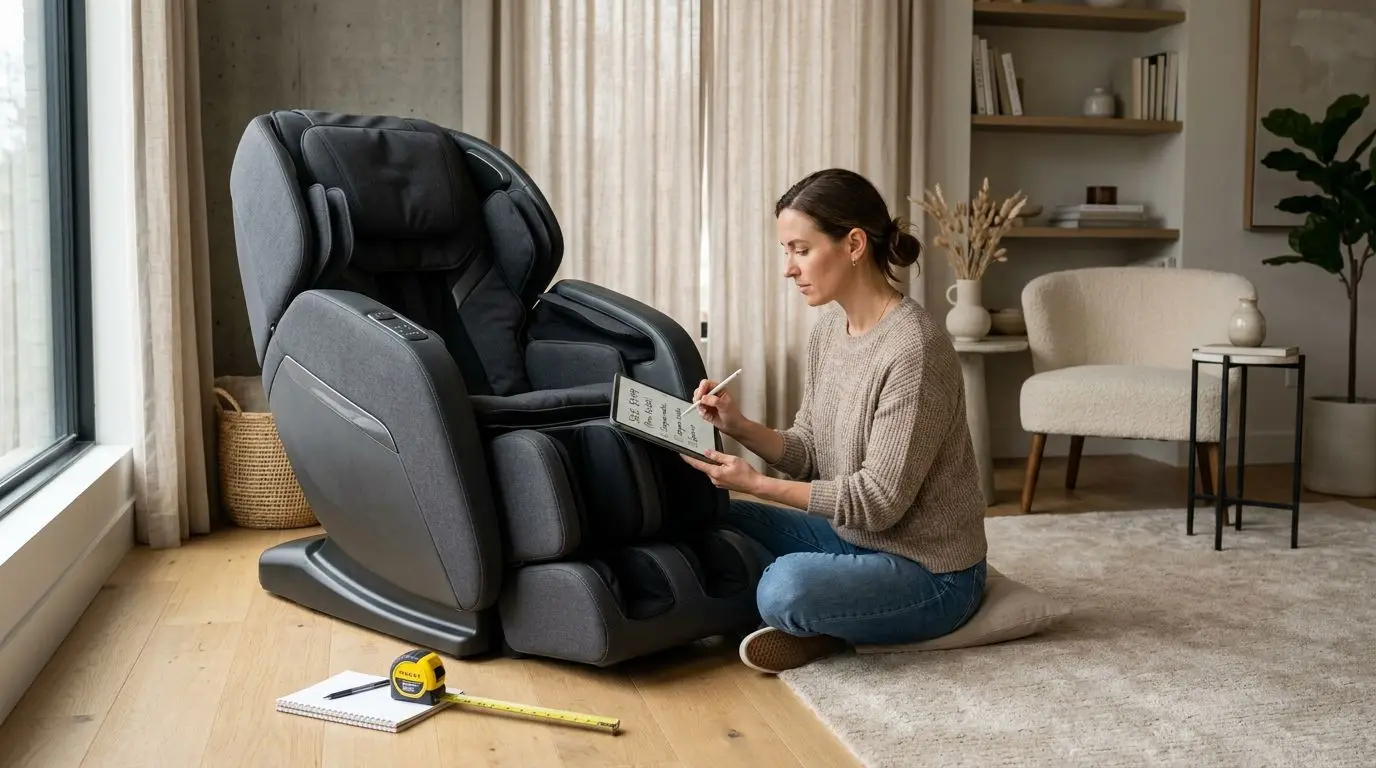
Massage Chair Sale Prices: How to Tell a Real Deal From a Fake Discount
12 min read