Disclosure: We may earn a commission when you buy through links on this page, at no extra cost to you. We buy nothing, sell nothing and accept no payment for coverage — commissions never decide what we recommend. How we make money.
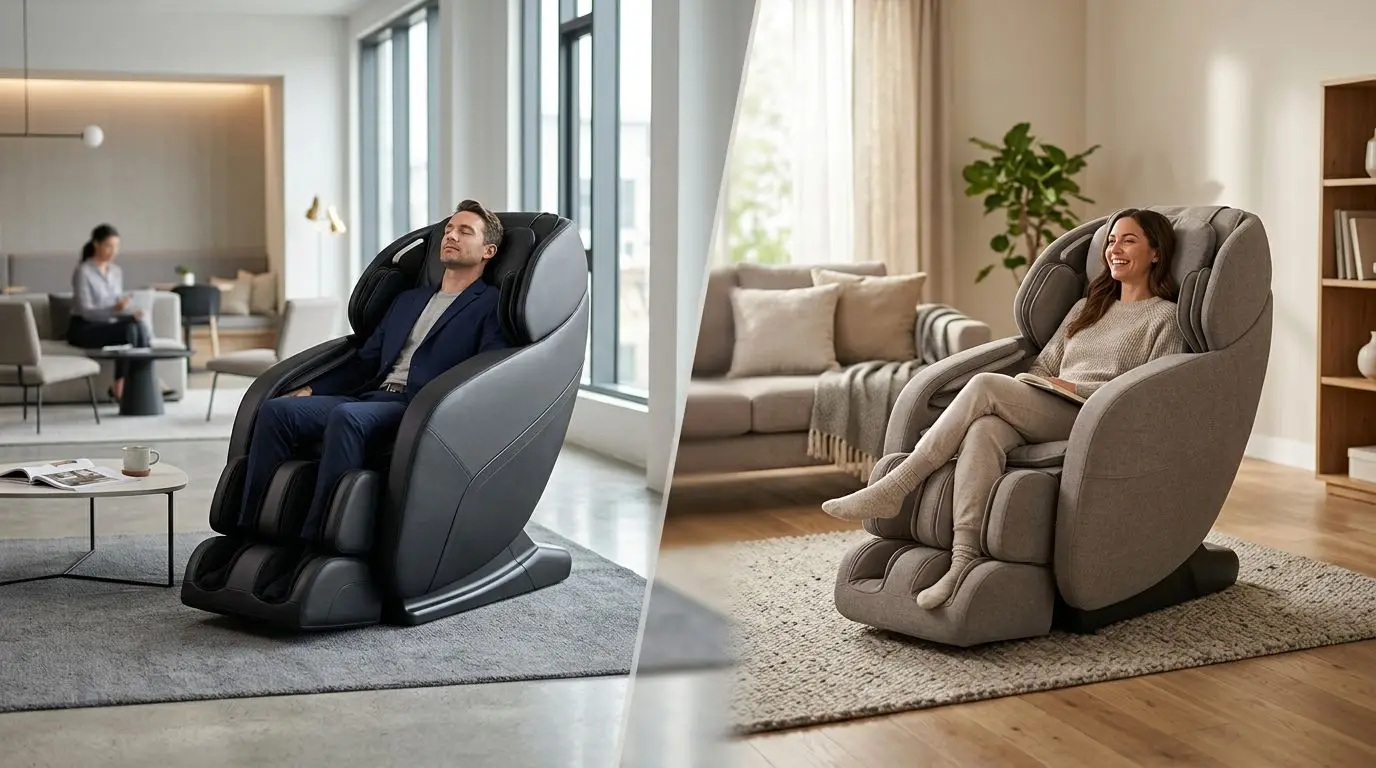
Commercial massage chairs are built for shared use, shorter sessions, simple controls, and easier cleaning. Home massage chairs are usually designed for personal comfort, deeper customization, and a better fit in a living room. The right choice depends on whether one person will use the chair a few times a week or dozens of people may use it every day in 10- to 30-minute cycles.
If the chair is going into a gym, office, airport lounge, apartment amenity room, or waiting area, think like an operator: durability, hygiene, access control, floor space, service downtime, and clear instructions matter as much as roller quality. If it is going into a home, prioritize fit, comfort, noise level, body scanning, recline clearance, and controls that match how your household will actually use it.
1. The core difference: shared use versus personal use
A home massage chair is typically chosen for 1 to 4 regular users. A commercial-style chair may see 10, 30, or even more individual sessions in a single day, depending on the location. That difference affects almost every design decision.
Home chairs often focus on comfort variety. You might see multiple automatic programs, adjustable roller intensity, foot roller settings, heat zones, memory positions, voice controls, or app-based features. These can be useful when the same users return to the chair and learn what they like.
Commercial chairs need to work for strangers who have never read a manual. A good shared-use setup is simple: sit down, press one or two buttons, choose a short session, and get up when the timer ends. The less explanation required, the better.
That does not mean commercial chairs are always more advanced. In many cases, they are less feature-heavy but more practical. A business owner may prefer a chair with a 15-minute default session, wipeable surfaces, and a durable remote over a chair with 20 programs and delicate upholstery.
2. Durability and duty cycle: 5 sessions a week is not 50 sessions a week
Durability is the biggest practical divide. A home chair might be used for 15 to 30 minutes after work, several times per week. In a commercial setting, the same 15-minute session length can repeat all day. Rollers, motors, reclining mechanisms, footrest slides, remotes, and upholstery all go through far more cycles.
Commercial-style chairs often emphasize heavier frames, simpler moving parts, reinforced upholstery panels, and parts that can be accessed for service. The goal is not just a strong first impression. It is steady operation after repeated use by people of different heights, weights, and habits.
For planning purposes, businesses should ask about expected daily use, not just maximum user weight. A chair rated for a 300 lb user may still not be the best choice for a busy employee break room if it was designed for light household use. Weight capacity and duty cycle are related, but they are not the same thing.
Home buyers can still benefit from durable construction, especially in a large household. They may, however, be willing to trade some ruggedness for quiet operation, softer upholstery, more attractive styling, or a smaller footprint.
3. Controls and access: 1-button operation beats a 20-page manual in public spaces
Controls matter more in shared spaces than many buyers expect. In a home, a detailed remote can be a plus. You have time to learn it, save preferences, and adjust intensity during a 20-minute session. In a public or semi-public space, too many options can slow turnover and lead to support questions.
Commercial-style controls usually favor simple labels, large buttons, countdown timers, and limited choices. A chair in a gym lobby might need three obvious settings: start, intensity, and stop. A chair in a paid-use area may also need a payment interface, access code, card reader, or timed lockout.
Session length is another key difference. Home users may prefer 20, 25, or 30 minutes. Businesses often prefer shorter cycles, commonly around 10 to 15 minutes, so more people can use the chair and no one occupies it indefinitely. A visible timer helps set expectations.
Safety controls should be easy to understand. A stop button should be simple to find from the seated position. If the chair reclines, users need clear instructions about keeping children, bags, shoes, and loose items away from moving sections.
4. Hygiene and upholstery: shared chairs need cleaning every day, not once a month
Hygiene is a design issue, not just a housekeeping task. A chair used by one household may only need routine dusting and occasional wipe-downs. A chair used by 20 people a day needs a cleaning plan, posted rules, and upholstery that can handle frequent contact with approved cleaners.
Commercial-style chairs often use smoother, less textured coverings because seams, perforations, and deep grain patterns can trap debris. Removable headrest covers, replaceable pads, and fewer fabric-like surfaces can make daily care easier. A chair with beautiful soft-touch material may feel great at home but become frustrating in a waiting area if it is hard to clean between users.
Businesses should confirm which cleaners are allowed by the chair maker. Some upholstery materials can crack, peel, fade, or become sticky if cleaned with harsh disinfectants. A practical cleaning routine might include wiping touch points, head and arm areas, remote controls, cup holders if present, and foot wells at set intervals throughout the day.
Foot areas need special attention. If the chair includes enclosed calf or foot sections, consider whether users will keep shoes on, remove them, or use disposable liners. Each approach has trade-offs in comfort, cleanliness, and maintenance time.
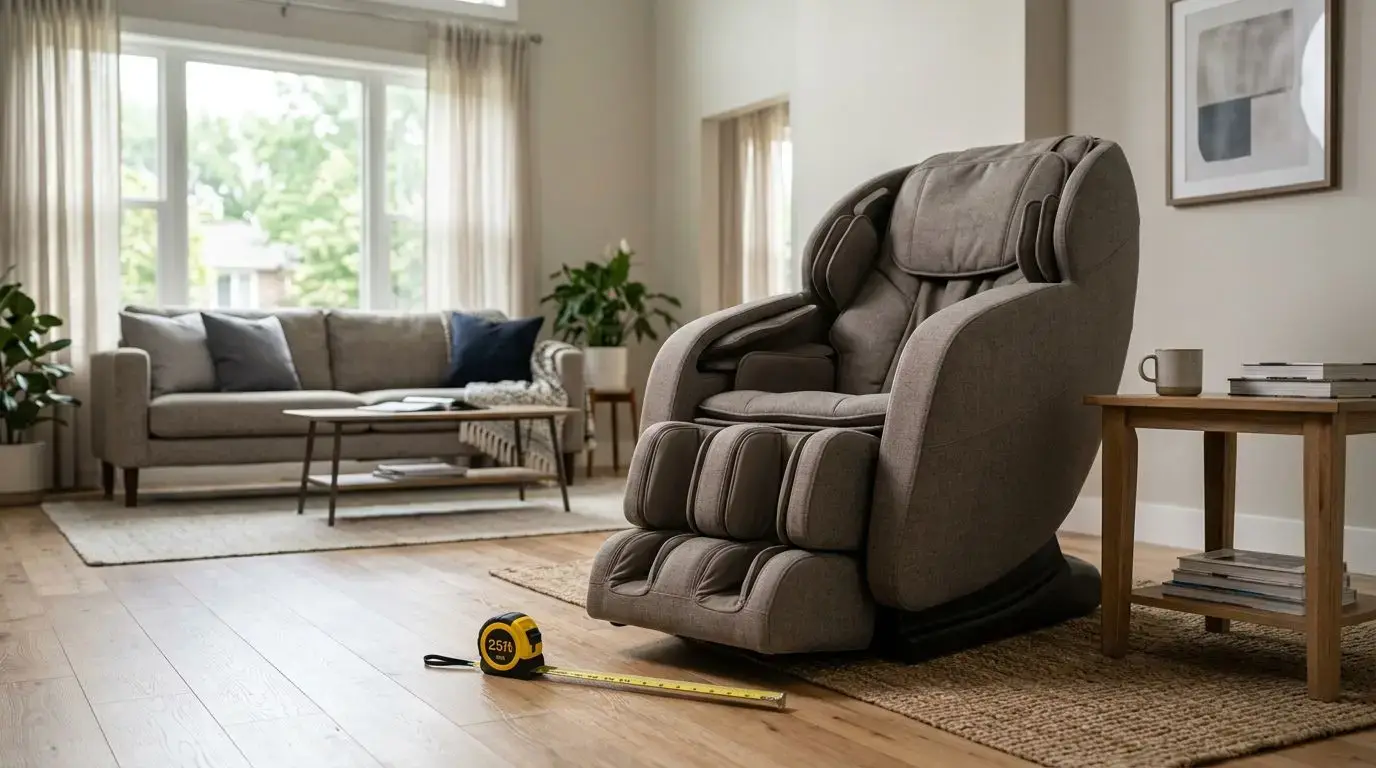
5. Placement and footprint: measure the chair, the recline, and a 30-inch walking path
A massage chair is not just the size it appears when upright. Many chairs are roughly 29 to 36 inches wide, 45 to 65 inches long when upright, and significantly longer when reclined. Some space-saving recline designs need only a few inches behind the chair, while others may need much more clearance.
For commercial placement, start with traffic flow. A chair should not block a hallway, fire exit, reception desk, doorway, or accessible route. A 30-inch clear walking path is a useful minimum planning target in many interiors, though local building and accessibility rules may require more depending on the space.
Noise and privacy matter too. A chair placed next to a conference room wall may be distracting. A chair in a bright lobby may feel too exposed for users. A chair near a front desk is easier to monitor but may be less relaxing to sit in. Small placement choices affect use.
Home buyers should measure doorways, stair turns, elevator openings, and the final room before purchase. Many massage chairs are heavy, often in the 200 to 350 lb range, and some require partial disassembly for delivery. Measure the route, not just the room.
6. Track, rollers, and intensity: 2D, 3D, 4D, S-track, L-track, and SL-track explained
Both commercial and home chairs can use similar core massage mechanisms. The difference is how those mechanisms are tuned and packaged. A simple commercial chair may use a sturdy roller system with limited settings, while a home chair may offer more intensity levels, more automatic programs, and more detailed body scanning.
Roller terms can be confusing. A 2D roller moves up and down and side to side along the back. A 3D roller adds in-and-out depth control, which can make the pressure feel stronger or softer. Some chairs use the term 4D to describe programmed changes in roller speed or rhythm, often combined with depth adjustment. These labels are useful, but they do not guarantee comfort.
Track design affects coverage. An S-track follows the curve of the back. An L-track extends lower, typically under the seat area. An SL-track combines a curved back path with extended seat coverage. For a shared-use chair, consistent fit across users may matter more than the longest possible track. For a home chair, a taller or shorter user may care more about body scan accuracy and shoulder position.
| Feature type | Common use in home chairs | Common use in commercial-style chairs | What to check |
|---|---|---|---|
| 2D rollers | Simpler pressure feel, often lower complexity | Durable, straightforward programs | Whether intensity feels too light or too firm |
| 3D rollers | Adjustable depth for different users | Useful if controls stay simple | Number of depth levels and default setting |
| S-track | Back-focused coverage | Good for shorter sessions | Shoulder and lower-back reach |
| L-track or SL-track | More coverage into the seat area | Can add appeal in paid or amenity settings | Fit for tall users and recline clearance |
| Air compression | Adjustable squeeze at arms, calves, or feet | Must be easy to enter, exit, and clean | Whether users can quickly release pressure |
7. Cost expectations: the purchase price is only 1 line item
With home chairs, buyers often focus on the chair price, delivery, warranty length, and perhaps an extended service plan. In business use, the total cost picture is wider. You may also need cleaning supplies, replacement pads, staff time, signage, payment hardware, floor protection, and a plan for downtime if the chair needs service.
Commercial-style chairs often cost more than comparable home-focused chairs because they are designed for heavier use, easier maintenance, or shared access. Even so, a higher price does not automatically mean a chair is fit for public use. Ask specifically whether the warranty allows commercial or shared-use placement. Some warranties are written for residential use only.
Downtime has a cost. If a chair is part of a paid amenity or employee wellness room, one broken remote can make the whole unit unusable. Businesses should ask how parts are replaced, whether on-site service is available, how long common parts take to arrive, and what maintenance the owner is expected to perform.
Home buyers should not pay for commercial features they will never use. A payment box, simplified public-use interface, or ultra-rugged vinyl covering may add little value in a den or bedroom if comfort and quiet operation are the main goals.
8. Who it is best for: choose by use case, not just features
A commercial-style chair is best for spaces where multiple unrelated users will share the chair on a schedule or walk-up basis. Examples include gyms, offices, apartment amenity rooms, airports, auto service waiting areas, salons, break rooms, and hospitality spaces. If the chair may run 5 to 8 hours in a day, choose for durability and cleaning first.
A home massage chair is best for personal or household use where the same users want repeatable comfort and more control. It makes sense for a living room, bedroom, home office, media room, or basement relaxation area. Here, the chair can be more customized and less operator-proof.
| Use case | Better fit | Why | Key priority |
|---|---|---|---|
| One adult uses it 3 nights per week | Home chair | Personal settings matter more than rugged controls | Comfort and adjustability |
| Employee break room with 25 staff members | Commercial-style chair | Shared use increases wear and cleaning needs | Durability and simple timer |
| Apartment amenity space | Commercial-style chair | Users vary widely and instructions must be clear | Hygiene and access control |
| Family of 4 with different height preferences | Home chair | Body scan and personal intensity settings matter | Fit range and programs |
| Paid use in a lobby or lounge | Commercial-style chair | Turnover, payment, and downtime affect operations | Serviceability and controls |
9. How to choose and measure: use a 10-point checklist
Before comparing features, define the use case in writing. A chair for one person after work is a different purchase than a chair for 40 visitors per day. Use this checklist to avoid expensive mismatches.
- Count expected users. Estimate daily and weekly sessions, not just the number of people with access.
- Choose a session length. For shared spaces, 10 to 15 minutes often keeps turnover reasonable. Home users may prefer 20 to 30 minutes.
- Measure the chair location. Measure width, upright depth, reclined depth, ceiling clearance, and space for the footrest to extend.
- Measure the delivery path. Check every doorway, hallway turn, stair landing, and elevator. A 34-inch doorway can still be difficult if the hallway turn is tight.
- Check the floor. Heavy chairs can indent soft flooring. Use a protective mat when appropriate and confirm the floor is level.
- Confirm power access. Most consumer massage chairs use a standard household outlet in the US, but the cord should not cross a walkway.
- Match controls to the user. Shared spaces need quick-start controls. Homes can support more detailed remotes.
- Review cleaning instructions. Confirm approved cleaners and whether headrest or footwell covers are replaceable.
- Read the warranty use terms. Residential-only coverage may not apply in a business or amenity room.
- Plan service access. Leave room around the chair so panels, remotes, and power connections can be reached without moving heavy furniture every time.
For fit, do not rely only on listed height ranges. If possible, test the chair with the shortest and tallest likely users. Shoulder detection, footrest extension, calf well depth, and seat width can feel very different across body types even when the listed height range looks adequate.
10. Safety, signage, and supervision: a 60-second warning can prevent misuse
A massage chair is a consumer wellness product, not a medical device. It is designed to provide mechanical pressure, movement, heat, vibration, and positioning sensations. It should not be presented as a product that treats, cures, prevents, or manages a medical condition.
In a commercial space, safety information should be visible before the user sits down. A short sign with plain language is often better than a long document no one reads. Include the session length, stop-button location, basic use steps, and any house rules such as no food, no children using the chair unsupervised, and no loose items near moving parts.
Some people should ask a physician before using a massage chair, especially in shared settings where staff cannot screen each user. This includes people who are pregnant; have a pacemaker or other implanted cardiac device; have blood clots or take anticoagulants; have osteoporosis; recently had a fracture or surgery; have spinal disc problems; have neuropathy; or have uncontrolled hypertension. When in doubt, do not guess. Ask a physician first.
Heat and strong pressure deserve special caution. A user who cannot clearly feel pressure or temperature may not realize a setting is uncomfortable until after the session. Shared-use chairs should default to moderate settings and make it easy to stop immediately.
11. Bottom line: match the chair to the workload, not the showroom demo
The best commercial-style massage chair is not simply the toughest-looking one. It is the chair that can handle the expected number of sessions, stay easy to clean, give first-time users clear controls, fit the space safely, and be serviced without disrupting the entire business.
The best home massage chair is the one that fits your body, room, delivery path, and routine. You can prioritize quieter operation, more programs, finer intensity control, softer materials, and the way the chair looks in your home.
If you are unsure which direction to go, start with one question: will this chair be used mostly by known household users or by a rotating group of people? Once that answer is clear, the right design priorities become much easier to see.
FAQ: Commercial and home massage chairs
Can I use a home massage chair in a business?
You can physically place one there, but it may not be designed or warranted for shared commercial use. Check the warranty terms, expected daily session volume, cleaning requirements, and service support before using a residential chair in a business.
Are commercial massage chairs more comfortable than home chairs?
Not always. Commercial-style chairs often prioritize durability, simple controls, and cleaning. Home chairs may offer more personal adjustment, softer finishes, quieter operation, or more programs. Comfort depends on fit, roller design, intensity range, and user preference.
How long should sessions be in a shared-use setting?
Many shared spaces use shorter sessions, often around 10 to 15 minutes, because it improves turnover and keeps people from occupying the chair too long. Home sessions are often longer, commonly 20 to 30 minutes, depending on the chair settings and user comfort.
What should I measure before buying?
Measure the final space, recline clearance, doorway width, hallway turns, stair landings, elevator access, and walking paths around the chair. Also check the chair’s weight, power cord location, and whether the footrest extends into a traffic area.
What features matter most for a business location?
Durable upholstery, simple start and stop controls, a visible timer, easy cleaning, strong service support, and warranty coverage for shared use matter most. Advanced programs are useful only if users can understand them quickly.
Who should ask a physician before using a massage chair?
People who are pregnant; have a pacemaker or other implanted cardiac device; have blood clots or take anticoagulants; have osteoporosis; recently had a fracture or surgery; have spinal disc problems; have neuropathy; or have uncontrolled hypertension should ask their physician first.
Frequently asked questions
Can I use a home massage chair in a business? +
You can physically place one there, but it may not be designed or warranted for shared commercial use. Check the warranty terms, expected daily session volume, cleaning requirements, and service support before using a residential chair in a business.
Are commercial massage chairs more comfortable than home chairs? +
Not always. Commercial-style chairs often prioritize durability, simple controls, and cleaning. Home chairs may offer more personal adjustment, softer finishes, quieter operation, or more programs. Comfort depends on fit, roller design, intensity range, and user preference.
How long should sessions be in a shared-use setting? +
Many shared spaces use shorter sessions, often around 10 to 15 minutes, because it improves turnover and keeps people from occupying the chair too long. Home sessions are often longer, commonly 20 to 30 minutes, depending on the chair settings and user comfort.
What should I measure before buying? +
Measure the final space, recline clearance, doorway width, hallway turns, stair landings, elevator access, and walking paths around the chair. Also check the chair’s weight, power cord location, and whether the footrest extends into a traffic area.
What features matter most for a business location? +
Durable upholstery, simple start and stop controls, a visible timer, easy cleaning, strong service support, and warranty coverage for shared use matter most. Advanced programs are useful only if users can understand them quickly.
Who should ask a physician before using a massage chair? +
People who are pregnant; have a pacemaker or other implanted cardiac device; have blood clots or take anticoagulants; have osteoporosis; recently had a fracture or surgery; have spinal disc problems; have neuropathy; or have uncontrolled hypertension should ask their physician first.
Related guides
Commercial Massage Chairs for Gyms, Waiting Rooms, and Shared Spaces: What Type Works Best?
16 min read
Massage Chairs for Office Use: What to Consider for a Workplace or Home Office
13 min read
Buying a Massage Chair Online vs. In Store: Price, Testing, Delivery, and Return Trade-Offs
14 min read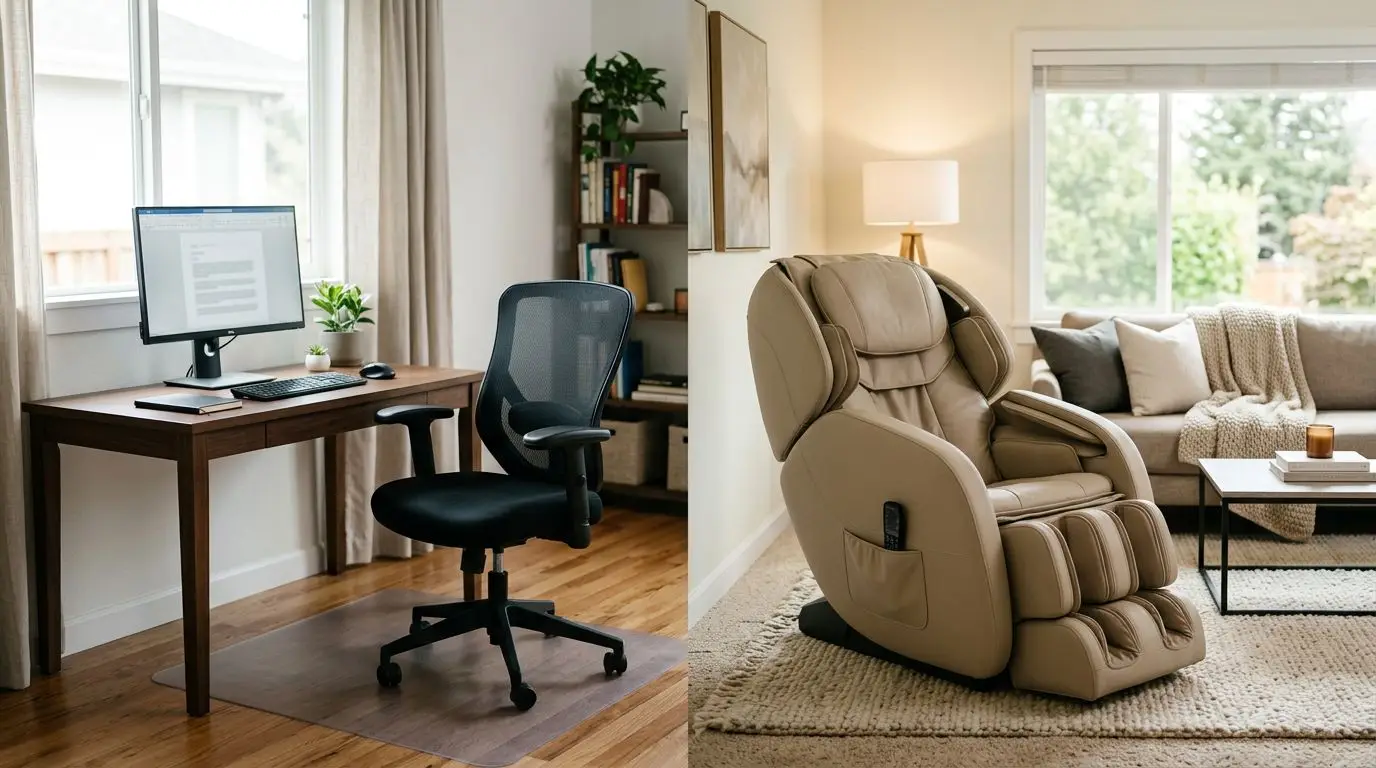
Office Massage Chairs vs. Home Massage Chairs: Key Differences Before You Buy
13 min read
Home Massage Chairs Explained: Main Types, Room Fit, and Best Use Cases
15 min read