Disclosure: We may earn a commission when you buy through links on this page, at no extra cost to you. We buy nothing, sell nothing and accept no payment for coverage — commissions never decide what we recommend. How we make money.
To move a massage chair without damaging it, unplug it, document every cable connection, remove only the parts designed to come off, and support the chair from its frame—not the footrest, arms, or plastic trim. Most room-to-room moves can be handled by 2 strong adults, but stairs, tight turns, or chairs over about 250 lb are good reasons to hire help.
The safest approach is to treat the chair like a powered recliner with delicate exterior parts. Measure first, protect floors and doorways, use a furniture dolly when possible, and never force a stuck panel, connector, or reclining mechanism.
Before You Move It: 10-Minute Prep That Prevents Most Damage
Spend at least 10 minutes preparing before anyone lifts the chair. Massage chairs combine a heavy steel frame, moving rollers, wiring harnesses, air hoses, speakers, control panels, and plastic covers, so a rushed move can crack trim or pull a connector loose.
Return the chair to its fully upright position first. If the legrest is extended, retract it. If the backrest is reclined, bring it forward. Many chairs are easiest to move in their smallest footprint, often roughly 45 to 65 inches long depending on chair style and whether the footrest retracts fully.
- Unplug the chair from the wall. Do not move it while powered on or mid-cycle.
- Remove loose items. Take out remote controls, detachable pillows, pads, blankets, cup inserts, or phone holders.
- Photograph the chair. Take 6 to 10 photos: front, back, both sides, underside if visible, and close-ups of any cable connections.
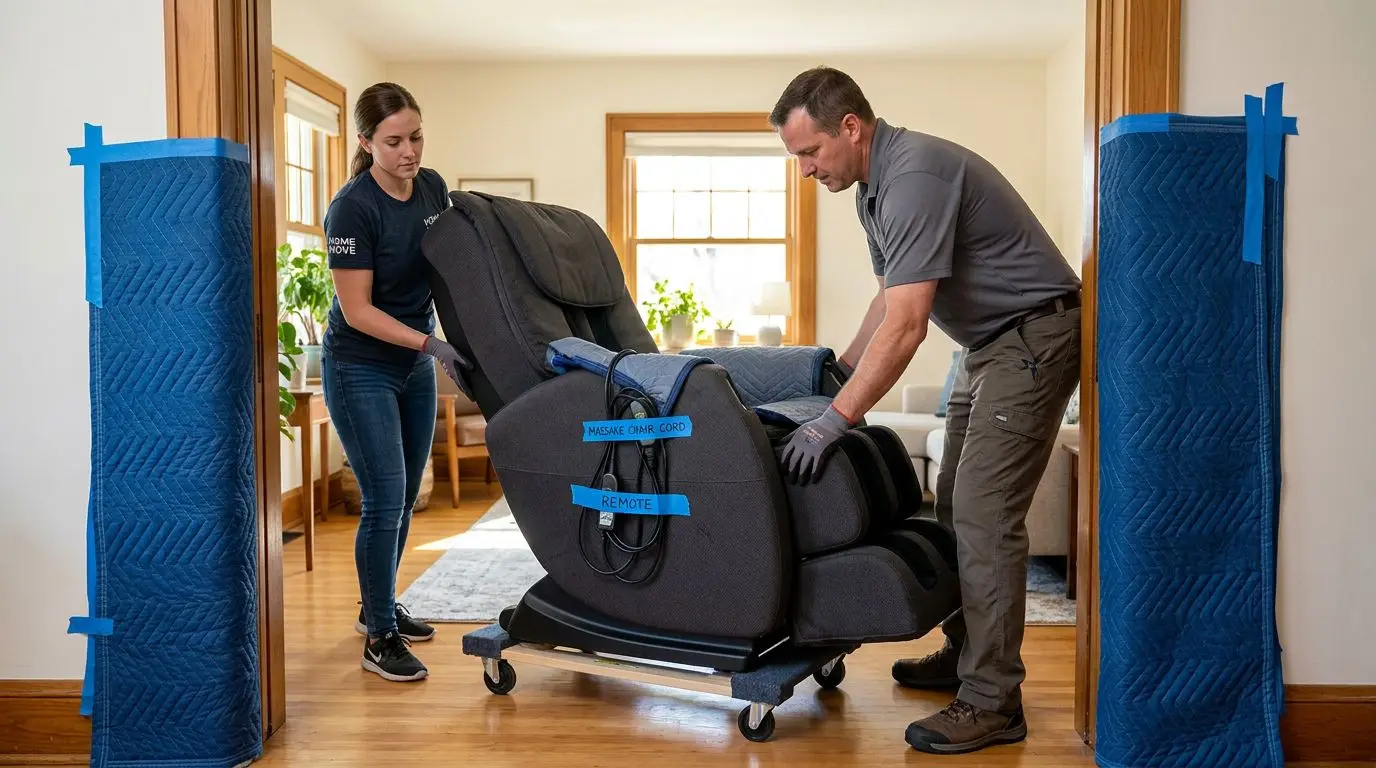
- Label cables. Painter’s tape works well because it is easy to remove later.
- Bag small hardware. If you remove screws or clips, put them in a zip bag and tape it to the part they came from.
Check the owner’s manual if you have it. Some chairs include a documented moving procedure, shipping lock, or caution about lifting points. If you do not have the manual, look for labels near the rear panel, power box, base, or footrest.
One safety note is important: do not help lift a heavy chair if you are pregnant, have a recent fracture or surgery, spinal disc problems, osteoporosis, neuropathy, uncontrolled hypertension, blood clot concerns, or are taking anticoagulants unless your physician says it is appropriate. Moving a 200 lb or heavier chair is a lifting job, not just a furniture shuffle.
What Can Usually Be Removed: 5 Parts to Check First
Not every massage chair is meant to be disassembled by the owner, but several parts are commonly removable. The goal is not to strip the chair down to its frame. It is to reduce width, prevent dangling parts, and avoid stress on the footrest or side panels.
| Part | Often removable? | Why remove it? | What to avoid |
|---|---|---|---|
| Head pillow or neck pad | Yes | Prevents scuffs and gives clearer hand placement | Do not pull hard on stitched straps |
| Back pad or seat cushion | Sometimes | Reduces snagging and exposes fasteners on some chairs | Do not tear hook-and-loop seams or hidden zippers |
| Arm panels | Sometimes | Can reduce width by several inches | Do not pull if air hoses or wires are still connected |
| Footrest or calf section | Sometimes | Shortens the chair and reduces front weight | Do not let the mechanism drop after removing pins or bolts |
| Side covers or rear cover | Sometimes | May expose moving handles or connector access | Do not pry plastic clips with force |
The head pillow is the easiest part to remove on many chairs. It may attach with hook-and-loop strips, snaps, zippers, or a simple strap. Cushions and pads may also lift off, but some are routed around air hoses or heating wires. If a pad still feels tethered after all visible fasteners are released, stop and inspect.
Arm panels are where many moving-day mistakes happen. They can contain air-cell connections, control buttons, speakers, USB ports, lighting, or wiring for sensors. If you remove an arm, support it with one hand while disconnecting any plug or hose with the other. Mark left and right parts clearly.
Footrests vary more than almost any other chair component. Some use hinge pins, bolts, quick connectors, or retaining clips. Others are not intended for routine owner removal. Since the footrest may include motors, air lines, rollers, or position sensors, never twist it sideways to “make it fit.” That is one of the fastest ways to bend a bracket.
How to Measure Doorways, Halls, and Stairs to the Nearest 1/2 Inch
Measure before disassembly. A typical interior doorway in the United States is often about 28, 30, 32, or 36 inches wide, but usable clearance is smaller once hinges, door stops, trim, and handles are considered. Measure the real opening to the nearest 1/2 inch.
Use a tape measure and write down four numbers: the chair’s widest point, the chair’s narrowest movable position, the doorway’s clear width, and the tightest hallway or stair turn. Measure the chair with pillows removed and the chair fully upright. Measure again if you plan to remove arm panels or the footrest.
- Doorway clear width: Measure from the inside of the jamb to the opposite stop, not just the slab size.
- Chair width: Measure the widest point across arms, side panels, or shoulder area.
- Chair height: Measure floor to highest point with the chair upright.
- Hall turn radius: Measure the hall width and the length available to pivot.
- Stair landing: Measure the landing depth and ceiling clearance.
Allow at least 1 inch of extra clearance on each side if you are carrying the chair by hand. Less than that can work only when the path is straight, surfaces are protected, and the movers can control the chair precisely. A 30-inch chair through a 30-inch opening is not a plan; it is a jam waiting to happen.
If the doorway is close, try removing the door from its hinges. That can add about 1 to 1.5 inches of working space in many homes. Remove hinge pins carefully, set the door on cardboard or a blanket, and keep the pins in one bag.
Stairs need extra caution. A chair that clears a doorway may still fail at a landing because it cannot rotate. If a landing is only 36 inches deep and the chair is long, the problem is usually turning room, not weight.
Who Should DIY It and Who Should Hire Help: A 2-Person Reality Check
A small massage chair may weigh around 120 to 180 lb, while larger full-body chairs commonly land well above 200 lb. Some are heavier. The listed weight, if available, is one of the most useful numbers in the manual or shipping paperwork.
A room-to-room move on the same floor can be reasonable for 2 capable adults if the path is wide, flat, and short. Use sliders or a dolly, keep the chair upright when possible, and move slowly. A whole-house move, an apartment stairwell, or a doorway that requires partial disassembly is a different job.
| Move situation | DIY suitability | Suggested equipment | Why it matters |
|---|---|---|---|
| Same room, a few feet | Usually reasonable | Furniture sliders, floor protection | Low lifting, low risk of impact |
| Room to room, same floor | Often reasonable with 2 adults | Dolly, straps, moving blankets | Doorway and hallway clearance are key |
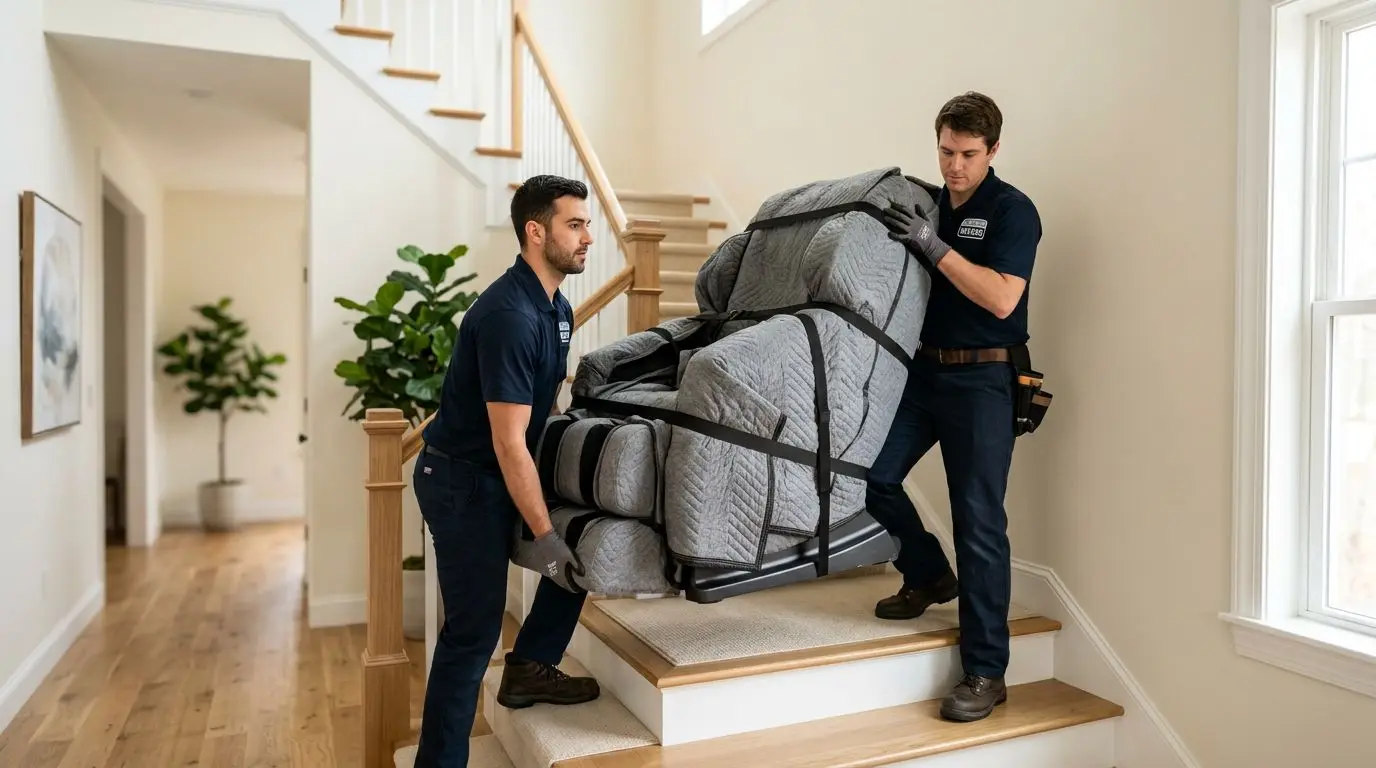
| One flight of stairs | Usually hire help | Professional movers, stair-rated equipment | Weight shifts quickly on stairs |
| Tight apartment elevator | Measure first; hire if close | Blankets, elevator padding, dolly | Elevator doors and cab depth limit turning |
| Long-distance move | Often hire help or crate carefully | Truck, tie-downs, padding, ramps | Vibration and tipping can damage trim |
Hire professional movers if the chair must go up or down stairs, if it weighs more than the helpers can control without strain, if the route has tight 90-degree turns, or if any powered part must be disconnected beyond obvious plug-style connectors. Movers are also a smart choice when the chair is newer and you want to avoid accidental warranty issues caused by owner disassembly.
Ask movers specific questions. Have they moved powered recliners or massage chairs before? Will they bring a dolly rated for at least the chair’s weight? Can they pad door frames and secure the chair upright in the truck? A general “yes, we move furniture” is less useful than a clear plan.
Step-by-Step Room-to-Room Move for 2 Adults
For a same-floor move under about 50 feet, plan the route first and move the chair once. Repeated starts and stops increase the chance of bumping trim or catching a cable.
- Power down and unplug. Let the chair sit for a minute after unplugging before handling control cables.
- Remove loose parts. Take off pillows, pads, and accessories. Bag any small pieces.
- Secure moving parts. Use soft straps or stretch wrap around cushions if needed, but do not wrap so tightly that it compresses buttons, air cells, or trim.
- Protect the path. Put moving blankets on door jambs and cardboard or hardboard over delicate flooring.
- Tip only as much as needed. Many chairs can be tilted slightly onto rear transport wheels, if equipped. If yours has no wheels, use a dolly under the frame.
- Lift from the base frame. Do not lift from the footrest, armrests, side panels, calf massagers, or plastic shrouds.
- Move slowly through openings. One person should guide the top and watch the walls while the other controls the weight.
- Set it down gently. Do not drop the chair from even 1 or 2 inches; powered mechanisms do not like shock loads.
If the chair has rear transport wheels, they are meant for short, controlled repositioning on smooth floors. They are not a substitute for a dolly across gravel, thresholds, steep ramps, or long sidewalks. Small wheels can dig into soft wood or vinyl, so use floor protection when in doubt.
On hard flooring, furniture sliders can help, but choose the right type. Felt sliders are for hard surfaces; plastic sliders are for carpet. Keep the chair balanced, and do not drag it by the arms. If the sliders walk out from under the base, stop and reset them.
Moving Truck and Storage Tips for 1 Day or Longer
If the chair is leaving the house, keep it upright whenever possible. A massage chair can be padded and transported safely, but laying it on its side for hours increases the chance of cosmetic pressure marks, shifted cushions, or strain on side-mounted parts.
Wrap the chair in moving blankets, then secure the blankets with stretch wrap or soft straps. Avoid packing tape directly on faux leather, leather, vinyl, painted trim, or plastic covers. Tape residue can be hard to remove, and pulling tape off can damage a finish.
In a truck, place the chair against a wall and use at least 2 tie-down points so it cannot rock. Do not stack boxes on the seat, footrest, arm panels, or shoulder area. A medium box may seem harmless, but a 30 lb load bouncing against a side panel during transit can crack clips or loosen trim.
Keep the chair dry. If it must pass through rain, wrap it before it leaves the house and unwrap it once indoors so trapped moisture does not sit against upholstery. For storage longer than 1 day, choose a clean, dry space and avoid extreme heat, freezing temperatures, and direct sun.
If the chair has been in a cold truck or garage, let it return to room temperature before plugging it in. A practical wait is 2 to 4 hours after a cold move, longer if condensation is visible. This is a simple electronics precaution, not a performance upgrade.
What Not to Force: 7 Common Damage Risks
Most expensive moving damage comes from forcing one of 7 things: a doorway, a stuck connector, a plastic cover, a footrest, an arm panel, a reclining back, or a tilted chair on stairs. If something does not move with steady, controlled pressure, stop.
- Do not force the chair through a tight doorway. Scraped upholstery and cracked side trim are common when clearance is less than about 1 inch per side.
- Do not pull wires by the cord. Grip the connector body. Photograph first, then disconnect.
- Do not pry plastic covers aggressively. Hidden screws and clips are easy to break.
- Do not carry by the footrest. It is a moving assembly, not a handle.
- Do not twist arm panels outward. Air hoses and wiring may still be attached inside.
- Do not force the recline mechanism manually. If it will not move under power before unplugging, do not muscle it into position.
- Do not tip the chair past your control point. Once a heavy chair starts to roll or rotate, it can be hard to recover safely.
Connectors deserve patience. Many have a small latch or keyed shape, so they fit only one way. If a plug does not release, look for a tab. If it does not reconnect easily, check orientation rather than pushing harder.
The same goes for screws. Use the correct screwdriver or bit size. A stripped screw can turn a simple panel removal into a repair problem. If a screw is hidden under upholstery or a decorative cap, do not cut fabric to reach it unless the manual specifically shows that access point.
Reassembly and First Power-On: 5 Checks Before You Sit Down
After the chair is in place, give yourself 15 to 20 minutes for reassembly and inspection. Rushing the last step can undo a careful move.
- Check level placement. The chair should sit flat with no rocking. Uneven contact can create noise or stress the frame.
- Reconnect labeled plugs and hoses. Match your photos and labels. Do not force a connector.
- Inspect the footrest and arms. Confirm hinges, pins, screws, and clips are fully seated.
- Verify clearance. Leave enough room behind and in front for recline and legrest movement. Many chairs need several inches; wall-hugging designs need less but still require clearance.
- Test without a person seated. Plug in, power on, and run only basic positioning first if the chair allows it.
Listen for unusual clicking, grinding, rubbing, or repeated error beeps. A single panel slightly out of place can contact a moving part. If something sounds wrong, stop the chair, unplug it, and inspect before trying again.
Once the chair powers normally and moves through its basic positions, sit down and test low-intensity settings first. A move can shift pads or cushions, so the chair may feel slightly different until everything is seated correctly.
FAQ: 5 Moving Questions Answered
Can one person move a massage chair alone?
Usually, no. Even if the chair has rear wheels, one person can lose control at a threshold, doorway, or turn. For anything more than a small repositioning on the same floor, plan on 2 adults or professional movers.
Can I take a massage chair apart completely?
Most owners should not fully disassemble a massage chair. Removing pillows, pads, and sometimes arms or the footrest may be reasonable if the chair is designed that way, but the roller track, main frame, motors, and internal wiring should generally be left intact.
Is it safe to lay a massage chair on its side?
Briefly tilting a chair may be necessary during a move, but long side transport is not ideal. If it must be laid down, pad it heavily, avoid pressure on arm panels or the footrest, and return it upright as soon as practical.
What if the chair will not fit through the door?
Do not force it. Remove the door from its hinges, remeasure the clear opening, and check whether pillows, pads, arms, or the footrest can be removed according to the chair’s design. If it is still too tight, hire movers who can evaluate the route.
Should I keep the original packaging?
If you have space, yes. Original foam, corner protectors, and cartons are useful for long-distance moves. If you do not have them, use moving blankets, stretch wrap, cardboard edge protection, and secure tie-downs instead.
Frequently asked questions
Can one person move a massage chair alone? +
Usually, no. Even if the chair has rear wheels, one person can lose control at a threshold, doorway, or turn. For more than a small repositioning on the same floor, use 2 adults or hire professional movers.
What parts of a massage chair can usually be removed? +
Head pillows and loose pads are commonly removable. Some chairs also allow arm panels, rear covers, or footrests to come off, but only remove parts that release cleanly and have accessible connectors or fasteners.
Can I lay a massage chair on its side during a move? +
Brief tilting may be necessary, but long side transport is not ideal. If you must lay it down, pad it heavily, avoid pressure on arms and the footrest, and return it upright as soon as possible.
How do I know if my massage chair will fit through a doorway? +
Measure the chair at its widest point and the doorway’s true clear width to the nearest 1/2 inch. Allow about 1 inch of working clearance on each side, and consider removing the door from its hinges for extra space.
When should I hire movers for a massage chair? +
Hire help for stairs, tight apartment turns, long-distance moves, very heavy chairs, or any move that requires more disassembly than pillows, pads, or simple plug-style parts.
Related guides
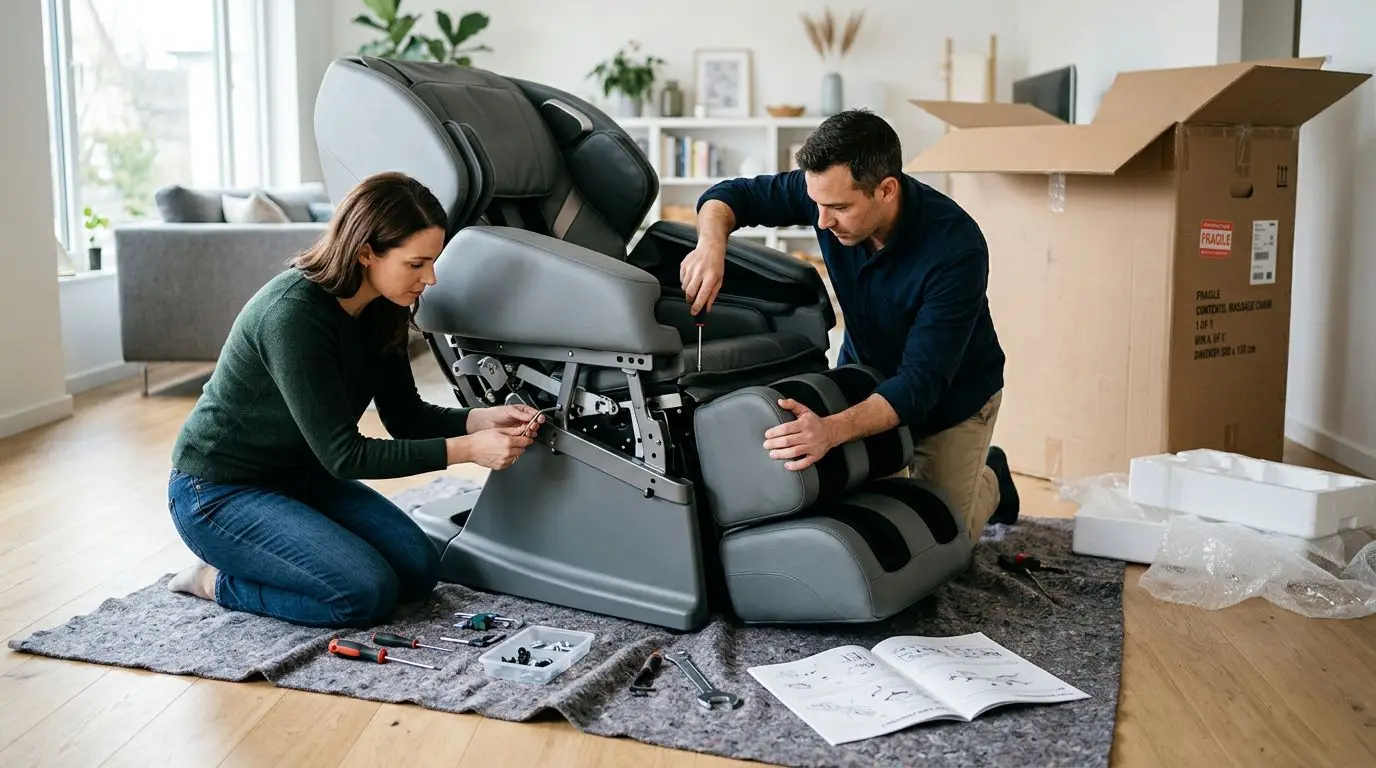
Massage Chair Assembly and Disassembly: What to Expect Before Setup or Moving
13 min read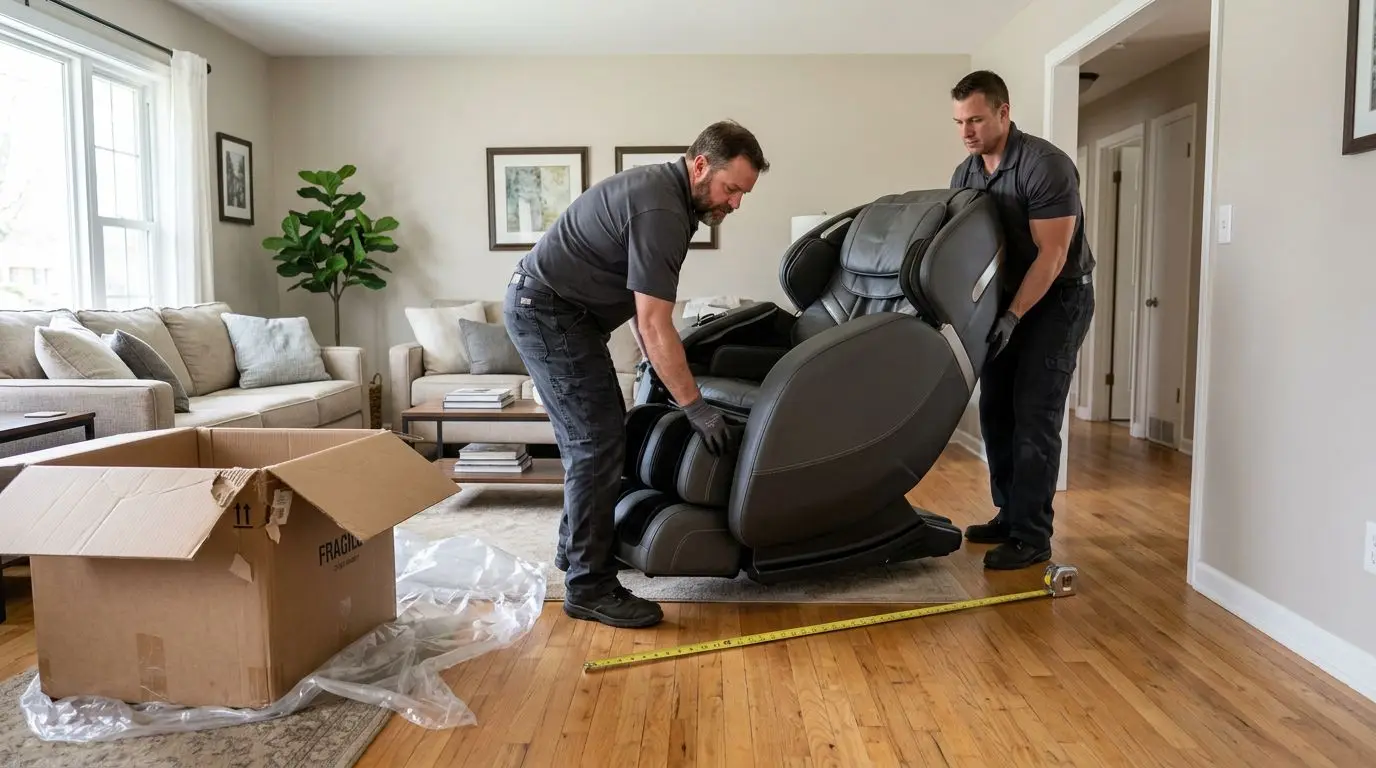
The Hidden Costs of Buying a Massage Chair: Delivery, Setup, Repairs, and Moving
15 min read
New vs. Used Massage Chairs: Savings, Risks, and What to Check Before You Buy
13 min read
Massage Chair Delivery and Setup Guide: Threshold Delivery, White-Glove Installation, Stairs, and Assembly
14 min read
Can You Put a Massage Chair Upstairs or in an Apartment?
11 min read